



Prop-firm fees are at risk, most participants do not reach a payout, and simulated funding does not necessarily represent live firm capital. This review is informational, not financial advice.
Velotrade Overview
Velotrade Screenshots
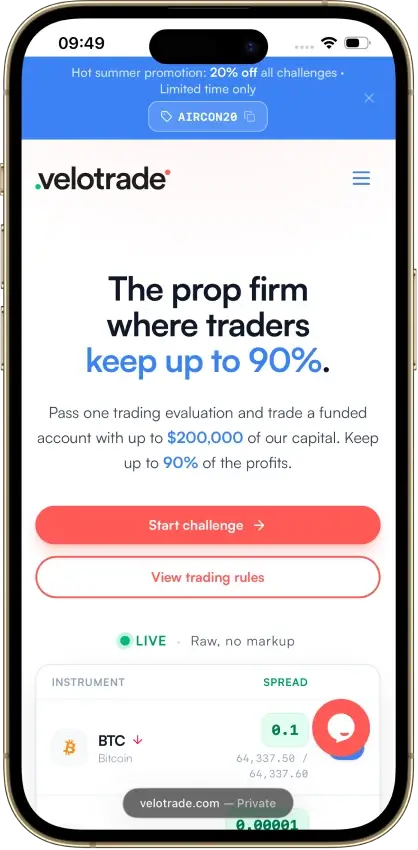

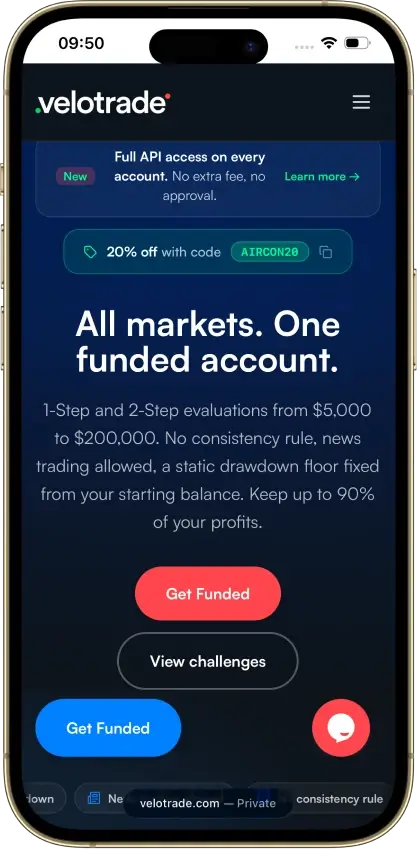

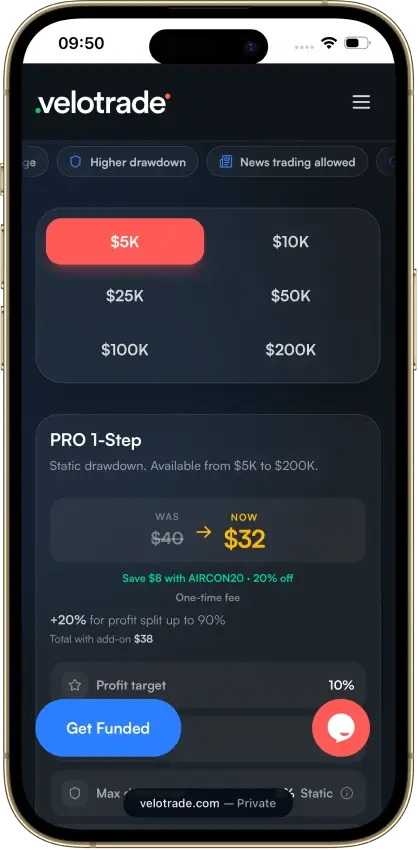
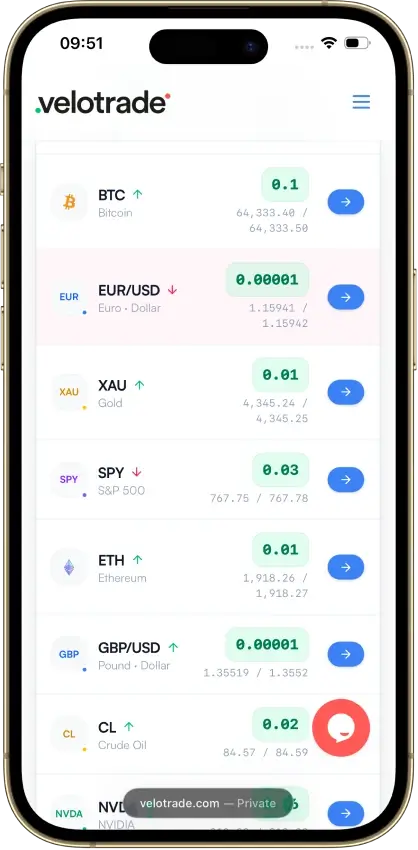
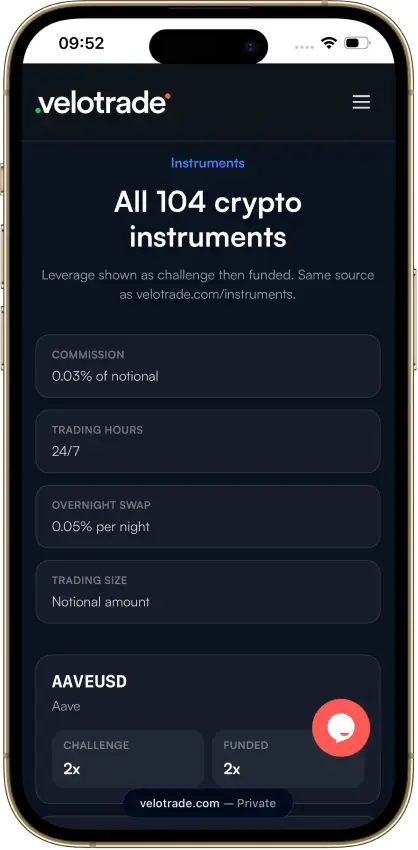
Screenshot 1 of 8
Velotrade Pros and Cons
Pros
- All 60 payout certificates match the chain
- $40 entry, PRO cheapest at every size
- No time limit on any evaluation phase
- EAs and API allowed with no fee or approval
- Verified 20% code covers plans and add-on
Cons
- First two payouts cap at 20x fee, excess lost
- A trading day needs 0.8% realized profit
- 90% split is a paid add-on over 80% default
Velotrade Discount Code
AIRCON20 takes 20% off every challenge at every size, and it also discounts the 90% split add-on. On the cheapest entry the $40 PRO $5K falls to $32. With the add-on, the $48 basket falls to $38.40. We tested AIRCON20 in Velotrade’s checkout on 19 August 2026. It applied, and a made-up code was rejected. The banner sells it as “Limited time only” while the firm’s coupon settings set no end date. The FAQ states that discount codes cannot be applied on purchases arriving through a referral link, so confirm the final figure on the checkout summary before paying. A discount never moves a score.
| Code | Discount | Applies to | Verified | Expires |
|---|---|---|---|---|
| AIRCON20 | 20% | Every challenge type, every size $5K to $200K, and the 90% split add-on | 19 August 2026, in the checkout | No end date in the firm’s coupon settings |
How Velotrade Works
Velotrade sells three challenge families on one platform, and PRO 1-Step is the tightest one-step evaluation it sells, at a 3% drawdown against CLASSIC 1-Step’s 7%. CLASSIC 1-Step runs one phase at that wider 7% floor, and CLASSIC 2-Step runs two phases at 10%. Every family targets 10% in its first phase and has no time limit. Each also requires 5 qualifying days per phase, and there is no instant funding, since the FAQ states every trader passes an evaluation first.
PRO is the cheapest route at every size and the only family reaching $200,000, which makes the pricing order unusual for this category. Between the CLASSIC families, the 1-Step costs more than the 2-Step at every size, $67 against $54 at $5,000 and $1,075 against $769 at $100,000. Most of this category sells the shorter route cheaper. Velotrade sells it as the premium product, and a buyer picking 1-Step for speed pays roughly 24% to 40% more than the two-phase route at the same size.
After a pass, KYC runs through a partner before a funded account is issued, requiring government photo ID plus proof of address dated within three months. The Terms add a clause worth knowing before purchase, stating that an offer of a funded account “is not guaranteed, regardless of Evaluation performance,” and that the offer lapses if not accepted within 30 days. A free route also exists in Sprint Trading, a five-minute BTC prediction game whose leaderboard winners receive challenge accounts. The FAQ states the profit split and payout cap on free or awarded challenges are “limited” and directs winners to a sales representative. Those limits are not disclosed.
PRO 1-Step
| Phase | Profit target | Daily loss | Maximum drawdown | Minimum days | Time limit | Consistency rule |
|---|---|---|---|---|---|---|
| EvaluationNote 1 | 10% | 3% | 3% | 5 | None | None |
- A trading day counts only if it closes with realized profit of at least 0.8% of the initial balance. Each phase requires five qualifying days. The published maximum drawdown is static for every challenge family, and clause 8.1(c) of the Terms now confirms that the floor is calculated from the starting account balance and does not trail profits.
No scaling plan. The FAQ states there is no time-based scaling and the full split applies from the first payout. Combined funded capital across all accounts is capped at $200,000.
CLASSIC 1-Step
| Phase | Profit target | Daily loss | Maximum drawdown | Minimum days | Time limit | Consistency rule |
|---|---|---|---|---|---|---|
| EvaluationNote 1 | 10% | 4% | 7% | 5 | None | None |
- A trading day counts only if it closes with realized profit of at least 0.8% of the initial balance. Each phase requires five qualifying days. The published maximum drawdown is static for every challenge family, and clause 8.1(c) of the Terms now confirms that the floor is calculated from the starting account balance and does not trail profits.
No scaling plan. The FAQ states there is no time-based scaling and the full split applies from the first payout. Combined funded capital across all accounts is capped at $200,000.
CLASSIC 2-Step
| Phase | Profit target | Daily loss | Maximum drawdown | Minimum days | Time limit | Consistency rule |
|---|---|---|---|---|---|---|
| Phase 1Note 1 | 10% | 5% | 10% | 5 | None | None |
| Phase 2Note 2 | 5% | 5% | 10% | 5 | None | None |
- A trading day counts only if it closes with realized profit of at least 0.8% of the initial balance. Each phase requires five qualifying days. The published maximum drawdown is static for every challenge family, and clause 8.1(c) of the Terms now confirms that the floor is calculated from the starting account balance and does not trail profits.
- Phase 2 keeps a 10% static maximum drawdown, calculated from the Phase 2 starting balance. The floor stays fixed within that phase. A trading day counts only if realized profit reaches at least 0.8% of the starting balance, and five qualifying days are required.
No scaling plan. The FAQ states there is no time-based scaling and the full split applies from the first payout. Combined funded capital across all accounts is capped at $200,000.
These maximum-drawdown percentages are static limits under Velotrade’s current published rules. Its operating guide says the same applicable risk rules continue after funding.
Velotrade Rules and Restrictions
CLASSIC 2-Step $100,000: where the floor sits
Velotrade’s current product rules and Terms both specify static maximum drawdown for all three challenge families.
The Drawdown Explained
Velotrade’s current product rules specify static maximum drawdown for all three challenge families. Clause 8.1(c) of the Terms now confirms that the applicable maximum drawdown uses a static model, is calculated from the starting account balance and does not trail profits.
On a $100,000 CLASSIC 2-Step account, the floor is $90,000 and does not rise when the account makes a profit. A $5,000 PRO account has a $4,850 floor. The amended clause resolves the document mismatch identified in the original review. That review found no trader subjected to a trailing floor.
Earlier descriptions of trailing drawdown are historical and do not establish the rules for current accounts.
Based on Velotrade’s published static maximum-drawdown rules.
Funded account risk limits
Velotrade’s current website states that the same applicable risk rules continue after funding. The published daily loss limit and static maximum drawdown are 3% and 3% for PRO 1-Step, 4% and 7% for CLASSIC 1-Step, and 5% and 10% for CLASSIC 2-Step.
Daily loss is measured from the balance at the daily reset. Maximum drawdown is measured from the account’s starting balance. A static maximum drawdown does not make the daily loss threshold fixed for the account’s lifetime. Other funded-stage conditions, including leverage and payout eligibility, must be checked separately.
Consistency Rule: Five Qualifying Days
Every phase requires five qualifying days, and the rulebook defines the term strictly. “A trading day only counts if it closes with a net profit of 0.8% or more of the initial account balance.” Opening a trade does not count. Holding a trade across three days counts zero. Hitting the 10% target in two big days does not pass the phase, and trading continues until five separate days each close 0.8% or better. The count then resets to zero on the funded account and must be met again before the first payout.
On a $5,000 PRO account, each qualifying day requires at least $40 of realized profit. At the starting balance, the daily loss allowance and total drawdown buffer are each $150. The 0.8% qualifying-day condition is published in Velotrade’s rules and also appears on its current commodities page.
News and Weekend Trading
Velotrade generally permits news trading and overnight or weekend holding, subject to instrument-specific rules. Its Terms prohibit exploiting platform limitations during news events. Single-stock rules impose additional restrictions, including closure windows around earnings, ex-dividend dates and corporate actions; stock holding can also be restricted outside regular market hours or over weekends.
The published overnight funding rate is 0.05% of notional. Non-forex positions incur it at 00:30 UTC each day, including weekends. The single-stock rule now states that its holding charge is this same 0.05% overnight funding charge, applied to the trading account. Forex rollover is at 21:00 UTC, with a triple Wednesday charge of 0.15% and no separate weekend debit.
Prohibited Strategies
Velotrade bans the tactics most prop firms prohibit, covering grid trading, arbitrage, tick scalping, HFT, latency plays, coordinated multi-account trading, martingale, averaging down, account rolling, the exploitation of platform errors and the use of external or delayed data feeds. Hedging within one account is allowed and hedging across accounts or firms is a breach. EAs are permitted at no fee, with no approval process, and that includes third-party commercial ones.
Under Velotrade’s rule effective September 3, 2026, traders may mirror trades between Velotrade accounts they personally own. They may also independently use commercially available Expert Advisors and public signal services offered to anyone on standard subscription terms, including services delivered through Telegram or Discord. API access is available through REST and WebSocket without an additional fee.
Direct copying between different people’s accounts, private or restricted signals, third-party account management and coordination to circumvent account rules remain prohibited. Traders must retain control of their accounts and comply with each account’s risk limits. Similar trades from independent users of the same permitted service do not, by themselves, establish a breach.
The Terms retain broad discretion over prohibited strategies and allow payouts to be withheld where a breach is suspected.
Sanctions and Checkout Access
The only enumerated list on the site appears in Schedule 1 of the Terms, which names “North Korea, Iran, Syria, Cuba, Crimea, Donetsk, Luhansk, and any other jurisdiction designated under applicable sanctions laws”. Clause 3.3 adds anyone on the major sanctions lists. The FAQ says a current list of restricted countries “is available on our website”, and no such separate list exists. The checkout’s country menu offers all 249 ISO territories and blocks none of the ones Schedule 1 names. Nothing pre-purchase stops a restricted-territory buyer from paying a non-refundable fee.
| Rule | Limit | Consequence | Applies To |
|---|---|---|---|
| Maximum daily loss | 3 %–5%, depending on plan | PRO 3%, CLASSIC 1-Step 4%, CLASSIC 2-Step 5%. Reset at 00:30 UTC on that moment’s balance and measured on equity including floating losses. Hard breach: positions closed, account permanently disabled, no refund. | All Stages |
| Maximum drawdown | 3 %–10%, depending on plan | Static: PRO 1-Step 3%, CLASSIC 1-Step 7%, CLASSIC 2-Step 10% of starting balance. Clause 8.1(c) confirms the floor does not trail profits. Equity reaching or falling below the floor triggers a hard breach; funded payouts may be forfeited under the breach rules. | All Stages |
| Minimum trading days | 5 trading days | A day counts only if it closes with realized profit of 0.8% or more of the initial balance. Phase not passed, or first payout not released. The count resets to zero at funding. | All Stages |
| Inactivity | 30 calendar days | At least one trade held 60 seconds or more every 30 calendar days. Auto-deactivation, and a hard breach after 6 months without a reactivation request. | All Stages |
| First and second payout cap | 20 multiples of the challenge fee paid | Terms 5.4(f) caps the first and second payouts at twenty times the fee paid for the challenge. Any balance above the cap is forfeited. From the third payout no cap applies. | Funded |
| Combined funded capital | $200,000 | Combined funded capital across all of one person’s accounts is capped at $200,000. Breach closes all accounts without notice, revokes payouts and bans the trader permanently. | All Stages |
| Funded account offer window | 30 calendar days | An offer of a funded account is not guaranteed regardless of evaluation performance, and lapses if not accepted within 30 days. Non-acceptance is deemed rejection. | Funded |
| Hedging | 1 trades | Hedging within one account is allowed. Hedging across accounts, firms or platforms is a breach. A first single-trade offense is a soft breach once per user, anything more is a hard breach. | All Stages |
Restricted Countries
- Cuba
- Iran
- North Korea
- Syria
Marketing vs. Contract
Marketing language is checked against the terms that govern the selected program.
Three published restrictions matter when comparing plans: each qualifying day requires at least 0.8% realized profit; the first two payouts are capped at 20 times the challenge fee paid; and combined funded capital is limited to $200,000.
Velotrade Pricing and Account Sizes
Each challenge has a one-time entry fee, and the $40 PRO entry sits among the cheapest prop firm evaluations we track. PRO stays the cheapest family at every size up to its $1,114 top end at $200,000. There is no activation or subscription fee and no data or platform charge. No reset product exists either. Failing means buying again at full price, and whatever code is live at the time can be used on the re-buy.
The challenge fee is the only direct payment the trader makes to enter an evaluation. Commissions and overnight funding are trading costs deducted from the simulated trading account as trades are placed or positions are held; they affect profit and drawdown calculations but are not charged separately to the trader’s card or payment method.
Published commission is 0.004% of notional per side on forex, 0.01% on commodities, and 0.03% on crypto, indices and single stocks. On an unchanged $100,000 position, the round-trip commission is $8 for forex, $20 for commodities or $60 for crypto, indices and stocks, before funding and price movement.
The standard overnight funding rate is 0.05% of notional. At $100,000 notional, this is $50 per ordinary funding debit. Non-forex funding is charged daily, including weekends. Forex has a triple Wednesday debit of $150 at that notional and no separate weekend charge.
Withdrawal network fees are publicly disclosed as variable deductions, with the amount displayed at withdrawal. The single-stock rule states that positions are subject to the same 0.05% overnight funding charge described in the FAQ. It applies at 00:30 UTC, including weekends, and is deducted from the trading account.
| Account balance | PRO 1-Step | CLASSIC 1-Step | CLASSIC 2-Step |
|---|---|---|---|
| $5,000 | $40 One-time | $67 One-time | $54 One-time |
| $10,000 | $74 One-time | $127 One-time | $100 One-time |
| $25,000 | $165 One-time | $290 One-time | $225 One-time |
| $50,000 | $305 One-time | $543 One-time | $419 One-time |
| $100,000 | $558 One-time | $1,075 One-time | $769 One-time |
| $200,000 | $1,114 One-time | — | — |
Velotrade Payouts and Profit Split
Payout Terms
The default split is 80% on every funded account, and the checkout prints “Profit Split (Funded Accounts): 80%” at the moment of payment. The advertised “keep up to 90%” is an optional line item in the same basket, listed under add-ons at +20% of the challenge fee, which is $8 on the cheapest plan and $223 on the largest. A first payout can be requested 14 calendar days after the first funded trade, once the five qualifying days are re-booked, then weekly. The minimum payout is $100, paid in USDC or USDT. Velotrade states that processing takes place within 24 hours of approval. Payouts are full withdrawals only; partial withdrawals are not available. The account balance resets to its starting value afterward. A variable network fee is deducted from the payout, and the FAQ says the applicable amount is displayed at withdrawal.
The first- and second-payout cap is disclosed in Terms clause 5.4(f) and the current FAQ. “The first and second Payouts are subject to a cap of twenty (20) times the Fee paid for the applicable Challenge. Any balance exceeding the Payout Cap is forfeited.” From the third payout onward no cap applies. Because withdrawals are all-or-nothing and the balance resets, a trader who earns past the cap on payout one or two cannot hold the excess back for a later withdrawal. Several firms we score cap early payouts and drop the cap later, so the structure itself is ordinary for the category. The cap bites hardest on PRO, the family whose fees are lowest against its account size. On a $200,000 PRO account, profit beyond 13.9% of balance on a first payout is forfeited at the default split.
Clause 5.4(f) says “the Fee paid”, and Velotrade does not say which amount that means when a code is applied. The cap figures in this review use the undiscounted list fee. On the other reading the cap follows the discounted price. AIRCON20 would then cut the $5,000 PRO cap from $800 to $640, the 80% split would start forfeiting profit at $800 instead of $1,000, and every other cap figure would fall by the same 20%. A buyer paying with a code should ask Velotrade in writing which amount its cap uses before trading toward it.
| Account | List fee | Cap on payouts 1 and 2 (20x the list fee) | Profit where the cap binds at 80% | Profit where the cap binds at 90% |
|---|---|---|---|---|
| PRO 1-Step $5K | $40 | $800 | $1,000 (20.0% of balance) | $889 (17.8%) |
| PRO 1-Step $100K | $558 | $11,160 | $13,950 (14.0%) | $12,400 (12.4%) |
| PRO 1-Step $200K | $1,114 | $22,280 | $27,850 (13.9%) | $24,756 (12.4%) |
| CLASSIC 2-Step $100K | $769 | $15,380 | $19,225 (19.2%) | $17,089 (17.1%) |
| CLASSIC 1-Step $100K | $1,075 | $21,500 | $26,875 (26.9%) | $23,889 (23.9%) |
Verified Payout Evidence
Velotrade settles payouts on Arbitrum and publishes certificates listing the transaction hashes, inviting anyone to check them. We checked every one of them by extracting the 60 payout records published on the payouts page, then looking up every hash on the public Arbitrum chain and reading the stablecoin transfer each one records. Of the 60, 58 transfers match the stated amount exactly and 2 match to sub-dollar rounding because the site displays whole dollars. There were 0 mismatches and 0 hashes missing from the chain. The transfers run 30 May to 12 August 2026 and total $32,994 across 59 wallets, only one of which was paid twice. Individual payouts range $109 to $2,501 in USDT and USDC, all sent from one Velotrade-controlled Gnosis Safe. Stated wait times of 4 to 21 hours fall inside the 24-hour claim. This is the only payout record among the prop firms we compare on payout speed that a reader can check against a public source at all.
Velotrade labels the payouts on its own site “examples, not a complete record”. The chain proves stablecoins left the firm’s wallet to 59 addresses, and confirming that much takes no trust in Velotrade. The chain cannot prove those addresses belong to independent funded traders, and it cannot show whether any payout was ever refused. Every one of the 60 states a challenge cost matching the PRO 1-Step fee for its size, so no published payout comes from a CLASSIC account. No published payout is large enough to have reached its own 20x cap, so nothing in the record shows the forfeiture clause being applied. The cap lifts from the third payout, and the record contains no third payout. Ten weeks and $32,994 is a young record.
| Evidence | Class (VERIFIED / REPORTED / CLAIMED) | Source | Date accessed |
|---|---|---|---|
| 60 published payouts totaling $32,994 to 59 wallets, 30 May to 12 August 2026 — every hash resolves on Arbitrum to a successful transfer in the stated token, 58 for the exact amount and 2 within a dollar of the whole-dollar figure shown, 0 mismatches and 0 hashes missing | VERIFIED | velotrade.com/payouts cross-checked against the public Arbitrum chain | 15 August 2026 |
| “Payouts processed within 24 hours of approval” | CLAIMED — the stated wait times are the firm’s own and request timestamps are not disclosed | Velotrade FAQ and payouts pages | 15 August 2026 |
| One unquantified trader line, “they gave me my prize”, naming no amount, asset or timing | REPORTED | Trustpilot review, 18 April 2026 | 15 August 2026 |
Scaling Plan
No scaling plan exists on any Velotrade page, and the FAQ states there is no time-based scaling and the full split applies from the first payout. Combined funded capital across all of one person’s accounts is capped at $200,000 by the Terms, so a trader cannot scale beyond the largest account.
Velotrade Platforms and Trading Conditions
Velotrade runs on DXtrade only, in the browser on desktop and mobile web. There is no download and no MT4 or MT5, so EAs written for MetaTrader will not connect natively. Dedicated iOS and Android apps are CLAIMED as in development. A free read-only guest version of the platform is available. Velotrade’s published list runs to more than 230 instruments across five asset classes, spanning 104 crypto, 39 forex pairs, 77 single stocks, 7 indices, 7 commodities. Crypto is the largest class at 104 instruments, and with stablecoin payouts and crypto accepted at checkout Velotrade belongs among prop firms built for crypto traders.
Velotrade publishes commission of 0.004% of notional per side on forex, 0.01% on commodities, and 0.03% on crypto, indices and single stocks, with no spread markup claimed. The homepage table headed “Live · Raw, no markup” is a fixed list of figures written into the site’s own code. Nothing in that code asks for a current quote, and none of the 70 code files we read contains a request for one. Two checks minutes apart returned identical figures. The figures may still be representative of Velotrade’s actual pricing, but nothing on the site sources them, so every spread number on the homepage is CLAIMED. A table labeled Live that never changes is a trading-conditions disclosure defect on its own.
Leverage steps down at funding on most classes, and forex majors run 50x in evaluation and 30x funded, minors 30x then 20x. The BTC, ETH, SOL group runs 6x then 5x, indices 6x then 5x, commodities 3x then 2x, stocks 2x at both stages. The homepage’s crypto card claims “the highest leverage in the evaluation model” for that group, while the firm’s instruments list caps crypto at 6x and forex majors on the same account run 50x. On execution, the homepage states “We never trade against you” and the FAQ describes the model as A-Book, B-Book, C-Book, with the B-Book defined as an internal book for some positions. Both statements are the firm’s own. For crypto charting the FAQ names KuCoin Swap Perpetuals as the closest match to its own charts, and that is the only outside price source Velotrade names anywhere. Accounts are simulated throughout and no client funds are held.
Is Velotrade Legit and Safe?
The original review found no evidence proving a scam and matched all 60 payout records it checked to on-chain transfers. Velotrade’s current FAQ says the funded trading venture was founded in Hong Kong in 2025, Velotrade Re Limited was incorporated in November 2025, and the funded trading platform officially launched in March 2026. Velotrade Re Limited gives its Hong Kong company number as 79182891. Its founders are Gianluca Pizzituti, CEO, and Vittorio De Angelis, Executive Chairman. De Angelis held prior roles at JP Morgan, Dresdner Kleinwort and Bank of America.
Velotrade Management Limited is the separate legacy trade-finance business established in 2016. The firm is unregulated and says so. Accounts are simulated and no client funds are held. Disputes go to arbitration at the HKIAC in Hong Kong, customers give up the right to join a class action, and the most Velotrade says it will pay in damages is the previous twelve months of fees.
The FAQ now distinguishes the venture’s 2025 founding, the operator’s November 2025 incorporation, the platform’s March 2026 launch and the legacy business established in 2016. Other pages still use different labels: the About-page timeline says “2025 Multi-asset prop launch,” the homepage says “From the founders of Velotrade (est. 2016),” and Velotrade’s directory profile says “Founded 2016.” The $2.5B client-payout figure belongs to Velotrade Management Limited’s trade-finance business. These labels should be reconciled with the FAQ’s March 2026 platform-launch date.
The directory profile awards Velotrade 9.0 out of 10, and the company’s blog publishes a Velotrade review bylined by its Executive Chairman without a separate company-authorship disclosure. It runs alongside a best-prop-firms list placing Velotrade first. These are company-authored materials and should be read as such.
The Trustpilot profile displays no rating, and the notice on it reads “This company’s rating is unavailable due to a breach of our guidelines.” The notice is undated and identifies nobody. Four of the nine other prop firms’ Trustpilot pages we checked carry the same notice and five do not, so it is not unique to Velotrade. Seven visible reviews were posted between 31 January and 1 July 2026, the thinnest base we have recorded on any firm we score. Six are positive and short on specifics. One alleges a scam and account denial, and two predate the firm’s launch announcement of 13 March 2026. The firm writes detailed replies, and one CEO reply answered the scam allegation by publishing the identified reviewer’s position size and instrument along with the entry level. The rebuttal exposed a customer’s trade in the process. Beyond Trustpilot, every press article we found is a Velotrade press release or paid material, and six of the seven aggregator pages we read carry affiliate links, discount codes or both. Those directory ratings do not replace examination of the current product rules and Terms. The Terms now align with the static drawdown rules; the remaining company-date labeling issue is explained above.
Incorporated: November 2025 (Velotrade Re Limited). Platform launched: March 2026. Legacy trade-finance business established: 2016.
Velotrade Alternatives
HyroTrader’s Bybit-connected evaluations run the trades on your own Bybit sub-account through an API key, and the fee is a refundable deposit returned with the first funded payout. Its split climbs from 80% to 90% over eight months on time served, with no paid add-on involved. BrightFunded’s untimed evaluations make withdrawals easier than Velotrade does, with a VERIFIED $0.01 payout minimum, no firm-side payout fee and no qualifying-day profit floor, though its 1-Step floor trails on floating profit under a checkout label that does not say so. Velotrade is the only one of the three that publishes a payout record a reader can check on-chain.
Final Verdict
Velotrade’s published payout evidence remains the review’s strongest finding. Current disclosures clarify permitted copy trading, funded-stage risk limits and the distinction between the challenge fee and account-level trading costs. Clause 8.1(c) of the Terms now matches the static drawdown model stated in the product rules. Readers should still consider the five qualifying-day requirement, the first- and second-payout caps, ongoing trading costs and the firm’s short operating record. Following reassessment of the rules, cost and company-transparency categories, Velotrade scores 7.0 out of 10.
All 60 published payouts verified on Arbitrum · 230+ instruments across five asset classes · Weekly stablecoin payouts from a $100 minimum
Prop-firm fees are at risk, most participants do not reach a payout, and simulated funding does not necessarily represent live firm capital. This review is informational, not financial advice.
Disclaimer: CryptoSlate may receive a commission when you click links on our site and make a purchase or complete an action with a third party. This does not influence our editorial independence, reviews, or ratings, and we always aim to provide accurate, transparent information to our readers.
Scoring methodology
September 2026 reassessment.
The category scores below incorporate the September 10 and September 15 factual updates and produce a weighted total of 7.0 out of 10.
Correction and update — September 10, 2026: We corrected the platform launch date to March 2026 and distinguished it from the operator’s November 2025 incorporation. We updated copy-trading coverage to reflect the September 3 rules, replaced the statement that funded risk limits were unavailable, and clarified trading-cost disclosures and current commission rates. We also revised the drawdown discussion to distinguish the then-current inconsistency in the Terms from the published static rules. The original review found no trader subjected to trailing drawdown.
Follow-up update — September 15, 2026: We verified that clause 8.1(c) of the Terms now defines maximum drawdown as static, calculated from the starting account balance, and states that the floor does not trail profits. We confirmed the funded limits for each challenge family, clarified that commissions and overnight funding are deducted from the simulated trading account rather than charged separately to the trader’s card, and confirmed that the single-stock holding charge is the published 0.05% overnight funding charge. We also added the FAQ’s distinction among the venture’s 2025 founding, the operator’s November 2025 incorporation, the platform’s March 2026 launch and the legacy business established in 2016. We reassessed the affected score categories accordingly.
See our prop firm reviews for the category comparison.
Assessment update details
Rules Fairness and Transparency: Current rules and clause 8.1(c) of the Terms specify static maximum drawdown from the starting account balance. Funded limits and permitted copy-trading uses are published. Five qualifying days, each with at least 0.8% realized profit, remain required. Reassessed score: 7.5/10.
Cost and Value: Entry starts at $40. The challenge fee is the only payment charged to the trader’s card or payment method. Published commissions and overnight funding are deducted from the simulated trading account, and the single-stock holding charge is the same 0.05% overnight funding charge. Reassessed score: 7.0/10.
Firm Transparency and Stability: The FAQ distinguishes the funded venture’s 2025 founding, Velotrade Re Limited’s November 2025 incorporation, the platform’s March 2026 launch and the separate trade-finance business established in 2016. The About page still labels 2025 as the “Multi-asset prop launch,” and other pages attach 2016 to the prop firm. Reassessed score: 5.0/10.
| Category | Weight | Assessment | Score |
|---|---|---|---|
| Payout Reliability and Evidence | 25% | All 60 certificates resolve on Arbitrum, 58 for the exact amount and 2 within a dollar, across 59 wallets and $32,994 in 10 weeks. Held under 9 by the young record. | 8.5 out of 10 |
| Rules Fairness and Transparency | 20% | Static drawdown, funded limits and copy-trading uses published; clause 8.1(c) aligned. Five 0.8%-profit qualifying days and broad prohibited-strategy discretion remain. | 7.5 out of 10 |
| Cost and Value | 15% | Entry $40, the only direct payment. Commissions and funding are deducted from the simulated account; single-stock holding uses the standard 0.05% overnight rate. | 7.0 out of 10 |
| Trading Conditions | 15% | Five asset classes, EAs and API free with no approval. The homepage spread table labeled Live is a hardcoded array in the bundle, so every spread figure is CLAIMED. | 6.5 out of 10 |
| Profit Split and Scaling | 10% | 80% default, 90% sold as an add-on at +20% of the fee, a structure other firms we score share. The checkout prints 80% at payment. No scaling path beyond $200,000. | 6.5 out of 10 |
| Firm Transparency and Stability | 10% | FAQ separates 2025 founding, Nov. 2025 incorporation, Mar. 2026 launch and 2016 legacy business. About-page launch label and other 2016 references still need alignment. | 5.0 out of 10 |
| Support and Reputation | 5% | Trustpilot displays no rating over seven reviews, the thinnest base we have recorded. The firm replies substantively, but one reply disclosed a reviewer’s position data. | 4.5 out of 10 |
| Weighted total | 7.0 out of 10 | ||
FAQ
Velotrade FAQs
Is Velotrade a good prop firm?
Velotrade’s published payout evidence is the review’s strongest finding. Current rules clarify permitted copy trading and the risk limits that continue after funding, and the Terms now confirm static maximum drawdown. Traders should still consider the qualifying-day requirement, early payout caps, ongoing trading costs and the firm’s short operating record. Following reassessment, Velotrade scores 7.0 out of 10.
Is Velotrade legit or a scam?
No evidence here proves a scam. Velotrade Re Limited gives its Hong Kong company number as 79182891. It is unregulated and open about it, and it runs simulated accounts. All 60 published payouts verify on-chain. Trustpilot shows no rating and seven visible reviews, checked 15 August 2026. One review alleges an account denial the CEO publicly disputed.
Does Velotrade really pay out?
All 60 hashes resolve on Arbitrum to successful transfers worth $32,994 to 59 wallets between 30 May and 12 August 2026. Fifty-eight match the stated amount exactly. The other two run a few cents above the whole-dollar figure the site displays. Nothing mismatched, and no hash missing from the chain. Velotrade describes its list as examples, and the chain cannot show whether any payout was refused.
Is Velotrade’s drawdown static or trailing?
Velotrade’s current rules and Terms specify static maximum drawdown for every challenge family: 3% for PRO 1-Step, 7% for CLASSIC 1-Step and 10% for CLASSIC 2-Step. Clause 8.1(c) says the floor is calculated from the starting account balance and does not trail profits. The original review found no trader subjected to a trailing floor.
How much does a $100,000 Velotrade account cost?
PRO 1-Step costs $558, CLASSIC 2-Step $769 and CLASSIC 1-Step $1,075 at list, falling to $446.40, $615.20 and $860 with the verified AIRCON20 code. The 90% split add-on costs a further 20% of the fee. Fees are one-time and non-refundable, and no reset product exists.
What is Velotrade’s profit split?
Every funded account defaults to 80%, printed on the checkout at the moment of payment. The advertised 90% is a paid add-on at +20% of the challenge fee. Velotrade caps the first two payouts at 20 times the fee with any excess forfeited, and from the third payout no cap applies.
Does Velotrade have a discount code?
AIRCON20 takes 20% off every challenge at every size and off the 90% split add-on, tested in Velotrade’s checkout on 19 August 2026. Its coupon settings set no end date. Its FAQ states codes cannot be combined with referral-link arrivals, so confirm the figure at checkout.
Is Velotrade the same company as the trade-finance Velotrade?
No. Velotrade’s FAQ says the funded trading venture was founded in Hong Kong in 2025, Velotrade Re Limited was incorporated in November 2025, and the funded trading platform launched in March 2026. Velotrade Management Limited operates the separate legacy trade-finance business established in 2016. The businesses share founders and a domain.