

Prop-firm fees are at risk, most participants do not reach a payout, and simulated funding does not necessarily represent live firm capital. This review is informational, not financial advice.
FundedElite Overview
- Company Name
- FundedElite
- Registered In
- Italy — Italian law, exclusive jurisdiction Tribunale di Latina
- Launch Year
- 2023
- Evaluation Fees
- $5–$5,200
- Account Balances
- $5,000–$400,000
- Challenge Types
- One Step, Two Step, Instant, A funded ladder of six to seven stages, each with its own paid reset
- Profit Targets
- 5–12%
- Maximum Drawdown
- Intraday Trailing (Real-Time Equity): 6%; Static (Initial Balance): 6–8%
- Maximum Daily Loss
- 3–5%
- Profit Split
- 70%–95%
- Minimum Trading Days
- 3–5
- Fee Refund
- Refundable: The challenge fee returns with the third payout, only on accounts that never used the free retry and never reset.
- Website
- fundedelite.com
FundedElite Screenshots
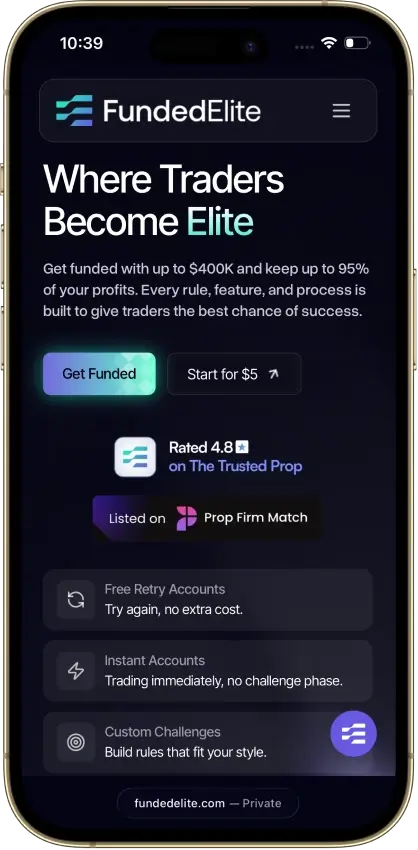
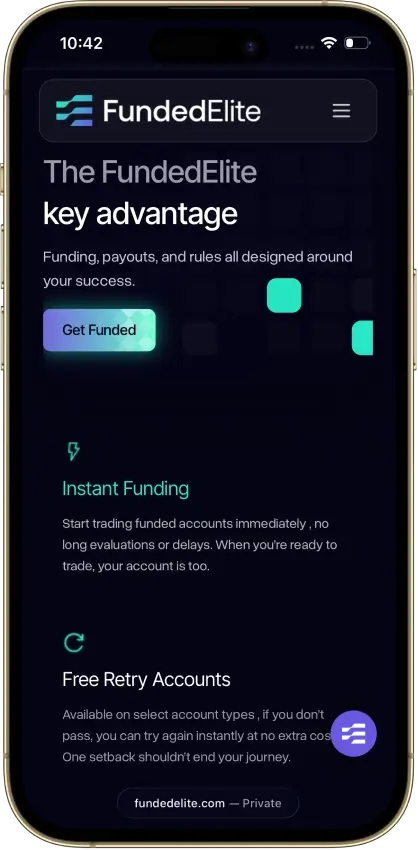

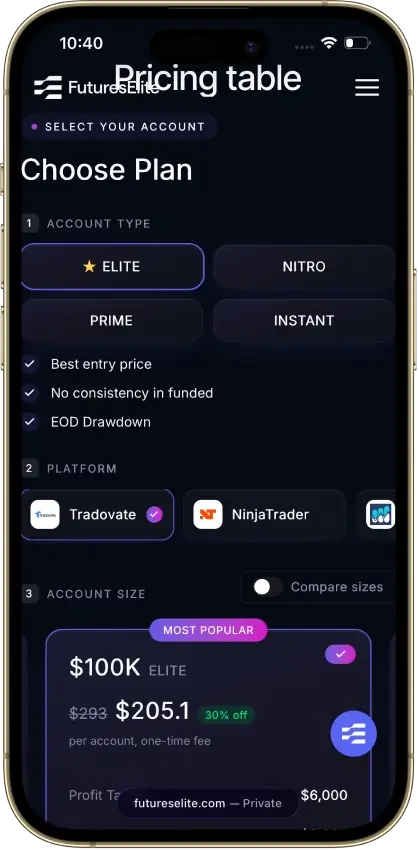
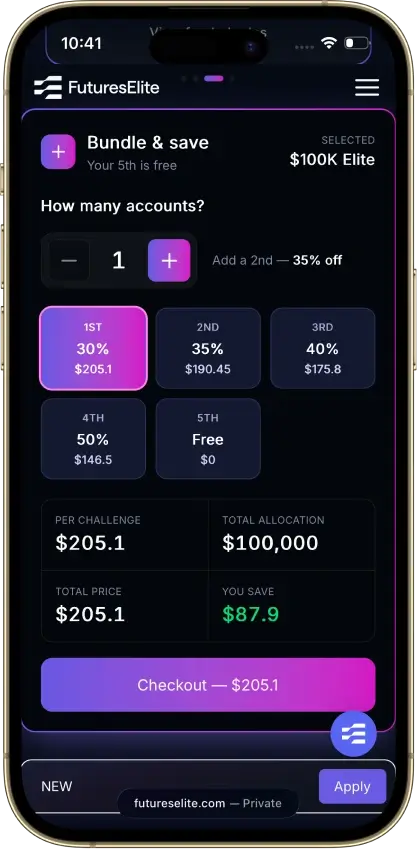
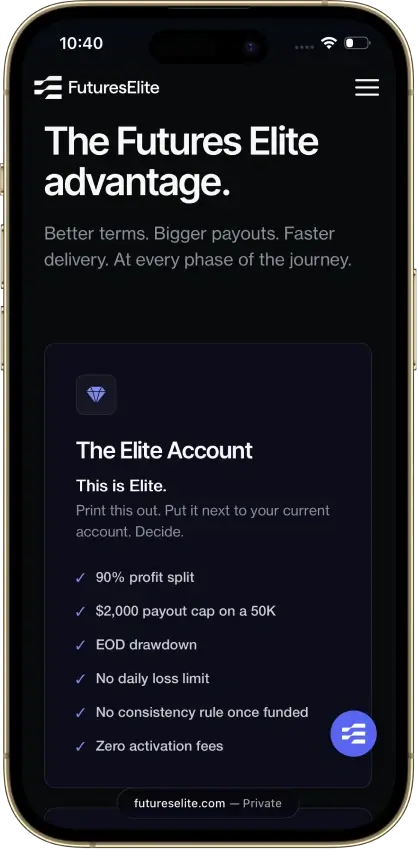
Screenshot 1 of 8
FundedElite Pros and Cons
Pros
- Entry from $23.40, among the cheapest we track
- Static drawdown on six of eight families
- No per-cycle profit limit on any of 49 plans
- Support speed praised in both review bases
Cons
- Resets sold as free, fee on 48 of 49 plans
- Free retry carries a permanent 50% split
- Add-ons compound, $569 becomes $2,358
- Spreads, commission unit and swaps not listed
FundedElite Discount Code
Four near-identical names circulate in search results, and one of them belongs to a company whose website has closed. This review covers FundedElite at fundedelite.com, run by Quantum SRL of Latina, Italy. Funded Elite Traders at fundedelitetrader.com is a different, closed firm, and Elite Trader Funding is a separate Delaware futures firm. Nothing reported about either describes the firm reviewed here.
Two things FundedElite advertises as free are paid, and the prices appear nowhere a buyer reads. The site-wide FAQ answers the reset question with “Free resets help you keep going if you break a rule,” while the checkout catalog carries a reset fee on 48 of 49 plans, most of them larger than the plan cost. The free retry the firm is named for carries, in the help center’s own words, “a permanent profit split of 50% for all payouts requested on the challenge.” Against that sits paid entry from $23.40, at the cheapest end of the firms we track, with no subscription, platform or data fee anywhere in the catalog.
A standing discount applies automatically at checkout, with nothing for a buyer to enter. It takes 40% off the standard families and 50% off Catalyst and the $300K and $400K Instant Elite plans, while Flash Activation gets 0%. We verified it on 19 August 2026 against the firm’s own pricing engine, which applied it with no code supplied and rejected a made-up code at full price. The $39 Lite 2-Step $5K falls to $23.40. No banner or countdown exists anywhere on the site, and the firm’s own settings carry no end date. The figure that matters is the one on the order summary at the moment of payment. A discount never moves a score.
| Code | Discount | Applies to | Verified | Expires |
|---|---|---|---|---|
| SUMMER, applied with no code entered | 40% on standard families, 50% on Catalyst and the two largest Instant Elite plans, 0% on Flash Activation | 47 of 49 plans | 19 August 2026, in the pricing engine | No end date in the firm’s own settings and no countdown on the site |
How FundedElite Works
FundedElite sells 49 plans across eight families, from $5 with an activation fee behind it to $5,200 at list. Five families are evaluations. 1-Step and Lite 1-Step run a single phase, the format shared by the one-step prop firms we compare, and the Flash Activation evaluation is also single-phase. 2-Step and Lite 2-Step run two phases. Instant and Instant Elite skip the test the way instant-funding prop accounts do, and they pay for the shortcut with trailing equity drawdown and a 70% first split against 80% elsewhere. Catalyst is a funded ladder that starts at $25,000 and advertises doubling toward $1,000,000.
The free retry exists only on the 1-Step and 2-Step “Free Retry” plans, two of the eight families. Fail one of those while following the rules and a second-chance account of the same size follows. The split and floor changes it carries appear under payouts below. The other six families sell no retry.
After a pass, KYC runs through Veriff at the funded stage and asks for ID plus a selfie. The Terms then require a video interview within five business days and a separate Risk Interview, where failure means denial of pending payouts and cancellation of associated accounts. Two further clauses state that completing the evaluation guarantees nothing, which is common wording across the category. The road to a first payout runs 21 days on most families and 14 on Flash Activation and Catalyst $25K.
1-Step + Free Retry
| Phase | Profit target | Daily loss | Maximum drawdown | Minimum days | Time limit | Consistency rule |
|---|---|---|---|---|---|---|
| Single PhaseNote 1 | 12% | 3% | 8% | 3 | None | None |
- 12% default target, reducible to 8% via a +40% paid add-on. Minimum days count only at 1% or more profit. A second-chance (free retry) account tightens max loss to 6% and carries a permanent 50% split.
The challenge fee returns with the third payout, only on accounts that never used the free retry and never reset. · No scaling plan published for this family. Live allocation caps at $400,000.
2-Step + Free Retry
| Phase | Profit target | Daily loss | Maximum drawdown | Minimum days | Time limit | Consistency rule |
|---|---|---|---|---|---|---|
| Phase 1Note 1 | 8% | 5% | 8% | 3 | None | None |
| Phase 2Note 2 | 5% | 5% | 8% | 3 | None | None |
- Minimum days count only at 0.5% or more profit. A second-chance account tightens daily loss to 3% and carries a permanent 50% split.
- Minimum days count only at 0.5% or more profit.
The challenge fee returns with the third payout, only on accounts that never used the free retry and never reset. · No scaling plan published for this family. Live allocation caps at $400,000.
Lite 1-Step
| Phase | Profit target | Daily loss | Maximum drawdown | Minimum days | Time limit | Consistency rule |
|---|---|---|---|---|---|---|
| Single PhaseNote 1 | 12% | 3% | 6% | 3 | None | None |
- CONTESTED: max drawdown reads 6% in the checkout catalog and 8% in the help centre. The catalog figure is entered here. Minimum days count only at 1% or more profit.
The challenge fee returns with the third payout, only on accounts that never used the free retry and never reset. · No scaling plan published for this family. Live allocation caps at $400,000.
Lite 2-Step
| Phase | Profit target | Daily loss | Maximum drawdown | Minimum days | Time limit | Consistency rule |
|---|---|---|---|---|---|---|
| Phase 1Note 1 | 10% | 4% | 8% | 3 | None | None |
| Phase 2Note 2 | 5% | 4% | 8% | 3 | None | None |
- Minimum days count only at 0.5% or more profit.
- Minimum days count only at 0.5% or more profit.
The challenge fee returns with the third payout, only on accounts that never used the free retry and never reset. · No scaling plan published for this family. Live allocation caps at $400,000.
Instant
| Phase | Profit target | Daily loss | Maximum drawdown | Minimum days | Time limit | Consistency rule |
|---|---|---|---|---|---|---|
| Funded (no evaluation)Note 1 | — | 3% | 6% | 4 | None | None |
- No evaluation. First split is 70% against 80% on the evaluation families, and the product page headlines "Keep Up to 95% of Profits" where 95% is a +20% add-on. Minimum days count only at 0.5% or more profit. Consistency 25%.
The challenge fee returns with the third payout, only on accounts that never used the free retry and never reset. · No scaling plan published. Live allocation caps at $400,000.
Instant Elite
| Phase | Profit target | Daily loss | Maximum drawdown | Minimum days | Time limit | Consistency rule |
|---|---|---|---|---|---|---|
| Funded (no evaluation)Note 1 | — | 3% | 6% | 4 | None | None |
- No evaluation. 70% first split. Sizes $50K to $400K at $890 to $5,200 list. Three-day payouts cost +160% on this family against +50% on the standard families.
The challenge fee returns with the third payout, only on accounts that never used the free retry and never reset. · No scaling plan published. Live allocation caps at $400,000.
Flash Activation
| Phase | Profit target | Daily loss | Maximum drawdown | Minimum days | Time limit | Consistency rule |
|---|---|---|---|---|---|---|
| Evaluation, then fundedNote 1 | 6% | 3% | 6% | — | None | None |
- $5 buys the evaluation and a $159 to $1,999 activation fee falls due separately. Target is 6% in the evaluation, resolving to 2% on the $100K and larger plans under the standing discount, and none once funded. Drawdown is 6% static in the evaluation and 6% trailing equity once funded, where 3 days at 0.5% then apply. The $1,499 and $1,999 activation fees on the $300K and $400K plans appear in no help-centre article.
The challenge fee returns with the third payout, only on accounts that never used the free retry and never reset. · No scaling plan published. $5 buys the evaluation and a $159 to $1,999 activation fee falls due separately.
Catalyst
| Phase | Profit target | Daily loss | Maximum drawdown | Minimum days | Time limit | Consistency rule |
|---|---|---|---|---|---|---|
| Funded stage (of six to seven)Note 1 | 8% | 3% | 6% | 5 | None | None |
- 8% per stage, with 5% or 10% selectable. Drawdown 6% at $25K and 5% above, trailing equity. Minimum days are 5 at fixed dollar floors. Each stage carries its own paid reset, catalogued at $890, $1,290, $1,790, $2,490, $3,390 and $4,790 — $14,640 against a $249.50 entry, and neither surface prints a single figure. Consistency 30%.
The challenge fee returns with the third payout, only on accounts that never used the free retry and never reset. · Advertises doubling from $25,000 toward $1,000,000 at a 95% split. The per-stage splits appear on no human-readable surface and the two copies inside the page code disagree at $200,000. The ladder also runs past the help centre cap of $400,000 live allocation.
FundedElite Rules and Restrictions
Instant $100,000: a floor that follows floating profit
The help center’s transparency article states “There are absolutely no hidden rules when you join our program.” Traders on both ends of the star range report rules they met only after funding. A one-star reviewer of 19 June 2026 writes that rules appear “finally after funded only then it will be shown in dashboard,” a three-star reports live-account risk rules that differ from the challenge, and two five-star reviews flag undisclosed IP and scalping rules while awarding top marks. A complaint that survives inside a firm’s own favorable reviews carries corroboration most complaints never get, and this one decides the Rules score.
The Rulebook and the Contract
Every rule the firm applies lives in an Intercom help center at faq.fundedelite.com, and the Terms reference that help center nowhere. Drawdown type, minimum hold, consistency, second chance, reset pricing, payout timing, every one of them sits in that unreferenced rulebook. Section 26 incorporates the Privacy Policy and “any other policies or agreements referenced herein” and supersedes all prior communications. The Terms themselves state no drawdown figure, no profit target, no profit split, no payout schedule, no consistency rule, no reset price. No clause says which document wins when they differ, and they differ twice today. The help center permits copy trading between your own accounts while clause 8.2 prohibits copy trading “between accounts, whether your own or third-party accounts, unless expressly authorized.” The help center terminates an account after 29 days without a trade while clause 17.1 says thirty or more. Two collisions is a small count for this category. A buyer still cannot read the rules and the contract in one place and know which binds.
The number separating a soft breach from a hard breach is published nowhere at all. Per the rule text it is reported in the trader’s dashboard only, and neither the Terms nor the help center carries it. The boundary between keeping a payout at a 30% split and losing the account therefore sits in a figure no buyer can read before paying.
The Drawdown Explained
Drawdown is static at 6% to 8% of the starting balance on six of the eight families, with the floor fixed where it starts. The static six are 1-Step, 2-Step, Lite 1-Step, Lite 2-Step, the Flash Activation evaluation, the second-chance variants. That is the more trader-favorable shape. Instant, Instant Elite, the funded stage of Flash Activation and every Catalyst stage trail on equity instead. A trailing equity floor follows your highest equity up with floating profit included, and it never comes back down. A $100,000 Instant account that touches $104,000 in open profit carries its loss floor up by that $4,000, so a position that retraces to its entry can end the account even though the closed balance never fell. Daily loss runs 3% to 5% by family, which the firm measures against the higher of the prior day’s closing equity or balance, and a touch closes the account on every plan.
Two published figures disagree on Lite 1-Step, where the help center describes a customizable max loss of 8% while the catalog defaults all eight Lite 1-Step plans to 6%. And the max-loss selector the help center describes as selectable at 5, 6, 8, 9 or 10 percent is disabled at checkout on 41 of 49 plans whenever the standing discount is applied, which is always.
Static on six families, trailing equity on Instant, Instant Elite, funded Flash Activation and Catalyst.
The Soft Breach
A soft breach leaves the account open and cuts the money instead, and exactly one help-center article describes it. That article states “The payout will still be processed, but with a 30% profit split.” The payout cycle then resets and the fee refund is gone. Three further clean payouts are needed to regain refund eligibility. Triggers include a trade closed inside the three-minute minimum hold, a non-malicious IP flag or a hedging flag. “Gambling,” defined as relying on a single trade for the profit target, is a fourth trigger. No marketing page and no other help-center article mentions a 30% outcome. Five one-star reviewers describe being offered 30% of their profits after a compliance review, the figure recurring verbatim. Whether they hit this automatic rule or a discretionary decision that landed on the same number cannot be resolved from outside. The two published numbers describe two different outcomes, with 30% as the soft-breach split and 50% as the second-chance split covered under payouts below.
Consistency Rule
“No Consistency Rules” appears on the free-retry product page, and “No restrictions on strategy” on two others. The catalog configures consistency on 40 of its steps. Instant runs 25% while Catalyst and the funded stage of Flash Activation run 30%. The $300K plans of the four standard families run 60% and also require five minimum trading days in place of three. Removing the rule costs +35% on Flash Activation and +40% on Catalyst.
News and Weekend Trading
News trading is permitted, and the help center says so plainly, while the Terms prohibit gap trading around scheduled macroeconomic events. Weekend holding is allowed. Weekend trading defaults to not allowed, costs +10% to enable, is breached even when a stop loss or take-profit fills over the weekend, and detection means immediate account termination. Two product pages sell “Hold over weekends … No restrictions on strategy” regardless. Catalyst offers no weekend option at any price.
Strategy, EA, and IP Controls
Martingale and grid trading are permitted, and so is news trading. The stated limits bar martingale EAs, public scalping EAs and manipulation. EAs are otherwise allowed but must not execute trades independently. HFT and micro-scalping are banned behaviorally. The minimum hold is three minutes, which the paid scalping add-on lowers to 30 seconds. Hedging is prohibited within and across accounts. VPNs and VPSs are allowed only if pre-notified, and travel requires proof before departure. IP sharing means immediate termination with a possible permanent ban.
The help center is unusually detailed for the category, which shows in its 73 English articles that put a number on most things they ban. Three of its rules verify exactly against the catalog, among them the funded-stage reset ladder and Catalyst’s per-stage profit floors.
Conflicting Country-Access Lists
FundedElite’s three first-party surfaces give three different answers on the restricted-country question. The checkout blocks 13 country codes, including all of Ukraine and Belarus. The help center prohibits 16 territories on MT5 accounts, including the United States and Syria, neither of which the checkout blocks. The Terms publish no list and defer to sanctions regimes. We probed the firm’s own order system in both directions. A Turkish buyer is refused and a US buyer is not, while a help-center article prohibits US residents on MT5 accounts. A third article caps Vietnam and Pakistan at $100,000, a cap neither list mentions. Post-checkout enforcement is observable only by purchasing, and we make no claim about it. Mismatched country lists are common in this category.
| Rule | Limit | Consequence | Applies To |
|---|---|---|---|
| Maximum daily loss | 3% | 3% to 5% by family, measured against the higher of prior-day closing equity or balance. Hard breach — the account closes on a touch. | All Stages |
| Maximum drawdown | 6% | 6% to 8% static on six families, trailing equity on the instant-style plans and Catalyst. Lite 1-Step reads 6% in the catalog and 8% in the help centre. Hard breach. | All Stages |
| Minimum hold time | 3 minutes a trade must be held to count | 3 minutes per trade, lowered to 30 seconds only by the paid scalping add-on at +30%. Soft breach: the pending payout pays at 30% and the cycle resets. | All Stages |
| Single-instrument risk | 50% | No more than 50% of the daily loss limit risked on one instrument in a day, measured on the worst excursion even if the trade closes green. The threshold deciding soft against hard is shown only in the dashboard. | Funded |
| Consistency | 25% | 25% on Instant, 30% on Catalyst and Flash Activation funded, 60% on $300K standard plans. Disclosed on no purchase surface. | All Stages |
| Weekend trading | 10% | Not allowed by default. A +10% add-on enables it. Breached even when a stop or take-profit fills over the weekend, and the consequence is immediate account termination. Catalyst sells no weekend option. | All Stages |
| Inactivity | 29 calendar days | 29 days without a trade per the help centre, 30 or more per the Terms. Termination, and recovery costs 40% of the account price per the help centre. | All Stages |
| Live allocation cap | $400,000 | Up to 50 active challenges per trader, live allocation capped at $400,000, with Vietnam and Pakistan capped at $100,000. The advertised Catalyst ladder to $1,000,000 runs past this cap and neither surface acknowledges the other. | Funded |
Prohibited Strategies
- Hedging, within and across accounts, firms and platforms
- HFT and micro-scalping — a 3-minute minimum hold, which the paid scalping add-on lowers to 30 seconds
- IP sharing (immediate termination, possible permanent ban). VPN and VPS allowed only if pre-notified, travel needs advance proof
- Martingale EAs, public scalping EAs and manipulation. EAs are otherwise allowed but must not execute trades independently
Marketing vs. Contract
Marketing language is checked against the terms that govern the selected program.
FundedElite Pricing and Account Sizes
The site-wide FAQ, live on the homepage and five other pages, answers the reset question with “Free resets help you keep going if you break a rule.” The checkout catalog carries a reset fee on 48 of 49 plans, and on most of them the reset costs more than the plan. $299 buys a Lite 2-Step $100K and $899 resets it, and $1,599 buys a 1-Step $300K and $3,089 resets it. No page on fundedelite.com and no help-center article mentions an evaluation reset fee at all, and one $200K plan carries no fee value. Whether the fee is levied could not be established without an account. The disclosure failure stands either way, because the site’s own answer to the question is free. The firm can publish a reset ladder when it wants to, because the funded-stage self-reset is published, matches the catalog exactly and runs at 40% of the plan cost, doubling on the second and again on the third, which is the last.
Catalyst sharpens the same failure, because marketing sells “The Safety Net … 6× Resets Available” while the help center says each stage carries its own paid reset and the catalog prices the six at $890, $1,290, $1,790, $2,490, $3,390 and $4,790. That is $14,640 against a $249.50 entry, and neither surface prints a single figure.
The pricing story turns on the add-ons, because the six surcharges below sum to 165 percent, a figure that would take the $569 1-Step $100K to about $1,508. The firm’s pricing engine instead returns $2,358.02, or 4.14 times the headline, because each surcharge applies to the running total of the ones before it. No other prop firm we score compounds its add-ons this way, and the specification this stack prices is the one the marketing leads with. A buyer configuring the advertised 95% split plus three-day payouts and weekend trading pays 4.14 times the advertised price while four live pages state “No Hidden Fees – Transparent pricing and evaluation costs.” Two further charges sit outside the help center entirely. The $1,499 and $1,999 activation fees on the $300K and $400K Flash Activation plans appear in no help-center article, and the transfer fee on both payout rails is deducted at a rate published nowhere.
Paid entry runs from $23.40 to $2,600, which is the counterweight to all of the above. The low end sits among the lowest-priced prop firm challenges we compare, and there is no subscription and no platform or data fee anywhere in the 49 plans. The challenge fee returns with the third payout on accounts that never used the retry and never reset. A bulk ladder also runs undisclosed in the buyer’s favor, where marginal unit prices fall by 10, then 20, then 30 percent as quantity rises. A fifth account then comes free.
| Account balance | 1-Step + Free Retry Refund note 1 | 2-Step + Free Retry Refund note 1 | Lite 1-Step Refund note 1 | Lite 2-Step Refund note 1 | Instant Refund note 1 | Instant Elite Refund note 1 | Flash Activation Refund note 1 | Catalyst Refund note 1 |
|---|---|---|---|---|---|---|---|---|
| $5,000 | — | — | $49 One-time | $39 One-time | — | — | — | — |
| $7,000 | $95 One-time | $89 One-time | — | — | $120 One-time | — | — | — |
| $25,000 | — | — | — | — | — | — | $5 One-time | $499 One-time |
| $50,000 | — | — | — | — | — | $890 One-time | $5 One-time | $899 One-time |
| $100,000 | — | — | — | — | — | — | $5 One-time | — |
| $200,000 | — | — | — | — | $1,690 One-time | — | $5 One-time | — |
| $300,000 | $1,599 One-time | $1,499 One-time | $1,099 One-time | $899 One-time | — | — | $5 One-time | — |
| $400,000 | — | — | — | — | — | $5,200 One-time | $5 One-time | — |
- The challenge fee returns with the third payout, only on accounts that never used the free retry and never reset.
The ladder below was verified against the pricing engine one add-on at a time, then all together, on the $569 1-Step $100K.
| Add-on | Surcharge |
|---|---|
| 95% profit split | +20% |
| Payouts every 3 days | +50% on standard families, +160% on Instant and Instant Elite |
| 1:100 leverage | +15% (1:50 costs +10%) |
| Scalping, 30-second minimum hold | +30% |
| Weekend trading | +10% |
| 8% profit target, from 12% | +40% |
| All six together | $2,358.02 at list, 4.14 times the $569 headline |
FundedElite Payouts and Profit Split
Payout Terms
The base split is 80% on six families and 70% on Instant and Instant Elite, whose product page headlines “Keep Up to 95% of Profits.” The advertised 95% is a +20% add-on on every family that offers it. A first payout can be requested at 21 days on most families, 14 on Flash Activation and Catalyst $25K, a window shared by several of the firms we rank on payout turnaround. The gap sits in what the marketing says about it. The homepage promises “Get paid within 3 days,” the site-wide FAQ promises crypto “inside 48h,” and the help center states “the first payout is always requestable after 21 days anyways.” Faster cadence is priced. On Instant and Instant Elite, 14-day payouts cost +12%, 7-day +80% and 3-day +160%, on the product whose page sells “get paid in just 3 days.” Only the free-retry product page states plainly that three-day payouts are an add-on.
Payouts run through Rise for bank and coin transfers, or through direct crypto. Crypto carries “a maximum request of 500 USD gross per payout cycle,” stated in exactly one help-center article and on no marketing page. The FAQ block advertising crypto payouts inside 48 hours mentions no cap, and payout caps of this shape are ordinary in the category. Both rails deduct a transfer fee at a rate published nowhere. A minimum payout is stated only for Flash Activation, which has none. Free or giveaway accounts carry a disclosed 2% payout cap. No plan among the 49 carries a per-cycle profit cap or a maximum payout count, caps that hold several firms we score down.
The sharpest edge on the split is the free retry that gives the firm its name. Three marketing surfaces sell it as free, from “Try again, no extra cost” to “try again instantly at no extra cost” to “you’ll receive a free retry on an account of the same size.” The help center describes the same feature in its own words, saying “The second chance status determines a permanent profit split of 50% for all payouts requested on the challenge and a reduction in the allowed drawdown percentages.” The catalog confirms it. Second-chance funded steps pay 50% against 80% on the normal funded step, max loss tightens from 8% to 6% on 1-Step, daily loss goes from 5% to 3% on 2-Step, and the fee refund is gone. Against a headline of up to 95%, the free retry costs 45 points of profit split.
Verified Payout Evidence
FundedElite does not publish a payout page, certificate register or transaction hash that independently supports its payout claims. Its first-party evidence is a ten-item screenshot carousel hosted on the firm’s site, with each image linking to a private Discord channel. All ten items are timestamped 20 March 2026. Nine were posted within 90 seconds, and the amounts total $73,842. The firm’s own totals conflict: the homepage and three challenge pages show $2.3 million, a supporting site asset shows $1.2 million, and the Flash Activation page shows $2,033,746+. These are static marketing figures with no published calculation method or independent verification.
The volume evidence is third-party, and it comes from one aggregator’s payout tracker holding 3,480 payouts, $2,078,469 in total, a largest single payout of $18,048 and a median payout time near 21 hours, with entries as recent as 19 August 2026. The page states no source and no verification method, and its total sits close to the firm’s own $2.3M marketing figure. It also reports zero delays, a figure the format guarantees, because a denied payout never becomes a payout and a payout ledger cannot record one. The ledger and the complaint record are blind to each other, and this review holds both.
The complaint record is specific in a way the volume record is not. Payout denial on an IP-sharing or shared-device flag raised at the withdrawal step appears in 8 of the 18 one-star Trustpilot reviews we captured, with reports from independent reviewers dated 30 January, 1 February, 5 May, 22 May, 28 May, 16 June, 7 July, 12 August 2026, a run of seven months. Several state their ISP assigns dynamic addresses and several trade from a VPS. One was asked to buy a dedicated IP at roughly $20 a month on top of the challenge fee, and one states the firm confirmed no account sharing had occurred and denied the payout anyway. One third-party aggregator reports the same flag pattern. The flag also survives inside the firm’s own favorable reviews. A five-star of 28 July 2026 rates support five stars while naming undisclosed IP and scalping rules, and a five-star of 23 July 2026 reports a payout completed only after warning support in advance about a static address. Among the firms we score, this is the only complaint theme we have seen repeated inside a firm’s own five-star base. The evidence class is REPORTED, because money demonstrably reaches some traders and no part of the record can be independently checked.
| Evidence | Class (VERIFIED / REPORTED / CLAIMED) | Source | Date accessed |
|---|---|---|---|
| Ten payout screenshots totaling $73,842, hosted on the firm’s own WordPress, every one timestamped 20 March 2026 and nine posted inside 90 seconds, each linking into a private Discord channel | CLAIMED | fundedelite.com homepage carousel | 19 August 2026 |
| Three site-wide paid-out totals — $2.3M, $1.2M and $2,033,746+ — all hardcoded with no data request behind them | CLAIMED | fundedelite.com pages and their own code files | 19 August 2026 |
| A payout tracker holding 3,480 payouts, $2,078,469, an $18,048 largest payout and a median time near 21 hours, provenance undisclosed | REPORTED | One third-party prop-firm aggregator | 19 August 2026 |
| Eight dated one-star reviews over seven months reporting payout denial on an IP-sharing or shared-device flag, the same flag named in two five-star reviews | REPORTED | Trustpilot review record | 19 August 2026 |
Scaling Plan
The Terms state that details of any scaling plan are published on the Website, and the site-wide FAQ promises scaling milestones that expand buying power. No scaling plan appears on any surface outside Catalyst. Catalyst starts at $25,000 and advertises doubling through the stages to $1,000,000 at a 95% split, with “$194,600 in total payouts waiting at the top.” The per-stage splits appear on no human-readable surface. They exist twice inside one code file on the product’s own page, and the two copies disagree at $200,000. One says 92% and the other 95%, and the checkout catalog agrees with the second, so the hero animation a buyer watches is wrong. Reaching the advertised top requires hitting an 8% target seven consecutive times without touching a trailing equity floor of 5 to 6% or a 3% daily floor, while booking five qualifying days each time, and no product surface states that. The $1,000,000 ladder also runs past the help center’s own statement that live funded allocation is capped at $400,000. Neither surface acknowledges the other.
FundedElite Platforms and Trading Conditions
FundedElite publishes none of the three costs of holding a position, and no other prop firm we score leaves all three unpublished. There is no spread table on any surface, and the help center’s answer is that traders can ask the team to check the spreads. The commission table reads “FX 3$” with no unit stated, so the charge could be per lot or per side or per round turn as written. The accounts are stated as not swap free, and no swap rate appears anywhere. A trader cannot price a round turn before taking it and cannot price holding it overnight.
FX leverage defaults to 1:30, with 1:50 at +10% and 1:100 at +15 to 20%, so the 1:100 the firm’s own comparison pages advertise is a paid upgrade. Leverage outside FX is published only as four images with no text equivalent in a single help-center article. The platform list is contested on the firm’s own surfaces. The homepage says MT5 and Match-Trader while the help center’s challenge articles say MT5 and TradeLocker, and the restricted-countries article names all three. A buyer cannot determine which platforms they will trade on before paying, and one trader review turns on exactly that preference.
Instrument breadth is the credit that traders name themselves, with crypto depth beyond BTC and ETH the most-cited positive on a trader-review platform’s 183-review base. The named lists cover FX majors with 17 crosses and 31 exotics and minors, then 12 indices, oil, gas, four precious metals, US, EU, Hong Kong equities, roughly 30 crypto pairs, index, commodity, bond futures, VIX. The lists are given as examples and no total is published. Execution complaints are the fewest we have recorded on any firm we score. The one methodical report, from March 2026, describes stop-outs on MT5 with an outside chart showing price 20 pips clear of the stop. The server day resets at 4pm ET.
Is FundedElite Legit and Safe?
FundedElite pays some traders and denies others at the withdrawal step, and both records are documented above. The company behind it is stated four ways on its own surfaces, as Quantum SRL in the Terms, Quantum srls in the Privacy Policy’s first line under a heading naming Quantum SRL, Quantum LTD in one help-center article, Quantum Srls in another. That is one company name rendered four ways, across four postal addresses in three countries, spanning Via Maira 13 in Latina, Corso G. Matteotti 61 with no city given, a London address, a Saint Lucia address. We ran no registry check on the stated VAT number, P.IVA 03095010595, so the identity is unverified in both directions. Nothing here implies the company does not exist. The site names Christian Habibi as CEO and Artur Deshko as COO, and two outside sources corroborate both names, as they do the 2023 founding.
The contract reads cleaner than the identity of the company that wrote it. Governing law is Italian and stated consistently, with exclusive jurisdiction at the Tribunale di Latina and liability capped at twelve months of fees. There is no arbitration clause and no class-action waiver, and the absent clauses favor the trader. Clause 9.3, headed “Review-Based Threats (Extortion),” makes threatening the company with negative reviews or reputational harm a material breach. The firm is unregulated and says so in plain words. “Funded Elite is not a regulated broker … We are a technology company.” Italy’s markets regulator issued a sector-wide notice on retail prop trading in July 2024 that names no firm.
Transparency fails hardest on the marketing estate, where twelve live pages sell an “Elite Now account” with a 6% overall and 4% daily drawdown and 1:100 leverage, and one page sells an “Elite Challenge Account” stating “a $100,000 account can be purchased for a one time fee of $349” alongside consolidations to $600,000. No such plan exists in the catalog and no $100,000 plan costs $349. Instant’s daily loss is 3% and default leverage is 1:30, and the allocation ceiling is $400,000. Seventeen live pages call the firm “Futures Elite,” one of them naming Futures Elite as the firm running the support Discord. A cyber-week discounts page live on 19 August 2026 describes Black Friday 2024, and a comparison page names My Forex Funds as a live competitor two years after the 2023 CFTC and OSC action against it. The homepage’s AS SEEN ON strip names MarketWatch, Benzinga, Morningstar, Yahoo Finance, Business Insider, all with no link and no press page. We searched for that coverage and found zero independent journalism about this firm. The one syndication located is the firm’s own 2024 release, labeled as paid, distributed to Yahoo Finance.
FundedElite’s Trustpilot page carries no score at all. Standing where one would be is the notice “This company’s rating is unavailable due to a breach of our guidelines.” Four of nine other prop-firm profiles we have checked carry the same notice and it identifies nobody. A firm can be the target of fake reviews as easily as their source, so we print no score. The profile holds several hundred reviews, checked 19 August 2026. Support speed is the best-evidenced positive on the firm. It is the dominant five-star theme on Trustpilot and it repeats on a trader-review platform’s 183-review base, two populations with different recruitment reaching the same conclusion. Every readable third-party review site carries affiliate links or discount codes, and reviewers on that 183-review base cite the platform’s own discount code inside their reviews, so the praise is at least partly recruited through the affiliate funnel. That reduces the weight it carries, and nothing we read shows it is false. Three one-star reviewers allege legal threats over reviews, and the firm’s public replies allege the reverse, one accusing a reviewer of attempting to extort cryptocurrency in exchange for removing fake one-star reviews. Neither direction is established and we draw no conclusion from either. The support plumbing itself is broken in places. The site-wide Talk to Support button returns a 404 while three surfaces describe the 24/7 channel set three different ways, and the help center directs traders to a dashboard address with no DNS record. One limit on our read is geography. This firm’s traders sit heavily in India, Pakistan, Indonesia, Nigeria, the Philippines, whose trading communities run on channels we could not search, so the community record here rests on Trustpilot and one trader-review platform.
FundedElite Alternatives
HyroTrader routes its evaluations into a Bybit sub-account the trader already owns, so the fills land on an exchange the trader can audit instead of inside the firm’s own terminal. Its entry fee comes back as a deposit once the first funded payout clears, and the walk from 80% to 90% is earned by holding the account eight months rather than bought outright. That is the same ten points FundedElite prices at +20%, then takes back down to 50% the moment a trader uses the retry. BrightFunded prices what FundedElite leaves blank, publishing its commission and swap figures, charging no payout fee of its own, and setting a VERIFIED $0.01 floor on withdrawals with no consistency gate in front of them. FundedElite’s counter is the entry price at $23.40, an instrument list running past 30 crypto pairs, and static drawdown on six of its eight families.
Every firm in CryptoSlate’s prop firm rankings is scored on the same seven weighted categories, and FundedElite’s contributions sum to exactly 5.100, published as 5.1. Trading conditions is the only pillar above the midpoint, carried by instrument breadth and one lone execution complaint. The heavier pillars sit below it because what the firm publishes about resets, retries, rules, costs keeps differing from what its catalog and help center say.
Prop Firm Pillar Scores
- Payout Reliability and Evidence 25% weight Eight dated denial reports in seven months, the same flag inside the firm’s own five-star reviews, and no checkable first-party evidence. A tracker’s 3,480 entries hold it at 5.0.5.0 / 10
- Rules Fairness and Transparency 20% weight Every operating rule lives in a help center the Terms never reference, the documents collide twice, and traders in both star bands report rules that surface only after funding.4.5 / 10
- Cost and Value 15% weight Entry from $23.40 paid sits at the cheapest end of the firms we track. Resets answered as free carry catalog fees on 48 of 49 plans, and six add-ons compound to 4.14x.5.5 / 10
- Trading Conditions 15% weight Spreads, the commission unit and swap rates are all unpublished, so a position cannot be priced before it is taken. Broad instruments and one lone execution complaint hold it here.6.0 / 10
- Profit Split and Scaling 10% weight 80% base with 95% at +20% is category-normal. The free retry carries a permanent 50% split, cancels the fee refund and tightens the drawdown floors.5.5 / 10
- Firm Transparency and Stability 10% weight One company name rendered four ways across four addresses in three countries, twelve live pages selling products that exist in no catalog, and 17 pages using the wrong name.4.0 / 10
- Support and Reputation 5% weight Support speed is the best-evidenced positive on the firm, repeated across two review populations. The Talk to Support button 404s and Trustpilot displays no rating.5.5 / 10
Final Verdict
FundedElite sells 49 challenge plans across eight families, from $23.40 paid to $2,600, with no subscription and static drawdown on six of eight families. Two things it advertises as free are paid: the site-wide FAQ answers the reset question with free while the catalog carries a reset fee on 48 of 49 plans, and the free retry the firm is named for carries a permanent 50% profit split against an up-to-95% headline. The score is 5.1 because what a buyer is told before paying repeatedly differs from what the product does.

Prop-firm fees are at risk, most participants do not reach a payout, and simulated funding does not necessarily represent live firm capital. This review is informational, not financial advice.
CryptoSlate may earn a commission when you use partner links, at no extra cost to you. Our reviews, ratings, and editorial decisions remain independent of advertisers. Read How CryptoSlate Makes Money for funding details.
FAQ
FundedElite FAQs
Is FundedElite a good prop firm?
FundedElite scores 5.1 out of 10, held up by entry from $23.40 paid, static drawdown on six of eight families and no configured profit caps. Rules score 4.5 and firm transparency 4.0, because the resets and retry sold as free carry a catalog fee and a permanent 50% split.
Is FundedElite legit?
FundedElite demonstrably pays some traders, with a third-party tracker holding 3,480 payouts totaling $2,078,469. Quantum SRL runs it from Latina in Italy and is unregulated, which the firm states plainly. Eight dated reviewers report payout denials on an IP-sharing flag at the withdrawal step, so read the IP and minimum-hold rules before paying.
Does FundedElite actually pay out?
The evidence class for FundedElite payouts is REPORTED, which sits above CLAIMED and below VERIFIED. A third-party tracker records 3,480 payouts totaling $2,078,469 with entries as recent as 19 August 2026, and its provenance is undisclosed. The firm itself publishes no payouts page, no register, no transaction hash. Eight dated reviewers report denial at the withdrawal step over seven months.
Are FundedElite resets free?
The site-wide FAQ answers yes, while the checkout catalog carries a reset fee on 48 of 49 plans, with a $299 Lite 2-Step $100K listing an $899 reset. No page or help-center article prices an evaluation reset, and whether the fee is levied could not be established without an account. The published funded-stage ladder is separate, at 40% of cost, then double, then double.
What is FundedElite's profit split?
80% base on six families and 70% on Instant and Instant Elite, with 95% sold as a +20% add-on. A soft breach pays the pending payout at 30%. A used free retry pays a permanent 50% on that challenge. Five different figures, every one published by the firm.
How much does a FundedElite $100K account cost?
$179.40 paid on Lite 2-Step ($299 list), $221.40 on Lite 1-Step, $311.40 on 2-Step and $341.40 on 1-Step with the automatic discount. Instant runs $534 and Instant Elite $894. Flash Activation charges $5 up front and a $499 activation fee after the evaluation.
Is FundedElite the same company as Funded Elite Traders?
No, this review covers fundedelite.com, run by Quantum SRL of Latina, Italy. Funded Elite Traders at fundedelitetrader.com is a separate company whose website has closed, and Elite Trader Funding is a separate Delaware futures firm. Claims about those companies do not describe this one.