



Prop-firm fees are at risk, most participants do not reach a payout, and simulated funding does not necessarily represent live firm capital. This review is informational, not financial advice.
The5ers Overview
- Company Name
- The5ers
- Registered In
- England and Wales (company 12553363, London) and Israel (company 515864007, Raanana). Governing law is Israel, with jurisdiction in Tel Aviv.
- Launch Year
- 2016
- Restricted Countries
- Afghanistan, Belarus, Bosnia and Herzegovina, Cuba, Iran, Iraq, Israel, North Korea, …Afghanistan, Belarus, Bosnia and Herzegovina, Cuba, Iran, Iraq, Israel, North Korea, Russia, Syria, Venezuela
- Evaluation Fees
- Forex / CFD: $19–$850; Futures: $59–$219
- Account Sizes
- Forex / CFD: $2,500–$250,000; Futures: $25,000–$150,000
- Challenge Types
- Forex / CFD: One Step, Two Step, Three Step; Futures: Futures Evaluation
- Profit Targets
- Forex / CFD: 5–10%; Futures: 6%
- Maximum Drawdown
- Forex / CFD: 4–10%; Futures: 4%
- Maximum Daily Loss
- Forex / CFD: 3–5%; Futures: 0%
- Profit Split
- Forex / CFD: 50%–100%; Futures: 80%
- Minimum Trading Days
- Forex / CFD: 0–3; Futures: 0
- Fee Refund
- Forex / CFD: Program dependent: Current official materials do not clearly establish a withdrawable CFD refund for this program. Do not treat the fee as recoverable without written confirmation. The separate futures policy adds the original evaluation fee to account equity after the third successful payout.; Refunded as credits, not cash, on the same 10/20/70 split as High Stakes New. Hub credits cannot be withdrawn or transferred and buy new accounts only.; Refunded from the third payout. The refund is calculated on the amount paid excluding discounts, so a Summer Plan buyer is credited on the discounted price.; Futures: Refundable: Refunded from the third payout.
- Maximum Allocation
- Forex / CFD: $175,000–$4,000,000; Futures: $500,000
- Payout Time
- Crypto: 8 business days; Rise: 8 business days; Bank Transfer: 8 business days
- Website
- the5ers.com
The5ers Screenshots

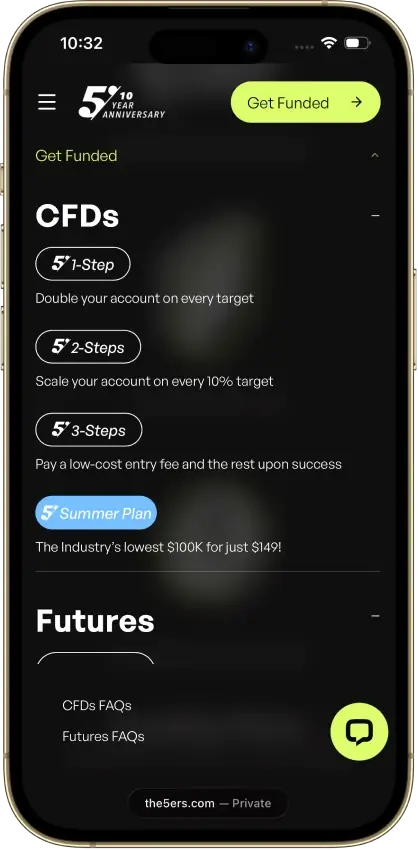
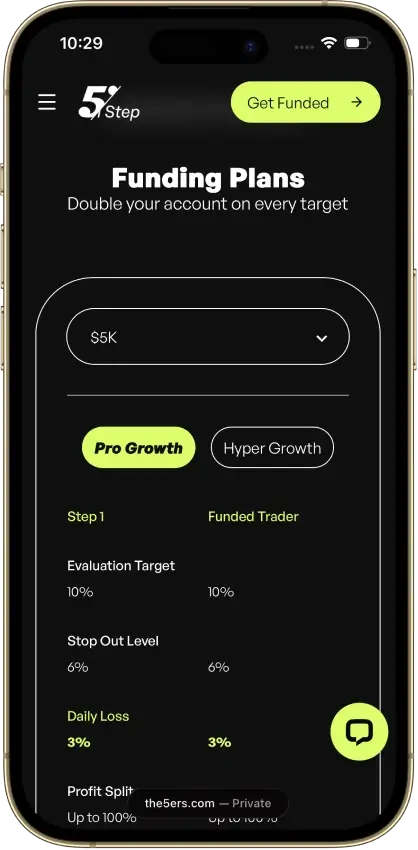
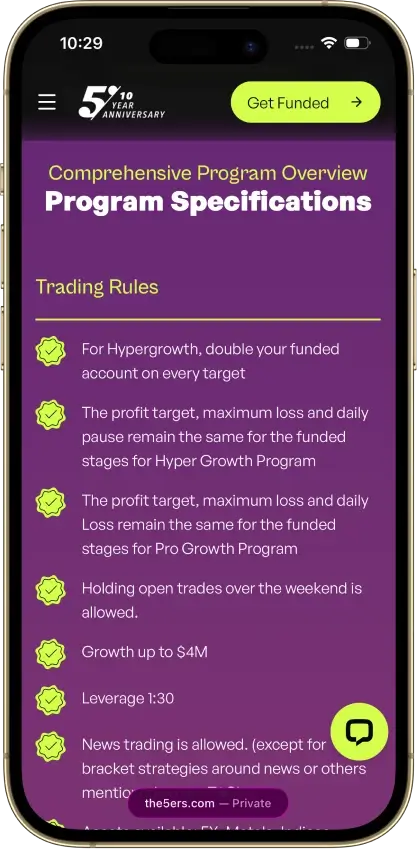
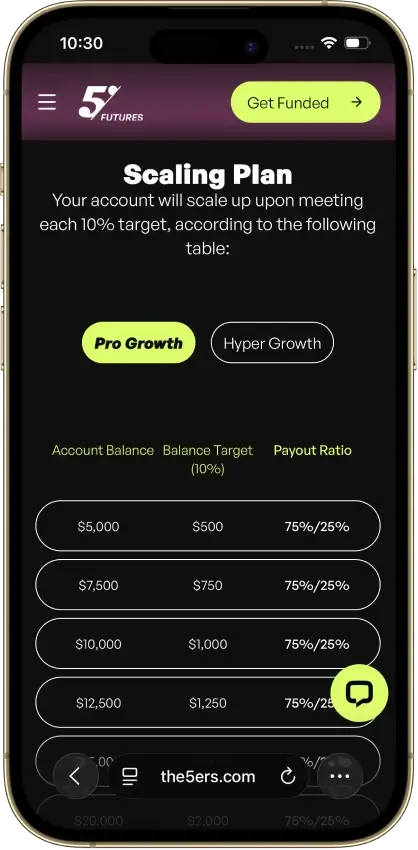



Screenshot 1 of 8
The5ers Pros and Cons
Pros
- Static drawdown on all five CFD programs
- No time limit to pass any challenge
- Entry from $19 for a 2-step $2.5K account
- Five CFD and two futures programs
- Overnight and weekend holding on CFD plans
Cons
- Refund terms conflict on its own page
- Futures drawdown trails, unlike CFD plans
- Splits start at 50/50 on two programs
- 30x leverage on three of five CFD plans
- Scaling resets the 14-day payout clock
The5ers Discount Code
LWDK is CryptoSlate’s referral code at The5ers. The5ers runs no public sitewide sale, so enter it at checkout and read the total before paying. The saving that does exist is the Summer Plan, which prices a $100,000 account at $149 as a 2-step or $249 as a 1-step. It is the only route to a 1-step $100,000 account, and it undercuts the standard 2-step $100,000 High Stakes evaluation at $491 by a wide margin.
The Summer Plan’s lower price comes with a 50% daily consistency requirement and a $2,000 payout cap per cycle. Its minimum withdrawal rises to $250. The split stays at 75/25 as the account scales. Current official materials do not establish a clear withdrawable CFD fee refund, so do not count one toward the plan’s value without written confirmation.
The5ers Discount At a Glance
How The5ers Evaluation Works
Each program begins with an upfront fee and a profit target on a simulated account. Reaching the target without breaching the loss limits moves the trader to a funded account that pays out every 14 days. The number of steps and the price vary by program, and so do growth rates, so compare the terms with the wider prop firm rankings before choosing a plan.
Evaluations have no deadlines, although an inactivity rule expires an account after 30 consecutive days without a trade.
Pro Growth and Hyper Growth, 1-Step
Pro Growth
| Phase | Profit target | Daily loss | Maximum drawdown | Minimum days | Time limit | Consistency rule |
|---|---|---|---|---|---|---|
| EvaluationNote 1 | 10% | 3% | 6% | 3 | None | None |
| Funded AccountNote 2 | — | 3% | 6% | — | None | None |
- No deadline — the only clock is a 30-day inactivity rule. A 3% daily breach terminates the account outright rather than pausing it, which is the difference between this and Hyper Growth. A profitable day means closed positions netting at least 0.5% of the starting balance, so on a $10,000 account a day needs $50 of closed profit to count. Leverage 1:30.
- Opens at 75/25 and does not improve until $400,000, with a $500,000 ceiling. Payouts run every 14 days once the account has 3 profitable days, minimum $150, and the cycle restarts each time the account scales.
Scales on a 10% trigger from an opening 75/25, improving only from $400,000, with a $500,000 ceiling. Leverage is 1:30.
Hyper Growth
| Phase | Profit target | Daily loss | Maximum drawdown | Minimum days | Time limit | Consistency rule |
|---|---|---|---|---|---|---|
| EvaluationNote 1 | 10% | 3% | 6% | 0 | None | None |
| Funded AccountNote 2 | — | 3% | 6% | — | None | None |
- The same rulebook as Pro Growth at roughly five times the price. Two things come back for that: the 3% daily limit pauses trading until 00:00 server time instead of killing the account, and no minimum profitable days apply. Leverage 1:30.
- Opens at 50/50, the lowest starting split on the board. The funded balance doubles at every 10% target rather than stepping up, which is how it reaches the $4,000,000 ceiling.
Shares Pro Growth’s rulebook at roughly five times the price. The funded balance doubles at every 10% target instead of stepping up, which is how it reaches $4,000,000 while Pro Growth stops at $500,000. Opens at 50/50. Leverage is 1:30.
High Stakes New
| Phase | Profit target | Daily loss | Maximum drawdown | Minimum days | Time limit | Consistency rule |
|---|---|---|---|---|---|---|
| Step 1Note 1 | 10% | 5% | 10% | 3 | None | None |
| Step 2Note 2 | 5% | 5% | 10% | 3 | None | None |
| Funded AccountNote 3 | — | 5% | 10% | 3 | None | None |
- The most forgiving loss limits of the CFD programs at 1:100 leverage. A 5% daily breach terminates the account. A profitable day means closed positions netting at least 0.5% of the starting balance, so on a $10,000 account a day needs $50 of closed profit to count.
- Half the first step’s target with identical limits and still no deadline.
- Opens at 80/20 and reaches 100/0 with fixed payouts from $350,000, ceiling $500,000. Up to 11 concurrent accounts. The fee comes back as credits rather than cash.
Current official materials do not clearly establish a withdrawable CFD refund for this program. Do not treat the fee as recoverable without written confirmation. The separate futures policy adds the original evaluation fee to account equity after the third successful payout. · Scales on a 10% trigger from 80/20, reaching 100/0 with fixed payouts from $350,000, ceiling $500,000. Allows up to 11 concurrent accounts. Leverage is 1:100.
High Stakes Classic
| Phase | Profit target | Daily loss | Maximum drawdown | Minimum days | Time limit | Consistency rule |
|---|---|---|---|---|---|---|
| Step 1Note 1 | 8% | 5% | 10% | 3 | None | None |
| Step 2Note 2 | 5% | 5% | 10% | 3 | None | None |
| Funded AccountNote 3 | — | 5% | 10% | 3 | None | None |
- An 8% first-step target against New’s 10%, which is the easier pass for most traders and the reason Classic costs a little more at every size. A profitable day means closed positions netting at least 0.5% of the starting balance, so on a $10,000 account a day needs $50 of closed profit to count.
- Identical to High Stakes New from this point on.
- Opens at 80/20 and reaches 100/0 with fixed payouts from $350,000. Up to 4 concurrent accounts against New’s 11.
Refunded as credits, not cash, on the same 10/20/70 split as High Stakes New. Hub credits cannot be withdrawn or transferred and buy new accounts only. · Costs a little more than New at every size and drops the first-step target from 10% to 8%, the easier pass for most traders. Allows up to 4 concurrent accounts. Leverage is 1:100.
Bootcamp
| Phase | Profit target | Daily loss | Maximum drawdown | Minimum days | Time limit | Consistency rule |
|---|---|---|---|---|---|---|
| Step 1Note 1 | 6% | — | 5% | 0 | None | None |
| Step 2Note 2 | 6% | — | 5% | 0 | None | None |
| Step 3Note 3 | 6% | — | 5% | 0 | None | None |
| Funded AccountNote 4 | 5% | 3% | 4% | 0 | None | None |
- The step balance is not the plan name. A $20K Bootcamp starts at $5,000, a $100K at $25,000 and a $250K at $100,000, so a 6% step-1 target on a $20K plan is $300. There is no daily loss limit at any evaluation step.
- The balance steps up: $10,000 on a $20K plan, $50,000 on a $100K, $150,000 on a $250K.
- The last evaluation step: $15,000 on a $20K plan, $75,000 on a $100K, $200,000 on a $250K. A second fee falls due on passing.
- The funded account is finally issued at the plan’s headline size. The floor tightens from 5% to 4% and a 3% daily limit appears for the first time, pausing trading until the next day rather than terminating. Opens at 50/50 and scales on a 5% trigger to $4,000,000.
Scales on a 5% trigger from an opening 50/50 to a $4,000,000 ceiling. The plan name is the funded balance, not the starting balance, and the fee is split in two with a second charge on passing. Leverage is 1:30.
Summer Plan
| Phase | Profit target | Daily loss | Maximum drawdown | Minimum days | Time limit | Consistency rule |
|---|---|---|---|---|---|---|
| EvaluationNote 1 | 10% | 3% | 6% | 0 | None | None |
| Funded AccountNote 2 | — | 3% | 6% | — | None | 50% Total Profit |
- The cheapest route to a $100,000 account and the only route to a 1-step one. A 3% daily breach terminates the account. Leverage 1:100, and no minimum trading days.
- The only CFD program carrying a consistency rule: no single day may exceed 50% of total profit, and a breach withholds the payout until the rule is met. Payouts cap at $2,000 per cycle against a $250 minimum request, and the 75/25 split never improves however far the account scales. Ceiling $175,000. The fee is refunded from the third payout, calculated on the discounted price.
Refunded from the third payout. The refund is calculated on the amount paid excluding discounts, so a Summer Plan buyer is credited on the discounted price. · Scales on a 10% trigger but the 75/25 split never improves, and the ceiling is $175,000, the lowest of any program here. Leverage is 1:100.
Day Trade
| Phase | Profit target | Daily loss | Maximum drawdown | Minimum days | Time limit | Consistency rule |
|---|---|---|---|---|---|---|
| EvaluationNote 1 | 6% | 0% | 4% | 0 | None | 40% Total Profit |
| Funded AccountNote 2 | — | 0% | 4% | — | None | 40% Total Profit |
- Sold as buying power rather than an account balance, and there is no daily loss limit at either stage. The 4% floor trails the end-of-day balance and never falls back, the opposite of every CFD program here. On a $50,000 account the floor starts at $48,000. Finish a day at $55,000 and it climbs to $52,800, so giving back $2,300 the next session ends the account even though it is still $2,700 above where it started. The 40% consistency rule applies per position, not per day, and a breach delays the payout rather than failing the account.
- All positions must be flat by 4:50 PM ET and failing to do so terminates the account. No overnight and no weekend holding. Split fixed at 80/20 with no improvement, minimum withdrawal $2,000, market data included and no activation or monthly fee. Contract limit 2 mini and 20 micro at $25,000.
Refunded from the third payout. · Scales on a 10% trigger plus 5% more buying power, but the 80/20 split never improves. Ceiling $500,000. No activation fee and no monthly charge.
Swing
| Phase | Profit target | Daily loss | Maximum drawdown | Minimum days | Time limit | Consistency rule |
|---|---|---|---|---|---|---|
| EvaluationNote 1 | 6% | 0% | 4% | 0 | None | 40% Total Profit |
| Funded AccountNote 2 | — | 0% | 4% | — | None | 40% Total Profit |
- The same rulebook as Day Trade, sold only at $50,000 of buying power. The 4% floor trails the end-of-day balance and never falls back, the opposite of every CFD program here. On a $50,000 account the floor starts at $48,000. Finish a day at $55,000 and it climbs to $52,800, so giving back $2,300 the next session ends the account even though it is still $2,700 above where it started. The 40% consistency rule applies per position, not per day, and a breach delays the payout rather than failing the account.
- Permits an overnight carry of up to 1 mini or 10 micro contracts, which is the reason to pay $120 against Day Trade’s $59. It still closes before the weekend. Contract limit 40 micro at $50,000. Split fixed at 80/20, minimum withdrawal $2,000. Up to 5 futures accounts may run at once and copy trading between them is permitted, though it is banned on the CFD side.
Refunded from the third payout. · The same rulebook as Day Trade plus an overnight carry of up to 1 mini or 10 micro contracts, which is the reason to pay the difference. Split fixed at 80/20. Still closes before the weekend.
Pro Growth and Hyper Growth share a rulebook but differ on price and pace. Hyper Growth costs roughly five times more at the same account size. Its daily limit pauses the account instead of ending it. The funded balance also doubles at every 10% target, reaching $4 million while Pro Growth stops at $500,000.
High Stakes, 2-Step
High Stakes, Phase by Phase
High Stakes New
| Phase | Profit target | Daily loss | Maximum drawdown | Minimum days | Time limit | Consistency rule |
|---|---|---|---|---|---|---|
| Step 1Note 1 | 10% | 5% | 10% | 3 | None | None |
| Step 2Note 2 | 5% | 5% | 10% | 3 | None | None |
| Funded AccountNote 3 | — | 5% | 10% | 3 | None | None |
- The most forgiving loss limits of the CFD programs at 1:100 leverage. A 5% daily breach terminates the account. A profitable day means closed positions netting at least 0.5% of the starting balance, so on a $10,000 account a day needs $50 of closed profit to count.
- Half the first step’s target with identical limits and still no deadline.
- Opens at 80/20 and reaches 100/0 with fixed payouts from $350,000, ceiling $500,000. Up to 11 concurrent accounts. The fee comes back as credits rather than cash.
Current official materials do not clearly establish a withdrawable CFD refund for this program. Do not treat the fee as recoverable without written confirmation. The separate futures policy adds the original evaluation fee to account equity after the third successful payout. · Scales on a 10% trigger from 80/20, reaching 100/0 with fixed payouts from $350,000, ceiling $500,000. Allows up to 11 concurrent accounts. Leverage is 1:100.
High Stakes Classic
| Phase | Profit target | Daily loss | Maximum drawdown | Minimum days | Time limit | Consistency rule |
|---|---|---|---|---|---|---|
| Step 1Note 1 | 8% | 5% | 10% | 3 | None | None |
| Step 2Note 2 | 5% | 5% | 10% | 3 | None | None |
| Funded AccountNote 3 | — | 5% | 10% | 3 | None | None |
- An 8% first-step target against New’s 10%, which is the easier pass for most traders and the reason Classic costs a little more at every size. A profitable day means closed positions netting at least 0.5% of the starting balance, so on a $10,000 account a day needs $50 of closed profit to count.
- Identical to High Stakes New from this point on.
- Opens at 80/20 and reaches 100/0 with fixed payouts from $350,000. Up to 4 concurrent accounts against New’s 11.
Refunded as credits, not cash, on the same 10/20/70 split as High Stakes New. Hub credits cannot be withdrawn or transferred and buy new accounts only. · Costs a little more than New at every size and drops the first-step target from 10% to 8%, the easier pass for most traders. Allows up to 4 concurrent accounts. Leverage is 1:100.
Classic costs a little more at every size and drops the first-step target from 10% to 8%, which is the easier pass for most traders. New is cheaper and allows nearly three times as many concurrent accounts.
Bootcamp, 3-Step
Bootcamp plan names refer to the funded balance instead of the starting balance. A $20K Bootcamp begins at $5,000 and steps up through $10,000 and $15,000 before the funded account is issued at $20,000. A $250K Bootcamp starts at $100,000.
Bootcamp, Phase by Phase
Bootcamp
| Phase | Profit target | Daily loss | Maximum drawdown | Minimum days | Time limit | Consistency rule |
|---|---|---|---|---|---|---|
| Step 1Note 1 | 6% | — | 5% | 0 | None | None |
| Step 2Note 2 | 6% | — | 5% | 0 | None | None |
| Step 3Note 3 | 6% | — | 5% | 0 | None | None |
| Funded AccountNote 4 | 5% | 3% | 4% | 0 | None | None |
- The step balance is not the plan name. A $20K Bootcamp starts at $5,000, a $100K at $25,000 and a $250K at $100,000, so a 6% step-1 target on a $20K plan is $300. There is no daily loss limit at any evaluation step.
- The balance steps up: $10,000 on a $20K plan, $50,000 on a $100K, $150,000 on a $250K.
- The last evaluation step: $15,000 on a $20K plan, $75,000 on a $100K, $200,000 on a $250K. A second fee falls due on passing.
- The funded account is finally issued at the plan’s headline size. The floor tightens from 5% to 4% and a 3% daily limit appears for the first time, pausing trading until the next day rather than terminating. Opens at 50/50 and scales on a 5% trigger to $4,000,000.
Scales on a 5% trigger from an opening 50/50 to a $4,000,000 ceiling. The plan name is the funded balance, not the starting balance, and the fee is split in two with a second charge on passing. Leverage is 1:30.
The target is 6% at each of the three steps and 5% once funded. Max loss is 5% through the evaluation and tightens to 4% on the funded account. There is no daily limit during the evaluation, and a 3% daily pause applies only once funded.
So a step-1 target on a $20K Bootcamp is 6% of $5,000, which is $300. Reading the plan name as the starting balance overstates it fourfold.
Summer Plan, Phase by Phase
Summer Plan
| Phase | Profit target | Daily loss | Maximum drawdown | Minimum days | Time limit | Consistency rule |
|---|---|---|---|---|---|---|
| EvaluationNote 1 | 10% | 3% | 6% | 0 | None | None |
| Funded AccountNote 2 | — | 3% | 6% | — | None | 50% Total Profit |
- The cheapest route to a $100,000 account and the only route to a 1-step one. A 3% daily breach terminates the account. Leverage 1:100, and no minimum trading days.
- The only CFD program carrying a consistency rule: no single day may exceed 50% of total profit, and a breach withholds the payout until the rule is met. Payouts cap at $2,000 per cycle against a $250 minimum request, and the 75/25 split never improves however far the account scales. Ceiling $175,000. The fee is refunded from the third payout, calculated on the discounted price.
Refunded from the third payout. The refund is calculated on the amount paid excluding discounts, so a Summer Plan buyer is credited on the discounted price. · Scales on a 10% trigger but the 75/25 split never improves, and the ceiling is $175,000, the lowest of any program here. Leverage is 1:100.
The5ers Futures: Day Trade and Swing
The futures programs use a different model, so traders crossing over cannot apply the CFD rules. Both are single-step programs sold as buying power instead of an account balance.
Day Trade is the cheaper entry and closes flat every session. Swing costs more and permits overnight holding up to 1 mini or 10 micro contracts, which is the reason to pay the difference. Neither carries a time limit or an activation fee.
The5ers Futures, Phase by Phase
Day Trade
| Phase | Profit target | Daily loss | Maximum drawdown | Minimum days | Time limit | Consistency rule |
|---|---|---|---|---|---|---|
| EvaluationNote 1 | 6% | 0% | 4% | 0 | None | 40% Total Profit |
| Funded AccountNote 2 | — | 0% | 4% | — | None | 40% Total Profit |
- Sold as buying power rather than an account balance, and there is no daily loss limit at either stage. The 4% floor trails the end-of-day balance and never falls back, the opposite of every CFD program here. On a $50,000 account the floor starts at $48,000. Finish a day at $55,000 and it climbs to $52,800, so giving back $2,300 the next session ends the account even though it is still $2,700 above where it started. The 40% consistency rule applies per position, not per day, and a breach delays the payout rather than failing the account.
- All positions must be flat by 4:50 PM ET and failing to do so terminates the account. No overnight and no weekend holding. Split fixed at 80/20 with no improvement, minimum withdrawal $2,000, market data included and no activation or monthly fee. Contract limit 2 mini and 20 micro at $25,000.
Refunded from the third payout. · Scales on a 10% trigger plus 5% more buying power, but the 80/20 split never improves. Ceiling $500,000. No activation fee and no monthly charge.
Swing
| Phase | Profit target | Daily loss | Maximum drawdown | Minimum days | Time limit | Consistency rule |
|---|---|---|---|---|---|---|
| EvaluationNote 1 | 6% | 0% | 4% | 0 | None | 40% Total Profit |
| Funded AccountNote 2 | — | 0% | 4% | — | None | 40% Total Profit |
- The same rulebook as Day Trade, sold only at $50,000 of buying power. The 4% floor trails the end-of-day balance and never falls back, the opposite of every CFD program here. On a $50,000 account the floor starts at $48,000. Finish a day at $55,000 and it climbs to $52,800, so giving back $2,300 the next session ends the account even though it is still $2,700 above where it started. The 40% consistency rule applies per position, not per day, and a breach delays the payout rather than failing the account.
- Permits an overnight carry of up to 1 mini or 10 micro contracts, which is the reason to pay $120 against Day Trade’s $59. It still closes before the weekend. Contract limit 40 micro at $50,000. Split fixed at 80/20, minimum withdrawal $2,000. Up to 5 futures accounts may run at once and copy trading between them is permitted, though it is banned on the CFD side.
Refunded from the third payout. · The same rulebook as Day Trade plus an overnight carry of up to 1 mini or 10 micro contracts, which is the reason to pay the difference. Split fixed at 80/20. Still closes before the weekend.
Traders can operate up to 5 futures accounts at once and copy trades between them. That distinction is worth noting because copy trading is banned outright on the CFD side.
The5ers Rules and Restrictions
The Drawdown Explained
CFD programs set a static threshold from the starting balance for the life of the account. On a $10,000 Hyper Growth account with a 6% maximum loss, the threshold remains $9,400 whether the account is worth $10,000 or $30,000. Growth never reduces the room beneath the account balance, making this the firm’s single most trader-friendly rule.
Futures programs work the opposite way, trailing 4% off the end-of-day balance and never falling back. The worked example below sets out what that costs.
How the futures floor trails, and why profit does not protect you
The5ers runs a static floor on all five CFD programs and a trailing one on both futures programs. This is the futures model.
Day Trade futures, $50,000 of buying power. End-of-day trailing floor, no cap.
Consistency Rule
The Summer Plan is the only CFD program with a consistency requirement, capping a single day at 50% of total profit.
The futures programs apply 40% to a single position instead of a single day. A breach delays the payout without failing the account. When one trade accounts for more than 40% of total profit, trading continues until the position represents 40% or less. The firm’s worked example uses a $50,000 account with a $3,000 target. A trade making $1,600 is 53% of profit, so total profit must reach $4,000 before the account meets the rule.
The firm documents this rule two ways. The futures pages and the checkout call it 40% per position. The general calculation page explains it as best trading day divided by total profit, with 50% and 30% examples. Work to the per-position figure the checkout shows.
Daily Loss
Daily loss is calculated at 00:00 MT5 server time against the higher of the day’s starting equity or starting balance. A breach pauses trading until the next day on some programs and closes the account on others.
One inconsistency is worth knowing before buying. The Growth page lists “No daily stop-loss” as a headline benefit, while the specification table directly beneath it shows a 3% daily loss. The table is correct.
News and Weekend Trading
Overnight and weekend holding are allowed on every CFD program, though holding indices over the weekend carries heavy swaps. News rules differ by program and the difference matters. On the Growth programs, news trading is allowed except for bracket strategies. On High Stakes there is an additional restriction: no orders may be executed from two minutes before to two minutes after a high-impact release.
Futures permits news trading, but Day Trade positions must be closed by 4:50 PM ET. Failing to close them terminates the account, and neither futures program permits weekend holding. Those limits make futures stricter in a different direction.
CFD and Futures Strategy Controls
CFD programs ban arbitrage and tick scalping. They also prohibit high-frequency trading, copy trading between accounts, account sharing and one-sided bets. Automated trading requires written approval and must use the trader’s own program. Third-party expert advisors are refused. Futures programs prohibit high-frequency trading, algorithmic trading and hedging with no approval route.
The5ers watches trade sizes too. Trading far outside a trader’s own historical size is treated as a breach, so someone who normally risks $50 and suddenly risks $500 can expect the account to be reviewed.
Two Terms provisions matter more than their placement suggests. Publishing private correspondence with the firm, including support tickets and chat logs, closes the account without a refund and forfeits profit already earned. The same sanction applies to a public disparaging statement. Traders should know that before taking a dispute to social media.
Country Restrictions and VPN Use
The Terms list 31 forbidden territories including Afghanistan, Belarus, Bosnia and Herzegovina, Cuba, Iran, Iraq, Israel, North Korea, Russia, Syria and Venezuela. VPN and proxy workarounds are treated just as seriously: the firm can close the account and keep both the fee and any profit earned if it finds one at verification.
Note that the website footer publishes a shorter list of 30 that omits Bosnia and Herzegovina. The Terms are the contract, so treat 31 as the number.
Every The5ers rule in one table
| Rule | Limit | Consequence | Applies To |
|---|---|---|---|
| Maximum daily loss | 0 3% on Pro Growth, Hyper Growth and Summer Plan, 5% on High Stakes, none on futures | Calculated against the higher of the day’s starting equity or starting balance at 00:00 MT5 server time. What a breach costs depends entirely on the program: 3% terminates the account on Pro Growth and the Summer Plan, 5% terminates on High Stakes, while 3% only pauses trading until the next day on Hyper Growth and on funded Bootcamp. Bootcamp carries no daily limit during the evaluation at all. Note the Growth page lists "No daily stop-loss" as a headline benefit and the specification table directly beneath it shows 3%. The table is correct. | Program Dependent |
| Maximum loss | 0 6% on Pro Growth, Hyper Growth and Summer Plan, 10% on High Stakes, 5% on Bootcamp, 4% end-of-day trailing on futures | All five CFD programs use a static floor set from the starting balance that never moves, running 4% to 10% by program. On a $10,000 Hyper Growth account the floor sits at $9,400 whether the account is worth $10,000 or $30,000, which is the single most trader-friendly rule the firm has. Both futures programs work the opposite way, trailing 4% off the end-of-day balance and never falling back. The headline claim that the drawdown is static is true of the CFD plans, not of the firm. | Program Dependent |
| Consistency rule, Summer Plan | 50% | The only CFD program carrying a consistency requirement. No single day may exceed 50% of total profit, and a breach withholds the payout until the rule is met rather than failing the account. | Funded |
| Consistency rule, futures | 40% | Applied to a single position rather than a single day. A breach delays the payout instead of failing the account: trading continues until total profit is large enough that the trade sits at 40% or less. The firm’s own example uses a $50,000 account with a $3,000 target, where a trade making $1,600 is 53% of profit, so total profit must reach $4,000. Note the firm documents this two ways — the futures pages and checkout say 40% per position, while the general calculation page explains it as best day divided by total profit. Work to the per-position figure the checkout shows. | All Stages |
| Inactivity | 30 calendar days | Thirty consecutive days without a trade expires the account. It is the only clock on any program, because nothing here carries a deadline to pass. | All Stages |
| Publishing support correspondence | 0 Prohibited outright, with no numeric threshold | Making any private communication with the firm public, including support tickets and chat logs, terminates the account with no refund and forfeits any profit already earned. The same applies to public disparaging statements. Worth knowing before taking a dispute to social media. | All Stages |
| Position sizing outside historical norms | 0 No fixed threshold, judged against your own prior trading history | Trading far outside a trader’s own historical size is treated as a breach and the account is reviewed and may be removed. A trader who normally risks $50 and suddenly risks $500 can expect to be flagged. | All Stages |
| Payout commission | 2% | No breach. 2% is deducted on Rise and crypto withdrawals and 3% on bank transfer. Above a threshold the firm sets at its own discretion, payouts are split into weekly instalments capped at $10,000 each. | Funded |
| Scaling resets the payout cycle | 0 Not a threshold, scaling restarts the payout timer | No breach, but it decides when a trader is paid. The 14-day payout cycle restarts every time an account scales. Scaling is the main reason traders choose this firm, and taking it restarts the clock on getting paid. | Funded |
| Bootcamp plan names are the funded balance | 0 Not a threshold, plan names state the funded balance rather than the evaluation size | No breach, but reading the plan name as the starting balance overstates it fourfold. A $20K Bootcamp begins at $5,000 and steps through $10,000 and $15,000 before the $20,000 funded account is issued, so a step-1 target of 6% is $300, not $1,200. A $250K Bootcamp starts at $100,000. | Evaluation |
Prohibited Strategies
- Arbitrage
- Tick scalping
- High-frequency trading
- Copy trading between CFD accounts, though it is permitted between futures accounts
- Account sharing
- One-sided bets
- Third-party expert advisors — automated trading needs written approval and must be the trader’s own work
- Algorithmic trading and hedging on futures, refused outright with no approval route
Restricted Countries
- Afghanistan
- Belarus
- Bosnia and Herzegovina
- Cuba
- Iran
- Iraq
- Israel
- North Korea
- Russia
- Syria
- Venezuela
Marketing vs. Contract
Marketing language is checked against the terms that govern the selected program.
The5ers Pricing and Account Sizes
Every CFD program except Bootcamp charges a single fee with no monthly charge. There is also no data or reset fee. A failed account means buying again at full price. Untraded accounts can be refunded within 14 days of purchase provided no trading has taken place and no rule has been broken.
Fees rise with account size. What “refundable” means on High Stakes depends which line of the official page you read, and the two do not agree. The refund section below sets out both.
Bootcamp splits its cost into an entry charge of $22 to $225 and a further $50 to $350 after a pass. The Summer Plan prices a $100,000 account at $149 or $249. Futures costs $59 to $120.
Two costs sit outside the headline. Choosing cTrader adds $10 to any CFD plan, while MetaTrader and TradingView add nothing. Payout commissions are 3.5% for Rise, crypto and bank transfer. A receiving bank may add its own fee.
The5ers fees by program and account size
The prices below are Summer Plan campaign pricing rather than The5ers’ standing rates. The campaign puts a $100,000 two-step account at $149 on a 10% then 5% target, or $179 for the 8% then 5% split, against $491 for the nearest standing High Stakes account at the same size. A one-step $100,000 runs $249. On futures the same campaign sets Swing at $69, $120, $189 and $219 across the four account sizes. The5ers has not published an end date for any of it, and the only dated marker on the page is a trader contest on 24 August 2026, so read every figure here as good until they change it.
| Account size | Pro Growth | Hyper Growth | High Stakes New Refund note 1 | High Stakes Classic Refund note 2 | Bootcamp | Summer Plan Refund note 3 | Day Trade Refund note 4 | Swing Refund note 4 |
|---|---|---|---|---|---|---|---|---|
| $2,500Balance | — | — | $19 One-time | $22 One-time | — | — | — | — |
| $5,000Balance | $52 One-time | $260 One-time | $35 One-time | $39 One-time | — | — | — | — |
| $10,000Balance | $98 One-time | $450 One-time | $69 One-time | $78 One-time | — | — | — | — |
| $20,000Balance | $189 One-time | $850 One-time | — | — | $22 One-time | — | — | — |
| $25,000Balance | — | — | $176 One-time | $195 One-time | — | — | — | — |
| $50,000Balance | $329 One-time | — | $278 One-time | $309 One-time | — | — | — | — |
| $100,000Balance | — | — | $491 One-time | $545 One-time | $95 One-time | $249 One-time | — | — |
| $250,000Balance | — | — | — | — | $225 One-time | — | — | — |
| $25,000Buying Power | — | — | — | — | — | — | $59 One-time | $69 One-time |
| $50,000Buying Power | — | — | — | — | — | — | $100 One-time | $120 One-time |
| $100,000Buying Power | — | — | — | — | — | — | $170 One-time | $189 One-time |
| $150,000Buying Power | — | — | — | — | — | — | $199 One-time | $219 One-time |
- Current official materials do not clearly establish a withdrawable CFD refund for this program. Do not treat the fee as recoverable without written confirmation. The separate futures policy adds the original evaluation fee to account equity after the third successful payout.
- Refunded as credits, not cash, on the same 10/20/70 split as High Stakes New. Hub credits cannot be withdrawn or transferred and buy new accounts only.
- Refunded from the third payout. The refund is calculated on the amount paid excluding discounts, so a Summer Plan buyer is credited on the discounted price.
- Refunded from the third payout.
The5ers Payouts and Profit Split
Payout Terms
The first payout request opens 14 days after the funded account is activated. Subsequent requests can be made two weeks after the last approved payout, and scaling resets the 14-day clock. The current help-center policy sets a $150 minimum after the profit split and says approved requests are typically processed within 5 to 8 business days.
The5ers supports Rise, cryptocurrency, bank transfer and Hub Credits. Crypto withdrawals are capped at $1,500. Rise, crypto and bank transfer each carry a 3.5% commission, while Hub Credits carry no commission and can be used only to buy new accounts. Bank timing and receiving-bank charges can vary.
Payout terms at a glance
- Pro Growth — 10% trigger, opening 75/25, improving only from $400,000, ceiling $500,000: 100%
- Hyper Growth — 10% trigger with the balance doubling each time, opening 50/50, ceiling $4,000,000: 100%
- High Stakes — 10% trigger, opening 80/20, reaching 100/0 with fixed payouts from $350,000, ceiling $500,000: 100%
- Bootcamp — 5% trigger, opening 50/50, ceiling $4,000,000: 100%
- Summer Plan — 10% trigger, 75/25 with no improvement at any point, ceiling $175,000: 75%
- Futures — 10% trigger plus 5% more buying power, 80/20 with no improvement, ceiling $500,000: 80%
What the Refund Actually Pays
The live High Stakes page labels a funded-stage “Refund,” while the current Terms state that an evaluation fee becomes non-refundable once trading begins. Those official pages do not establish a clear, generally withdrawable High Stakes refund after passing, and the older hub-credit breakdown is not reliable enough to use as the current rule.
Futures has a separate, explicit policy. After the third successful payout on a funded futures account, The5ers adds 100% of the original evaluation fee to account equity. The policy applies to Day Trade and Swing accounts. Get written confirmation for any CFD refund before treating it as recoverable.
Verified Payout Evidence
Claimed = the firm’s own figure. Reported = traders, on platforms the firm does not run. Verified = a record the firm does not control.
| Evidence | Evidence Class | Source | Date accessed |
|---|---|---|---|
| 4,376 payouts per month at a 16-hour average | Claimed | the5ers.com homepage | 10 August 2026 |
| Trustpilot 4.7 from 34,964 reviews | Claimed | Trustpilot, paid profile, company invites reviews | 10 August 2026 |
| Traders reporting payouts landing in 3 to 7 days | Reported | Trustpilot reviews | 10 August 2026 |
| Traders reporting waits beyond two weeks | Reported | Trustpilot reviews | 10 August 2026 |
| Account terminated on an automated linking flag with funds retained | Reported | Trustpilot, 9 August 2026 | 10 August 2026 |
No independent record establishes that payouts are made, because no on-chain or registry record is available. Positive reports appear in large numbers, but the firm’s 16-hour figure remains a marketing claim. Trader reports far more often describe waits of 3 to 7 days.
Scaling Plan
| Program | Trigger | Starting split | Split ceiling | Max funding |
|---|---|---|---|---|
| Pro Growth | 10% | 75/25 | 80% to 100% from $400K | $500,000 |
| Hyper Growth | 10%, account doubles | 50/50 | 80% to 100% | $4,000,000 |
| High Stakes | 10% | 80/20 | 100/0 plus fixed payouts from $350K | $500,000 |
| Bootcamp | 5% | 50/50 | 100/0 | $4,000,000 |
| Summer Plan | 10% | 75/25 | 75/25, no improvement | $175,000 |
| Futures | 10%, plus 5% buying power | 80/20 | 80/20, no improvement | $500,000 |
The advertised “up to 100%” is real and it is a long way off. Hyper Growth and Bootcamp both start at 50/50, and Pro Growth holds 75/25 through $300,000 before improving. The true withdrawable share for most traders for most of the journey is 50% to 80%, not 100%.
The5ers Platforms and Trading Conditions
The forex and CFD programs run on MT5 Hedge across desktop, web and mobile. cTrader is available for $10 more and TradingView at no extra cost. Traders can access FX, metals, indices and crypto, with oil added on High Stakes.
Leverage is the weakest part of the offer. Pro Growth, Hyper Growth and Bootcamp cap it at 1:30, the retail-standard level inside a prop account. High Stakes and the Summer Plan allow 1:100. A standard EUR/USD lot at 1:30 ties up roughly $3,700 in margin, compared with roughly $1,100 at 1:100. Scalpers and intraday traders using tight stops should consider the High Stakes plans instead of the Growth programs.
Trading conditions at a glance
Futures trading conditions
The futures programs do not use MT5 Hedge. They run on one supported platform and that is the entire choice, so there is no NinjaTrader, Tradovate or Quantower alternative, and any charts, indicators or automation a trader already depends on have to be rebuilt before the first session. The checkout sells a premium tier of that platform for a one-time $10.
Market data is included at no extra cost, and there are no monthly fees. This is worth taking seriously because futures firms often use data and platform charges to offset a low entry price. The5ers does not list a fee schedule per exchange.
Position sizing is capped by contract count, not lot size, and scaling lifts the cap by 1 mini and 10 micro at each 10% milestone alongside a 5% increase in buying power.
Is The5ers Legit and Safe?
Yes, on the evidence available. The5ers has traded since 2016 and publishes both corporate registrations. Trustpilot showed a 4.7 rating from 34,964 reviews on 10 August 2026.
Two directors are on record at Companies House: Gil Ben Hur, appointed in August 2022, and Mulinda Welcome Mwanje, appointed in November 2023. A third resigned in November 2023. None is named on the firm’s own site, which is a small transparency gap given how much else it publishes.
Like almost every prop firm, The5ers is unregulated and says so itself. The Terms state that it is not a custodian or exchange. It is also not a financial institution or broker-dealer. Funded accounts use simulated capital instead of brokerage accounts. That structure is common among prop firms and is not a mark against The5ers on its own. KYC is required before funding.
Corporate and licensing facts
The 4.7 score appears on a paid profile where the firm solicits reviews, so it includes feedback that The5ers asked traders to leave. The firm answers 96% of its negative reviews, usually within a week. No other firm on this page has a higher reply rate.
Negative reviews cluster on judgment calls about the rules, not on being paid. The most common complaint describes an account closure after the firm’s system flagged it as risky, with the trader disputing the evidence and the funds retained. The Terms give the firm extensive termination powers for suspected coordination. That is the relevant risk, without implying that the firm does not pay.
The5ers Alternatives
The best firm for another trader can be unusable for you. Session-based daily limits punish anyone holding overnight, while a static maximum loss suits a trader building an account slowly across many small positions. Minimum trading days and consistency rules work against a strategy that makes its money in two or three trades. Match the rule set to how you trade before you compare price.
The alternatives to The5ers worth putting on a shortlist are ranked here by CryptoSlate score.
Shortlist two firms and buy the smallest account at each. The smallest size at most firms costs less than a single reset on a large one, and a month against the live dashboard tells you more about a rule set than any amount of comparing. Fees are at risk in every case, and most participants never reach a payout.
Prop Firm Pillar Scores
- Payout Reliability and Evidence 25% weight Ten years trading and heavy positive reporting, but no independent payout record. Traders describe the advertised 16-hour average as 3 to 7 days, and some report funds retained.8.0 / 10
- Rules Fairness and Transparency 20% weight Static drawdown and no deadlines favor the trader. Futures still trails, Bootcamp names overstate the start fourfold, and publishing support correspondence forfeits profit.6.5 / 10
- Cost and Value 15% weight Entry from $19 is among the cheapest anywhere, with no reset, data or monthly fees. The High Stakes refund pays in credits not cash, and Bootcamp charges again on passing.7.0 / 10
- Trading Conditions 15% weight Three platforms including cTrader and TradingView, a broad asset list, and free market data on futures. Held back by 1:30 leverage on three of the five CFD programs.7.0 / 10
- Profit Split and Scaling 10% weight The ladder to $4M is the headline, but Hyper Growth and Bootcamp start at 50/50 and most of the journey pays 50% to 80%. Futures is fixed at 80/20 with no improvement.6.0 / 10
- Firm Transparency and Stability 10% weight Entities, jurisdictions and program parameters are published. Marked down for a "No daily stop-loss" headline its own table contradicts, and help pages disagreeing on consistency.7.0 / 10
- Support and Reputation 5% weight 24/7 support, a free academy and community, and replies to 96% of negative reviews within a week.8.5 / 10
Final Verdict
The5ers is a decade-old prop firm with five CFD programs and two futures programs. Its scaling ladder reaches $4 million, and no evaluation has a deadline. Static CFD drawdown works in the trader's favor, while entry starts at $19. The marketing does not make two limits clear. The High Stakes refund is described two ways on one page, and the difference decides whether the fee comes back. Futures drawdown trails, while most of the scaling ladder pays 50% to 80% instead of the advertised 100%.
Prop-firm fees are at risk, most participants do not reach a payout, and simulated funding does not necessarily represent live firm capital. This review is informational, not financial advice.
Evaluation trading carries a substantial risk of losing the fees paid. You can lose the fees paid without ever reaching a payout, and most participants never reach one. Simulated accounts are not deposits of real trading capital, and nothing on this page is financial advice.
Weights are site-wide, and how CryptoSlate weights every rating is published in full. Scores come from CryptoSlate’s own testing and research, not from the firm’s marketing, and a discount never moves a score. The pillar-by-pillar breakdown is below.
FAQ
The5ers FAQ
Is The5ers legit?
The5ers has funded traders since 2016 and publishes two corporate registrations, Five Percent Online Ltd in England and Wales (company 12553363) and a second entity in Israel (515864007). Like almost every prop firm it is unregulated and says so in its own terms. Trustpilot showed 4.7 from 34,964 reviews on 10 August 2026.
How much does a The5ers account cost?
CFD entry starts at $19 for a $2,500 High Stakes account and runs to $545 for a $100,000 Classic. Pro Growth spans $52 to $329 across $5,000 to $50,000. Futures start at $59 for $25,000 of buying power. The cheapest route to $100,000 is the Summer Plan at $149.
Does The5ers have a daily loss limit?
On the CFD programs, yes. Pro Growth and Hyper Growth cap it at 3% and High Stakes at 5%, measured at the end of each trading day against equity or balance, whichever is higher. The futures programs have no daily loss limit at all. They use a 4% drawdown that trails the end-of-day balance instead.
Is the evaluation fee refundable?
On futures, yes. The5ers refunds the full fee once you reach your third payout on a funded account and adds it to your equity, and it applies to Day Trade and Swing at every account size. The CFD programs do not refund the fee.
Does The5ers have a discount code?
No. There is no coupon to apply at checkout. The saving is the Summer Plan, a separately priced set of accounts rather than a discount on the standard ladder, and it prices a $100,000 two-step at $149 against $491 for the standard equivalent.
How long do you have to pass a The5ers evaluation?
There is no deadline on any program. The only clock is an inactivity rule that expires an account after 30 consecutive days without a trade.