




- Fidelity affiliate appointed as custodian
- Fidelity Bitcoin Reference Rate benchmark
- BitGo appointed as an additional custodian
Fidelity Wise Origin Bitcoin Fund Overview
- Fund Name
- Fidelity Wise Origin Bitcoin Fund
- Ticker
- FBTC
- Listing Exchange
- Cboe BZX Exchange
- Fund Family / Issuer
- Fidelity Investments / FD Funds Management LLC
- Underlying Asset
- Bitcoin
Additional details
- Exposure
- Spot bitcoin held by the trust; passive exposure to bitcoin prices.
- Fund Structure
- Delaware statutory trust treated as a grantor trust for U.S. federal income tax purposes. Not registered under the Investment Company Act of 1940.
- Sponsor fee
- 0.25%
- Fee Assessment Base
- Calculated on the prior day’s Bitcoin Holdings, as defined in the prospectus, net of liabilities; accrued daily and payable monthly.
- Effective Annual Charge
- 0.25%
- Fee Waiver / Conditions
- Fidelity reports gross and net expense ratios of 0.25%. The sponsor may waive fees at its discretion. Taxes and certain extraordinary expenses are additional.
- Fee Terms Checked
- Sep 17, 2026
- Benchmark
- Fidelity Bitcoin Reference Rate
- Custody Appointments
- Fidelity Digital Assets, N.A.; Bitcoin custodian; Sponsor affiliate. Formerly Fidelity Digital Asset Services, LLC. The June 30, 2026 financial report states that all fund bitcoin was held with this custodian.BitGo Bank & Trust, N.A.; Additional bitcoin custodian; Available at the sponsor’s discretion. The April 29, 2026 prospectus reported no bitcoin allocated to BitGo and no then-current plan to transfer assets to it.State Street Bank and Trust Company; Cash custodian and transfer agent; Responsible for cash custody; this appointment does not establish bitcoin custody.
- Retail Asset Redemption
- Individual retail shares cannot be redeemed for bitcoin. Authorized participants may create or redeem 25,000-share baskets for cash or bitcoin under the prospectus procedures.
- 30-day Median Bid/Ask Spread
- 0.04%As of Sep 24, 2026Fidelity Institutional; Median bid/ask spread (30-day); Published 30-day observation; not a live spread.; Retrieved Sep 28, 2026
- Fund Assets
- USD 13,870,000,000As of Aug 31, 2026
Month-end net assets (approximate)Fidelity Institutional; Net assets; Approximate; issuer-reported rounded month-end figure.; Retrieved Sep 28, 2026
- Official fund name
- Fidelity Wise Origin Bitcoin Fund
- Issuer-reported inception
- January 10, 2024
- First exchange trading
- January 11, 2024
- CUSIP
- 315948109
Fidelity Wise Origin Bitcoin Fund Screenshots
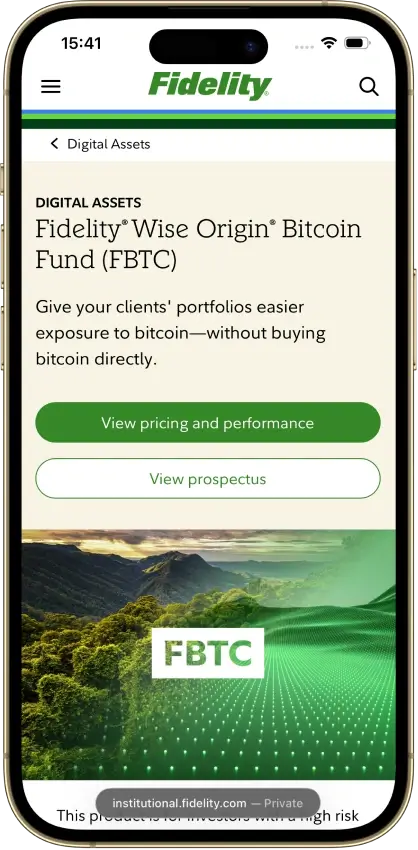


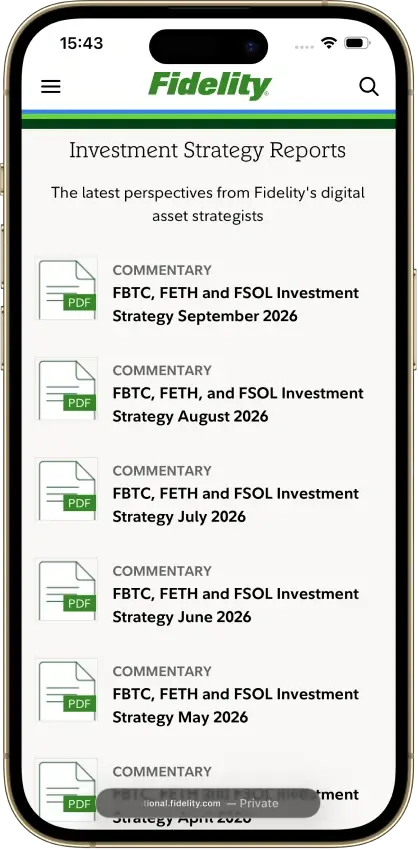

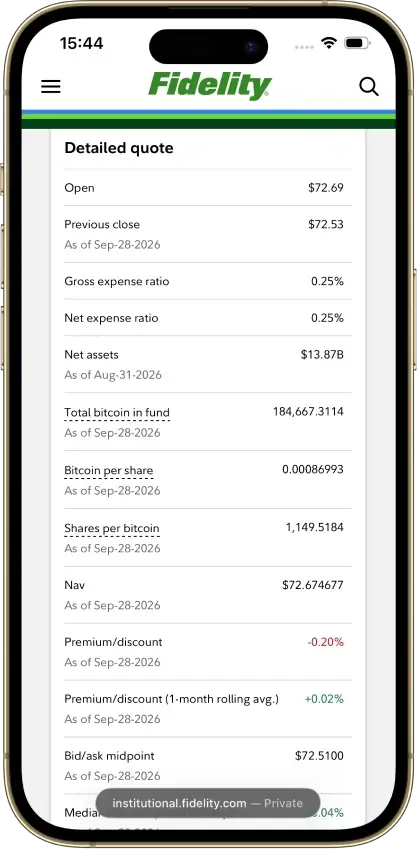
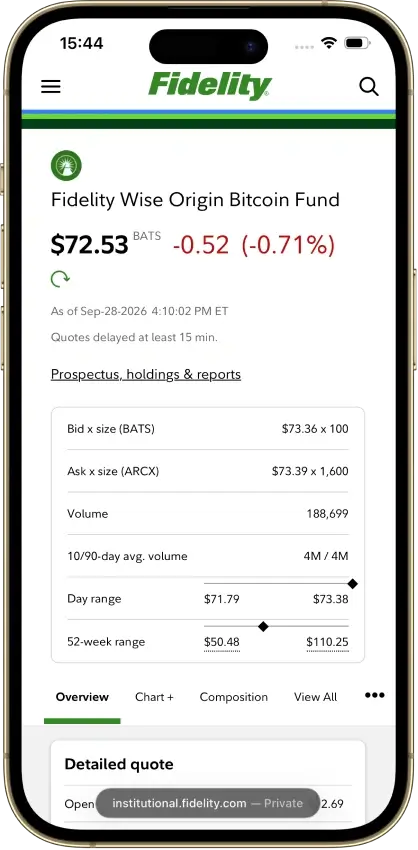
Screenshot 1 of 8
Fidelity Wise Origin Bitcoin Fund Pros and Cons
Pros
- Buy alongside other brokerage holdings
- No Bitcoin keys to store yourself
- Direct Bitcoin backing, without futures
Cons
- Annual fee continues while shares are held
- No Bitcoin withdrawals to a personal wallet
- Market price may differ from fund value
Who FBTC Is For
FBTC lets investors hold Fidelity’s Bitcoin fund alongside securities in a brokerage account. That can suit someone who already uses a broker and wants to manage Bitcoin exposure through the same account.
Choosing FBTC still means accepting Bitcoin’s price movements. A Fidelity account may be familiar, but the underlying investment can fall sharply. Investors seeking capital stability would need a different type of asset.
CryptoSlate Rating
FBTC scores 8.6/10. Fidelity reports a 0.04% 30-day median bid-ask spread as of Sep. 24, 2026, and $13.87 billion in net assets as of Aug. 31, 2026.
| Pillar | Weight | Score | Assessment |
|---|---|---|---|
| Costs | 30% | 7.9/10 | Ongoing charge 0.25%, currently effective at the same rate. The fee amount carries 25% of the overall and fee clarity another 5%. |
| Published spread indicator | 25% | 9.2/10 | Published 30-day median: 0.04%, dated Sep. 24, 2026. |
| Fund scale | 10% | 10.0/10 | $13.87 billion in net assets, dated Aug. 31, 2026. Additional size earns no points above $1 billion. |
| Custody terms | 20% | 7.0/10 | Fund ownership and account entitlement are recorded separately. An applicable safekeeping responsibility clause requires gross negligence or more serious misconduct. |
| Reporting | 15% | 10.0/10 | Current required reports and product disclosures are available. Management reported effective disclosure controls at June 30, 2026. |
FBTC pays a 0.25% annual sponsor fee. Fidelity reports a 0.04% 30-day median bid-ask spread as of Sep. 24, 2026, and $13.87 billion in net assets as of Aug. 31, 2026. Fidelity Digital Assets records the trust’s entitlement to its Bitcoin, but its liability for a safekeeping loss generally requires gross negligence or more serious misconduct. BitGo is an additional appointed custodian whose ordinary-negligence liability is capped at three months’ fees. The weaker applicable responsibility term sets the custody grade. BitGo’s appointment does not establish an allocation of the trust’s Bitcoin between the providers.
At a 0.05% median spread, FBTC would score 8.5/10; at 0.03%, it would remain 8.6/10.
Custodian liability limits and insurance terms can affect how much the trust recovers after a loss. A high rating does not make Bitcoin low risk.
What FBTC Is and How It Works
The trust holds Bitcoin and seeks to follow its price after fund expenses and liabilities. FBTC avoids the need for the shareholder to buy coins on a crypto platform or arrange storage. Its holdings provide spot exposure without a futures strategy.
Each share represents an interest in the trust. The fund’s custody providers handle the underlying asset, while the investor holds the listed security.
Benchmark and Tracking
FBTC uses the Fidelity Bitcoin Reference Rate as its benchmark. The rate combines eligible Bitcoin market trades using a volume-weighted median price.
The fund’s return can differ from both its benchmark and the return on directly held Bitcoin. A useful tracking comparison aligns dates and measures the fund’s net asset value return against its stated benchmark. Price snapshots taken at different times can distort that comparison.
Is FBTC Safe? Custody and Investment Risks
FBTC can lose substantial value as Bitcoin’s price falls. Appointed custodians are responsible for safekeeping the Bitcoin. Investors still carry the asset’s market risk.
Who Holds FBTC’s Bitcoin?
The fund’s April 2026 prospectus names Fidelity Digital Assets, N.A., a Fidelity affiliate, as a Bitcoin custodian. It also names BitGo Bank & Trust, N.A. as an additional custodian, as disclosed in a February 2026 filing.
The June 2026 quarterly report describes Fidelity Digital Assets as responsible for safekeeping all of the trust’s Bitcoin. BitGo’s appointment gives the sponsor another provider it can use, but the filing does not disclose a current BitGo balance. The appointments do not fix future allocations.
Neither arrangement gives a shareholder personal control of Bitcoin keys. Investors rely on the trust and its service providers to safeguard the holdings. Custody failures and operational disruption remain risks.
Fund Structure and Regulatory Status
FBTC is commonly described as a Bitcoin ETF, but it is an exchange-traded Delaware statutory trust. It is not registered under the Investment Company Act of 1940, which governs many familiar ETFs and mutual funds.
Its securities offering and reporting remain subject to securities laws. Registration of a securities offering does not protect a shareholder against investment losses.
FBTC Fees and Trading Costs
FBTC charges a 0.25% annual sponsor fee. Fidelity’s factsheet and the fund data published through Schwab also show gross and net expense ratios of 0.25%.
| Cost | How It Applies | What to Compare |
|---|---|---|
| Fund charge | 0.25% annual sponsor fee | The ongoing charge on each fund under consideration |
| Bid-ask spread | Difference between the quoted buying and selling prices | The quote available for your intended trade |
| Brokerage and account charges | Depend on the service and account | Commission schedules and any applicable account fees |
A constant $5,000 holding multiplied by 0.25% equals $12.50 over one year. This simplified illustration isolates the annual fund rate. It assumes an unchanged investment value and excludes trading costs, so it is not a fixed charge for every $5,000 purchase.
Trading Costs Alongside the Fund Fee
Frequent buying and selling adds repeated trading costs to FBTC’s ongoing fund charge. A broker’s commission-free offer can remove one expense, while the bid-ask spread and annual fund fee still apply.
Buying and Selling FBTC
Search for Fidelity Wise Origin Bitcoin Fund and confirm the US Cboe BZX listing. Fidelity also uses FBTC for the Canadian-listed Fidelity Advantage Bitcoin ETF, a different fund. Check that your account supports the US fund before comparing order options.
FBTC and Fidelity Crypto Accounts
Fidelity distinguishes FBTC held in a brokerage account from Bitcoin held through its separate Fidelity Crypto service. Buying FBTC does not create a Bitcoin balance in that service.
Use the brokerage’s security order process and check its eligibility requirements.
Prices and Order Checks
FBTC shares trade at a market price. Net asset value, or NAV, measures the trust’s assets after liabilities on a per-share basis. When the share price is higher than NAV it trades at a premium. A lower price is a discount.
A delayed quote or yesterday’s NAV may describe a different market from the one in which an order executes. Check the bid and ask timestamps, along with the broker’s supported trading sessions and order types.
Selling FBTC Shares
To leave an FBTC position, an ordinary investor sells shares through a broker. The fund’s creation and redemption arrangements operate through authorized participants, firms that transact with the trust in large share baskets under terms set by the trust. Those arrangements do not give retail shareholders a right to exchange their individual shares for Bitcoin.
If the intended destination is Bitcoin in your own wallet, a direct purchase through a service that supports withdrawals would meet that requirement. Selling FBTC and buying Bitcoin separately involves another transaction and its own costs.
FBTC Alternatives
BlackRock’s iShares Bitcoin Trust ETF (IBIT) is a relevant comparison for someone choosing a US spot Bitcoin fund. Holding Bitcoin in a wallet whose keys you control serves the separate need to make transfers or manage custody personally.
FBTC vs IBIT
| Feature | FBTC | IBIT |
|---|---|---|
| Fund family | Fidelity | BlackRock / iShares |
| US listing | Cboe BZX | Nasdaq |
| Annual sponsor fee | 0.25% | 0.25% |
| Named Bitcoin benchmark | Fidelity Bitcoin Reference Rate | CME CF Bitcoin Reference Rate – New York Variant |
| Custody appointments | Fidelity Digital Assets, plus BitGo as an additional custodian | Coinbase, plus Anchorage Digital as an additional custodian |
| Retail redemption for Bitcoin | Unavailable | Unavailable |
The equal headline fee leaves custody arrangements and practical brokerage costs as useful points of comparison. The different benchmark methods do not, by themselves, establish a tracking winner.
An existing Fidelity customer should check whether their account supports both funds before considering a change of broker.
References
Fidelity’s prospectus and quarterly report describe the fund’s structure, fee, custody and reporting. Its February 2026 filing describes the BitGo appointment. Fidelity’s public fund dashboard reports the dated spread and net-asset figures shown above.
This review provides general information, not personal investment advice. To flag an error, contact the CryptoSlate team.
Bitcoin ETFs Pillar Scores
- Fund fees 30% weight Ongoing sponsor charge before temporary waivers, fee basis, covered expenses, extra fund costs, and waiver terms.Not disclosed
- Trading spread 25% weight Published 30-day median bid-ask spread, with its source, observation date, and calculation definition recorded.Not disclosed
- Fund size 10% weight Assets attributable to the fund, using a dated figure and a clearly identified asset-value basis.10.0 / 10
- Custody & asset rights 20% weight Fund ownership, separate asset records, and the custodian's contractual responsibility for its own safekeeping failures.7.0 / 10
- Reporting & transparency 15% weight Required reports, public holdings, valuation benchmark, net asset value (NAV), and management's disclosure-control conclusions.10.0 / 10
Final Verdict
FBTC merits consideration when you want Fidelity’s spot Bitcoin fund in a brokerage portfolio and prefer to leave custody to the fund’s providers. Its Fidelity-affiliated custodian distinguishes it from IBIT, while BitGo is named as an additional custodian. Those relationships do not establish a custody safety advantage. The 0.25% annual sponsor fee gives FBTC no headline cost advantage over IBIT. Compare the custody terms and the costs in your account before choosing between them. FBTC still carries Bitcoin’s price risk and offers no retail withdrawal of coins.
Best For
Investors who want Fidelity’s Bitcoin fund alongside other holdings in a brokerage account.
Avoid If
- You want Bitcoin you can transfer or spend, or you need personal control of the keys.
Disclaimer: CryptoSlate may receive a commission when you click links on our site and make a purchase or complete an action with a third party. This does not influence our editorial independence, reviews, or ratings, and we always aim to provide accurate, transparent information to our readers.