



 Released in 2024
- Annual sponsor fee of 0.15%
- Launched from GBTC in July 2024
- NYSE Arca share listing
Grayscale Bitcoin Mini Trust ETF Overview
- Fund Name
- Grayscale Bitcoin Mini Trust ETF
- Ticker
- NYSEARCA: BTC
- Listing Exchange
- NYSE Arca
- Fund Family / Issuer
- Grayscale
Additional details
- Exposure
- Spot Bitcoin held within the trust.
- Fund Structure
- Commodity trust, not registered as an investment company under the Investment Company Act of 1940.
- Annual sponsor fee
- 0.15%
- Fee Assessment Base
- Assets less liabilities, as defined for the sponsor fee.
- Effective Annual Charge
- 0.15%
- Fee Terms Checked
- Sep 13, 2026
- Benchmark
- CoinDesk Bitcoin Benchmark Rate
Effective from Apr 1, 2026
- Custody Appointments
- Coinbase; Primary Bitcoin custodian; Preserves recorded fund ownership and provides negligence-based custody responsibility. Setoff language still refers to undefined Sponsor Assets, and recovery remains subject to contract limits.Anchorage Digital; Additional Bitcoin custodian; Grayscale says the additional custodian holds a portion of the assets, without specifying the amount.
- Retail Asset Redemption
- Individual shareholders cannot redeem shares for the underlying Bitcoin. Selling produces cash proceeds through a broker; authorized participants use a separate creation and redemption process.
- 30-day Median Bid/Ask Spread
- 0.03%As of Sep 24, 2026Grayscale, issuer; 30D MEDIAN BID/ASK SPREAD (%); Issuer describes NBBO midpoint percentage sampled every ten seconds over 30 calendar days.; Retrieved Sep 28, 2026
- Fund Assets
- USD 5,313,285,328As of Sep 24, 2026
Non-GAAP AUM using investor NAVGrayscale, issuer; Non-GAAP AUM using investor NAV; Separate GAAP AUM: $5,313,688,935.; Retrieved Sep 28, 2026
- Issuer-reported inception
- July 31, 2024
- First exchange trading
- July 31, 2024
- Quarterly report reviewed
- Quarter ended June 30, 2026
- Operating-period annual audit reviewed
- Year ended Dec. 31, 2025
- Rating reviewed
- Sep. 14, 2026, CryptoSlate methodology version 2.1, data cutoff Sep. 11
Grayscale Bitcoin Mini Trust ETF Screenshots
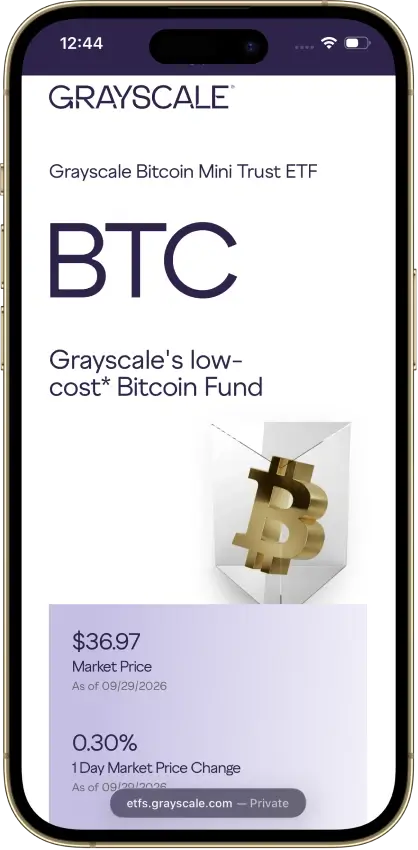
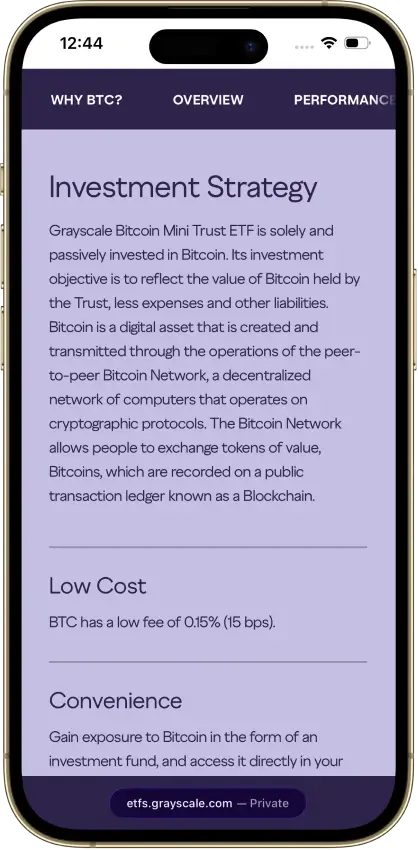
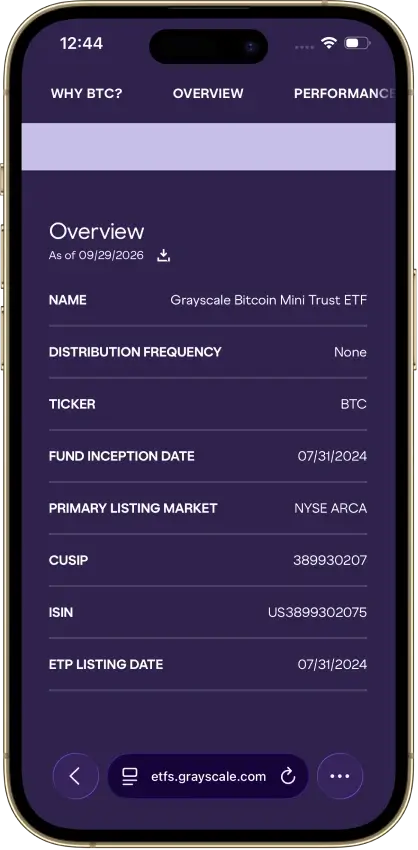
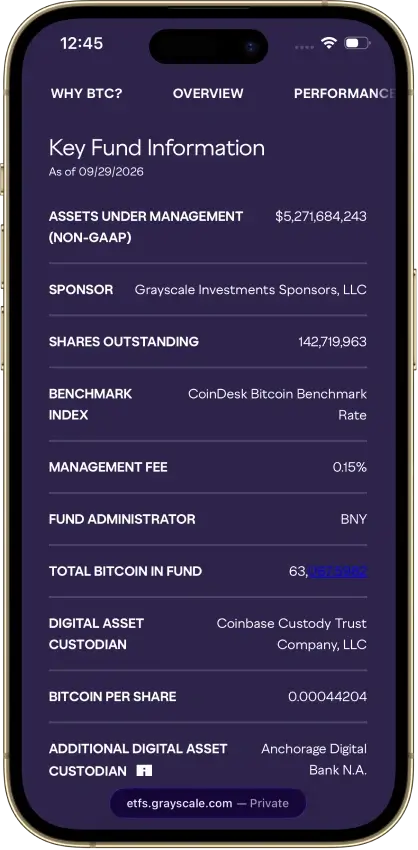
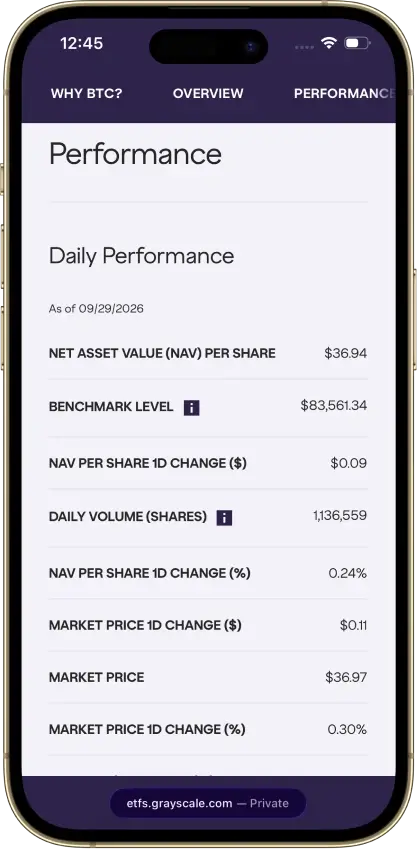
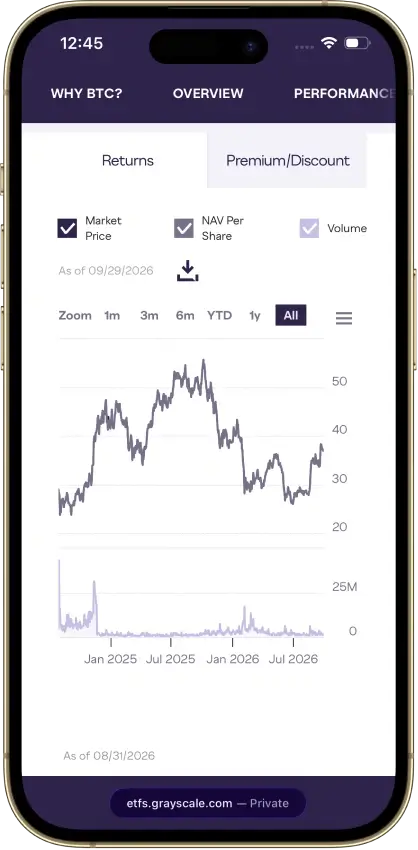
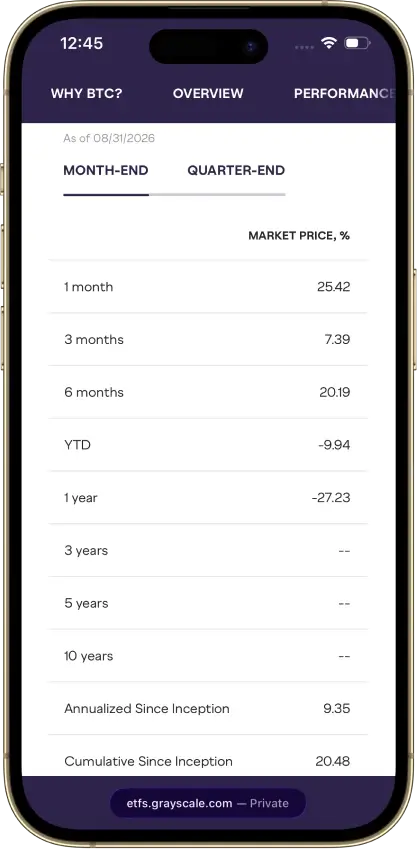
Screenshot 1 of 8
Grayscale Bitcoin Mini Trust ETF Pros and Cons
Pros
- Lower annual rate than IBIT and GBTC
- Coin custody arranged by the trust
- Monitor Bitcoin alongside brokerage assets
Cons
- Bitcoin losses can dwarf the fee saving
- Holding shares gives no access to fund wallets
- Trading costs come on top of the annual fee
Who BTC Is For
BTC is worth comparing when an investor has chosen the fund format and wants to keep recurring charges low. Its 0.15% sponsor rate can matter over a long holding period, when the fee is incurred year after year. Buying and selling frequently brings the cost of each trade into greater focus.
The Grayscale name also makes BTC relevant to someone comparing it with GBTC. These are separate funds, despite their shared provider and underlying asset. GBTC’s substantially higher annual rate should not be assumed to apply to the Mini Trust.
An investor must still be comfortable with the price risk attached to Bitcoin. Choosing a low-fee fund addresses one expense of owning that exposure. It does not make a large allocation appropriate for someone who cannot tolerate large losses.
CryptoSlate Rating
BTC scores 9.5/10 based on public fund terms and reported market indicators as of September 24, 2026.
| Pillar | Weight | Score | Assessment |
|---|---|---|---|
| Costs | 30% | 8.8/10 | Ongoing charge 0.15%, currently effective at the same rate. The fee amount carries 25% of the overall and fee clarity another 5%. |
| Published spread indicator | 25% | 9.4/10 | Published 30-day median: 0.03%, dated Sep. 24, 2026. |
| Fund scale | 10% | 10.0/10 | $5,313.29 million in reported fund assets, dated Sep. 24, 2026. Additional size earns no points above $1 billion. |
| Custody terms | 20% | 10.0/10 | Fund ownership and account entitlement are recorded separately. Ordinary negligence supports a claim under the assessed safekeeping terms. |
| Reporting | 15% | 10.0/10 | Current required reports and product disclosures are available. Management reported effective disclosure controls at June 30, 2026. |
BTC’s 0.15% ongoing fee earns 8.5 in the fee-amount component, and its 0.03% published spread earns 9.4. Its asset base exceeds the scale cap. Coinbase and Anchorage preserve recorded fund ownership and provide negligence-based custody responsibility. Coinbase’s setoff language still refers to undefined Sponsor Assets, and recovery remains subject to contract limits. The custody grade therefore covers two specific protections rather than comprehensive protection from loss.
At a 0.04% spread, with the other inputs unchanged, the overall would be 9.4/10. At 0.02%, it would remain 9.5/10. The issuer’s reported 0.03% spread is used for the displayed rating.
The custody agreements provide specific ownership and safekeeping protections. Lien and recovery limits still matter, and a high rating does not make Bitcoin low risk.
What BTC Is and How It Works
The trust owns Bitcoin, and investors own shares representing an interest in its assets after liabilities. Changes in the underlying coin price drive the investment’s value, with fund costs reducing what remains for shareholders.
Understanding the Mini Trust Name
BTC began trading on July 31, 2024 after a spin-off from GBTC. It operates as its own security. The history explains the family relationship, but each ticker identifies its own holding in a brokerage account.
The word Mini should not be read as a limit on percentage losses. An investment of a given dollar amount still takes exposure to Bitcoin’s price movements. A small annual charge does not absorb a large decline in the underlying asset.
In a discussion of crypto assets, BTC usually means Bitcoin itself. On a brokerage order for this fund, BTC identifies Grayscale Bitcoin Mini Trust ETF. Confirm the full security name before treating a displayed balance as either fund shares or coins.
Benchmark and Tracking Comparisons
The current valuation reference is the CoinDesk Bitcoin Benchmark Rate. It is used in calculating the trust’s net asset value, or NAV. Dividing NAV by the number of outstanding shares gives NAV per share. The benchmark changed from the CoinDesk Bitcoin Price Index (XBX) on April 1, 2026. Comparisons spanning that date must account for the change in reference series.
An exchange price reflects the bids and offers available for shares. It can sit above or below NAV per share, so a fund’s traded return and its NAV return can differ over the same period. Specify which measure is being compared before drawing a conclusion about tracking.
The annual rate gives one known cost input for that assessment. It cannot establish the size of every observed difference between the fund and a chosen Bitcoin price series.
Is BTC Safe? Custody and Investment Risks
BTC can suffer substantial losses even though its recurring fee is modest. The fund combines Bitcoin market exposure with dependence on the organizations handling its assets. Neither the Mini name nor a low expense figure removes those risks.
Who Holds BTC’s Bitcoin?
Coinbase is the primary Bitcoin custodian. Grayscale says Anchorage Digital, an additional custodian, holds a portion of the trust’s assets but does not disclose how much.
Shareholders avoid the task of backing up the secret keys needed to control Bitcoin, because those responsibilities are handled for the trust. They instead rely on its custody arrangements to keep the assets available. Failures in those arrangements could affect a holder even if they have secured their own brokerage login correctly.
Fund Structure and Regulatory Status
The Mini Trust is a commodity trust. It has no registration as an investment company under the Investment Company Act of 1940, which distinguishes its legal framework from funds registered under that Act.
Federal securities disclosure and antifraud obligations still govern the product. Filing financial reports makes information about its operation available to investors. It does not guarantee recovery of the investment if Bitcoin falls or an operational failure causes a loss.
BTC Fees and Trading Costs
The annual sponsor rate is 0.15%, consistent with the expense ratio in independent fund datasets. The trust pays this charge from its assets.
The Dollar Difference Against IBIT and GBTC
Assume a holding stays worth $10,000 for an entire year. Multiplying by BTC’s 0.15% annual rate gives $15, compared with $25 at IBIT’s 0.25% rate and $150 at GBTC’s 1.50%. The Mini Trust is $10 below IBIT and $135 below GBTC on these assumed annual fund charges.
The example excludes changes in investment value and all trading costs. It highlights why the GBTC comparison is more consequential on annual fees than the IBIT comparison. A less favorable entry price could consume a modest yearly saving against IBIT.
Over time, paying fund expenses reduces the Bitcoin represented by a share. The share’s dollar value can still rise if the underlying asset appreciates enough. Looking only at a positive account return would miss that reduction in coin backing.
Buying and Selling BTC
Look up Grayscale Bitcoin Mini Trust ETF and confirm the NYSE Arca listing. A broker may display crypto trading and securities trading in different parts of the same app. Check that the order describes the fund you intend to own, then confirm that it is available for your account.
Assessing an Order
Check the buy and sell quotes alongside the fund’s advertised annual rate. The spread affects a transaction immediately, whereas the sponsor charge accumulates while the position is held. A published expense ratio therefore answers a different question from the cost of the order in front of you.
Also check the valuation time when comparing a share quote with NAV per share. A premium means the market price exceeds NAV per share, while a discount means it is lower. Values observed at different times can exaggerate or obscure the comparison.
Exiting the Investment
For a retail holder, selling fund shares produces brokerage cash proceeds. The trust creates and redeems share baskets through authorized participants. An ordinary shareholding provides no right to direct Bitcoin delivery.
Anyone who wants to send coins to a wallet they manage independently would need to obtain withdrawable Bitcoin separately. That practical requirement is worth settling before choosing between a fund and a coin purchase.
BTC Alternatives
IBIT and GBTC provide useful reference points for the Mini Trust’s annual cost. The first offers Bitcoin exposure through BlackRock’s iShares range, while the second is Grayscale’s older fund.
BTC vs IBIT and GBTC
| Feature | BTC | IBIT | GBTC |
|---|---|---|---|
| Provider | Grayscale | BlackRock / iShares | Grayscale |
| US listing | NYSE Arca | Nasdaq | NYSE Arca |
| Annual sponsor rate | 0.15% | 0.25% | 1.50% |
| Investment exposure | Spot Bitcoin | Spot Bitcoin | Spot Bitcoin |
BTC has the lowest annual rate among these three funds. The table makes no claim about which will deliver the best execution on a particular order. Actual quotes matter when an investor is deciding where to place a trade.
Direct Bitcoin ownership offers control over where the coins are held and how they are transferred. It also leaves the owner responsible for the chosen custody setup. The fund decision should account for that difference in use, alongside the recurring charge.
References
Grayscale’s fund page lists a 0.03% 30-day median spread and $5,313,285,328 in non-GAAP assets as of Sep. 24, 2026. Its June 30, 2026 quarterly report supplies the reporting and fee terms discussed above.
Grayscale’s product disclosures, NYSE Arca listing records and SEC filings describe the structure, custody terms and shareholder rights discussed above.
Details can change. Please notify our editors of any corrections.
This is general product research, without an assessment of personal investment suitability.
Bitcoin ETFs Pillar Scores
- Fund fees 30% weight Ongoing sponsor charge before temporary waivers, fee basis, covered expenses, extra fund costs, and waiver terms.Not disclosed
- Trading spread 25% weight Published 30-day median bid-ask spread, with its source, observation date, and calculation definition recorded.Not disclosed
- Fund size 10% weight Assets attributable to the fund, using a dated figure and a clearly identified asset-value basis.10.0 / 10
- Custody & asset rights 20% weight Fund ownership, separate asset records, and the custodian's contractual responsibility for its own safekeeping failures.10.0 / 10
- Reporting & transparency 15% weight Required reports, public holdings, valuation benchmark, net asset value (NAV), and management's disclosure-control conclusions.10.0 / 10
Final Verdict
Grayscale Bitcoin Mini Trust ETF charges an annual sponsor rate of 0.15%, giving it a substantial fee advantage over GBTC’s 1.50%. Its smaller advantage over IBIT’s 0.25% rate also merits attention for investors planning to retain their shares. The fee comparison supports including BTC among the funds considered for a brokerage Bitcoin allocation. The investment still requires acceptance of Bitcoin’s volatility and reliance on institutional custody. Mini describes the product name, without promising milder losses or coin withdrawal rights. Choose the fund format only if owning and trading shares fits the intended use of the investment.
Best For
Investors choosing Bitcoin exposure for a brokerage account who give priority to low recurring fund charges.
Avoid If
- You expect the Mini label to limit Bitcoin losses or want to move the underlying coins yourself.
Disclaimer: CryptoSlate may receive a commission when you click links on our site and make a purchase or complete an action with a third party. This does not influence our editorial independence, reviews, or ratings, and we always aim to provide accurate, transparent information to our readers.