
Kraken scores 7.8/10 for security controls, quarterly reserve checks, bank rails and advanced tools. Entry fees, reserve coverage and product restrictions are the main tradeoffs.
Kraken vs Gemini: Fees, Security, and Markets Compared
Kraken wins for most users with 0.40% maker and 0.80% taker entry fees, compared with Gemini's 0.60% and 1.20%. Kraken also provides quarterly reserve-inclusion checks, five bank rails, and 24/7 chat.

Gemini scores 7.1/10 for U.S. access, free ACH, and documented controls. Compare alternatives for lower entry fees or access in more countries.
Affiliate Disclosure
Some links in this comparison are affiliate links. CryptoSlate may earn a commission if you sign up through these links. Our ratings remain editorially independent.
Overview
Kraken Gemini
Current review score
7.8 / 10 for the flagship custodial service across the US, EEA, and UK
7.1 / 10 for the US flagship account
Best fit
Users who prioritize the 0.40% maker and 0.80% taker entry tier, reserve-inclusion checks, or five bank rails
US users who prioritize audited 1:1 custody, required 2FA, or a conventional crypto rewards credit card
Listed crypto
600+ globally. Exact US total is lower and not disclosed
99 in the Trust Center snapshot on August 29, 2026
Reported markets
Exact pair count not disclosed
Trust Center showed 655 pairs while the public endpoint returned 347 symbols on August 29, 2026. No single precise total is reliable
Entry advanced spot
0.40% maker and 0.80% taker
0.60% maker and 1.20% taker
Highest published spot endpoint
0% maker and 0.05% taker
0% maker and 0.02% taker at $250 million
US leveraged products
Margin and 16 U.S. dollar-settled perpetual contracts for eligible US accounts
Moonbase ECP margin up to 5x. Gemini sources conflict on whether positions are long-only or long-and-short
Staking
More than 20 assets where Rewards is available
ETH, SOL, and MON. Fee sources conflict: agreement 35%, product page up to 35%, support article 25%
Reserve disclosure
Quarterly user-verifiable Merkle proof
Audited financials and SOC examinations, no user Merkle proof
US bank rails and PayPal
ACH deposits and withdrawals, RTP cash-out, FedWire, and PayPal
ACH, domestic wire, and PayPal
Exchange-linked card
UK/EEA Mastercard debit card, unavailable to US accounts
US credit card with crypto rewards
API access
REST, WebSocket, FIX, futures APIs, and a public futures demo
REST, WebSocket, FIX for eligible institutional workflows, and TradingView
General support
24/7 messaging and live chat, plus support forms
Request form and email
Kraken wins overview
Kraken provides Kraken Pro, US perpetuals for eligible US accounts, five bank rails, a 12-network wallet set, and 24/7 chat. Gemini provides required 2FA, audited 1:1 custody, a five-network browser wallet, and a credit card.
Kraken vs Gemini Winners by Category
Kraken Gemini
Lower entry fees, reserve checks, and ACH, RTP, FedWire, SEPA, and Faster Payments
US audited custody, required 2FA, and a credit card
0.40% maker and 0.80% taker
0.60% maker and 1.20% taker
0% maker and 0.05% taker
0% maker and 0.02% taker at $250 million
Global count. Exact US total not disclosed
99 in the August 29, 2026 Trust Center snapshot
16 U.S. dollar-settled contracts for eligible US accounts
No comparable retail product stated
Available by account and product rules
Moonbase ECP accounts, up to 5x. Direction is unresolved because Gemini sources conflict
More than 20 assets
ETH, SOL, and MON
Hardware-key and app 2FA available
2FA required, with hardware keys and allowlisting available
Quarterly Merkle-tree inclusion check
No customer-queryable Merkle proof
Independent attestation supports quarterly reserve reports
Annual audited financials and SOC examinations support 1:1 custody
ACH, RTP, FedWire, SEPA, and Faster Payments
ACH, domestic wire, PayPal, and card wallets
UK/EEA Mastercard debit card, unavailable to US accounts
US credit card with crypto rewards
Kraken Wallet names 12 networks
Gemini Wallet names five networks
REST, WebSocket, FIX, futures APIs, and Status API
REST, WebSocket, FIX for eligible institutional workflows, and TradingView
24/7 messaging and live chat plus support forms
Request form and email
Kraken wins overall. Gemini wins required login security, audited custody disclosure, credit-card access, and TradingView integration. API protocol coverage is split.
Screenshots
Kraken screenshots

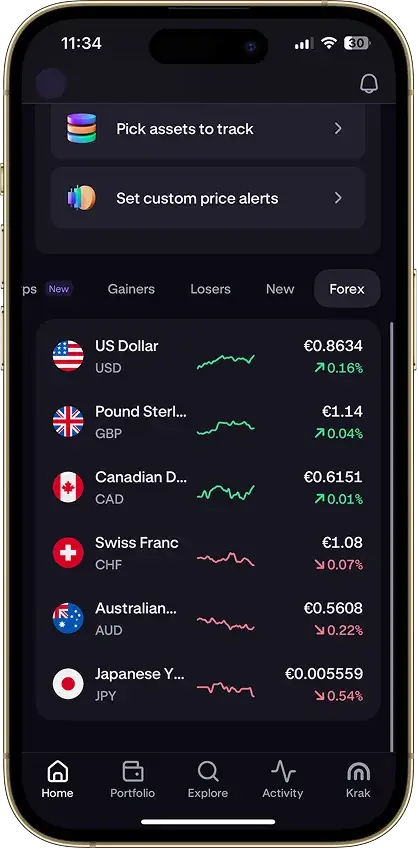
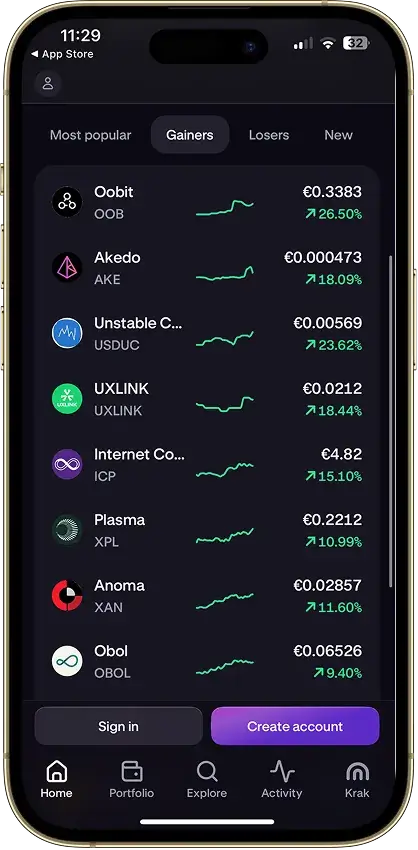
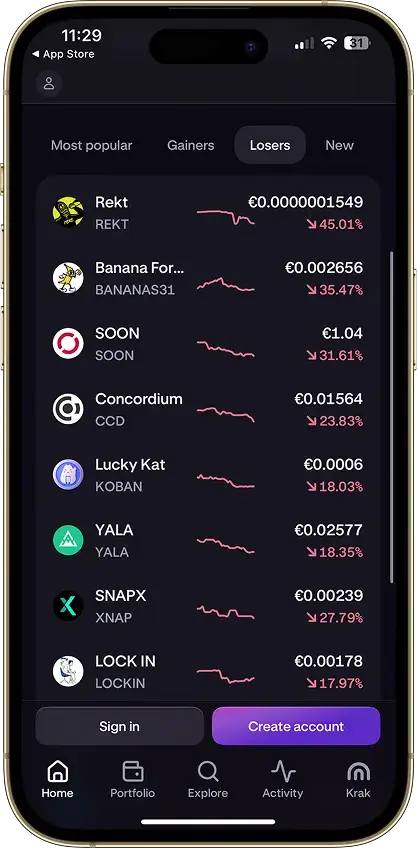
Screenshot 1 of 4
Gemini screenshots

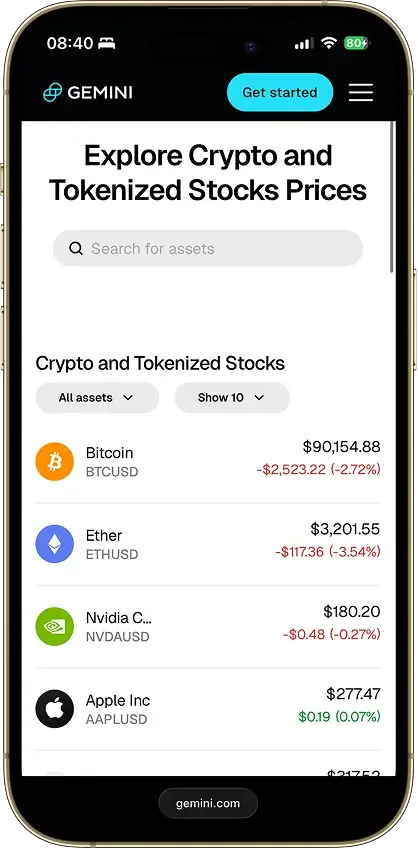
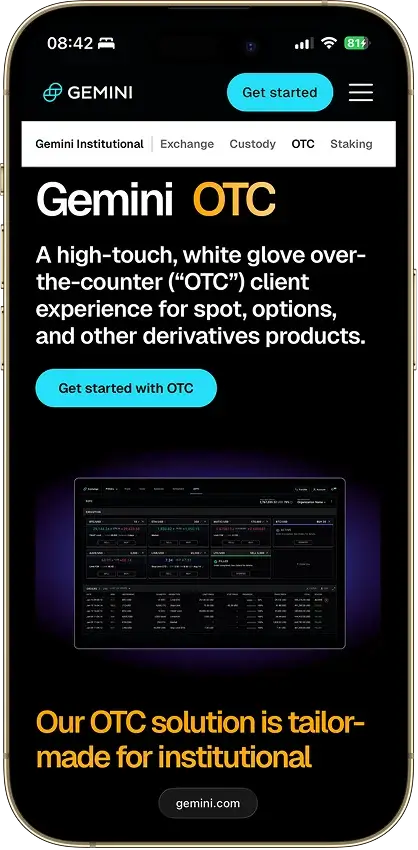
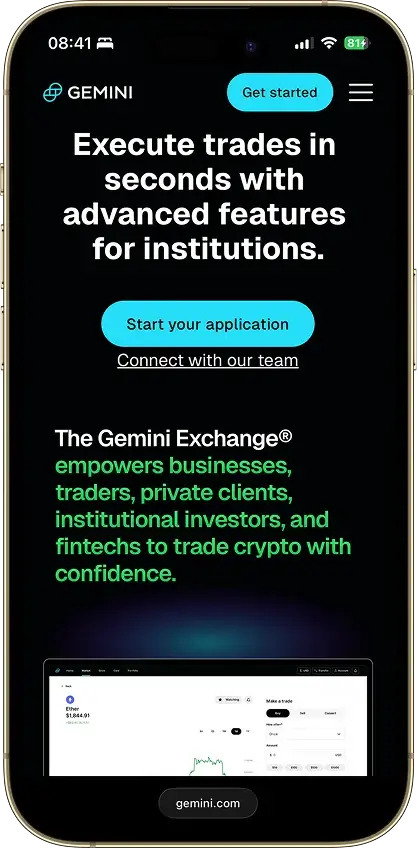
Screenshot 1 of 4
Trading Fees and Pricing
Kraken Gemini
Entry maker
0.40%
0.60%
Entry taker
0.80%
1.20%
$10,000 maker order at entry
$40
$60
$10,000 taker order at entry
$80
$120
Highest published endpoint
0% maker and 0.05% taker
0% maker and 0.02% taker at $250 million
Selected stablecoin pairs
No matched selected-pair rate stated
0% maker and taker on RLUSD/USD, USDC/GUSD, and GUSD/USD
Simple purchase
1% fee plus variable spread and payment cost, or 1.5% for custom orders
Spread plus variable transaction fee
Subscription
Kraken+ from $4.99 monthly or $49.99 annually
No trading subscription stated
Kraken wins trading Fees and Pricing
Kraken wins entry pricing. A precise high-volume crossover is unavailable because the published thresholds do not match tier for tier.
Kraken has lower entry spot fees. Gemini reaches a lower published top-tier taker endpoint and charges no maker or taker fee on RLUSD/USD, USDC/GUSD, and GUSD/USD.
Supported Crypto and Trading Markets
Kraken Gemini
Distinct crypto assets
600+ globally. Exact US total is lower and not disclosed
99 in the Trust Center snapshot on August 29, 2026
Reported pair or market count
Exact pair count not disclosed
Trust Center showed 655 pairs while the public endpoint returned 347 symbols on August 29, 2026. No single precise total is reliable
Major assets
BTC, ETH, SOL, and major stablecoins
BTC, ETH, SOL, GUSD, and other mainstream assets
Native stablecoin link
Multiple major stablecoins
GUSD ecosystem
Zero-fee stablecoin pairs
Not stated
RLUSD/USD, USDC/GUSD, and GUSD/USD
OTC
Dedicated OTC desk with Pro Personal access
OTC
No clear winner
The exchanges do not publish directly comparable asset totals. Gemini can be cheaper for its three zero-fee stablecoin pairs.
Kraken's published asset total is global, while Gemini's figure comes from an August 29, 2026 Trust Center snapshot whose geographic scope is not disclosed. The counts are not directly comparable. The same Trust Center showed 655 pairs while Gemini's public endpoint returned 347 symbols, so no single precise market total is reliable.
Spot, Margin, Perpetuals, Staking, and Earn
Kraken Gemini
Retail buy and sell
Yes
Yes
Order-book interface
Kraken Pro
ActiveTrader
US retail perpetuals
16 eligible US contracts settled in U.S. dollars
No comparable retail product stated
US margin
Available by account and product rules
Moonbase ECP accounts, up to 5x. Direction is unresolved because Gemini sources conflict
Non-US perpetuals
Available through the serving regional entity
Up to 100x in selected jurisdictions
OTC
Yes
Yes
Staking assets
More than 20 assets
ETH, SOL, and MON
Gemini stated maximum
Asset-specific rates
Up to 7% APR before the service fee
Gemini service fee
Not applicable
Agreement 35%, product page up to 35%, support article 25%
Kraken wins spot, Margin, Perpetuals, Staking, and Earn
Kraken wins US retail leveraged-product access and staking selection.
Kraken gives eligible US retail accounts access to margin and 16 U.S. dollar-settled perpetual contracts and supports Rewards on more than 20 assets. Gemini limits US margin to Moonbase ECP accounts, while perpetuals remain limited to selected non-US jurisdictions. Gemini's staking fee sources conflict. The agreement lists 35%, the product page caps the fee at 35%, and one support article lists 25%. Its staking exit rules include protocol unbonding, and the exchange does not publish a fixed withdrawal time.
Order Types, APIs, Liquidity, and Limits
Kraken Gemini
Market and limit orders
Yes
Yes
Stop orders
Yes
Multiple order types, full matched list not stated
Advanced interface
Kraken Pro
ActiveTrader
REST and WebSocket
Yes
Yes
FIX
Documented for order entry. Test access requires qualified onboarding
Eligible institutional workflows
Testing environment
Public futures demo. Spot test access requires qualified onboarding
No open retail sandbox documented
Key controls
Scoped keys and IP allowlisting
Account security controls apply, API specifics not fully matched
Published matched execution test
No
No
Limits
Verification-, method-, and account-dependent
Asset-, method-, account-, and verification-dependent
No clear winner
Execution is not ranked: there is no same-time comparison of spreads, depth, slippage, or fills. Kraken documents a public futures demo, but account limits cannot be compared on a single basis.
Both exchanges document FIX. Kraken has a public futures demo, while its spot REST, WebSocket, and FIX testing requires qualified onboarding. Gemini documents no open retail sandbox. Matched spreads, depth, slippage, and fill rates are unavailable.
Deposits, Withdrawals, and Fiat Rails
Kraken Gemini
ACH funding
Free, with near-instant trading credit
Free, with four to five business days before the associated value becomes withdrawable
ACH-funded amount hold
About seven days for the associated amount
Four to five business days before withdrawal
RTP
Near-instant where available
No comparable rail stated
Domestic wire
FedWire, zero to one business day
Processing window not disclosed
Card funding
$0.25 plus 3.75%
3.49%
PayPal
Supported, with a 72-hour hold on each purchase
2.50% deposit fee, $1,000 daily limit, and one-to-five-business-day clearing, US only
Apple Pay and Google Pay
Not documented
Supported
EEA bank rail
SEPA
Retail accounts closed
UK bank rail
Faster Payments
Retail accounts closed
Crypto withdrawal
Network-specific fee. A new address requires confirmation but does not create a separate 72-hour hold
Dynamic network fee with allowlisting available
Kraken wins deposits, Withdrawals, and Fiat Rails
Kraken wins bank-rail coverage, but the seven-day hold on an ACH-funded amount and the 72-hour hold on each PayPal purchase require planning.
Kraken provides five bank rails and serves the UK and EEA. Gemini adds Apple Pay and Google Pay but charges percentage fees on card and PayPal funding.
KYC, Regulation, and Geographic Availability
Kraken Gemini
Full KYC
Required
Required
US spot access
Unavailable in New York and Maine. Product access varies elsewhere
All states, Puerto Rico, and Washington, DC
US operating structure
Payward, Inc., with Kraken Financial as a Wyoming-chartered affiliate
Gemini Moonbase or Gemini Trust according to state
US on-chain staking
Core service unavailable in New York and Maine. Staking additionally unavailable in California, Maryland, New Jersey, and Wisconsin
Depends on state and asset
US perpetual futures
Eligible US accounts
No comparable retail product stated
United Kingdom
Available with Faster Payments
Closed April 6, 2026
EEA
Available with SEPA
Closed April 6, 2026
Australia
Availability not disclosed
Closed April 6, 2026
No clear winner
The user's state, serving entity, and requested product determine access.
Both exchanges require full KYC. Gemini states spot access across every US state, Puerto Rico, and Washington, DC. Kraken excludes New York and Maine from its US exchange coverage, continues to serve the UK and EEA, and offers eligible US accounts margin and perpetual contracts. Kraken's Australian retail availability is not disclosed.
Security, Custody, and Reserve Disclosure
Kraken Gemini
User-verifiable Merkle proof
Quarterly
No
Latest quantified reserve snapshot
June 30, 2026: BTC 102.9%, ETH 100.5%, SOL 100.6%, XRP 102.3%, ADA 100.3%. USDC, USDT, and USDG at least 105%
No comparable Merkle snapshot
Audited financial statements
Independent attestation supports reserve reports
Annual audited financials
SOC examinations
Type 1 on the main security page and Type 2 on an institutional page
Published
Customer assets segregated
Yes
Yes
Explicit 1:1 custody statement
Reserve ratios above 100% at the reported point
Yes
2FA requirement
Hardware-key and app 2FA supported
Required by default
Withdrawal allowlisting
Security locks and address holds
Available
Account-change lock
Global Settings Lock and master key
Address allowlisting and security review
Reported customer-fund hack
None since launch
No comparable statement published
No clear winner
The security decision is split: Kraken offers personal reserve-inclusion checks and account-change locks. Gemini requires 2FA and provides annual audited financial statements. These measures address different risks, so neither establishes an overall safety winner.
Kraken lets each user check reserve inclusion. Gemini documents 1:1 segregated custody through annual financial audits and SOC examinations. Gemini's required 2FA establishes the account-security baseline, while Kraken offers more account-locking tools.
Cards, Wallets, Apps, APIs, and Support
Kraken Gemini
Consumer app
Separate retail app
Retail app with card management
Advanced trading
Separate Kraken Pro app and web interface
ActiveTrader web interface
Self-custody wallet
Separate app, 12 named networks, user-controlled recovery phrase
Browser-based smart wallet, five named networks, passkey access
Exchange-linked card
UK/EEA Mastercard debit card, unavailable to US accounts
US credit card with crypto rewards
REST and WebSocket
Yes
Yes
TradingView
Not stated
Yes
Testing access
Public futures demo. Qualified onboarding for spot testing
No open retail sandbox documented
General support
24/7 messaging and live chat, plus support forms
Request form and email
Dedicated phone
No public direct-dial number. In-app voice where offered
24/7 card-support route only. No general exchange line
Kraken wins cards, Wallets, Apps, APIs, and Support
Kraken provides a mobile Pro app, public futures demo, qualified spot API testing, a 12-network wallet set, and 24/7 messaging and live chat plus support forms. Gemini provides a five-network browser wallet, a conventional crypto rewards credit card, and TradingView integration. Both document FIX.
Gemini wins the credit-card and TradingView comparisons, while both exchanges document FIX. The Gemini card reward terms charge neither an annual fee nor a foreign-transaction fee. Gemini Wallet is a browser-based smart wallet with passkey access and five named networks. Kraken provides a dedicated Pro app, public futures demo, qualified spot API testing, and 24/7 messaging and live chat plus support forms. The Kraken Wallet custody model uses a user-controlled recovery phrase and supports 12 named networks.
Users who choose Kraken's self-custody recovery model must secure the recovery phrase themselves.
Final Verdict
Affiliate Disclosure
Some links in this comparison are affiliate links. CryptoSlate may earn a commission if you sign up through these links. Our ratings remain editorially independent.
Kraken wins overall on entry fees, reserve inclusion, fiat rails, and general support.
Kraken wins overall with an entry maker fee 0.20 percentage points below Gemini's and a taker fee that is 0.40 points lower. It also gives users a quarterly reserve-inclusion check. Five bank rails and 24/7 live chat extend that advantage beyond trading.
Gemini requires 2FA and supports hardware keys plus address allowlisting. Audited financials and SOC examinations document its 1:1 segregated custody claim. Its credit card adds category rewards on eligible spending. High-volume accounts can also reach a 0% maker and 0.02% taker endpoint, below Kraken's stated 0.05% top taker rate.
Kraken users need to account for the seven-day hold on an ACH-funded amount and the 72-hour hold on each PayPal purchase, as well as a 0.80% entry taker rate. Gemini users accept a 1.20% entry taker rate, 99 assets in its August 29, 2026 Trust Center snapshot, and general support through a request form and email. Retail access in the UK, EEA, and Australia ceased at Gemini on April 6, 2026.
Choose Kraken If…
Kraken fits users prioritizing lower entry fees, reserve inclusion, fiat rails, and general live support.
- You need a coin absent from Gemini's 99-asset snapshot and can confirm Kraken lists it for US accounts.
- You expect to pay the entry spot rate and want 0.40% maker or 0.80% taker pricing.
- You want to check personal balance inclusion in a quarterly Merkle-tree reserve report.
- You need Kraken Pro, US perpetual futures for eligible accounts, or staking on more than Gemini's three assets.
- You use ACH, RTP, FedWire, SEPA, or Faster Payments and can plan around security holds.
- You prefer Kraken Wallet's standalone app, wider documented chain set, or recovery-phrase model.
Choose Gemini If…
Gemini fits users prioritizing required 2FA, audited custody disclosures, its credit card, or TradingView integration.
- You want mandatory 2FA together with security-key compatibility and an approved-address list for withdrawals.
- You prefer annual audited financials and SOC examinations supporting a stated 1:1, segregated custody model.
- You want a US credit card with no annual fee that pays rewards without selling crypto at checkout.
- You trade or hold enough to improve on ActiveTrader's starting 0.60% maker and 1.20% taker charges.
- You need TradingView integration.
- You trade RLUSD/USD, USDC/GUSD, or GUSD/USD at the stated zero-fee rate.
Kraken vs Gemini FAQs
Is Kraken or Gemini cheaper for spot trading?
Kraken is cheaper at the entry order-book tier, where Kraken Pro charges 0.40% maker and 0.80% taker. Gemini ActiveTrader starts at 0.60% and 1.20%. Gemini reaches the lower published top-tier taker rate of 0.02% at $250 million, compared with Kraken's 0.05% endpoint.
Does Kraken or Gemini list more crypto assets?
Kraken reports more than 600 assets globally, but its exact US inventory is lower and not disclosed. Gemini reports 99 in an August 29, 2026 Trust Center snapshot without specifying its geographic scope. Neither figure establishes a US asset-count winner. The signed-in asset and withdrawal menus provide the account-specific answer.
Can Kraken and Gemini users verify proof of reserves?
Kraken users can verify that their balances were included in its quarterly Merkle-tree report. Gemini uses annual financial audits and SOC examinations instead of that customer-queryable proof. Under its custody statement, each customer asset is backed 1:1 and held separately from company property.
Is Kraken or Gemini safer for account protection?
Gemini requires 2FA and offers hardware keys plus withdrawal allowlisting. Kraken supports hardware-key and app 2FA, Global Settings Lock, a master key, PGP email, and device controls. Kraken also has no reported customer-fund hack since launch. The preferred control set depends on whether required 2FA or additional account-locking tools matter more to the user.
Can US users trade margin or perpetual futures on Kraken and Gemini?
Kraken's eligible US lineup contains 16 contracts with dollar settlement, and margin is also offered. Gemini's US margin product is limited to Moonbase ECP accounts and permits up to 5x, but Gemini sources conflict on whether positions are long-only or long-and-short. Gemini perpetuals with higher position multiples are offered only in selected non-US jurisdictions.
Which has more staking choices, Kraken or Gemini?
Kraken's eligible Rewards list exceeds 20 assets, while Gemini limits staking to ETH, SOL, and MON. Gemini's advertised return reaches 7% APR, but its fee sources conflict. The agreement lists 35%, the product page caps the fee at 35%, and one support article lists 25%. Exact returns depend on the asset and location.
Is the Kraken debit card or Gemini Credit Card more useful?
US account holders cannot use Kraken Card, which is a Mastercard debit product limited to verified personal clients across the UK and EEA. Tax treatment depends on the funding asset and jurisdiction. The Gemini Credit Card charges no annual fee and pays crypto rewards by purchase type. The top category earns 4% across the first $300 of qualifying monthly purchases, then pays 1%.
Are Kraken and Gemini available in the UK, EEA, and Australia?
Kraken documents UK and EEA service with Faster Payments and SEPA, but its Australian retail availability is not disclosed. On April 6, 2026, Gemini's retail closures took effect across the UK and EEA as well as Australia. The signed-in product menu confirms availability for a specific service before funding.


Kraken receives a 7.8 overall score for its flagship custodial service across the US, EEA, and UK in the Kraken fee and reserve review. Gemini earns 7.1 for its US flagship account in the Gemini security and trading review. The scores cover different account scopes.
Kraken starts at 0.40% maker and 0.80% taker and lets users check inclusion in quarterly reserve reports. Gemini requires 2FA, documents audited 1:1 custody, and offers a credit card.