

Kraken combines quarterly reserve-inclusion checks with separate Pro trading tools and account security controls. Its entry spot fees and funding-related withdrawal holds are the main tradeoffs.
Kraken vs Binance.US: US Fees, Withdrawals and Security
Kraken wins overall for US reserve verification, cash-out options and additional trading products. Binance.US wins Advanced spot fees. Compare both US accounts, including state restrictions and funding holds.

Worth considering for planned Advanced spot trading in supported states. Less suitable for immediate withdrawals after funding or for checking independently that your balance is in reserves.
Affiliate Disclosure
Some links in this comparison are affiliate links. CryptoSlate may earn a commission if you sign up through these links. Our ratings remain editorially independent.
Overview
Kraken wins overall for US users who want independently attested reserve inclusion, more cash-out options and access to approved derivatives. Binance.US is the low-commission alternative for planned spot trading.
Kraken Binance.US
US Exchange
Kraken, operated by Payward, Inc.
Binance.US, operated by BAM Trading Services Inc.
Entry Maker / Taker
0.40% / 0.80% on Kraken Pro
0% / 0.02% on most Advanced pairs
Core State Access
Excludes New York and Maine
Excludes 12 states
Bank Cash-Out
ACH, FedWire and eligible RTP
ACH and domestic wire where USD services are enabled
Customer Reserve Inclusion
Quarterly independently attested snapshots
No customer-queryable reserve-inclusion tool
Screenshots
Kraken screenshots

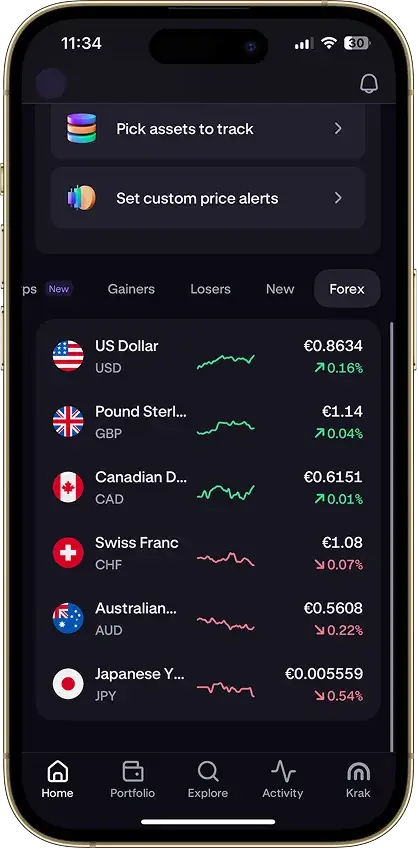
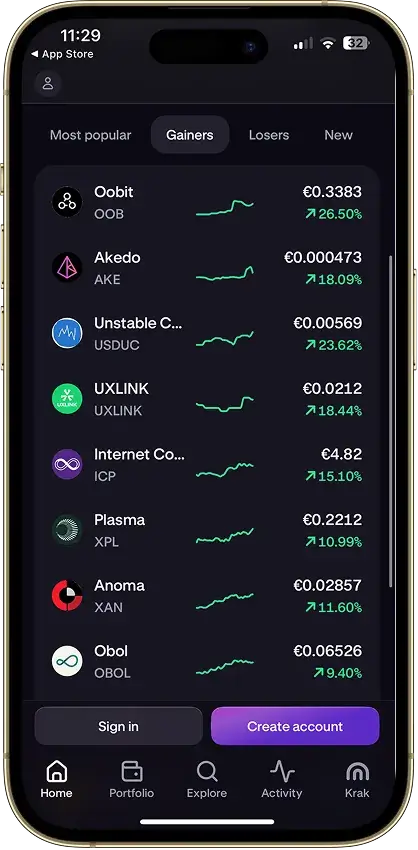
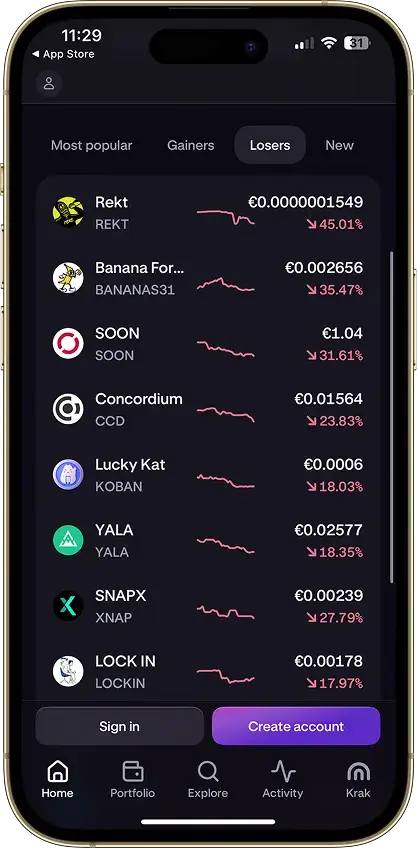
Screenshot 1 of 4
Binance.US screenshots
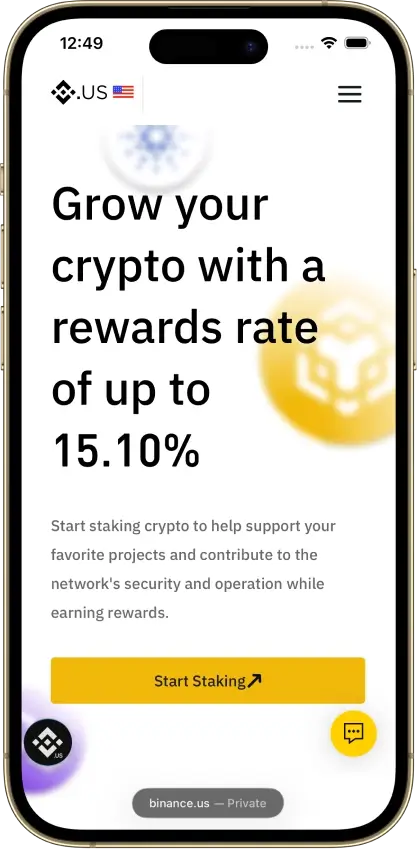
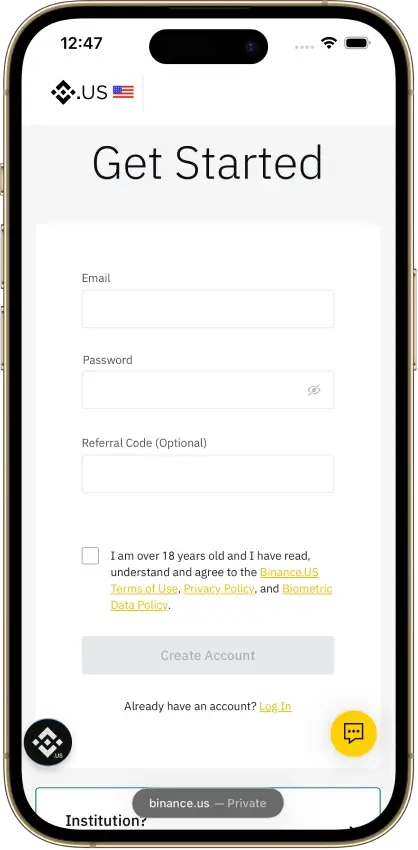
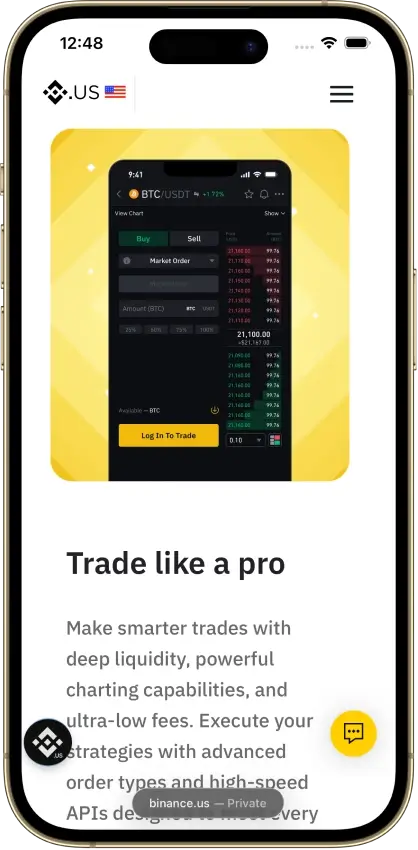
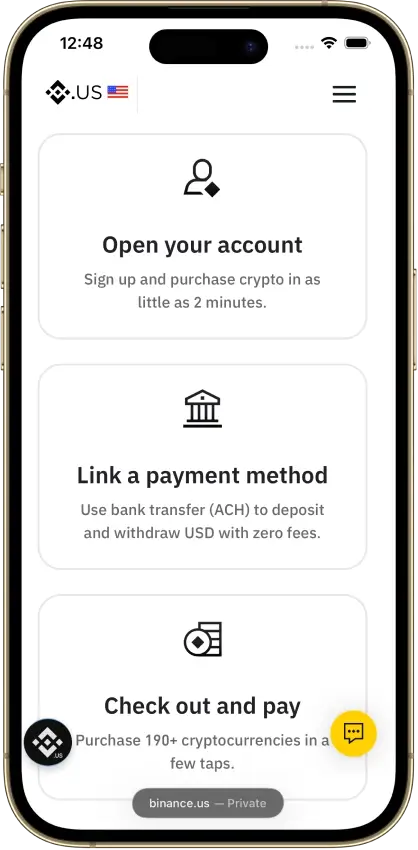
Screenshot 1 of 4
Kraken vs Binance.US Winners by Category
Kraken is the overall US winner for reserve verification, cash-out options and additional trading products. Binance.US wins Advanced spot commission. Both require planning around newly deposited funds.
Kraken Binance.US
Kraken is our default choice for a multipurpose US account. Binance.US fits a supported-state user primarily seeking low-cost spot orders.
Attested balance inclusion, cash-out choices and US derivatives
Very low Advanced spot commission
Binance.US saves $4 per $1,000 maker fill or $7.80 per taker fill at the standard opening rates.
0.40% maker / 0.80% taker
0% maker / 0.02% taker on most pairs
Kraken serves ten states excluded by Binance.US. Individual assets and additional products still have restrictions.
Core service unavailable in New York and Maine
Twelve states excluded
Kraken adds an instant route for eligible accounts and banks, and charges $21 less for a standard outgoing wire.
Free ACH, $4 FedWire and eligible instant RTP
Free ACH and $25 wire where USD services are enabled
Kraken lets customers check covered balances. Binance.US’s SOC 2 controls audit is not reserve verification.
Quarterly customer inclusion with independent attestation
One-for-one backing claim without attested customer-liability coverage
Kraken documents hardware authentication and named account-change locks. Binance.US does not disclose hardware-key or passkey support.
FIDO2 keys, Master Key and Global Settings Lock
Authenticator or SMS 2FA, allowlisting and anti-phishing code
Kraken supplies US derivatives routes with separate onboarding. A verified spot account alone is insufficient.
Sixteen US perpetual contracts and CME-listed futures after approval
No retail margin, futures, perpetuals or options
Kraken covers the overnight chat window. This compares published availability, not resolution speed.
24/7 messaging and live chat
Human chat daily from 6 a.m. to midnight Eastern
Kraken wins overall. Choose Binance.US when standard Advanced spot commission matters more than Kraken’s extra cash-out and verification features.
Spot Fees and Purchase Costs
Binance.US charges no maker commission on Advanced spot and 0.02% taker on most pairs. Kraken Pro’s opening rates are 0.40% for makers and 0.80% for takers. Quoted purchases use different pricing.
Kraken Binance.US
Standard Entry Maker
0.40%
0%
Standard Entry Taker
0.80%
0.02%
$1,000 Maker Order
$4 commission
$0 commission
$1,000 Taker Order
$8 commission
$0.20 commission
Discount Route
Qualifying trailing activity or assets held on-platform
Optional 5% BNB fee-payment reduction
Simple Buy and Convert
1% instant/recurring or 1.5% custom, plus spread and payment costs
Transaction-specific quote including a spread
Binance.US wins Advanced spot commission at the standard entry tier. Buy and Convert quotes still need an all-in price check.
Zero maker commission does not remove the market spread or guarantee a fill. A limit order pays taker commission when it immediately trades against an order already on the book. Binance.US offers post-only limits to avoid that immediate taker execution, but an unfilled order can miss the intended trade.
BNB/USD carries a 0.01% Binance.US taker rate. The same base taker rate applies at $500 million or more in trailing 30-day volume, a threshold far beyond a typical retail account. The ordinary 0.02% rate therefore matters more than the VIP label for most users.
Optional payment with available BNB reduces Binance.US commission by 5%, turning a $0.20 charge into $0.19. Actively staked BNB cannot pay the fee. Buying tokens for a one-cent saving on that order introduces token-price exposure, and Binance.com’s different discount must not be substituted.
Kraken Pro’s fee tier can improve with qualifying activity or assets. Kraken+ instead waives eligible consumer transaction fees within its allowance, leaving spread and processing charges in place. It does not reduce Pro, futures, API or OTC pricing. Always compare the purchase preview separately from the order-book commission.
State Access, Assets and Trading Tools
Kraken serves more US states and offers separately approved derivatives. Binance.US is a spot-focused service with 204 assets in its September 15, 2026 listing snapshot. Listings do not establish working transfer routes.
Kraken Binance.US
Excluded States
New York and Maine
Alaska, Connecticut, Georgia, Maine, New York, North Carolina, North Dakota, Ohio, Oregon, Texas, Vermont and Washington
USD Access Exceptions
Account and payment-method eligibility applies
Kansas and Wisconsin have crypto services only
US Asset Inventory
Exact current US count not disclosed
204 assets and 265 listed pairs on September 15, 2026
Conditional Spot Orders
OCO, trailing, iceberg, post-only and other Pro instructions
Post-only, OCO and iceberg on the web, with endpoint-specific controls
Retail Derivatives
Sixteen US perpetuals and CME-listed futures after required checks
No retail margin, futures, perpetuals or options
Identity Verification
Intermediate or Pro Personal checks
Basic requires identity information and SSN. Advanced adds photo ID and facial verification
Kraken wins state coverage and US derivatives access. Check individual assets and transfers on either platform.
New York and Maine residents cannot use either core exchange. Texas and the other nine additional states excluded by Binance.US may use Kraken’s core service, subject to asset and product rules. The US exchange access guide helps identify alternatives when a state exclusion decides the choice before fees do.
Kraken’s global asset headline is not a US inventory and is not used to award a listing winner. Binance.US’s dated pair count includes 54 USD, 202 USDT, five BTC and four USDC pairs. A pair remaining listed does not prove that deposits or withdrawals are operating.
Binance.US applies quantity and order-value filters together. Its BTC/USDT example requires at least 0.00001 BTC and a 1 USDT value. Kraken’s minimums also depend on the pair and order. Neither low commission nor an asset count measures liquidity for the order you plan to place.
Kraken’s US perpetuals use a separate brokered route from CME futures and require location, suitability and product checks. Their per-contract pricing and funding cannot be compared with Binance.US spot commission. The perpetual futures explainer covers the risks of keeping these positions open.
Bank Funding, Withdrawals and Holds
Both charge no platform fee for standard ACH transfers. Kraken has the lower outgoing wire fee and adds eligible RTP cash-out. Neither exchange lets a completed trade cancel a funding hold.
Kraken Binance.US
Standard ACH Transfer Fee
No Kraken fee
No Binance.US fee
New ACH Deposit Hold
Seven days on the associated amount
168 hours on the deposit’s dollar equivalent
ACH Withdrawal Estimate
Zero to two business days after release
One to five business days once funds are available
Outgoing Domestic Wire
$4 fee, $20 minimum
$25 fee, $100 initiation minimum
Instant Bank Withdrawal
Eligible RTP at 1.5%, capped at $50, with a $20 minimum
No RTP route disclosed
Card Deposit
Eligible US debit cards: $0.25 plus 3.75%, with a possible 72-hour hold
Credit/debit cards: 3.99%, plus possible issuer charges, and a seven-day hold
Kraken wins bank cash-out choice and standard outgoing wire cost. ACH funding requires a seven-day withdrawal plan on both exchanges.
The ACH hold concerns the newly funded amount. On Binance.US, pre-existing available funds are not automatically locked by a new deposit. On both exchanges, crypto purchased with unsettled funding can remain unavailable for withdrawal even after the order has filled.
Binance.US requires at least 130% of an intended ACH deposit to be available in the linked bank account. A $100 deposit therefore needs a $130 bank balance, although the transfer itself is still $100. Kansas and Wisconsin accounts cannot use its dollar banking at all.
Kraken estimates FedWire at zero to one business day after release. Binance.US’s wire instructions give two to five business days, while the same page’s FAQ gives one to three. Plan for the longer stated window. Neither estimate includes every compliance or funding hold, and banks may add their own charges.
Kraken’s RTP is near-instant only for eligible accounts, banks and available balances. Its percentage charge can make ACH preferable when timing permits. The $21 standard wire-fee difference is more useful to a wire user than an instant-payment feature their bank does not support.
Crypto Transfers and Security Holds
Crypto withdrawal costs depend on the chosen asset and network. Authentication changes can create additional locks, separate from the bank-deposit hold. Confirm both the destination format and available balance.
Kraken Binance.US
Withdrawal Charge
Flat fee and minimum for the asset-network route
Variable charge shown for the asset, network and amount
Bitcoin Routes
Check the available route in the account
Bitcoin and BEP-20, with no Lightning route disclosed
Stablecoin Networks
Asset and account-specific routes
Several USDT and USDC networks, subject to transfer status
Password-Change Hold
Can hold new or updated withdrawal addresses for 24 hours
Can suspend withdrawals for 48 hours
Other Security Changes
Address confirmation and account-specific security checks
Support-assisted 2FA reset: up to 48 hours. Email change: up to 120 hours
Compare the same asset, network and amount at confirmation. Security locks and network processing are separate parts of the withdrawal timeline.
Binance.US lists USDT on Ethereum and alternatives including TRON, Solana, Polygon, BEP-20 and Avalanche C-Chain. It lists USDC on Ethereum, Base, BEP-20, Solana and Avalanche C-Chain. The existence of a network is not a current fee quote or confirmation that transfers are open.
Kraken also requires a supported asset-network route at both ends. A low transfer fee is irrelevant if the receiving service does not support that format. These are custodial exchange balances until withdrawn: self-custody wallet choices bring separate recovery and transaction-approval responsibilities.
Staking and Reward Deductions
Binance.US lists 30 standard staking assets and four Soft-Staking assets. Kraken offers more than 20 staking assets with regional limits. The two services deduct different shares of rewards and use different exit rules.
Kraken Binance.US
Staking Selection
More than 20 assets, with state and product limits
30 standard assets. Soft-Staking covers SOL, ADA, ETH and BNB
Flexible Reward Deduction
30% for Flexible Staking and Auto Earn
90% for Soft-Staking
Bonded or Standard Deduction
Bonded tiers of 25%, 20%, 10%, 5% or 0%
Standard staking deducts 9.95%–39.95%
Reward Timing
Generally weekly
Asset-specific. SOL, ETH and BNB standard rewards weekly, Soft-Staking monthly
New-Account Condition
Product-specific enrollment and eligibility
Accounts created from June 5, 2026 must enroll in Soft-Staking for all account functions
Exit Conditions
Protocol unbonding for bonded assets, with possible flexible release constraints
Standard balances reserved during staking and unstaking. Soft-Staking balances remain usable
Kraken keeps a smaller share of flexible rewards, but no matched net-yield test establishes a return winner. Check Binance.US’s new-account enrollment condition before signing up.
For an illustrative $10 in gross rewards, Kraken’s 30% flexible deduction leaves $7, while Binance.US’s 90% Soft-Staking deduction leaves $1. That compares the deduction only. It does not establish which service earns more on the same asset or over the same period.
Binance.US’s mandatory Soft-Staking enrollment for new accounts deserves attention even if staking is not your reason for joining. Earlier accounts can opt out. The platform says it covers Soft-Staking slashing losses, but that does not remove exchange custody risk or make its reward rate a guaranteed return.
Kraken staking is unavailable in California, Maryland, New Jersey and Wisconsin, in addition to its core New York and Maine exclusions. Binance.US also requires a supported account and asset. Compare staking commissions and exit conditions for the particular token instead of choosing from an exchange-wide asset count.
Custody, Reserve Verification and Support
Kraken wins customer reserve verification and offers hardware authentication plus account-change locks. Binance.US announced a SOC 2 Type II controls audit, which does not provide an independently attested balance-inclusion check.
Kraken Binance.US
Customer Reserve Check
Quarterly independently attested inclusion for covered balances
No Merkle inclusion tool or current independently attested customer-liability coverage
Authentication and Account Controls
FIDO2 keys, passkeys, authenticator 2FA, Master Key and Global Settings Lock
Required authenticator or SMS 2FA, allowlisting and anti-phishing code
Custody Arrangement
User title and separate internal ledgers, with shared addresses possible
Beneficial ownership with assets held in omnibus wallets
Digital-Asset Insurance
Exchange accounts and digital assets not insured against loss
No FDIC insurance on fiat wallet or crypto, and no SIPC protection for digital assets
Human Chat
24/7 messaging and live chat
Daily, 6 a.m.–midnight Eastern
Phone Service
In-app voice when available, no public direct-dial number
Monday–Friday, 9 a.m.–7 p.m. Eastern
Trading Interfaces
Kraken, Pro and Desktop, with REST, WebSocket, FIX and futures APIs
Web and mobile Advanced, with REST and WebSocket APIs
Kraken wins covered-balance verification, documented hardware authentication and round-the-clock chat. These advantages do not insure the account or guarantee a support outcome.
Kraken’s June 30, 2026 reserve snapshot covers specified assets and supports customer inclusion. It does not cover every listed asset or all corporate liabilities. Binance.US says balances are backed one-for-one, but customers lack an independently attested way to check those liabilities. The absence of that check is not evidence of a shortfall.
A controls audit addresses systems and processes, not whether all customer assets are backed. Binance.US’s January 2026 SOC 2 announcement must therefore stay separate from reserve and insurance claims. Binance.com’s reserve reports and emergency fund do not extend to Binance.US accounts.
Both have websites and iOS and Android apps, but their testing environments differ from live trading. Kraken’s public futures demo does not provide open spot testing. Binance.US’s test-order endpoint is not a simulated market, and a public sandbox is not disclosed.
Kraken wins overnight human-chat availability. Binance.US offers scheduled telephone support as well as human chat, with an automated assistant outside service hours. Neither set of hours establishes how quickly an account review will be resolved.
Final Verdict
Kraken is our overall US choice for reserve inclusion, cash-out options and approved derivatives. Binance.US wins on Advanced spot commission for supported-state users who can plan funding and withdrawals.
Affiliate Disclosure
Some links in this comparison are affiliate links. CryptoSlate may earn a commission if you sign up through these links. Our ratings remain editorially independent.
Choose Kraken if you want an independently attested reserve-inclusion check, lower standard wire costs or eligible RTP cash-out. It also supplies US derivatives after additional approval. Budget for its higher entry spot commission and the seven-day Plaid ACH hold.
Choose Binance.US if you mainly place Advanced spot orders, your state and required dollar services are supported, and its deposit holds fit your plans. Review mandatory Soft-Staking enrollment for new accounts and decide whether the lack of customer reserve verification is acceptable.
FAQs
Is Kraken or Binance.US better for US users?
Kraken is our overall choice for reserve verification, cash-out options and separately approved derivatives. Binance.US is the cheaper standard Advanced spot account. State access, funding holds and the products you need can decide which is usable.
How much cheaper is Binance.US for a $1,000 trade?
At the standard entry rates, a $1,000 maker fill costs $0 on Binance.US versus $4 on Kraken Pro. A taker fill on most Binance.US pairs costs $0.20 versus $8. These figures exclude spread, slippage and transfer costs.
Is this Binance.com or Binance.US?
This comparison uses Binance.US, operated by BAM Trading Services, against Kraken’s US service. Binance.com is a separate international exchange. Its derivatives, reserve reports and fee discounts are not credited to Binance.US.
Can I withdraw immediately after buying with ACH funds?
Neither exchange makes newly deposited ACH funds immediately withdrawable. Kraken applies a seven-day hold to the associated amount, and Binance.US applies 168 hours to the deposit’s dollar equivalent. Trading or converting that amount does not cancel the hold.
Which has lower bank withdrawal fees?
Both offer standard ACH without a platform transfer charge where dollar services are enabled. Kraken’s standard outgoing FedWire fee is $4 versus Binance.US’s $25 wire fee. Kraken also offers eligible RTP at 1.5%, capped at $50. Bank charges may be additional.
Does Binance.US have proof of reserves like Kraken?
No comparable customer-inclusion tool or current independently attested liability coverage is disclosed for Binance.US. Kraken offers covered-balance inclusion in quarterly independently attested snapshots. Neither Kraken’s snapshot nor Binance.US’s SOC 2 controls audit guarantees continuous solvency.
Can I trade futures on both exchanges?
Kraken offers 16 US perpetual contracts and CME-listed futures through their respective routes after required checks. Binance.US does not offer retail margin, futures, perpetuals or options. Spot verification alone does not authorize Kraken derivatives.
Do new Binance.US accounts have to use Soft-Staking?
Accounts created on or after June 5, 2026 must enroll in Soft-Staking to use all account functions. Earlier accounts can opt out. Soft-Staking keeps supported balances usable but deducts 90% of rewards, and first rewards can take up to 30 days.




Binance.US makes the spot-fee decision easy at the opening tier: a $1,000 taker order costs $0.20 in commission, compared with $8 on Kraken Pro. The Binance.US pricing review explains why that saving belongs to Advanced orders, not every purchase made through the app.
The Kraken account and custody assessment documents benefits beyond the order ticket. Kraken offers an independently attested way to check covered balances, a $4 outgoing wire and eligible instant bank cash-out. Those features earn Kraken our overall recommendation despite its higher opening commission.
This comparison covers the two US services, with Binance.US kept separate from Binance.com. Global Binance futures, copy trading, token discounts and reserve reports do not apply to the US exchange discussed here.