

 Launched in 2013
- Check your own balance in its reserve proof
- No breach has cost clients their funds
- Kraken+ waives buy fees on $10,000 a month
Kraken Overview
- Crypto Exchange Name
- Kraken
- Parent Company
- Payward, Inc.
- Launch Year
- 2013
- KYC
- Yes
- Total Assets
- 600+
- Staking
- Yes
- Copy Trading
- No
- Derivatives
- Yes
- Proof of Reserves
- Yes
- Trading Fees
- 0.00% - 0.80%
- Maker Fee
- 0.40%
- Payout Time
- 5 days
Additional details
- Languages
- English, Spanish, German, French, Chinese, Russian, Portuguese, Italian, Turkish, Polish, Vietnamese, Ukrainian, Dutch
- Products
- Spot, Margin, Futures or Perps, OTC, Simple-buy Broker
- Restricted Countries
- Afghanistan, Cuba, Iran, Iraq, North Korea, Libya, Ukraine, Japan, …Afghanistan, Cuba, Iran, Iraq, North Korea, Libya, Ukraine, Japan, Belarus, Russia, Syria, South Sudan, Sudan
- Supported Cryptos
- Bitcoin, Ethereum, Bitcoin Cash, Augur, Cardano, …Bitcoin, Ethereum, Bitcoin Cash, Augur, Cardano, Dash, Dogecoin, EOS, Ethereum Classic, Gnosis, Iconomi, Litecoin, Enzyme, Monero, Quantum, XRP, Stellar, Tether, Tezos, Zcash
Kraken Screenshots

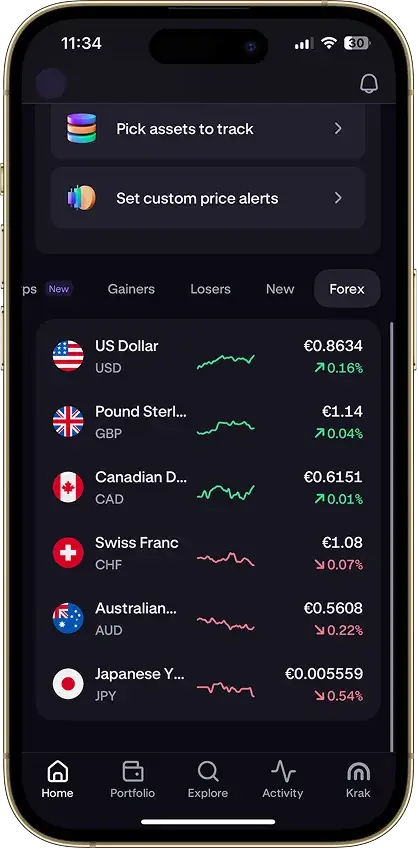
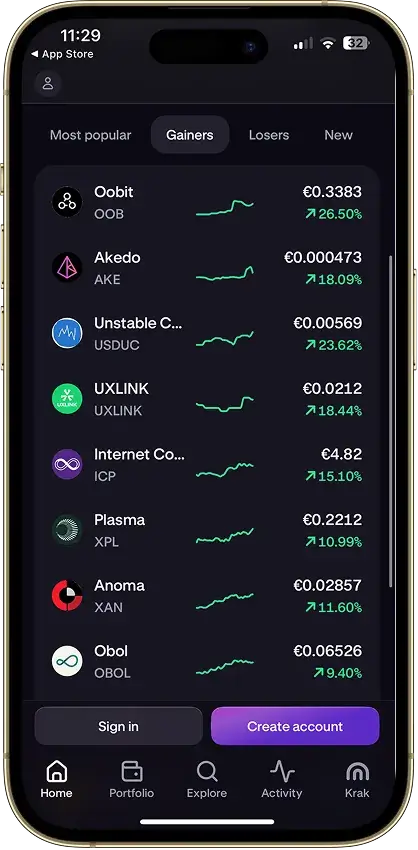
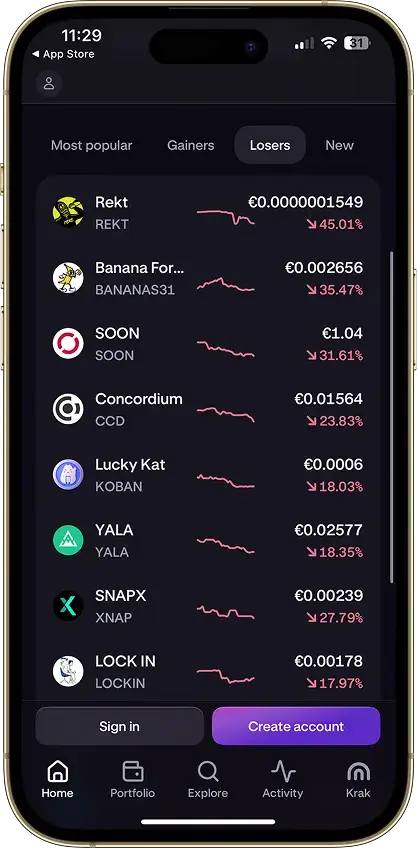
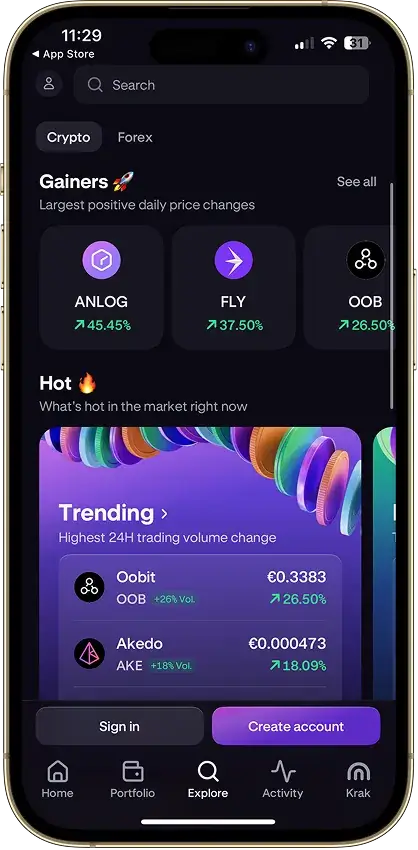
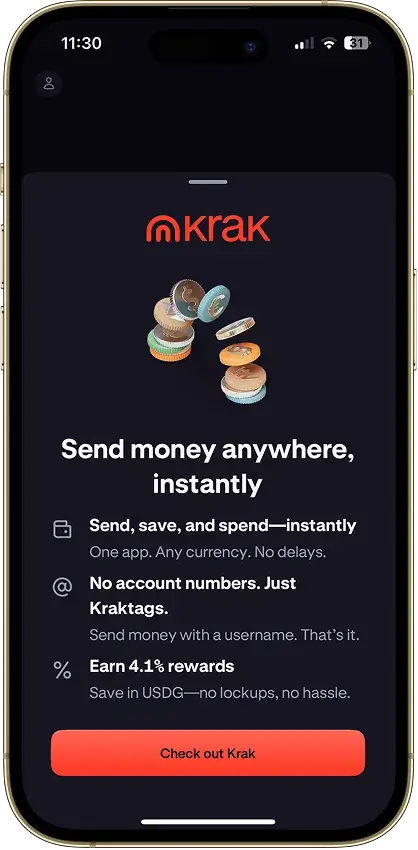
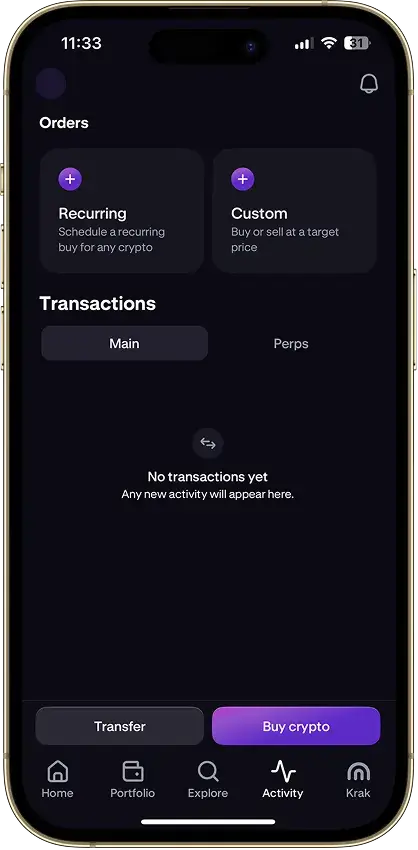
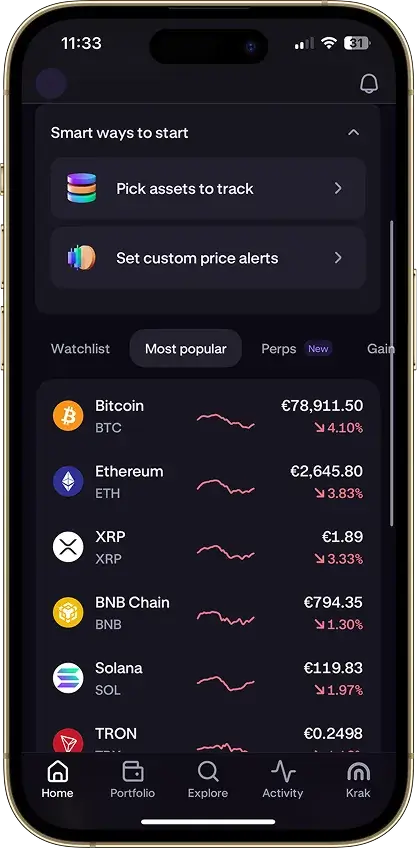
Screenshot 1 of 8
Kraken Pros and Cons
Pros
- Free U.S. ACH withdrawals
- Sixteen U.S. perpetual contracts after checks
- REST, WebSocket, FIX, and futures APIs
- FIDO2 passkeys and Global Settings Lock
- Advanced orders from TWAP to iceberg
Cons
- 0.40% maker, 0.80% taker at entry on Pro
- Seven-day hold on Plaid ACH amounts
- Simple buys add 1% to 1.5% plus spread
Quick Decision: Is Kraken Worth It?
Kraken users can verify inclusion in an independently attested reserve snapshot. The exchange fits people who can plan around funding holds and expect to use Kraken Pro, where order books and advanced controls replace the consumer app's simpler buy flow.
Compare alternatives if a 0.80% entry taker fee is too high or you live in New York or Maine. Kraken also separates consumer trading, Pro, payments, self-custody, and some derivatives across different interfaces. Use it for verifiable reserve inclusion and ACH, FedWire, or eligible RTP cash-out. Skip it if newly funded money must be withdrawable immediately.
Who Kraken Is Best For And Who Should Skip It
Residence and product eligibility decide what a Kraken account can access. The trading surface and verification level then determine the available tools and limits. This setup favors an active trader who plans funding, but it can frustrate a casual buyer who expects newly deposited money to leave immediately.
Plaid ACH works best when the deposited amount can remain on Kraken for seven days. After that planning step, a verified account can use Pro, staking, and eligible derivatives, although the products remain on separate surfaces.
Friction rises when a user wants an immediate withdrawal after ACH or PayPal funding, expects a U.S. card, or assumes the global asset figure applies unchanged to a U.S. account.
Features And Services
The Kraken app and Krak cover consumer trading, everyday transfers, and card management for eligible accounts. Kraken Pro and Kraken Desktop serve active traders, while Kraken Wallet handles self-custody.
Kraken Pro is the decisive trading surface because it supplies the order book and advanced orders. Its own fee tiers determine commission. The consumer app and Kraken+ change retail transaction fees, while Pro pricing stays separate. Futures, API, and OTC pricing are separate too.
Supported Assets And Markets
Kraken states that it lists more than 600 crypto assets globally. Its official global table contained 654 asset rows on August 28, 2026, while a separate restriction page listed 159 symbols unavailable in the United States. Those two lists do not establish one durable U.S. total.
The global asset count should not be used to estimate U.S. availability. Check the exact asset and withdrawal network in the account before funding.
Liquidity, Order Types, And Trading Limits
Kraken publishes order books and depth charts but no spread or depth figures for a specific pair. It also provides no slippage, fill-rate, or latency measurement. Users should inspect the exact market and order size instead of treating the global asset count as evidence of execution quality.
Market, limit, conditional, and time-based instructions give users several ways to control an order. Pair depth and large-order fill prices still require a live check.
Margin And Derivatives
Kraken separates U.S. perpetuals from CME-listed futures. Spot margin and international futures have their own rules. The fee unit and eligibility requirements differ between these products.
Bitnomial-listed U.S. perpetuals are brokered through Kraken Derivatives US and NinjaTrader, while CME contracts use a separate route. This split matters when comparing regulated crypto futures exchanges because Kraken's settlement and fees change with the contract type.
Staking And Rewards
Kraken supports bonded and flexible staking on more than 20 assets. Auto Earn and other reward products add separate choices. The commission and exit mechanics change by product, so a displayed reward rate does not show net yield by itself.
Kraken's staking value depends on the quoted reward after commission and the time required to unbond. Our comparison of exchange staking products ranks products using those variables alongside the headline rate.
Card
Kraken Card is a physical or virtual Mastercard debit card for verified personal clients in the U.K. and EEA. Krak manages the card, and advertised cashback reaches up to 2% according to the user's 30-day average-balance tier. Kraken charges no card transaction fee, although conversion and third-party costs can apply.
The card is not available to U.S. accounts. Tax treatment depends on the funding asset and the user's jurisdiction, so it is not accurate to describe every card purchase as a taxable crypto disposal.
Wallet And Self-Custody Options
Assets on the exchange remain in Kraken's custodial environment. Kraken Wallet is a separate self-custody product supporting Bitcoin, Ethereum, Solana, Dogecoin, Arbitrum One, Base, Optimism, Polygon, Ink, Blast, Avalanche, and Linea. The user approves transactions and controls the recovery phrase.
Kraken cannot restore a lost recovery phrase. The Kraken Wallet evaluation covers that separate custody model, which should not be counted as an exchange listing or treated as protected by exchange controls.
API And Programmatic Trading
The API stack matters to automated and institutional traders, but testing access is not identical across spot and futures. A public futures demo does not mean every retail API user receives a spot sandbox.
FIX supports order entry over a persistent session, and the separate Status API reports component health to an automated system. These protocols do not establish latency or fill quality, which still require a live test on the endpoint and pair being traded.
Fees And Pricing
Kraken Pro starts at 0.40% maker and 0.80% taker under the July 9, 2026 schedule. Trailing spot activity or eligible assets held on the platform can move the account to lower rates.
A $1,000 entry-tier Kraken Pro order costs $4 for a maker or $8 for a taker before spread and slippage. A consumer purchase uses the separate 1% or 1.5% transaction charge plus its variable spread and payment cost.
Hidden Costs To Watch On Kraken
The maker-taker schedule covers only order-book commission. Consumer transaction fees and spreads sit outside it. Funding methods and withdrawal routes can add cost, as can margin or derivatives positions.
- Consumer trades add variable spread
- Debit-card deposits cost $0.25 plus 3.75%
- PayPal fees appear before confirmation
- Crypto withdrawal fees vary by route
- Margin and derivatives add funding and liquidation risk
- Kraken+ does not cover Pro or derivatives
For U.S. users, the documented low-cost path starts with a bank deposit and ends on Kraken Pro, where the fee schedule assigns the account's tier. Check the withdrawal fee and hold before funding because the cheapest entry route may not provide the fastest exit.
VIP Tiers And Fee Discounts
Kraken compares trailing 30-day spot activity with qualifying Assets on Platform and applies the more favorable eligible tier. Kraken+ is separate from that Pro schedule.
Kraken+ costs $4.99 per month or $49.99 per year and waives eligible consumer Buy and Sell transaction fees on up to $10,000 of monthly activity. Convert transactions are included. Spread and processing charges remain. The waiver excludes Pro trades and futures, along with API and OTC activity.
Deposits, Withdrawals, KYC And Availability
Funding method determines both cost and when money can leave. A deposit can become tradable before the associated amount becomes withdrawable.
The seven-day ACH hold applies to the associated amount, not only a first deposit. Adding a withdrawal address requires confirmation but does not independently create a 72-hour hold.
What U.S. Users Need To Check Before Signing Up
U.S. access is product- and state-specific. Kraken serves most states through Payward, Inc., while affiliate Kraken Financial holds the separate Wyoming SPDI charter.
The separate Wyoming charter does not turn a retail exchange account into a bank account. Users comparing U.S. exchange choices should check state access and product onboarding before moving money.
Payment Rails, Networks, And Limits
Cash and crypto transfers use separate schedules. Processing estimates begin after Kraken releases the transfer, so funding holds and compliance review can extend the user's total wait.
Fiat Rails By Region
Plaid ACH and FedWire deposits carry no Kraken fee, while a U.S. debit-card deposit costs $0.25 plus 3.75%. Residence, account entity, and currency determine which rails are available.
For U.S. withdrawals, ACH is free with a $1 minimum and an estimated zero-to-two-business-day window. FedWire has a $20 minimum and costs $4. Its estimate is zero to one business day. Eligible RTP also has a $20 minimum. It costs 1.5% capped at $50 and is near-instant.
Withdrawal Networks And Fees
Listed asset access does not guarantee every withdrawal network. Kraken sets a flat fee and minimum for each supported asset-network route. The amounts displayed before confirmation apply to the selected transfer.
Choose a network supported on both sides and compare the displayed minimum and fee. A low-fee route is useful only when the receiving wallet or exchange credits that same network.
Verification Levels And Withdrawal Limits
Personal accounts use Intermediate and Pro Personal levels. Exact limits appear in the account. Residence and payment method can change them, as can a risk review.
A higher verification level does not remove every payment-method hold. Exact withdrawal ceilings and available products remain account-specific.
Is Kraken Safe? Security, Custody And Proof Of Reserves
FIDO2 passkeys and Global Settings Lock harden the account. The independently attested quarterly snapshot lets a user verify that in-scope balances were included. These measures do not insure exchange balances or prove continuous solvency.
Controls
Kraken supports FIDO2 passkeys and security keys alongside authenticator 2FA. A Master Key and Global Settings Lock add account controls. PGP email, device and session revocation, and withdrawal-address confirmation cover other risks. API users can restrict permissions and IP addresses. They can also set expiration and add API 2FA.
Custody And Insurance
Kraken says a majority of client crypto is held offline and uses cold- and hot-wallet controls. Its retail terms state that title remains with the user and that separate internal ledgers are maintained, although shared addresses can be used. In an insolvency, a court could still classify customer claims differently from Kraken's stated ledger treatment.
Exchange accounts and digital assets are not insured against loss and do not receive FDIC or SIPC protection. Kraken Financial is a separate SPDI affiliate and is not FDIC insured. Ordinary Kraken exchange balances are not bank deposits.
Proof Of Reserves Or Audits
Kraken's June 30, 2026 Proof of Reserves snapshot lets users verify inclusion for supported balances in a Merkle process and carries independent attestation. Published ratios were 102.9% for BTC and 100.5% for ETH. SOL stood at 100.6%, while XRP was 102.3% and ADA was 100.3%. Each of USDC, USDT, and USDG was at least 105%.
The procedure is point-in-time and does not cover every listed asset or every corporate liability. It shows that in-scope balances were included and covered at the snapshot. Its scope excludes future withdrawal performance and a complete balance-sheet audit.
Incidents And Remediation
Kraken's documented security record states that no breach has caused a loss of client funds. In June 2024, the company mitigated a deposit and funding flaw in under an hour. Kraken said client assets were neither impacted nor vulnerable.
Kraken's general security page cites ISO/IEC 27001:2022 certification and a SOC 2 Type 1 examination. Its SOC 2 Type 2 announcement specifically covers institutional qualified custody. That announcement does not establish Type 2 coverage for the retail exchange.
App, UX And Customer Support
Kraken splits its experience across several interfaces. That separation gives active traders dedicated tools but requires users to know when they are moving between consumer trading, Pro, payments, and self-custody.
UI And Navigation
The consumer app handles buying, recurring activity, funding, and portfolio tracking. Kraken Pro and Kraken Desktop expose order books, charts, advanced orders, margin, and eligible derivatives.
- Consumer and Pro trading stay separate
- Kraken Desktop adds an advanced workspace
- Krak handles transfers and card management where supported
- Kraken Wallet changes custody responsibility
Mobile App
Kraken and Kraken Pro are available on iOS and Android. The Pro app covers order-book trading and funding. Withdrawals and security settings sit there too, alongside eligible derivatives. Krak and Kraken Wallet serve different tasks.
- Kraken app for consumer activity
- Kraken Pro for active trading
- Krak for payments and card controls where supported
- Kraken Wallet for self-custody
Reliability And Status Page
Kraken publishes a status page broken out by service and asset. It gives users a place to distinguish a platform incident from a delay affecting one funding route or blockchain.
The status page improves visibility but does not guarantee uptime or settlement time. Users should check it before repeating a delayed deposit or withdrawal.
Customer Support
Kraken documents 24/7 messaging and live chat plus support forms. Voice support appears only through Kraken apps when available, and there is no public direct-dial support number.
- Help center for product instructions
- 24/7 chat and messaging
- Forms for account-specific cases
- In-app voice when offered
- No reversal of completed onchain transfers
Kraken publishes no response-time or resolution SLA for its support channels. A confirmed blockchain transfer cannot be reversed, regardless of whether support is contacted.
Reporting And Account Records
Kraken provides account history and statements, plus export functions. It does not publish universal tax-form thresholds or establish one jurisdiction-ready workflow. Users should confirm which reports and export limits appear in their account.
Kraken Alternatives
-


Coinbase
Coinbase fits U.S. users who fund by ACH and use Advanced, but Simple Buy costs and regional product rules require attention.
-

Gemini
Gemini offers U.S. access, free ACH, and documented controls. Compare alternatives for lower entry fees or access in more countries.
-

Crypto.com
Crypto.com Exchange serves spot traders in the U.S. and abroad, with global margin and derivatives outside restricted jurisdictions. Its U.S. bank-transfer terms differ from Main App banking, although ACH deposit allowances are...
-

Binance
Binance.com combines 0.10% entry spot fees with deep liquidity and extensive trading tools, but access, fiat rails, and products vary by jurisdiction.
Each alternative below removes one specific Kraken constraint: a state exclusion, an entry commission, a split app experience, or a different derivatives menu.
- Coinbase exchange assessment — All-state U.S. spot access and a 0.90% Advanced entry taker fee. It lacks Kraken's exchange-wide user-verifiable Merkle process
- Gemini exchange review — New York access and audited disclosures. ActiveTrader starts at 0.60% maker and 1.20% taker
- Crypto.com platform analysis — Exchange entry fees of 0.25% maker and 0.50% taker, plus separate card products. Its App, Exchange, and derivatives surfaces use different rules
- International Binance review — 0.10% entry spot commission plus USD-M and COIN-M futures, options, copy trading, and bots where permitted. Binance.com does not serve the United States
Residence decides the first cut: New York and Maine exclude Kraken, while the United States excludes Binance.com. After geography, compare the entry taker fee and whether separate consumer, trading, card, or wallet surfaces fit the intended use.
Kraken Category Scores
These scores highlight how this review performs in specific categories, with each score tailored to the focus of that category.
Final Verdict
Kraken suits users who prioritize reserve-inclusion checks and account security controls. Kraken Pro provides the order-book trading tools, with opening spot fees of 0.40% maker and 0.80% taker. Reserve checks cover selected assets at a snapshot, not every asset or corporate liability. U.S. users can withdraw through free ACH or $4 FedWire, with RTP also available to eligible accounts. Amounts funded through Plaid ACH face a seven-day withdrawal hold. That delay and the 0.80% entry taker fee may rule it out for frequent cash-outs or small market orders. Kraken does not serve New York or Maine.

CryptoSlate may earn a commission when you use partner links, at no extra cost to you. Our reviews, ratings, and editorial decisions remain independent of advertisers. Read How CryptoSlate Makes Money for funding details.