

Crypto.com Exchange serves spot traders in the U.S. and abroad, with global margin and derivatives outside restricted jurisdictions. Its U.S. bank-transfer terms differ from Main App banking, although ACH deposit allowan...
Crypto.com vs Kraken: US Fees, Funding and Features
Kraken wins our US Crypto.com vs Kraken comparison for recurring reserve checks and dollar cash-outs. Crypto.com offers lower entry spot fees and access in Maine.

Kraken combines quarterly reserve-inclusion checks with separate Pro trading tools and account security controls. Its entry spot fees and funding-related withdrawal holds are the main tradeoffs.
Affiliate Disclosure
Some links in this comparison are affiliate links. CryptoSlate may earn a commission if you sign up through these links. Our ratings remain editorially independent.
Overview
US customers can use Crypto.com Exchange and Kraken Pro for order-book trading. Crypto.com’s Main App adds separate consumer products, while Kraken’s US derivatives require their own approval.
Crypto.com Kraken
US Spot Trading
Crypto.com US Exchange
Kraken Pro
Entry Maker / Taker Fees
0.25% / 0.50%
0.40% / 0.80%
Core State Exclusions
New York
New York and Maine
ACH Withdrawal Minimum
$100 on the US Exchange
$1
Reserve Snapshot
December 7, 2022
June 30, 2026, with quarterly reporting
Crypto.com vs Kraken Winners by Category
Kraken wins overall for reserve reporting and US cash-out flexibility. Crypto.com wins entry trading fees and state coverage. Neither receives a speed or service-quality award from advertised support hours.
Crypto.com Kraken
Kraken is our choice for users who prioritize custody disclosure and access to their dollar balance over the opening trading fee.
Lower opening spot commissions
Quarterly reserve checks and flexible dollar cash-out
Crypto.com saves $1.50 on a $1,000 maker order or $3 on a taker order at the entry tier.
0.25% maker / 0.50% taker
0.40% maker / 0.80% taker
Kraken accommodates smaller ACH withdrawals and charges $16 less for the base wire transfer.
$100 Exchange ACH minimum and $20 base Fedwire fee
$1 ACH minimum, free ACH and $4 FedWire
Kraken provides a more recent recurring check for covered balances. Neither process is a full financial audit.
December 2022 inclusion snapshot
Quarterly independently attested inclusion checks
Kraken offers US perpetual futures for qualified accounts. Crypto.com’s domestic event products have different payoffs.
US event and limited-risk contracts, not global perpetuals
16 USD-settled perpetual contracts after product approval
Crypto.com provides an option in Maine. Product and funding restrictions can still apply.
Core US account excludes New York
Core service excludes New York and Maine
Both advertise continuous chat access. That does not establish equal response or resolution times.
24/7 in-app chat
24/7 messaging and live chat
Kraken wins overall. Crypto.com is the alternative for a user whose priority is lower entry spot commission.
Trading Fees
Crypto.com’s standard opening commission is lower on both sides of the order book. The comparison changes as an account qualifies for a higher tier, and neither schedule describes every simple purchase.
Crypto.com Kraken
Entry Maker Fee
0.25%
0.40%
Entry Taker Fee
0.50%
0.80%
$1,000 Maker Fill
$2.50 commission
$4 commission
$1,000 Taker Fill
$5 commission
$8 commission
At $2,500 in 30-Day Spot Volume
0.25% maker / 0.50% taker
0.30% maker / 0.60% taker
Maker Fee at $10,000 Volume
0.20%
0.22%
Taker Fee at $10,000 Volume
0.40%
0.38%
Consumer Buy Screen
App or Quick Buy quote and payment charges
1% instant/recurring or 1.5% custom order fee, plus spread and payment charges
Crypto.com wins entry spot pricing. Kraken has the lower standard taker rate at $10,000 in qualifying volume.
On an isolated $1,000 market order, the entry-tier commission difference is $3. Kraken’s first volume discount arrives at $2,500. At $10,000 in qualifying volume, its taker rate is below Crypto.com’s, while Crypto.com retains the lower maker rate. Opening rates therefore cannot predict the cost of a month in which the account moves through tiers.
Crypto.com offers discounts for qualifying CRO balances. Kraken can also use eligible Assets on Platform to assign certain tiers, but a $2,500 balance alone does not qualify for its first volume discount. Holding an asset solely to obtain a discount adds price exposure.
Kraken+ waives eligible consumer transaction fees within its monthly allowance. It does not waive Kraken Pro commissions, spread or payment processing. Crypto.com’s Main App also quotes purchases separately from Exchange orders. Compare the amount received, not just a displayed transaction fee.
Maker status depends on adding liquidity. A limit order that fills immediately can still attract a taker fee, as explained in this guide to order-book trading. Neither entry commission nor reported trading volume establishes the slippage on your order.
US Access and Supported Cryptocurrencies
Neither serves New York through the core US exchange account. Kraken also excludes Maine. Asset and product restrictions are separate from permission to open an account.
Crypto.com Kraken
New York
Unavailable
Unavailable
Maine
US account access available
Core service unavailable
Identity Verification
Required for ordinary trading and bank transfers
Required for ordinary trading and bank transfers
Crypto.com wins core state coverage because it accepts Maine residents. Neither is a core exchange option in New York.
Crypto.com’s 422-asset snapshot describes its Global Exchange. Kraken’s claim of more than 600 assets is also global. Neither figure is a reliable count of the coins a US customer can trade, so those totals do not decide an asset-selection winner.
Before transferring a less common coin, confirm both its market and its withdrawal network in the US account. A supported token can still have a restricted trading pair or transfer route. New York residents need a different choice from these two US crypto trading platforms.
Crypto.com’s US Exchange terms identify Foris DAX, Inc. Kraken Financial is a separate affiliate and its charter does not turn a retail exchange balance into a bank deposit. A bank charter, a money-transmitter registration and permission to trade a particular derivative do not grant the same protections.
US Trading Tools and Derivatives
Kraken’s US perpetual futures and Crypto.com’s domestic event contracts are different products. Spot automation is available separately from those derivatives permissions.
Crypto.com Kraken
Spot Order Controls
Market, limit, stop-loss, take-profit and OCO
Market, limit, stop and advanced Pro instructions
Trading Automation
DCA and Grid bots for supported spot pairs
API and supported Pro automation tools
US Spot Margin
Global Exchange margin excludes US users
Eligible US retail margin through a separate approved account
US Perpetual Futures
International Exchange perpetuals exclude US users
16 USD-settled contracts after verification and suitability checks
Other US Derivatives
Event, prediction and limited-risk contracts through CDNA
CME-listed futures through the applicable US route
Kraken wins for US perpetual-futures and retail-margin access after approval. These products are not suitable for every customer.
Kraken’s US perpetual contracts are listed by Bitnomial and brokered through NinjaTrader Clearing, trading as Kraken Derivatives US. Contract fees and daily funding differ from spot maker-taker commissions. Product approval is required, and borrowed exposure can cause rapid losses or liquidation.
Eligible US retail users can also apply for Kraken’s separate margin account through NinjaTrader and Payward Accredited. BTC/USD permits positions up to 20x the required margin, subject to account limits. This is not automatic access for every verified spot customer, and borrowing introduces fees and liquidation risk. Losses can exceed the original investment.
Crypto.com’s US event and limited-risk contracts have their own settlement and payout rules. Access to them does not enable the Global Exchange’s leveraged perpetuals. A user specifically seeking crypto futures trading platforms should compare the domestic contract, not an international product headline.
For spot trading, Crypto.com’s DCA bot schedules orders and its Grid bot places orders within a price range. Kraken Pro supports advanced order instructions and API-based workflows. Both require the user to understand order size, market conditions and cancellation rules. There is no matched execution test supporting a speed or liquidity winner.
Staking and Cards
Both offer staking with state restrictions and protocol withdrawal waits. Card products use separate accounts and eligibility rules, so their rewards do not reduce exchange trading fees.
Crypto.com Kraken
Staking Program
25 assets listed in the Main App
More than 20 assets across staking products
Staking State Access
Excludes NY, CA, MD, NJ and WI
Selected states only, with account and asset restrictions
Staking Commission
15% of ETH rewards, 35% for NEAR/INJ, 20% for other listed assets
Standard 30% Flexible/Auto Earn commission, with asset exceptions and separate bonded tiers
Access to Staked Funds
Protocol-dependent unbonding
Bonded unbonding or flexible-product release rules
US Cards
Credit card and separate prepaid card, excluding New York
Krak Visa debit card, excluding NY, ME, MA and IN
The available token and the net reward decide a staking comparison. Crypto.com’s 25-asset list and Kraken’s “more than 20” description do not establish which has more assets available to the same US account. Crypto.com deducts its service fee from protocol rewards, while Kraken’s bonded commission depends on the qualifying amount staked.
Neither program guarantees a return or instant withdrawal. ETH exit timing can depend on network queues, and each asset has its own unbonding process. Compare the same token and exit conditions when assessing staking fees and withdrawal terms.
Crypto.com offers a US credit card and a separate prepaid card with plan conditions and reward caps. Kraken’s US Krak Card is a Visa debit card issued by Lead Bank. It is a different regional product from the UK/EEA card, so overseas cashback terms should not be applied to it.
The US Krak Card has no monthly or annual fee, but currency conversion can include a variable spread and foreign transactions cost 1%. Its state exclusions are wider than Kraken’s core exchange restrictions. Credit approval, card spending terms and exchange fees need separate comparisons.
Deposits and Withdrawals
Kraken wins bank cash-out for its lower ACH minimum and wire fee. Instant bank funding at either platform can let you trade before the associated funds become withdrawable.
Crypto.com Kraken
ACH Withdrawal Minimum
$100 on US Exchange
$1
ACH Withdrawal Fee
Neither charges an ordinary ACH network fee. Crypto.com can add a separate USD withdrawal charge.
No ACH network fee. Additional USD withdrawal charges can apply
No Kraken fee
ACH Processing Estimate
1–3 business days
0–2 business days
Base USD Wire Withdrawal Fee
$20 plus applicable USD withdrawal charges
$4
Instant ACH Withdrawal Hold
7 business days on credited value and assets bought with it
7 days on the amount funded through Plaid ACH
Faster Dollar Cash-Out
Exchange bank route depends on eligibility
Eligible RTP: 1.5%, capped at $50, with a $20 minimum
Kraken wins for small ACH cash-outs and lower wire charges. Funding holds still apply to newly deposited amounts.
A $50 dollar balance is above Kraken’s ACH minimum but below Crypto.com US Exchange’s $100 minimum. For a wire withdrawal, Kraken’s $4 platform fee is $16 below Crypto.com’s $20 base charge. Receiving and intermediary bank fees can add to either route.
Crypto.com Exchange ACH withdrawals are capped at $100,000 or five transactions daily and $500,000 or 30 transactions monthly. Kraken displays account-specific limits based on verification and payment method. Its published processing estimates begin after a transfer is released and do not eliminate a funding or compliance hold.
Texas residents face method-specific restrictions: Crypto.com’s Fedwire service excludes them, as does Kraken’s Plaid cash-deposit guide. Crypto.com Fedwire also excludes Tennessee and Hawaii. Other bank routes have separate eligibility rules.
For Crypto.com Exchange, a rolling 30-day net USD withdrawal total above $1 million attracts a 0.05% charge on the excess. The ACH instructions allow additional USD withdrawal charges despite having no network fee. Fedwire’s $20 network charge is added separately.
Crypto.com Instant ACH uses a seven-business-day restriction. Its daily and monthly ACH deposit allowances are shared with the Main App, and failed settlement can lead to automatic crypto sales to cover a negative dollar balance. Kraken’s seven-day Plaid hold applies to the funded amount, not necessarily the whole balance. Neither route suits a plan to buy and immediately send all newly funded crypto elsewhere.
For crypto withdrawals, compare the fee for the actual asset and network at confirmation. A wallet’s supported chains do not determine the exchange’s transfer options, and sending on the wrong network can make recovery impossible.
Security, Custody and Reserve Checks
Kraken’s quarterly balance-inclusion reports are more recent than Crypto.com’s December 2022 snapshot. This gives Kraken the reserve-reporting verdict, without implying either platform guarantees customer funds.
Crypto.com Kraken
Latest Cited Reserve Snapshot
December 7, 2022
June 30, 2026
Reporting Cadence
Historical nine-asset report
Quarterly independently attested snapshots
Customer Inclusion Check
Merkle inclusion for the historical snapshot
Merkle inclusion for supported balances in recurring reports
Account Protection
Passkeys, MFA and withdrawal-address whitelisting
Passkeys, security keys, Master Key and Global Settings Lock
Separate Self-Custody Wallet
Crypto.com Onchain
Kraken Wallet
Kraken wins recurring reserve verification. The result is about reporting recency and scope, not a promise of safety.
Kraken’s June 2026 snapshot covers selected balances, with reported reserve ratios above 100% for the listed assets. Crypto.com’s independent December 2022 work used agreed-upon procedures on nine assets. Neither report is a complete, continuously updated audit of every asset and corporate liability.
Both exchanges hold trading balances in custody. Crypto.com Onchain and Kraken Wallet are separate self-custody products, where recovery and transaction approvals become the user’s responsibility. A lost recovery phrase is not an exchange-support reset.
Kraken’s Global Settings Lock can restrict sensitive account changes. Crypto.com provides an optional 24-hour lock for newly added withdrawal addresses. These tools help address account takeover, but they cannot remove insolvency, network or market risk. Neither exchange’s crypto balance has blanket deposit insurance.
Apps, API Access and Support
Both advertise 24/7 chat and offer consumer and advanced trading interfaces. Choose the interface that displays the fee schedule and product you intend to use.
Crypto.com Kraken
Consumer App
Main App for simple purchases, staking and cards
Kraken app for buying, funding and portfolio activity
Advanced Trading
Exchange website and Exchange app
Kraken Pro website/app and Kraken Desktop
Programmatic Trading
REST and WebSocket for supported Exchange functions
REST and WebSocket, with additional protocols for qualified workflows
General Customer Support
24/7 in-app chat
24/7 messaging and live chat
Support hours are a tie. No response-speed or resolution-quality winner is assigned.
A Main App purchase at Crypto.com does not inherit the Exchange’s maker-taker rate. Likewise, Kraken’s consumer purchase screen does not use Kraken Pro’s order-book commission. Switching to the advanced interface is a pricing choice as well as a layout choice.
Kraken provides support forms and in-app voice when offered, without a public direct-dial support number. Crypto.com offers chat and a Help Center. Neither publishes comparable case-resolution times, so continuous chat access supports a tie on opening hours only.
Both allow transaction-history exports. Crypto.com retired its in-house tax tool and points to external tax partners. Exported records can help reconcile trades and transfers, but they do not complete a tax return or establish that every transaction has been classified correctly.
Screenshots
Crypto.com screenshots

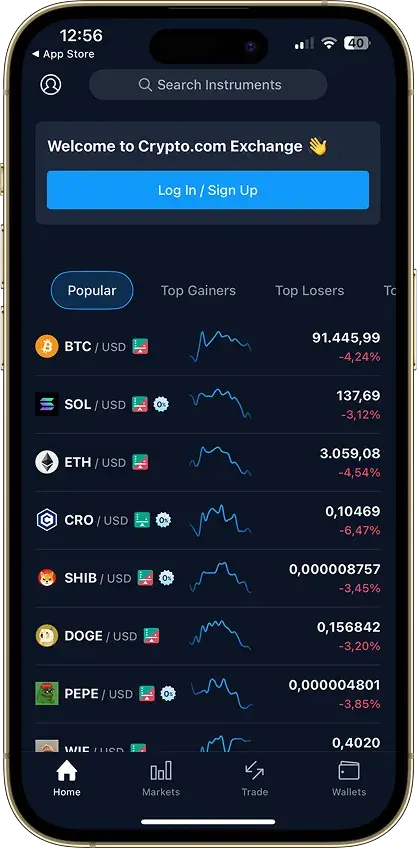
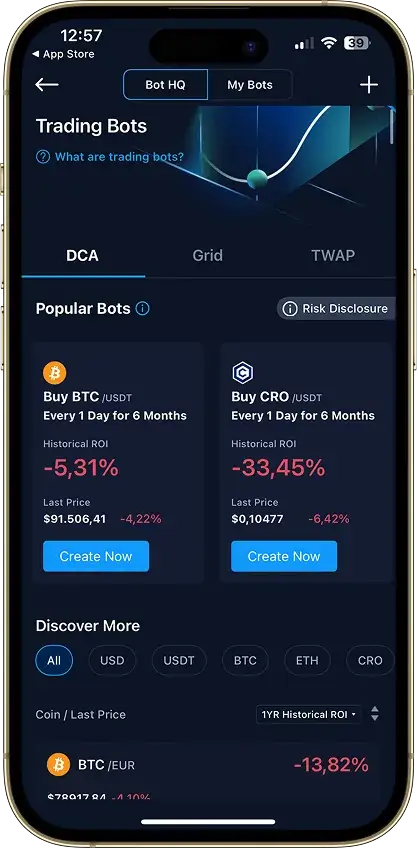
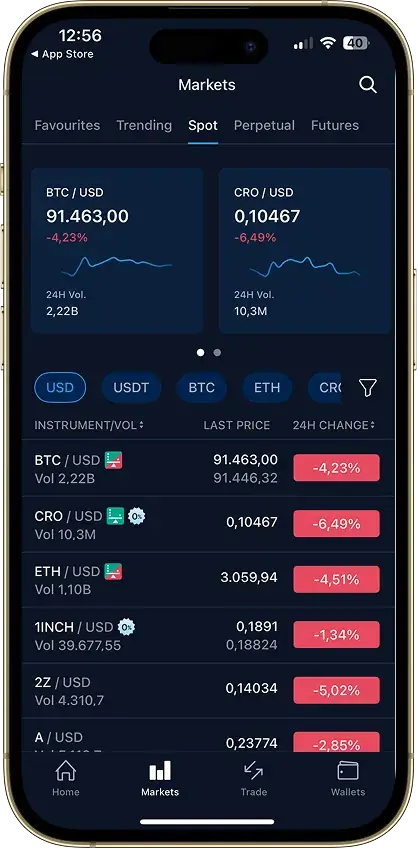
Screenshot 1 of 4
Kraken screenshots

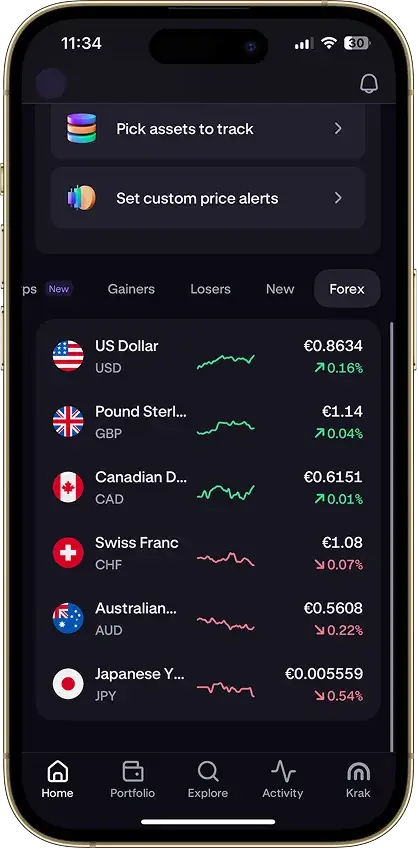
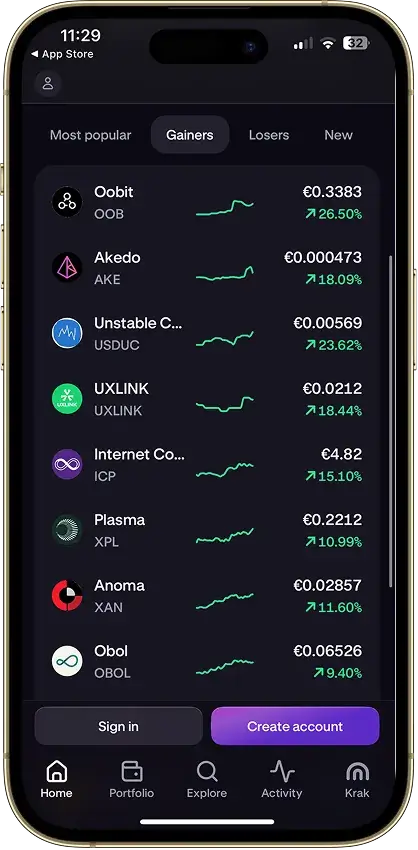
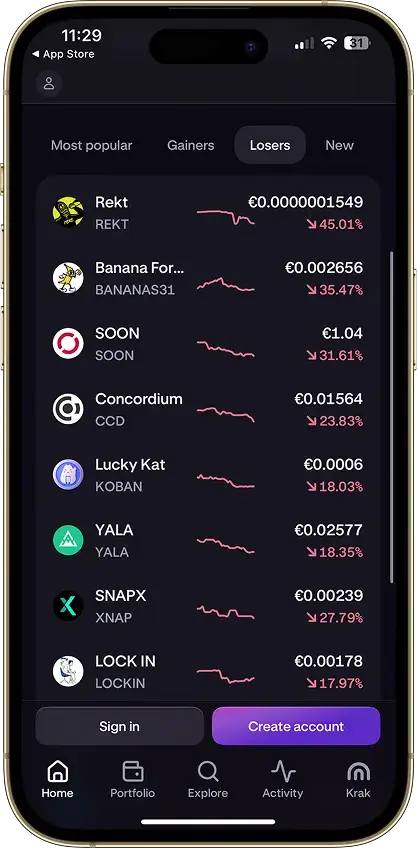
Screenshot 1 of 4
Final Verdict
Kraken is our overall US choice for recurring reserve checks and dollar cash-out options. Crypto.com is the entry-fee alternative, especially if most of your activity stays on its spot Exchange.
Affiliate Disclosure
Some links in this comparison are affiliate links. CryptoSlate may earn a commission if you sign up through these links. Our ratings remain editorially independent.
Choose Crypto.com If…
- You expect to place small spot orders and want the lower opening maker-taker rate.
- You live in Maine, where Kraken’s core service is unavailable.
- You want its Main App staking or card products alongside a separate Exchange account.
Choose Kraken If…
- You want quarterly independently attested reserve-inclusion checks.
- You need small ACH cash-outs or frequently use dollar wires.
- You want US perpetual futures and can meet the additional product requirements.
- You can plan withdrawals around the funding method’s hold.
FAQs
Is Crypto.com or Kraken better for US users?
Kraken is our overall pick for recurring reserve reporting and dollar cash-out options. Crypto.com offers lower entry spot commissions and accepts Maine residents. Neither core exchange serves New York, and individual products have additional restrictions.
Can US customers use Crypto.com Exchange, not just the App?
Yes. Crypto.com has US retail Exchange accounts with spot trading, ACH and eligible Fedwire transfers. Main App staking and cards remain separate products. US account access does not include the Global Exchange’s international margin or perpetuals.
Which has lower entry trading fees?
At entry, a maker pays 0.25% on Crypto.com Exchange versus 0.40% on Kraken Pro. Taking liquidity costs 0.50% or 0.80%, respectively. Crypto.com therefore saves $3 in commission on a $1,000 taker fill. At $10,000 in qualifying volume, Kraken has the lower standard taker rate.
Which is cheaper for withdrawing dollars?
Kraken offers free ACH with a $1 minimum and a $4 FedWire withdrawal fee. Crypto.com US Exchange ACH starts at $100 and has no network fee, but additional USD charges can apply. Its Fedwire base fee is $20, before applicable additional charges.
Can I withdraw immediately after an ACH deposit?
Not necessarily. Kraken applies a seven-day restriction to amounts funded through Plaid ACH. Crypto.com US Exchange Instant ACH restricts the credited value and assets bought with it for seven business days. Existing cleared balances and other deposit methods have separate rules.
Does Kraken offer US perpetual futures?
Yes. Eligible US accounts can access 16 USD-settled perpetual contracts after verification, suitability and product checks. They are distinct from Kraken’s international futures and from Crypto.com’s US event or limited-risk contracts. Funding and liquidation risks apply.
Which has the more recent proof of reserves?
Kraken’s cited snapshot is June 30, 2026, within its quarterly reporting program. Crypto.com’s individual reserve-inclusion report dates to December 7, 2022. Both cover selected balances at a point in time and are not blanket insurance or complete solvency guarantees.
Is staking available in every US state?
No. Crypto.com App staking excludes New York, California, Maryland, New Jersey and Wisconsin. Kraken offers staking only in selected states and its core service excludes New York and Maine. Check the program shown in your verified account before transferring a token to stake.



A user making occasional purchases and keeping funds on an exchange has different priorities from someone placing frequent orders. The Kraken trading and custody assessment highlights recurring reserve checks and several dollar cash-out routes. Those are the reasons it takes our overall verdict, despite its higher entry commissions.
The Crypto.com exchange review describes a separate order-book platform and consumer App. US retail Exchange accounts support spot trading and bank transfers. This comparison uses those US terms and labels Main App features separately, without crediting international margin or perpetuals.