
Quick Take
- Coinbase Borrow opened to eligible New York customers on Nov. 16, extending the service to the state it initially excluded.
- Lenders on Morpho supply the USDC. Coinbase says those retail loans sit off its balance sheet, separate from its institutional loan book.
- New York customers can borrow against Bitcoin, Ethereum or Solana, with variable rates, processing fees and collateral liquidation risk.


Coinbase opened its crypto-backed borrowing service to eligible New York customers on Nov. 16. The exchange runs the service in its app, and lenders on Morpho supply the USDC.
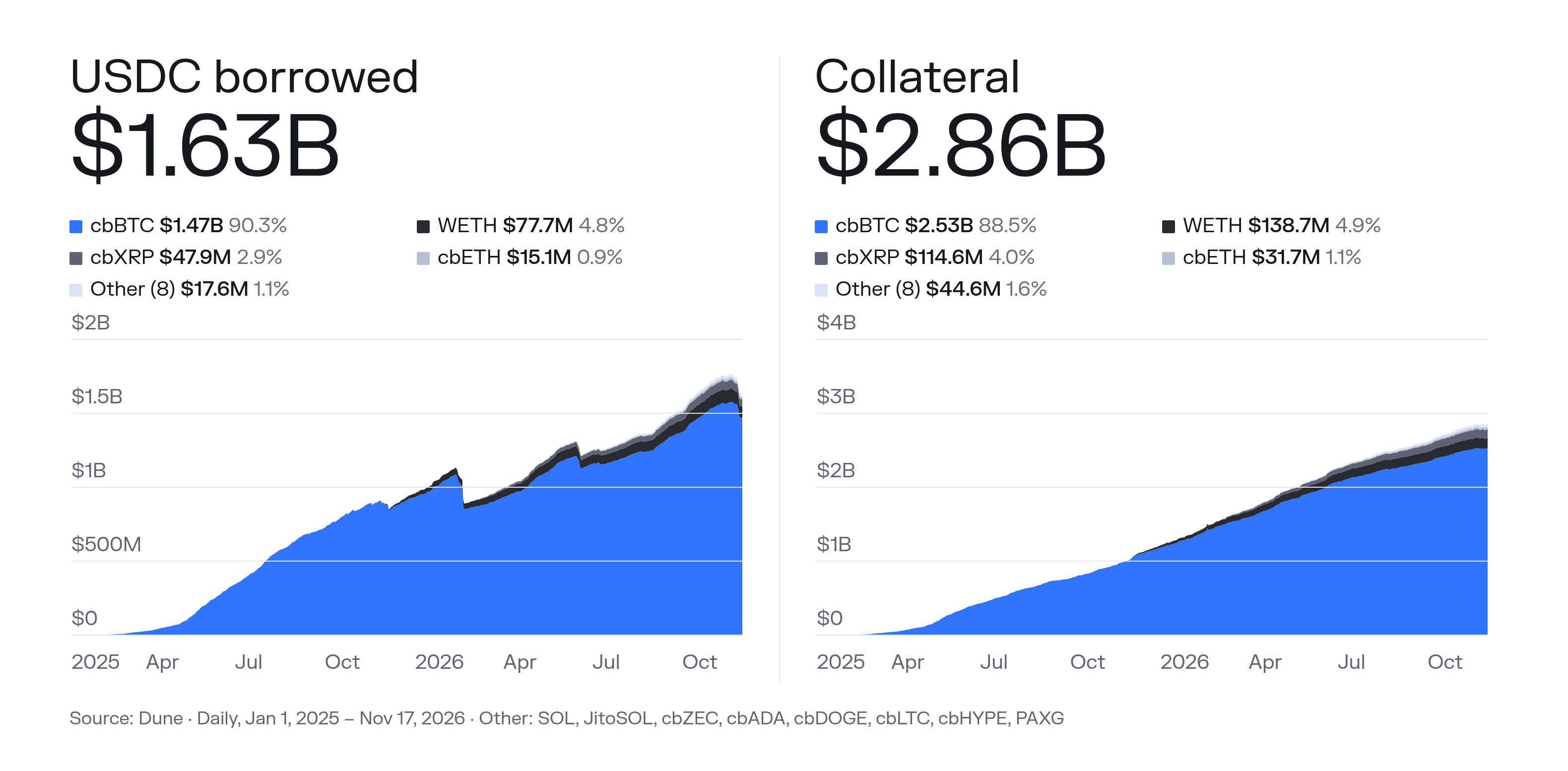
Morpho announced the expansion on Nov. 17. Its product-wide snapshot put outstanding Coinbase Borrow loans at $1.63 billion in USDC, backed by about $3 billion in crypto collateral.
Coinbase Chief Financial Officer Alesia Haas drew the accounting distinction on the company’s Oct. 29 analyst call. She said:
“We also are growing retail loans, but those are off balance sheet through our partnership with Morpho.”
Coinbase’s quarterly filing shows about $2 billion in institutional loan receivables at Sept. 30. Haas said Coinbase funds that book with corporate cash and with crypto or USDC that consenting institutional clients lend to Coinbase for it to lend onward.
Who supplies the money
For a Bitcoin-backed loan, Coinbase converts the pledged Bitcoin to its cbBTC wrapped version, and sends it to a Morpho smart contract on Base. Participants supplying USDC to Morpho’s lending markets provide the capital available for borrowers to draw.
Who funds Coinbase’s crypto loans?
The two lending arrangements draw on different sources of capital.
Coinbase connects retail borrowers to Morpho’s markets. It funds a separate institutional book and carries those receivables.
The amounts refer to separate portfolios and reporting dates. The dotted line shows how borrowers access Morpho through Coinbase’s app.
Sources and evidence
Sources
Supporting facts
- Morpho's Nov. 17 snapshot showed $1.63 billion in USDC loans outstanding against $2.86 billion in collateral across Coinbase Borrow. [1] [2]
- Reported statement On Oct. 29, Coinbase CFO Alesia Haas said the retail loans made through the company's Morpho partnership were off Coinbase's balance sheet. [3]
- Coinbase reported $1.976137 billion in Sept. 30 loan receivables, or about $1.98 billion. Note 6 attributes the balance to institutional financing lending arrangements, including an immaterial amount of trade-finance receivables. [4]
- Reported statement Haas said Coinbase funds its separate institutional lending book with corporate cash and with crypto or USDC that consenting institutional customers lend to Coinbase for it to relend. [3] [4]
- Coinbase supplies the retail interface for Coinbase Borrow. For bitcoin-backed loans, Coinbase converts pledged BTC to cbBTC and transfers it to Morpho's smart contracts on Base. Lenders supply the USDC available to borrow in Morpho's markets. [5] [6] [2] [7]
Method
Arrows trace the reported directions of funding. The retail outstanding balance is from Morpho’s Nov. 17 snapshot. The reported Sept. 30 Coinbase loan receivables are rounded to two decimal places in billions.
Scope
The amounts refer to separate portfolios and reporting dates. The dotted line shows how borrowers access Morpho through Coinbase’s app.
 CryptoSlate
Morpho says Coinbase Borrow has originated more than $3 billion since it launched in January 2025, including loans borrowers may already have repaid. The $1.63 billion figure measures what was still outstanding in the Nov. 17 snapshot.
Morpho co-founder Merlin Egalite sees a role for established financial firms in that arrangement. He told CryptoSlate:
“Banks and fintechs don’t disappear in this model. They own the customer relationship, distribution and compliance, while the network handles the plumbing.”
Alea Research’s third-quarter benchmark attributed 62% of the roughly $2 billion increase in Morpho’s outstanding loans to chains and collateral associated with Coinbase, Robinhood, Circle and Kraken.
Alea groups loans by the blockchain or collateral they use. For example, its Coinbase category covers loans backed by Coinbase-branded collateral on Base, across all interfaces. The groupings show where the debt sits and which assets back it, and they can include loans that originated outside the companies’ apps.
The trade-offs for borrowers
Jacob Frantz, Coinbase’s head of yield and investment products, framed the appeal in terms of what customers can do with assets they already hold. He told CryptoSlate:
“People ultimately want more flexibility baked into their financial services, without compromising trust.”
Coinbase’s New York terms limit eligible collateral to Bitcoin, Ethereum, and Solana and offer variable-rate loans only. The rate can move as supply and demand change in the lending market, and Coinbase may add a platform fee.
Each draw also carries a processing fee that gets added to the loan balance and accrues interest.
Coinbase says variable-rate loans have no set term or minimum payments. Borrowers can repay part or all of a loan at any time, but they need to watch the amount they owe relative to the collateral's value.
A drop in the collateral price or a rise in the balance as interest accrues can push the loan to the point of liquidation.
Coinbase also lists risks involving the lending protocol’s security and liquidity and its own wallet.
Mentioned in this article







Editorial credits