
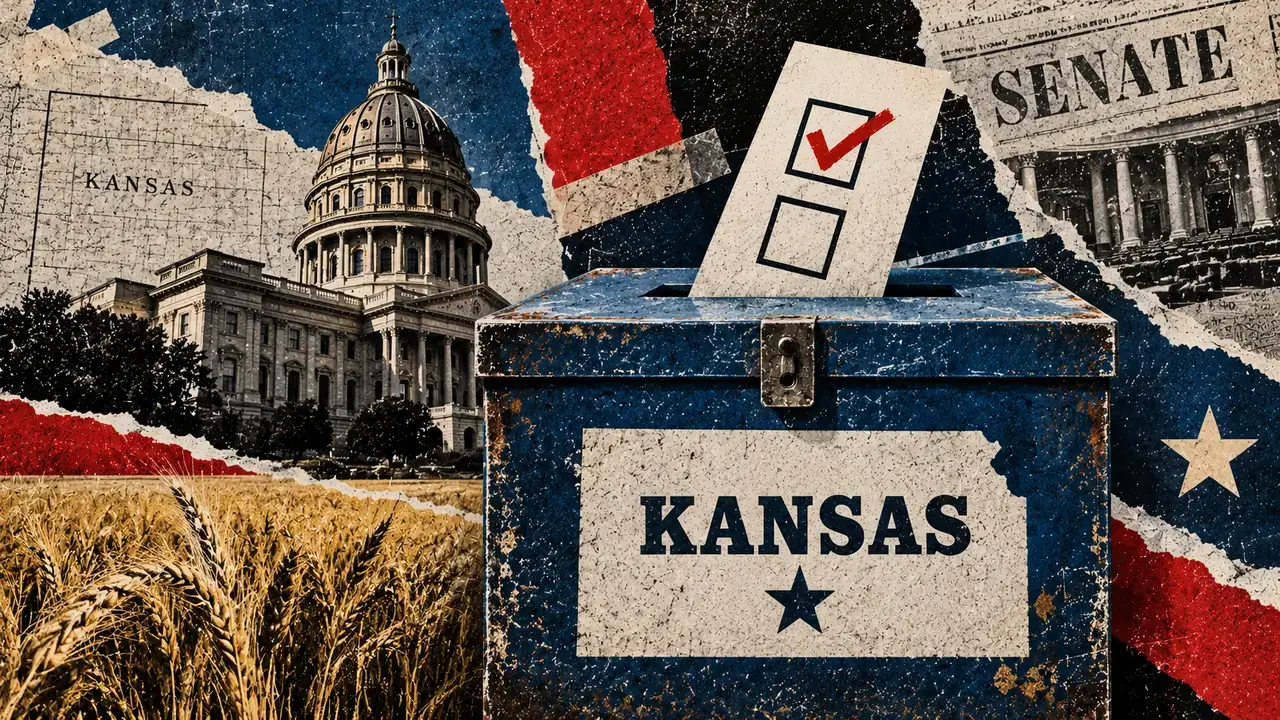
Who will win Kansas’s 2026 US Senate election?
Current Odds


Market Analysis
Kansas Senate election favors Marshall’s cash reserve over Hamilton’s fundraising challenge
Roger Marshall’s incumbency and spending capacity support a Republican-favored baseline, while Adam Hamilton’s receipts establish a credible challenge. The decisive test is whether Democratic fundraising produces measurable voter movement before Kansas’s registration and advance-voting deadlines narrow the campaign’s remaining opportunities.

Roger Marshall’s strongest advantage in Kansas’s 2026 Senate election is the combination of an established Republican electoral baseline and substantially more cash available to defend it. Adam Hamilton’s fundraising creates a plausible challenge, but the Democratic campaign still needs evidence that its resources can change voter preferences or turnout. That distinction explains why substantial challenger receipts can coexist with an incumbent-favored assessment.
The supplied Polymarket snapshot contains no outcome prices, so it cannot establish an observed ranking or the size of Marshall’s advantage. The supported inference is narrower: the election history and campaign-finance record favor Marshall unless fresh evidence shows Hamilton overcoming those structural advantages.
Marshall’s 2020 Kansas victory sets the electoral hurdle
Marshall defeated Democrat Barbara Bollier by more than 11 percentage points in 2020, according to the supplied AP race background. That result supplies a concrete reason to begin with a Republican-favored baseline: a serious Democratic challenge previously failed to bring this Senate seat within a narrow margin.
The causal assumption is that enough of the electorate’s partisan preference persists into 2026. Marshall also enters as the sitting senator, giving his campaign an established identity to defend. Neither fact determines the result. The previous margin becomes less predictive if credible polling shows substantial Republican defections, a different turnout composition, or a sustained shift toward Hamilton. The supplied record contains no polling that establishes such movement.
Campaign cash gives Marshall more room to respond
The supplied FEC summary for Marshall reports $5,388,078.28 in cash on hand through July 15, 2026, compared with Hamilton’s $1,730,620.91. Marshall’s reserve is approximately 3.1 times Hamilton’s, a gap that matters because cash remaining can finance subsequent advertising, voter contact, and responses to attacks.
This supports an inference about campaign resilience. If Hamilton gains attention or improves in polling, Marshall has more reported financial capacity to answer. That can make an emerging challenge harder to sustain, particularly if the challenger must spend heavily to persuade voters while the incumbent defends an existing coalition.
The hidden assumption is that available money will fund effective campaign activity. Cash balances do not measure message quality, voter receptiveness, or outside spending. Later filings showing Hamilton narrowing the reserve gap, or disclosed outside expenditures expanding Democratic reach, would weaken the financial explanation for Marshall’s advantage.
Hamilton’s receipts are the strongest counter-signal
Hamilton filed his statement of candidacy on April 30, 2026, and reported $4,169,077.81 in receipts through July 15, according to his FEC candidate overview. Those receipts establish a funded challenger capable of conducting a campaign. They also caution against treating Marshall’s cash advantage as proof that Democrats cannot compete.
Receipts and cash on hand answer different questions. Receipts show money raised; the remaining balance shows reported funds still available. The supplied figures do not establish whether Hamilton’s spending built useful campaign capacity or failed to persuade voters. Either interpretation would require additional evidence. Sustained polling gains alongside continued fundraising would strengthen the case that his resources are changing the contest; stagnant support despite spending would weaken it.
Kansas election deadlines narrow the paths to change
The Kansas secretary of state’s filing announcement places the partisan deadline on June 1 and the independent-candidate deadline on August 3. Once those deadlines pass, ordinary new-candidate entry becomes a less plausible source of change. Attention shifts toward the existing campaigns, voter preferences, and mobilization.
The official election calendar sets October 13 as the registration and address/name-update deadline, October 14 as the start of in-person advance voting, and November 3 as Election Day. Registration efforts must reach eligible voters before the cutoff. Campaign persuasion then begins operating alongside actual advance voting, reducing the share of voters still available to influence as ballots are cast.
Polling and turnout must test the Republican baseline
The strongest failure mode for a Marshall-favored assessment is a changed electorate that historical results and July cash balances do not capture. Hypothetically, Hamilton could attract crossover support while mobilizing voters who previously stayed home. The supplied evidence does not establish either development.
Repeated credible polls showing a narrowing race would directly challenge the partisan-baseline assumption. New financial disclosures could test campaign capacity. After October 14, advance-voting participation could help assess mobilization, although participation alone cannot establish candidate choice. The next meaningful test is whether these measures converge on a competitive race before voting opportunities begin closing.
Sources
Market Details
- Resolution criteria
- This market will resolve according to the winner of the 2026 midterm Kansas U.S. Senate election, inclusive of any run-offs.
- Platform
-


- Category
- Politics › US Election
- Scheduled deadline
- November 4, 2026, 4:59 AM UTC
- Market rules summary
- Multi-outcome Polymarket event. Each listed option is represented by its Yes price on the underlying market. View full rules
Frequently Asked Questions
What are the current Who will win Kansas’s 2026 US Senate election odds?
Polymarket reports Who will win Kansas’s 2026 US Senate election odds with Roger Marshall (R) at 62.5% and Adam Hamilton (D) at 37.5%. These probabilities are market-implied and can change as liquidity and trading activity update. The latest market snapshot includes $884.67K volume, $453.12K liquidity, and $566.9K open interest. CryptoSlate last synced this market data at Oct 13, 2026, 00:53 UTC.
How does the Who will win Kansas’s 2026 US Senate election prediction market resolve?
This market will resolve according to the winner of the 2026 midterm Kansas U.S. Senate election, inclusive of any run-offs. Multi-outcome Polymarket event. Each listed option is represented by its Yes price on the underlying market.
Related US Election Markets
 Who will win Alaska’s 2026 US Senate election?


 Which party will win Tennessee’s 2026 US Senate election?

 Which party will win Iowa’s 2026 US Senate election?

