

Republican Presidential Nominee 2028
Current Odds


37 more outcomes Listed by current odds, highest first


Odds Summary
J.D. Vance leads at 48.9% reported probability on Polymarket.
Polymarket · Last synced
Market Analysis
Vance Leads, Rubio Lingers as GOP Succession Market Gets Crowded
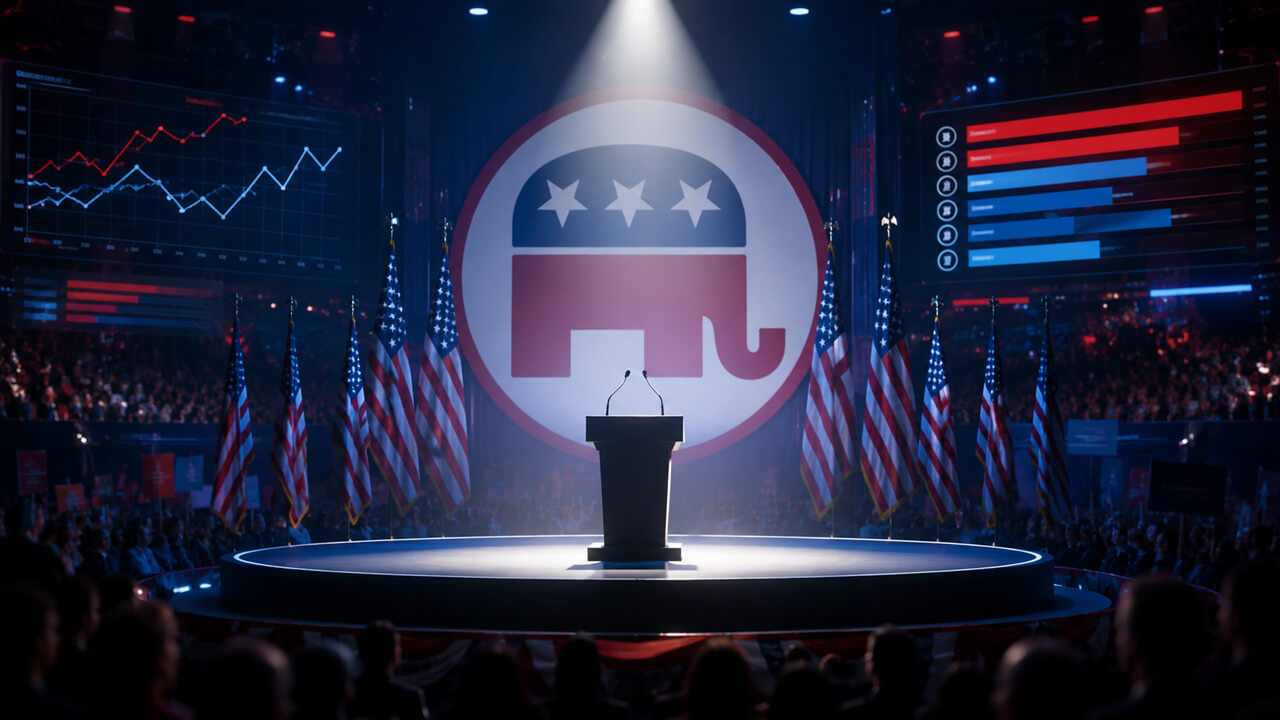
The market-implied story reads like a succession fight, with a secondary lane for coalition repair. The payoff comes from the assumptions embedded in that split, especially around endorsement power, acceptability, and campaign durability years before voting begins.

The market’s strongest message is that the 2028 Republican nomination is being priced as an inheritance contest with two credible shapes: a direct handoff lane led by J.D. Vance and a consolidation lane led by Marco Rubio. The gap matters because the contract resolves only on winning and accepting the nomination, so symbolic prominence, media attention, and family-name recognition must translate into a convention outcome.
Vance’s lead prices a cleaner succession path than the field offers
At 34%, Vance holds the top position by a wide margin, which implies the market sees him as the cleanest vehicle for continuity in a party field crowded with alternatives. That inference comes from rank and concentration, since the supplied market context does not include polling, endorsements, or campaign filings. The reason it matters is mechanical: early perceived coordination can shape who raises money, who enters, and who decides to wait, even before formal campaign evidence exists.
His small 24-hour gain of 0.1 percentage points adds little as a standalone move. Its value is in showing that the lead is currently stable despite the long calendar. For a market closing on Nov. 7, 2028, stability at this stage prices more than candidate popularity; it prices an assumption that the party’s strongest actors eventually prefer a relatively orderly succession path.
Rubio’s second-place price keeps a consolidation path alive
Rubio at 22.8% prevents the market from reducing the race to a single succession narrative. His price implies a second route in which familiarity, perceived general-election appeal, and broader acceptability become decisive if the leading lane loses momentum. Because the supplied context gives only market data, that reading rests on pricing structure: Rubio is close enough to matter, yet far enough behind that the market assigns him the role of alternative consolidator.
The 0.8 percentage-point decline over 24 hours is modest, but it matters because Rubio’s path likely depends on patience. A candidate priced as a consolidator benefits from fragmentation lasting long enough to create demand for a unifying option, then ending fast enough to avoid a drawn-out convention fight. That tension explains why Rubio can rank second without displacing Vance’s lead.
The long tail treats fame as optionality until organization appears
Below the top two, the market disperses across a wide set of names: Tucker Carlson at 6.5%, Ron DeSantis at 3%, Donald Trump Jr. at 2.6%, Donald Trump and Thomas Massie at 2.1%, and many others clustered near 1%. That structure matters because it separates recognition from nomination viability. The market allows room for shock entrants, media-driven surges, and factional protest bids, while assigning limited probability to paths that lack visible coalition machinery in the supplied data.
| Price cluster | Market-implied role | Why it matters |
|---|---|---|
| Vance and Rubio | Primary succession and consolidation lanes | They anchor most of the serious nomination probability |
| Carlson and DeSantis | Recognizable challengers | They can absorb attention if the top lanes weaken |
| Near-1% names | Tail scenarios | They keep procedural, celebrity, and surprise-entry outcomes alive |
Large liquidity gives the story weight, the calendar keeps it brittle
The market has $656.28 million in volume, $45.76 million in liquidity, and $8.82 million in open interest, so the current ordering is supported by more than casual quote placement. That matters for interpretation because a large market can encode a broad consensus about which political paths currently look easiest. The long close date creates the opposite force: every top price must survive years of possible entry decisions, reputational shifts, factional disputes, and campaign-cycle shocks.
The resolution rule also narrows the target. The winning individual must win and accept the Republican nomination. That acceptance condition makes procedural clarity important. A name can receive attention, signal interest, or become a symbolic placeholder and still fail the contract if no accepted nomination follows. This helps explain why several famous names remain low despite their ability to generate attention.
Repricing would likely follow coordination, not stray chatter
The strongest catalysts would be events that convert implied paths into observable organization. A hypothetical endorsement cluster around Vance would confirm the handoff thesis embedded in his lead. A hypothetical donor, surrogate, or elected-official alignment around Rubio would make the consolidation thesis more concrete. Formal entries, refusals, or withdrawals by leading names would also matter because the market is currently pricing optionality across many people who may never pursue the nomination.
- Credible national or early-state polling, if released, would test whether the top two have voter support matching their market rank.
- Fundraising disclosures, if available in the future, would show whether listed contenders can build campaign infrastructure.
- Debate participation or exclusion, if the primary process reaches that stage, would reshape visibility for second-tier names.
- Any convention or rules ambiguity affecting who wins and accepts would directly touch the resolution standard.
The main counter-signal is a field that refuses to consolidate
The clearest failure mode for the current structure is prolonged fragmentation. Vance’s lead assumes enough actors eventually coordinate around a frontrunner; Rubio’s second-place role assumes an alternative can gather support if that coordination falters. A field with several durable candidates would damage both assumptions by turning the race into a delegate and endurance contest, where early market rank may matter less than staying power.
The counter-signal would be a sustained rise in one or more names outside the top two paired with meaningful liquidity, especially if Vance and Rubio both lose share. That would imply the market is moving away from a two-lane succession model toward a more open nomination fight. Until then, the price structure says the 2028 Republican race is being organized around inheritance first, consolidation second, and surprise scenarios at the margins.
Sources
What Could Move the Odds?
Market-Implied Thesis
Vance’s 50.3¢ Yes price implies he is viewed as the likeliest current path to winning and accepting the 2028 Republican nomination.
The thesis rests on his sitting vice-presidential platform, which gives him an institutional starting advantage in a post-Trump contest.
What Could Reprice It
The November 2026 midterms are the nearest defined national test that could reset perceptions of party strength, succession, and candidate viability.
A materially different-than-expected midterm result could alter elite support and the relative case for Vance, Rubio, or another contender well before nomination voting.
Where the Market May Be Weak
Headline volume and event liquidity do not establish executable depth in Vance’s individual contract, limiting how precisely 50.3¢ reflects broad conviction.
The market supplies aggregate $709.42M volume and $52.4M liquidity, but no outcome-level order-book depth or trader count; turnover is not the same as durable participation.
Counter-Signal
Rubio’s 15.4¢ price and high-profile State Department role provide the clearest established alternative to a Vance-led succession narrative.
His national-security portfolio and Florida base offer a distinct route to elite visibility and support if party actors seek a different standard-bearer.
Market Details
- Resolution criteria
- This market will resolve to “Yes” if the named individual wins and accepts the 2028 nomination of the Republican Party for U.S. president. Otherwise, this market will resolve to “No”.
- Platform
-


- Category
- Politics › US Election
- Scheduled deadline
- November 8, 2028, 4:59 AM UTC
- Market rules summary
- Multi-outcome Polymarket event. Each listed option is represented by its Yes price on the underlying market. View full rules
Frequently Asked Questions
What are the current Republican Presidential Nominee 2028 odds?
Polymarket reports Republican Presidential Nominee 2028 odds with J.D. Vance at 48.9%, Marco Rubio at 15.3%, Tucker Carlson at 3.2%, and Ron DeSantis at 2.7%. These probabilities are market-implied and can change as liquidity and trading activity update. The latest market snapshot includes $709.93M volume, $52M liquidity, and $9.17M open interest. CryptoSlate last synced this market data at Oct 7, 2026, 00:57 UTC.
What could move the Republican Presidential Nominee 2028 prediction market odds?
Vance’s 50.3¢ Yes price implies he is viewed as the likeliest current path to winning and accepting the 2028 Republican nomination. The thesis rests on his sitting vice-presidential platform, which gives him an institutional starting advantage in a post-Trump contest. Catalysts to watch include November 2026 midterm elections and New candidate entry or withdrawals.
How does the Republican Presidential Nominee 2028 prediction market resolve?
This market will resolve to “Yes” if the named individual wins and accepts the 2028 nomination of the Republican Party for U.S. president. Otherwise, this market will resolve to “No”. Multi-outcome Polymarket event. Each listed option is represented by its Yes price on the underlying market.
Related US Election Markets
 Texas Senate Election Winner

 Which party will win the Senate in 2026?

 Minnesota Democratic Senate Primary Winner