
Who will win Iowa’s 2026 governor election?
Current Odds


Market Analysis
Iowa’s 2026 governor market hinges on nomination and election assumptions
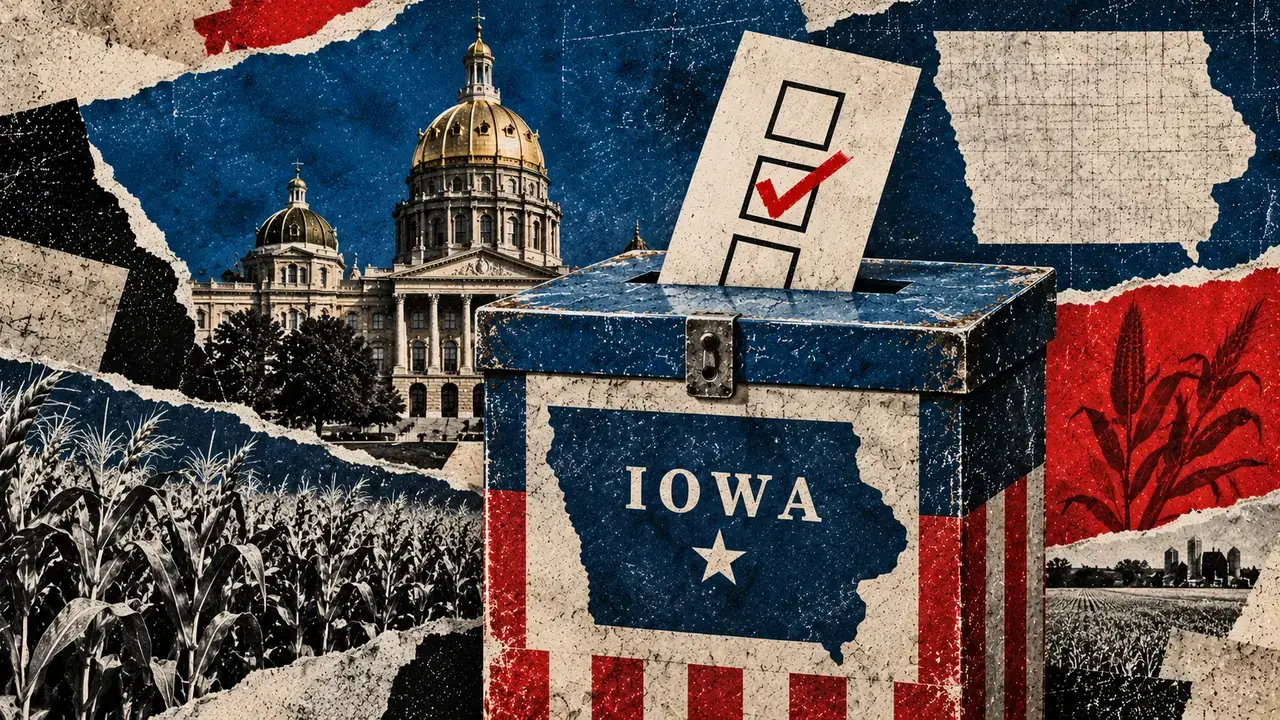
A candidate’s path to the governor’s office combines ballot access, party selection and general-election strength. The supplied record omits prices and candidate names, limiting any explanation of the current hierarchy, but those separate hurdles identify the evidence needed to test a favorite’s standing.

A favorite in Iowa’s 2026 governor election would need a credible route onto the ballot and a credible route to victory. Those hurdles can produce different candidate rankings: the strongest prospective nominee may face the weakest general-election matchup. The supplied Polymarket record contains no candidate outcomes or prices, so it cannot establish who leads or explain an observed price. The defensible analysis is conditional: what would have to support a hierarchy, and which developments would challenge it?
Iowa’s governor forecast combines nomination and general-election strength
For a candidate pursuing a party nomination, the election forecast combines the chance of securing that nomination with the chance of winning afterward. A hypothetical candidate with an 80% nomination probability and a 60% conditional general-election probability would have a 48% overall winning probability under that simplified model. Those figures illustrate the mechanism; they are not estimates for any Iowa contender.
This distinction changes how campaign evidence should be interpreted. A nomination endorsement could strengthen a candidate’s route through the party contest without demonstrating broader electoral appeal. Conversely, favorable general-election polling would provide limited support for an outright-win forecast if the candidate still faced a difficult nomination contest. An independent candidate would require a separate assessment of ballot access and electoral support.
A hierarchy could therefore rest on nomination certainty, general-election strength, or both. Without the candidate list and prices, choosing among those explanations would amount to guessing. Candidate announcements, withdrawals and evidence about the nomination contest would help identify which hurdle actually constrains each contender.
Party strength would need Iowa-specific evidence
A second possible explanation is that the hierarchy primarily follows expectations about which party will win Iowa’s governorship. Under that scenario, the leading candidate’s standing would depend heavily on being the most likely nominee of the favored party. A change in nomination expectations could then reorder candidates even while the forecast for party control stayed broadly unchanged.
Testing that interpretation would require documented Iowa election results, credible statewide polling and information about the actual field. None appears in the supplied context. The record also does not establish whether an incumbent is seeking another term. Incumbency, campaign organization and name recognition therefore cannot serve as factual explanations here.
The hidden assumption in a party-led forecast is that different nominees would perform similarly enough for party preference to dominate. Candidate-specific polling could weaken that assumption if alternative nominees produced materially different matchups. Evidence of crossover support, unusually high unfavorable ratings or a consequential campaign controversy could shift the explanation toward the individual candidate. These are hypothetical tests, not reported developments in this race.
Which 2026 campaign developments could change the forecast?
The clearest potential catalyst is a change in the field. A confirmed entry could create a new nomination obstacle for an existing contender. A withdrawal could remove one, although support would not necessarily transfer evenly among the remaining candidates. The causal question would be whose voters, endorsements and campaign resources become available, and whether another candidate can attract them.
Polling would answer different questions depending on its design. A nomination survey would test the route through a party contest. A statewide matchup survey would test performance against a specified opponent. Treating either as a complete forecast would obscure the other hurdle. Survey dates, sample composition, undecided shares and the candidates tested would determine how much each result could support.
Fundraising disclosures could provide another test if they showed a candidate gaining or losing the resources needed to sustain a statewide campaign. The relevant comparison would include spending and available cash, not receipts alone. No fundraising figures are supplied, so campaign capacity remains an untested explanation.
The strongest challenge is an opponent-dependent Iowa race
The strongest counterargument to a simple nomination-times-election model is that the two stages interact. A candidate’s nomination prospects may depend partly on perceived electability, while general-election prospects depend on whom the opposing party selects. One contender could perform well against one opponent and poorly against another. A single statewide poll would leave that matchup dependence unresolved.
The supplied record also omits resolution rules, preventing an assessment of how unusual outcomes would be handled. The next evidentiary step is a candidate-level price list paired with verified field information. That would allow a concrete test: whether the leader’s advantage survives plausible opponent changes, or depends chiefly on clearing the nomination contest.
Sources
Market Details
- Resolution criteria
- This market will resolve according to the winner of the 2026 Iowa gubernatorial election.
- Platform
-


- Category
- Politics › US Election
- Scheduled deadline
- November 4, 2026, 4:59 AM UTC
- Market rules summary
- Multi-outcome Polymarket event. Each listed option is represented by its Yes price on the underlying market. View full rules
Frequently Asked Questions
What are the current Who will win Iowa’s 2026 governor election odds?
Polymarket reports Who will win Iowa’s 2026 governor election odds with Rob Sand (D) at 90.5% and Zach Lahn (R) at 9.5%. These probabilities are market-implied and can change as liquidity and trading activity update. The latest market snapshot includes $196.6K volume, $146.92K liquidity, and $62.67K open interest. CryptoSlate last synced this market data at Oct 13, 2026, 20:32 UTC.
How does the Who will win Iowa’s 2026 governor election prediction market resolve?
This market will resolve according to the winner of the 2026 Iowa gubernatorial election. Multi-outcome Polymarket event. Each listed option is represented by its Yes price on the underlying market.
Related US Election Markets
 Who will win Nebraska’s 2026 US Senate election?


 Who will win Florida’s 2026 governor election?

 Who will win Kansas’s 2026 US Senate election?