
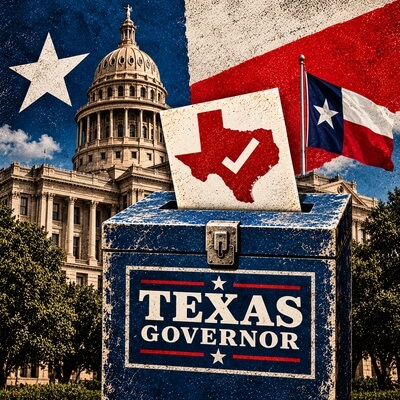
Which party will win Texas’s 2026 governor election?
Current Odds


Market Analysis
Texas governor market tests Republican durability against a near-tied Abbott poll

Greg Abbott’s incumbency gives Republicans a structural case for favoritism, while a late-campaign survey challenges assumptions about Texas’s electorate. The decisive question is whether that close result survives independent polling and the transition from likely-voter estimates to actual turnout.

The Republican case in Texas’s 2026 governor election depends on an electorate that continues to reward a familiar incumbent. The strongest supplied counter-evidence directly challenges that assumption: the latest University of Texas/Texas Politics Project poll puts Greg Abbott and Democratic challenger Hinojosa roughly one point apart. That makes the contest a test of how much predictive weight Texas’s Republican baseline deserves when current polling shows little separation.
Abbott’s fourth-term bid anchors the Republican case
Abbott is seeking a record fourth term, according to the UT/Texas Politics Project account. His incumbency and Texas’s established Republican strength supply the clearest explanation for Republican favoritism. The inference is that voters who have supported Republican statewide leadership will continue doing so, giving Abbott a durable base through the closing campaign.
That explanation carries a hidden assumption: familiarity continues to help Abbott. A long-serving governor gives voters an established record to evaluate, which can support continuity or concentrate dissatisfaction on the incumbent. The supplied evidence does not establish which effect dominates. Incumbency supports the Republican thesis only insofar as voters still prefer extending Abbott’s tenure.
The supplied market record includes no outcome prices, so it cannot establish the size of any Republican advantage. The defensible analysis concerns what could sustain that advantage, and what evidence would weaken it.
The UT poll challenges confidence in Texas’s baseline
The UT/Texas Politics Project survey interviewed 861 likely voters from September 25 through October 5, 2026, and found Abbott and Hinojosa separated by roughly one point, within the poll’s margin of error. The university describes historically close competition. That result gives the Democratic case a specific empirical foundation beyond a hypothetical favorable campaign.
A narrow polling gap matters because ordinary differences between the survey’s electorate and the electorate that votes could change the leader. It also limits what can reasonably be inferred from Abbott’s incumbency alone. A Republican advantage based heavily on historical strength would need to accommodate evidence that the current contest is much closer.
The competing explanation is that this survey captures a close sample without accurately describing the eventual electorate. One poll cannot distinguish a durable competitive race from survey-specific variation. Independent surveys using different sampling and turnout methods would help resolve that distinction. Repeated narrow results would weaken the argument that this finding is isolated.
Likely voters make turnout the central hidden assumption
The survey’s likely-voter designation narrows its relevance to people expected to participate, yet that expectation remains an estimate. Neither the supplied poll summary nor the market context provides the turnout model, subgroup results, or candidate support by participation history. Those gaps prevent a supported claim about which party benefits from any modeling error.
Two conditional scenarios follow. If Abbott’s supporters participate more consistently than the survey anticipates, a near-tied poll could coexist with a clearer Republican result. If Hinojosa’s supporters participate at stronger-than-expected rates, the same polling picture could precede a Democratic win. These are turnout mechanisms, not findings about either campaign’s electorate.
Evidence about participation would therefore matter most when connected to credible information about candidate preferences. Aggregate turnout alone cannot establish which party is gaining votes.
Texas’s voting calendar narrows the paths to change
The Texas secretary of state’s calendar sets Election Day for November 3, with early voting October 19–30 and an October 5 registration deadline. Once registration closes, campaigns’ remaining opportunities center on persuading eligible voters and getting supporters to cast ballots.
Early voting also changes the reach of late campaign developments. As ballots are cast, a new message or controversy can influence only voters who have not yet voted. A hypothetical debate breakthrough or damaging disclosure would therefore need evaluation against both its persuasive force and its timing. The supplied record establishes no such event.
Independent confirmation would strengthen Hinojosa’s challenge
The strongest counter-signal to Republican durability remains the near-tied UT result. Its weakness is the absence of corroborating polling in the supplied evidence. A subsequent independent survey showing comparable competition would strengthen the case that Abbott faces a sustained challenge. A clear Abbott lead would support the alternative explanation that the UT result did not capture the eventual balance.
The next useful catalyst is a fresh, methodologically transparent survey, especially one fielded during early voting that separates people who have already voted from those still planning to participate.
Sources
Market Details
- Resolution criteria
- This market will resolve according to the winner of the 2026 Texas gubernatorial election.
- Platform
-


- Category
- Politics › US Election
- Scheduled deadline
- November 4, 2026, 4:59 AM UTC
- Market rules summary
- Multi-outcome Polymarket event. Each listed option is represented by its Yes price on the underlying market. View full rules
Frequently Asked Questions
What are the current Which party will win Texas’s 2026 governor election odds?
Polymarket reports Which party will win Texas’s 2026 governor election odds with Greg Abbott (R) at 76.8% and Gina Hinojosa (D) at 22.5%. These probabilities are market-implied and can change as liquidity and trading activity update. The latest market snapshot includes $575K volume, $310.72K liquidity, and $211.4K open interest. CryptoSlate last synced this market data at Oct 16, 2026, 15:47 UTC.
How does the Which party will win Texas’s 2026 governor election prediction market resolve?
This market will resolve according to the winner of the 2026 Texas gubernatorial election. Multi-outcome Polymarket event. Each listed option is represented by its Yes price on the underlying market.
Related US Election Markets
 Who will win Alaska’s 2026 governor election?


 Which party will win Ohio’s 2026 governor election?

 Who will win Iowa’s 2026 governor election?

