
How many Senate seats will Republicans hold after the 2026 midterms?
Final Results
Scheduled deadline: Nov 3, 2026, 17:00 UTC
6 more outcomes Other final results
Market Resolution
Polymarket reports ≤47 as the winning outcome for the How many Senate seats will Republicans hold after the 2026 midterms prediction market with a final probability of 100%. Scheduled deadline: Nov 3, 2026, 17:00 UTC. Final reported trading volume was $7.19M.
Polymarket · Final sync
 Democratic Presidential Nominee 2028


 Which party wins 2028 US Presidential Election?


 Republican Presidential Nominee 2028


Market Analysis
Republicans’ 2026 Senate cushion depends on how widely voter frustration spreads

A 53-seat starting point gives Republicans room to absorb losses, but shared pressure from war and household costs could connect otherwise separate contests. Alaska adds another complication: a close result and certification litigation could leave the final seat count unsettled after voting ends.

Republicans’ 2026 Senate cushion depends on whether voter frustration stays concentrated in a few contests or spreads across their defense map. Starting from 53 seats, Republicans can absorb two net losses and retain an outright majority. The central inference is that national dissatisfaction could make several Republican-held seats vulnerable together. The supplied market record contains no outcome prices, so it cannot establish which seat total currently leads.
The 53-seat starting point creates a narrow buffer
The arithmetic separates a difficult election from a loss of Senate control. Three net losses would leave Republicans with 50 seats; four would leave them with 49. Any Republican pickup elsewhere would offset a loss. Analysis that counts vulnerable Republican incumbents without considering possible gains therefore leaves the seat-total calculation incomplete.
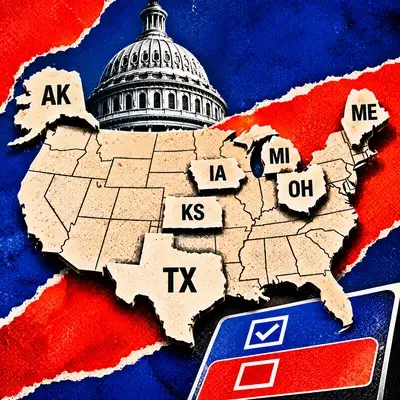
The Senate’s official Class II list identifies terms expiring January 3, 2027, including Republican-held seats in North Carolina, Alaska, Iowa, Maine, Kansas and Nebraska. That establishes the exposure, though it does not establish equal competitiveness. The supplied evidence also offers no detailed Democratic-defense assessment. A lower Republican total consequently requires an explicit assumption about how few offsets the party secures.
Iran and gas prices could connect separate Senate races
Associated Press reports that Republican strategists see the Iran war and elevated gas prices hurting their candidates, especially in competitive states. AP also reports that voters in both parties want the next Congress to address affordability and end the war. These are reported assessments of political pressure, not measurements of its eventual effect on votes.
The causal concern is shared exposure. If voters associate household costs and the war with the Trump administration, Republican Senate candidates could face the same penalty across multiple states. Under that scenario, treating each race as an isolated local contest would miss the possibility of clustered losses. Several individually survivable races could deteriorate together.
This explanation assumes dissatisfaction changes turnout or candidate choice. Frustrated voters might still support their Republican senator, distinguish congressional candidates from the administration, or prioritize other issues. Sustained state-level polling deterioration would strengthen the shared-pressure thesis. Falling gas prices or reduced war-related concern would weaken it, especially if Republican candidates recovered across several contests.
John Thune’s intervention tests Republican turnout resilience
AP describes Senate Majority Leader John Thune traveling to key races and urging turnout as Republican leaders work to protect their majority before the November 3 election. His intervention supports the view that party leaders perceive a meaningful threat. It does not, by itself, quantify that threat.
Leadership attention has two competing interpretations. It can reveal concern that ordinary campaign efforts will fail to produce enough Republican votes. It can also bring attention and organizational support to endangered candidates, helping contain losses. The strongest counterargument to a broad Republican retreat is that defensive mobilization works and local candidates retain support despite dissatisfaction with national conditions.
Evidence of improved Republican engagement in targeted states would support that counterargument. Continued weakness after sustained leadership intervention would suggest the problem extends beyond mobilization.
Alaska creates a seat-count risk and a certification question
AP reports a likely photo finish between Republican Senator Dan Sullivan and Democrat Mary Peltola, alongside a Trump administration lawsuit seeking to block certification if Sullivan loses. Alaska therefore supplies a specific route to a Republican loss outside a generic national-swing scenario.
The electoral and legal questions require separate treatment. A Peltola victory would change the projected partisan count. A certification challenge could affect when that result becomes settled; the existence of a lawsuit does not establish that it will succeed. Because the supplied market record lacks resolution rules, the analysis cannot assume how delayed certification would affect settlement.
The next evidence must distinguish isolated losses from a broader shift
The clearest repricing catalysts would be comparable state polls moving against several Republican candidates, evidence that turnout efforts are arresting those declines, and Alaska results or court orders that clarify the count. A single weak race would support a narrower loss scenario. Repeated deterioration across the defense map, without credible Republican pickups elsewhere, would support a lower final total. Alaska’s vote count and the courts’ treatment of certification could then determine both the last seat and the timing of clarity.
Sources
Market Details
- Resolution criteria
- This market will resolve according to the Republican Party’s seat count in the United States Senate as a result of the 2026 United States midterm election scheduled for November 3, 2026.
- Platform
-


- Category
- Politics › US Election
- Scheduled deadline
- November 3, 2026, 5:00 PM UTC
- Market rules summary
- Multi-outcome Polymarket event. Each listed option is represented by its Yes price on the underlying market. View full rules
Frequently Asked Questions
What was the final result of the How many Senate seats will Republicans hold after the 2026 midterms prediction market?
Polymarket reports ≤47 as the winning outcome for the How many Senate seats will Republicans hold after the 2026 midterms prediction market with a final probability of 100%. The final market snapshot includes $7.19M volume and $689.7K open interest. CryptoSlate last synced the final market data at Nov 4, 2026, 12:27 UTC.
How does the How many Senate seats will Republicans hold after the 2026 midterms prediction market resolve?
This market will resolve according to the Republican Party’s seat count in the United States Senate as a result of the 2026 United States midterm election scheduled for November 3, 2026. Multi-outcome Polymarket event. Each listed option is represented by its Yes price on the underlying market.
Related US Election Markets
 Which Senate Swing States will Republicans win? (Build Your Map)
 Which party will win Vermont’s 2026 governor election?