

Quick Take
- Polymarket’s five-minute Bitcoin markets have used 60-second averages for both opening and closing benchmarks since Aug. 14.
- Wang’s early post-change sample found the earlier Binance settlement-time pattern subsided, without measuring current wallet losses.
- Historical wallet gains cannot establish current exposure or combined strategy profits after underlying-market trades and execution costs.


Polymarket’s five-minute Bitcoin contract sampled on Oct. 27 uses averaged opening and closing benchmarks, following an August reform that changed the incentive to move its settlement price.
The current design requires a different risk assessment from the single-snapshot rule examined in earlier research.
An estimate of about $8.2 million earned by 821 wallets in earlier pushed cycles belongs to that historical research. Guangzhe Wang’s newer study cites the finding from Dai and co-authors.
Wang’s before-and-after results instead point to a subsiding Binance trading pattern in the first weeks after averaging. That gives the reform an empirical test, while keeping separate whether an observed settlement-time pattern declined and how much traders lose under the current rule.
The Oct. 27 Bitcoin market, covering 12:20-12:25 p.m. ET, names Chainlink’s BTC/USD 60-second time-weighted average price (TWAP) as its resolution source. Up wins when the ending benchmark is at least as high as the opening benchmark, and Down wins otherwise.
The Dai, Jia and Yu working paper, submitted to arXiv on June 30, reported settlement-time spot-flow spikes and subsequent reversals after the five-minute contract’s launch. The broader finding concerns the incentive to move the underlying reference market.
Wang’s newer paper examined Binance one-second data from July 1, 2025, through Sept. 4, 2026, with 82,752 Bitcoin boundaries where only the five-minute contract settled. For each sampled five-minute window, he measured the share of Binance volume traded in its final ten seconds:
| Regime | Final-ten-second volume share |
|---|---|
| Before five-minute contract launch | 3.05% |
| Single-snapshot settlement | 5.68% |
| 60-second average settlement | 3.02% |
In the first three weeks of the 60-second regime, Wang found no systematic migration into earlier bins and no recurrence of the earlier near-strike reversal pattern.
That bounded observation is consistent with the reform’s effectiveness for the measured pattern. It is neither a current wallet-profit audit nor proof that every possible manipulation strategy has disappeared.
The study tests an observed response to the reform, and its outcome is a trading pattern.
Two averages decide the bet
According to Polymarket’s changelog, crypto up/down markets switched from single snapshots to Chainlink-computed averages on Aug. 7. Both the opening price to beat and the final settlement value moved to the applicable TWAP feed.
On Aug. 14 at 00:00 UTC, the platform extended five-minute crypto markets to 60 seconds. The October contract reflects an operating rule introduced more than two months earlier, and its five-minute duration should not be confused with its one-minute benchmark window.
Under a snapshot rule, an unusually brief move can be important if it affects the selected reference price. Under an average, its contribution depends on how much of the measurement window it influences.
The economic question becomes whether the benefit on the prediction-market position exceeds the cost of affecting that average and executing the strategy.
A historical dollar gain cannot be carried into that changed calculation without evidence that the old behavior and economics still apply.
Polymarket’s documentation says it takes the applicable average, just as it does for the closing value. Evaluating a disputed result requires the reference values used at both boundaries, along with the relevant report timing.
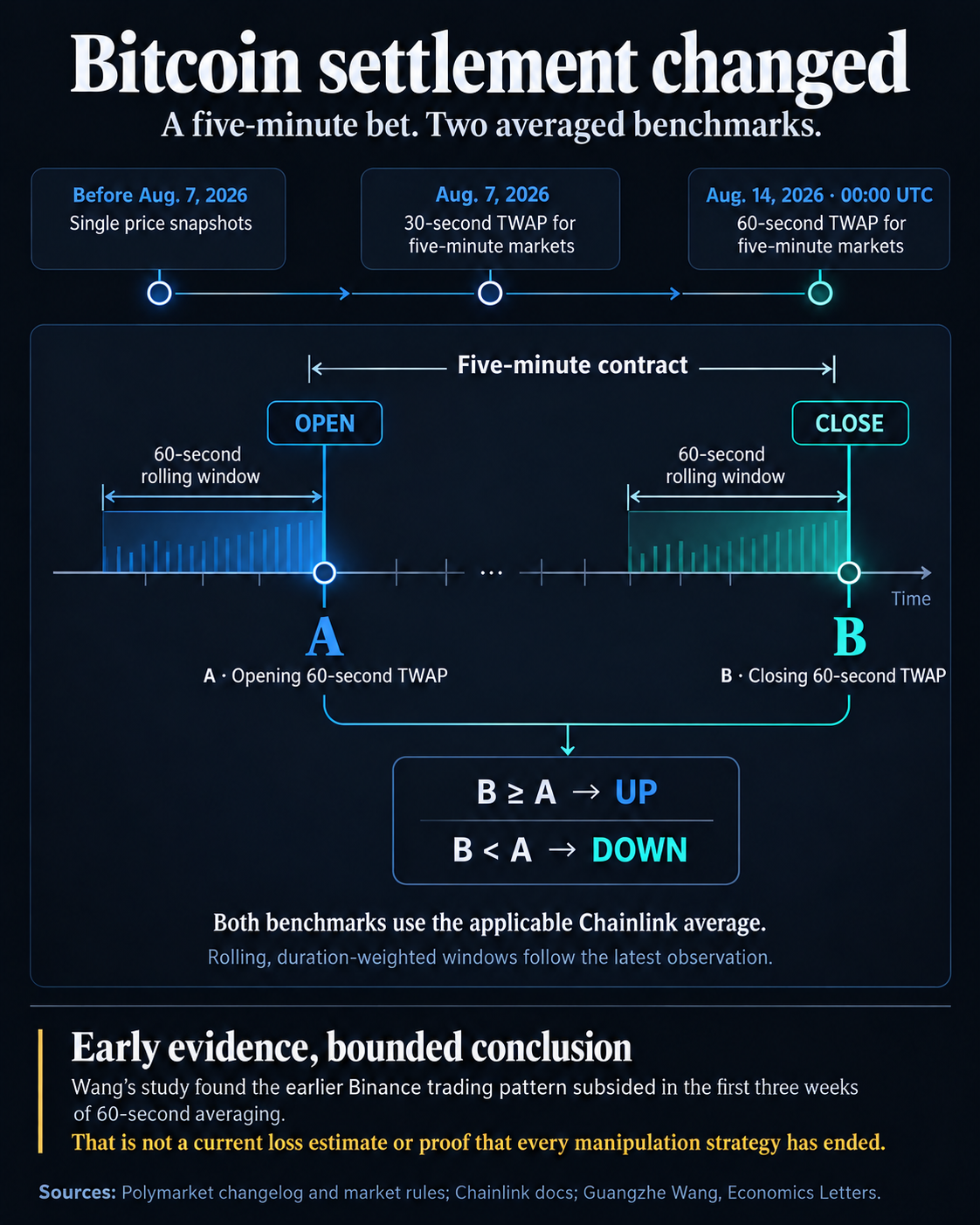
Chainlink’s timestamp documentation explains why the time printed on an exchange chart is insufficient. Each underlying report has a validity start and an observation timestamp, but report widths can vary, including when a later report absorbs a gap. The TWAP weights prices by the duration they cover.
The average also rolls with the latest observation rather than automatically snapping to a round clock minute. A 60-second TWAP is therefore neither the average price across the entire five-minute bet nor necessarily sixty equally weighted ticks.
What the old dollar figure cannot answer
A gain on a prediction-market position and the net return from a strategy involving the underlying asset are different measurements. If moving Bitcoin’s reference price requires trading Bitcoin, that leg and its execution costs belong in the profitability calculation.
Polymarket Institute distinguishes the decentralized international exchange from Polymarket US, with separate APIs and separately managed data.
Talos’s Oct. 27 quarterly review highlights its Kalshi integration and points to earlier analysis of potential Polymarket settlement manipulation.
The remaining measurement is financial as well as behavioral: gains and losses under the averaged rule, with the relevant underlying-market trades and execution costs accounted for.
Mentioned in this article


Editorial credits