


- Project-led selection using profile signals
- Embedded wallet available at signup
- Approval-first or deposit-first sales
Legion Overview
- Crypto Launchpad Name
- Legion
- Platform Type
- ICO Platform, Reputation-Based Launchpad
- Access Model
- Connected Wallet
- KYC Level
- Full KYC
- Core Sale Types
- ICO, Private / Community Round
- Allocation Model
- Merit / Reputation-Based, Hybrid, Varies By Sale
- API / Public Data Access
- Limited
- Status
- Live
Legion Screenshots
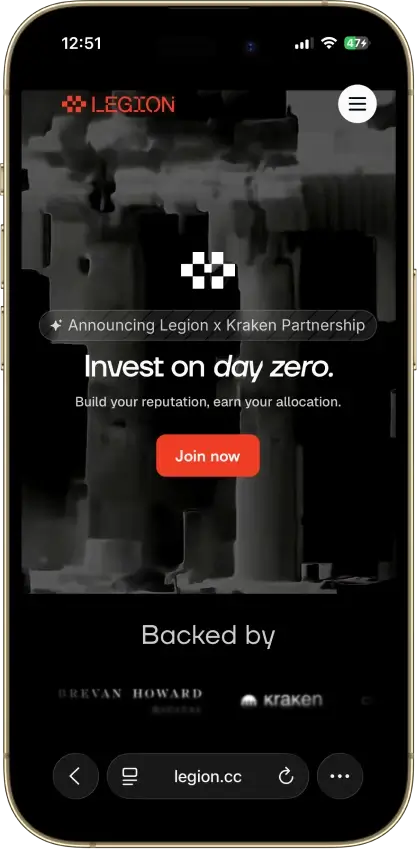
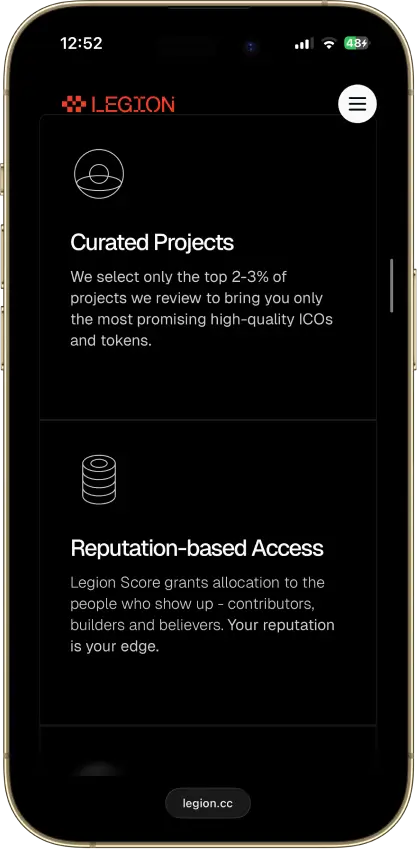
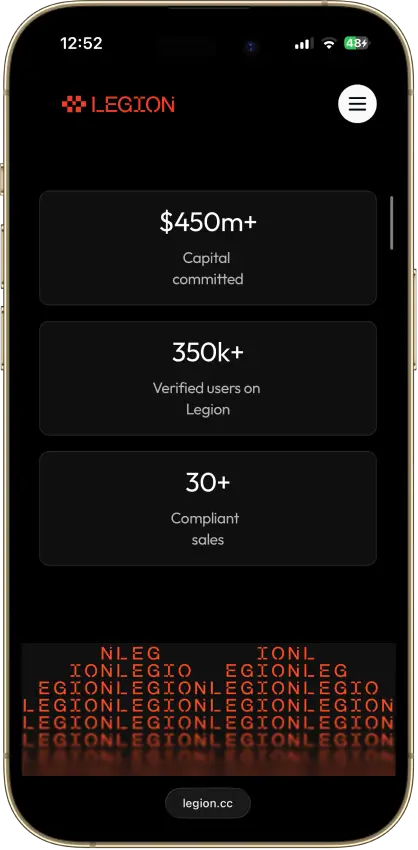
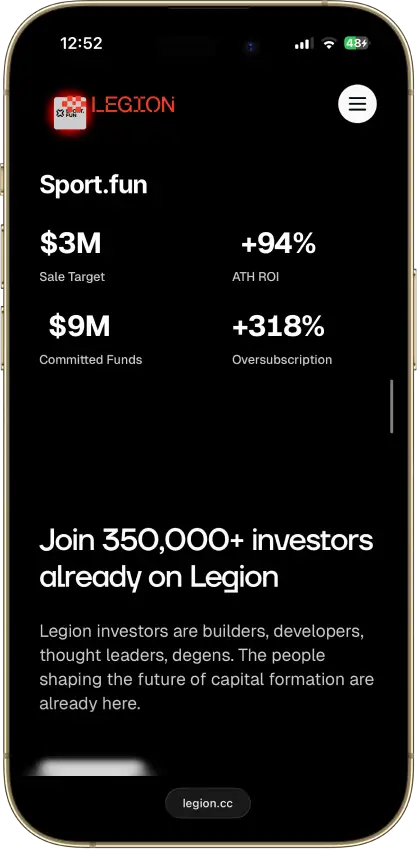
Screenshot 1 of 8
Legion Pros and Cons
Pros
- Jumper and Squid used direct USDC commitments
- Jumper and Squid describe allocation methods
- Unused deposits have an explicit reclaim process
Cons
- A high score can still result in no allocation
- Withdrawal guides give conflicting starting dates
- No Legion refund liability for project failure
Who Legion Suits

| User | Assessment |
|---|---|
| Users with an established onchain profile | Legion gives projects signals beyond the amount committed, although selection remains discretionary. |
| USDC holders considering a specific project | Jumper and Squid used USDC funding. The selected sale determines the asset, network, and application steps. |
| Users who need a predictable allocation | A score and a deposit leave the outcome uncertain until the project decides. |
| Users who need prompt access to their money | Reclaim steps, withdrawal deadlines, and token delivery require attention at different stages. |
Legion’s application process is easier to justify when you already want exposure to a particular project and can assess its purchase terms. Joining every available sale would create repeated application, funding, and claim tasks without a guaranteed allocation.
Applications, Legion Score, and Selection

Legion uses profile information and wallet activity to help projects assess applicants. Its score also considers social and developer signals. The project chooses how those signals affect its sale, so there is no universal conversion from score to allocation size.

Participation starts with an account, identity checks, and the sale’s application steps. Funding requirements belong to the individual sale. Jumper accepted USDC on Ethereum, which required users to budget for Ethereum transactions as well as the amount they wanted to commit.
Legion’s sale guide treats submitted applications as final. It also says a user who withdraws an application cannot submit it again. Choosing a deposit amount therefore requires more care than placing a provisional expression of interest.
Legion supports both deposit-first applications and sales where approved applicants fund later. Its Knowledge Hub describes the two approaches, while Jumper and Squid use the deposit-first process. The individual sale’s instructions determine when money is required.
Jumper’s Sale and the Current Catalog

Jumper’s application period began on Sep. 29, 2026 and ended on Oct. 2, 2026. Its continued catalog listing does not establish that applications remain open. Jumper announced allocations on Oct. 6, 2026. The announcement described community tiers and filters for linked wallets, with only the highest qualifying tier applying to each participant.
| Jumper Item | Scope |
|---|---|
| Funding asset | USDC on Ethereum |
| Application period | Sep. 29, 2026 to Oct. 2, 2026 |
| Public allocation announcement | Oct. 6, 2026 |
| Announced hard cap | $3 million |
| Announced deposits | About $48.6 million, including funds not accepted as allocations |
| Proposed public token release | 50% at token generation, then the remainder monthly over four months |

Deposits measure demand and capital awaiting allocation. They are not the amount the project ultimately accepted. The catalog and sale detail also use different participation counters, so neither figure provides a reliable count of successful buyers on its own.
Legion’s public Jumper page separates the application end from a later “Round closes” stage and still describes token generation and distribution as forthcoming. Jumper’s allocation announcement concerns selection, while claim and trading dates require separate confirmation.
Reclaiming Unused Funds and Withdrawing a Purchase
Unused deposits and an accepted purchase need different treatment. Money that receives no allocation can remain available to reclaim through the sale page. A reclaimable balance is not an automatic transfer back to an external wallet, so the user needs to complete the relevant action.
Legion’s help guides direct users to the reclaim control after applications have been processed. That action can return unused funds after a partial allocation as well as funds from an unsuccessful application. The accepted portion remains subject to the purchase agreement and its withdrawal conditions.
The Jan. 30, 2026 Launchpad Terms describe a withdrawal right beginning at the pledge and ending 14 calendar days after the sale window closes. It ends earlier if tokens are distributed to the wallet or the token is listed before that period finishes. Gas costs are not returned.
Legion’s explanations use inconsistent starting points. The reclaim guide refers to the application period, the sale guide refers to the conclusion of a token sale, and the Knowledge Hub counts from the time of investing. The legal terms refer to the sale window and include both early-expiry conditions.
Jumper adds a practical ambiguity because the application and round-closing stages have different dates. Its sale agreement and the applicable sale page need to resolve the deadline for that purchase. A generic 14-day answer is insufficient to calculate a buyer’s final withdrawal date, and the cancellation period should not be assumed to set the life of every unused-deposit balance.
The Token Purchase Agreement is between the buyer and the project. Legion’s Launchpad Terms direct claims over a breached agreement or failed token-generation event to that project and disclaim Legion’s refund liability for those failures. The withdrawal right therefore does not provide insurance against project non-delivery.
Claims, Vesting, and the Kraken Route
An allocation establishes how much a user can buy. Token delivery then follows the project’s release schedule, which can include an initial distribution and later vesting. Jumper’s proposed staged release would leave part of the purchased position unavailable at token generation.
Squid illustrates the additional wallet action that can follow selection. Its Aug. 4, 2026 guide instructed Legion participants to claim using the same wallet used for the sale. It described delivery to Kraken participants as account credit after settlement, with trading or withdrawal subject to the exchange’s opening schedule.
Kraken Launch is Kraken’s token-sale offering developed with Legion. Each participation route has its own recipient account or wallet and claim requirements. Selling also depends on delivery, vesting, and the availability of a market for the token.
Fees and Committed Capital
Legion’s general terms describe account creation and use of its services as free of platform fees, while reserving the ability to introduce fees later. Its Jumper and Squid guides describe USDC commitments without a separate launchpad-token staking step. Those sale examples still involve transaction costs and do not establish identical funding requirements for every campaign.
Users may spend gas to fund a sale, reclaim money, and claim or move tokens. Acquiring the accepted asset and bridging to the required network can create additional costs. These charges depend on the route and network, rather than a single fixed Legion total.
Capital can also remain committed while applications are reviewed. A small allocation can leave a user with both unused money to reclaim and an accepted position awaiting delivery. For smaller purchases, those separate transactions can make the network costs significant relative to the amount invested.
Allocation Fairness and Selection Limits

Legion gives projects tools to consider activity and contributions alongside committed capital. Jumper’s allocation announcement described tier rules and linked-wallet filtering. Its account of those decisions helps applicants understand which criteria the project used.
Project discretion can benefit an applicant whose contribution fits the project’s priorities. It can also make an unsuccessful result hard to predict from a score alone.
Wallet, Contract, and Privacy Risks

The embedded wallet reduces the need to bring a separate wallet at signup. Users remain responsible for account access and wallet security, while sale commitments interact with contracts and project-controlled delivery conditions. Pledged funds remain exposed to sale-contract behavior and project delivery even with user-held keys.
Legion’s security policy describes emergency actions for its app frontend and sale contracts, but those controls do not guarantee recovery after a contract loss.
The Zenith assessment dated Feb. 15–19, 2025 marked two high-severity findings as resolved. It also recorded a medium-severity issue as acknowledged, permitting pre-liquid projects to withdraw capital before supplying the purchased tokens. Legion’s response described that behavior as intentional because fundraising can precede token generation. The report covers specified pre-liquid code from that assessment period.
KYC, proof of address, and profile signals also require users to share identity and activity information. That information supports the application process, but participation involves a privacy cost beyond connecting a public wallet.
Support and Wallet Recovery
Legion’s Help Center covers verification, profiles, wallets, sales, and claims. Its direct contact address is hello@legion.cc.
The compromised-wallet guide describes conditional help linking a replacement wallet for eligible allocations. That can concern future token delivery, rather than recovery of assets already stolen. Assistance is voluntary and depends on timing and verification.
Legion’s vesting guide distinguishes projects whose token-generation event preceded Jul. 8, 2025 from those after that date. Older vesting contracts remain tied to the original wallet. For later events, the guide supports wallet-change requests through support. A profile wallet change alone does not redirect existing vesting contracts or guarantee recovery.
Legion Alternatives
-

Kucoin Spotlight
Uses a KuCoin account, with commitment and settlement rules set by each campaign.
-

Binance Launchpad
Its subscription format uses BNB commitments. Launchpool and other Binance distribution products have separate rules.
Legion’s project-led selection may suit applicants with a relevant activity history. An exchange-based route can suit someone who already keeps assets in that exchange account, but campaign eligibility and allocation still need checking.
Final Verdict
Legion makes sense for users who want projects to consider their activity and contributions when selecting buyers. A high score still leaves the project free to decline an allocation. Users need to distinguish unused money to reclaim from an accepted purchase with withdrawal conditions, then manage the project’s claims and vesting. That is a demanding process for anyone who needs predictable allocation or prompt use of their capital.

CryptoSlate may earn a commission when you use partner links, at no extra cost to you. Our reviews, ratings, and editorial decisions remain independent of advertisers. Read How CryptoSlate Makes Money for funding details.