

 Released in 2025
- Custom form offers 1% or 2% fees
- USDC, SOL, and JUP quote choices
- Meteora DBC-to-DAMMv2 migration
Jupiter Studio Overview
- Crypto Launchpad Name
- Jupiter Studio
- Release Date
- 2025
- Platform Type
- DEX / IDO Launchpad, Wallet Launchpad, Memecoin / Bonding-Curve Launchpad
- Access Model
- Connected Wallet
- KYC Level
- No KYC
- Core Sale Types
- Fair Launch, Presale
- Native Token Dependence
- None
- Allocation Model
- Bonding Curve, Mixed By Sale
- API / Public Data Access
- Limited
- Status
- Live
Jupiter Studio Screenshots
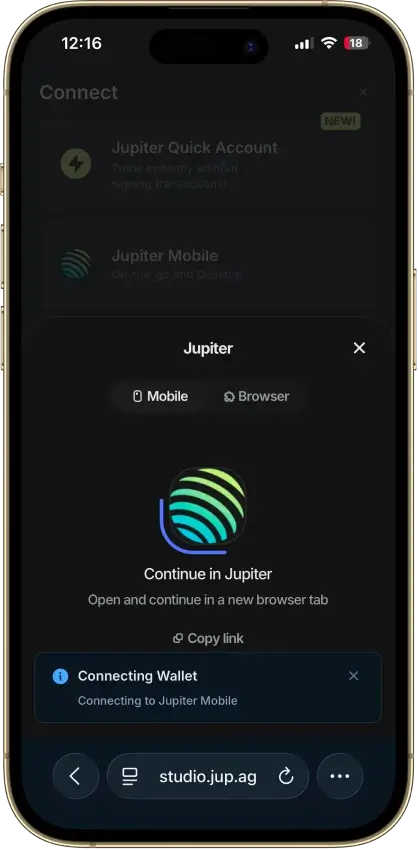
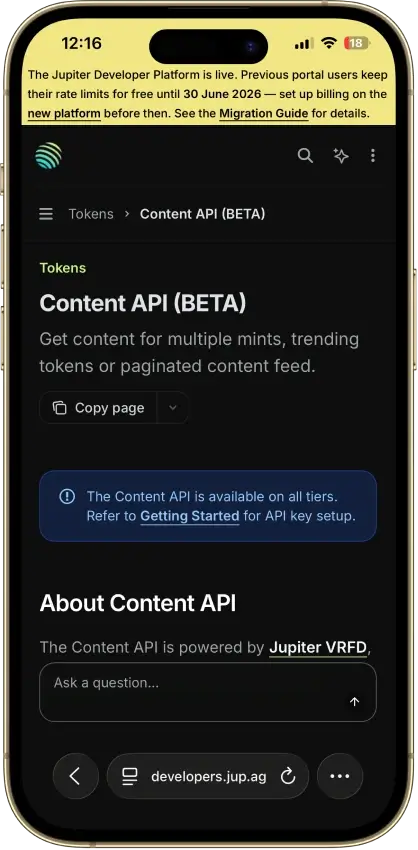
Screenshot 1 of 8
Jupiter Studio Pros and Cons
Pros
- Initial liquidity supplied by curve buyers
- Creator earnings have a separate claim path
- Creator allocations can follow a schedule
- Contract signals on token pages
Cons
- LP-lock descriptions conflict
- Curve completion can interrupt trading
- Opening buy fees can be severe
- Fee-share bases need qualification
Curve Launches and Funding
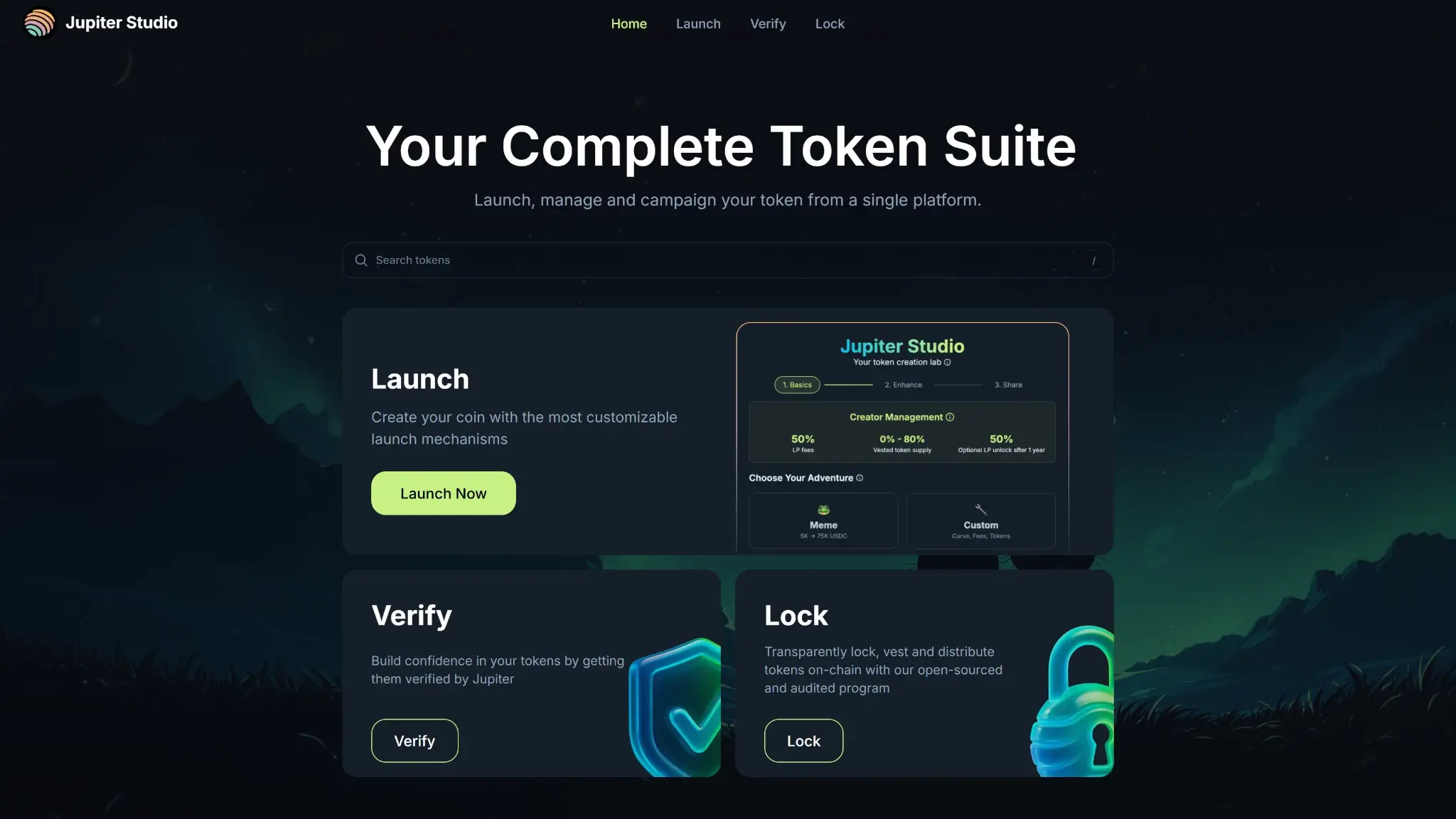
Creators can configure a launch without supplying its initial trading liquidity, while buyers fund the curve through purchases. That reduces the creator’s seed-liquidity requirement, but it leaves the coin dependent on subsequent demand. A configurable launch is suitable for someone able to examine the token’s costs and permissions, with no promise that a later sale will execute at an acceptable price.
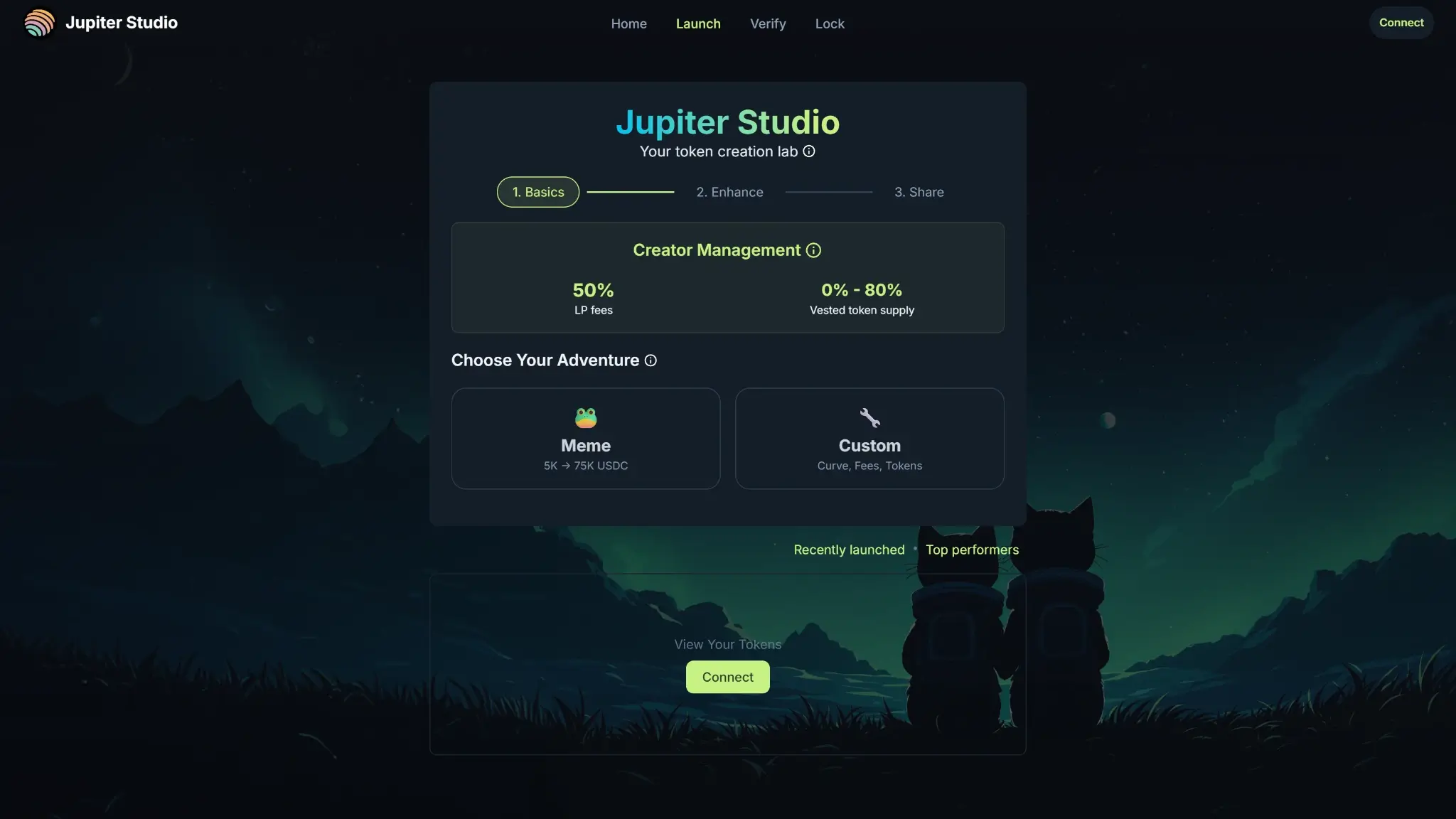
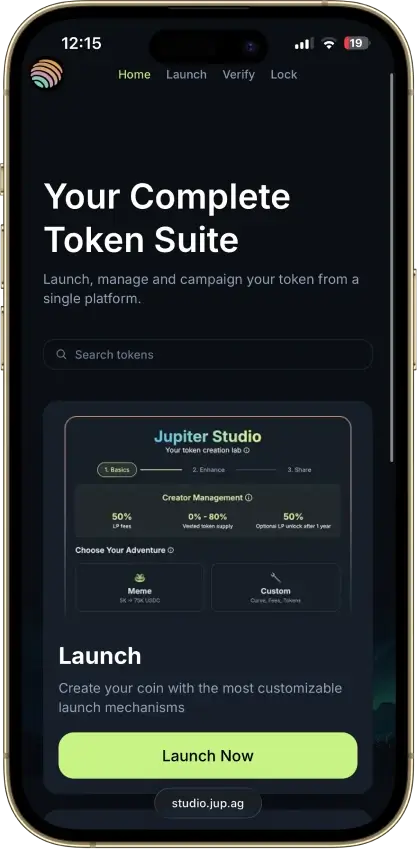
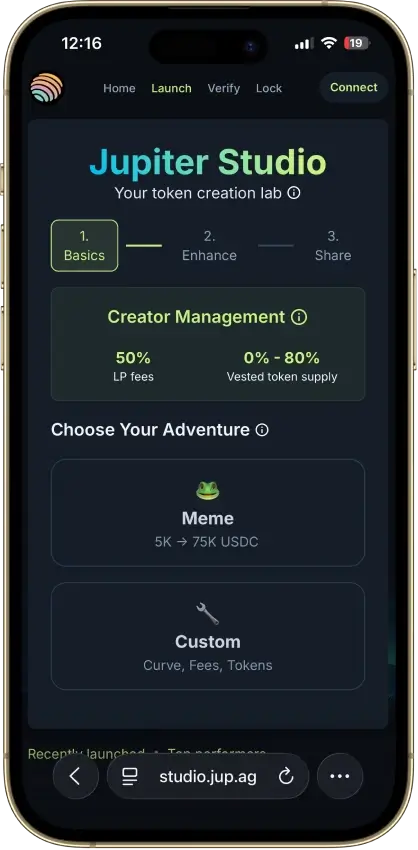
The public launch page separates Meme from Custom. Its Meme card displays a 5,000 USDC starting market cap and a 75,000 USDC graduation market cap. Custom opens controls for the quote asset, market caps, transaction fees, and creator allocation. The form’s USDC, SOL, and JUP choices are assets used on Solana, rather than three launch networks.
A bonding curve prices transactions using its reserves and configuration. Buyers acquire tokens through that market mechanism without first winning a fixed registration allocation. The available price and the amount received can change as other transactions execute, so open entry does not reserve equal purchases for everyone.
The displayed market-cap settings are also different from the money raised. A 75,000 USDC graduation market cap is not a requirement for one creator or buyer to deposit 75,000 USDC. Jupiter’s retail documentation says buyers supply the initial liquidity through the curve. Network charges, account funding, and any applicable creation-transaction costs remain separate questions.
Older developer examples use different market-cap presets from the current form. They do not establish the configuration of a newly created coin. Jupiter Studio is the token-creation product discussed here, and Jupiter LFG sale terms are not evidence of Studio settings. There is no basis for treating the two names as interchangeable.
Trading Fees and Creator Earnings
Jupiter’s launch guide describes 1% as the default Custom transaction fee. The public selector offers 1% or 2%, and the Studio creation API accepts ending fees of 100 or 200 basis points. One basis point is 0.01%, so those API values correspond to the displayed choices.
Other retail pages still describe 1% on every purchase and sale, before and after graduation. That blanket wording conflicts with the configurable fee surfaces. A selectable 2% setting does not by itself establish the charge on every existing token, its migrated pool, or a particular trading route.
| Cost or Distribution | Treatment |
|---|---|
| Custom transaction setting | Public form offers 1% or 2%, with 1% selected by default |
| Early-buy charge | A separate high opening-fee mechanism can apply when enabled |
| Network and account costs | Separate from the headline trading percentage |
| Interface or routing commission | Depends on the route and mode, with applicable charges reflected in its quote |
| Creator earnings | Product wording advertises a 50% share of LP fees. Gross-fee wording elsewhere conflicts with the underlying fee bases |
| Post-graduation trading | A Meteora DAMMv2 pool has its own applicable configuration and fee components |
The launch page advertises “50% LP fees,” while Jupiter’s retail explanation describes half the gross 1% trading fee. Meteora defines the liquidity-provider (LP) amount after its protocol component. Half an LP-fee amount is therefore not automatically half the total charge paid by a trader.
That does not justify substituting another universal percentage. The protocol split and creator share must match the particular pool’s configuration before a gross-fee amount can be calculated. Jupiter’s developer instructions provide a separate fee-claim workflow for the creator’s deployer wallet. An advertised share is not a forecast of trading volume or a guaranteed creator payment.
Anti-Sniping and Execution Costs
Jupiter’s retail launch guide describes an enabled anti-sniping mechanism that can begin at 99% on early purchases and decay over a randomized 15–60-second period. The public Custom form shows an Anti Sniping switch. Its presence does not establish that every Studio coin enables it or that an opening trade will receive the same charge.
The retail explanation calls that charge additional to the ordinary fee. Meteora’s underlying Dynamic Bonding Curve documentation instead caps total fees at 99% and describes a scheduler that changes the base fee. These descriptions do not support mechanically adding headline percentages into a universal transaction quote. In particular, the word “additional” is insufficient evidence for a verified 100% all-in charge.
Jupiter’s trading interface can add a separate commission according to the route. Its spot guidance describes different Ultra and Manual treatment, while pool charges, network costs, and applicable priority fees have their own bases. A Manual route with no Jupiter commission can still have a pool fee. Adding a maximum interface percentage to every Studio trade would also overstate some quotes.
Price impact and slippage can increase the amount lost on a purchase or sale even when the stated fee is understood. Review the specific coin’s opening-fee warning, selected route, and quoted execution conditions before authorizing a transaction. An anti-sniping label does not establish that automated traders or concentrated holders have been excluded.
Creator Allocations and Vesting
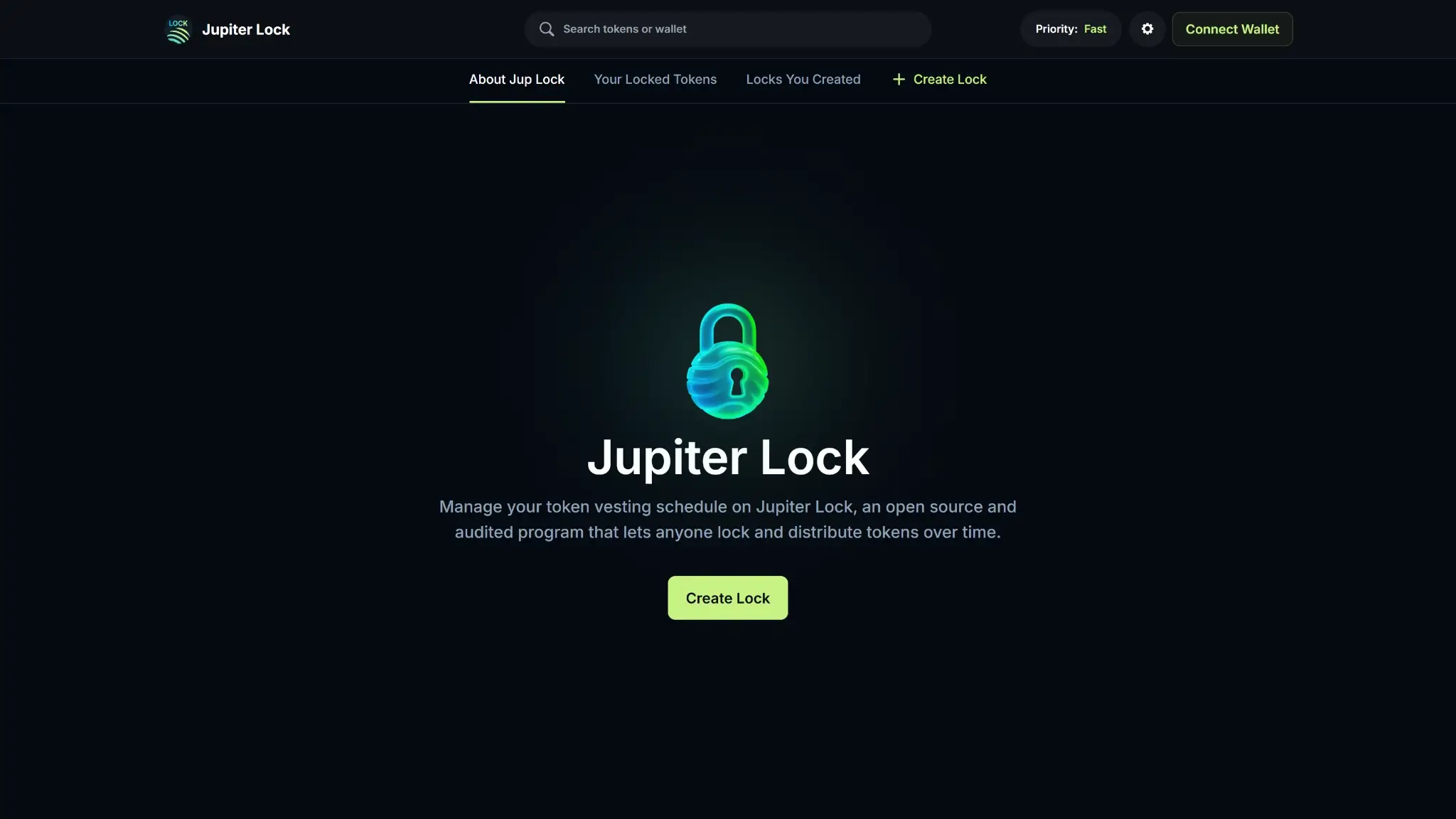
Studio’s retail guide describes an optional creator allocation of 0%–80% of supply. Its public Custom configuration has a separate vesting section, so creator settings should not be read as a vesting schedule imposed on ordinary curve buyers.
The duration menu offers Immediate, six months, and 12 months, with 12 months selected in the default 0% allocation configuration. Retail documentation describes six- or 12-month vesting. The visible Immediate choice does not establish that every nonzero allocation can deploy with immediate release, because that combination was not tested through a signed launch.
The creation API includes a cliff measured from migration, which can differ from the date someone first creates or buys the coin. A duration label alone is insufficient to calculate a creator’s release date. Fee claims, creator allocation claims, and tokens bought through the curve are separate entitlements.
Jupiter describes launch parameters as fixed after creation. That limits later changes to those specified settings, without establishing that every program authority, pool permission, or token risk is immutable. A creator considering an allocation needs to understand both its release conditions and the effect of a later sale on other holders.
Graduation and Liquidity Locks
Meteora’s technical documentation describes normal curve trading stopping when the reserve reaches its migration threshold. Migration and any required locker steps then precede creation of the new pool. Ordinary buyers may have no conventional vesting cliff, yet still encounter an interval in which their curve trade cannot execute. No fixed migration duration is promised here.
The documented destination is a Meteora Dynamic Automated Market Maker v2 (DAMMv2) pool. Graduation changes the trading venue and its liquidity arrangements. It does not guarantee a token’s value, sufficient depth for a large sale, or a profitable exit.
Jupiter’s retail graduation guide says all LP tokens from the initial pool are permanently locked. Its developer overview and creation API also describe an option involving 50% of graduated LP unlocking after one year. Historical launch reporting contains similar one-year language. Those accounts require a configuration and version distinction before any token can receive a permanent-lock assurance.
Consequently, a token’s actual lock arrangement needs to be checked independently of the general retail slogan. A statement about initial graduation liquidity also does not automatically cover positions added later. Locking liquidity restricts the covered withdrawal route, while token holders can still sell and the market price can still fall.
Token Signals and Contract Risk
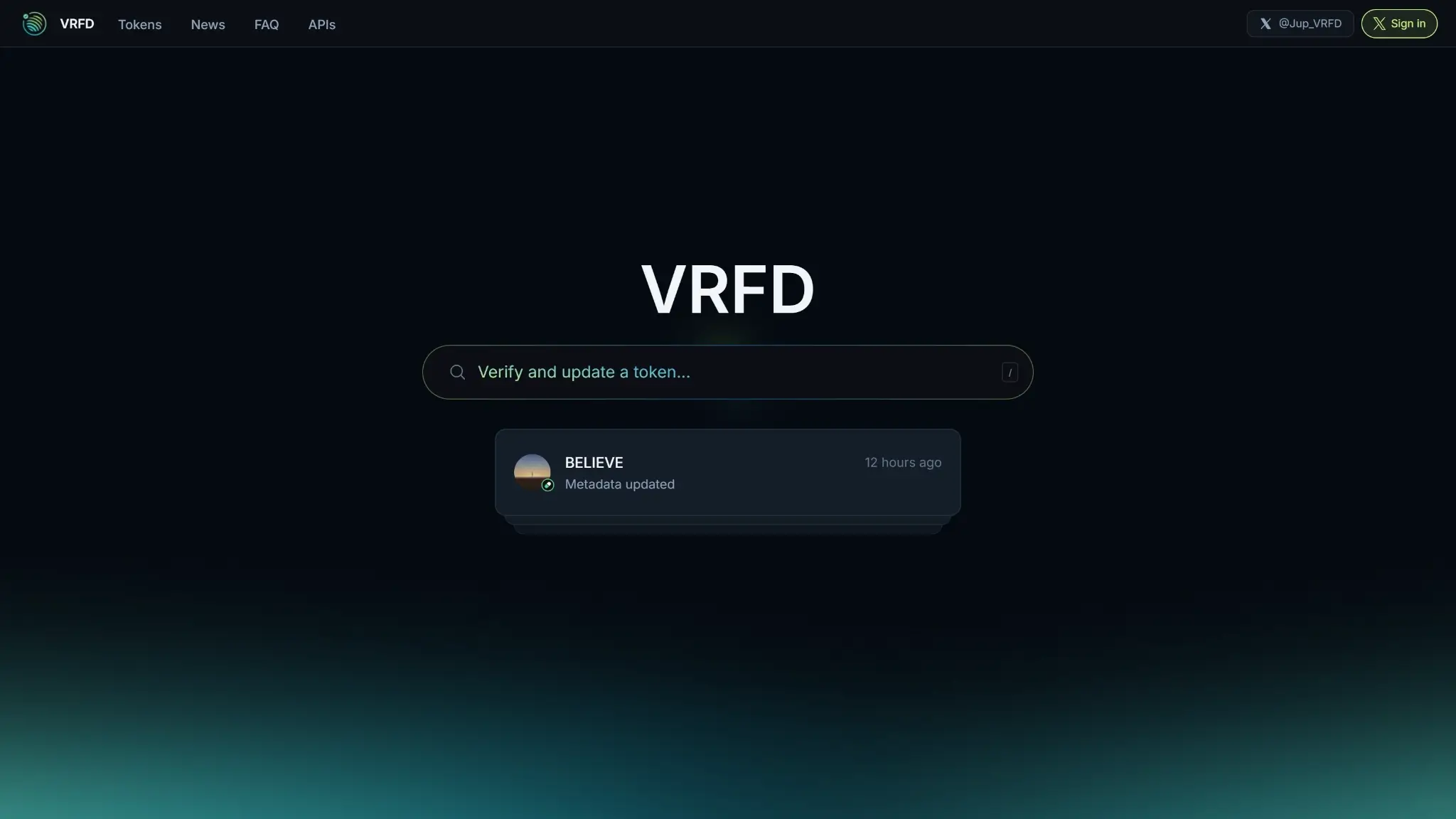
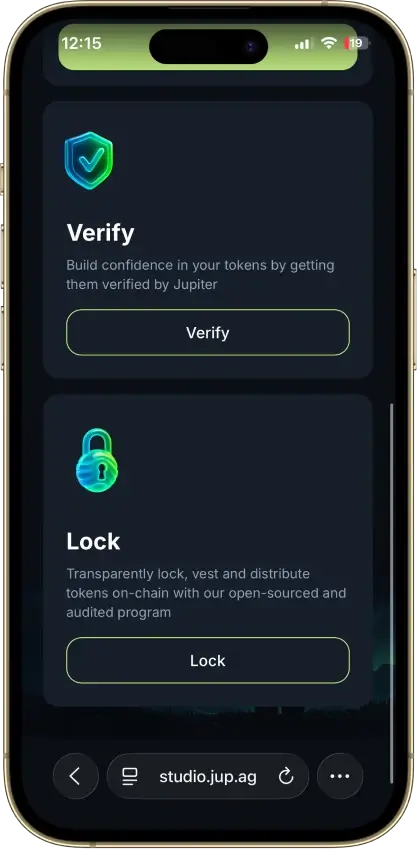
Jupiter token pages can display mint and freeze authorities, holder concentration, developer holdings, and curve progress. These signals help identify questions about a coin’s configuration, but they are not a project-selection committee or an assurance that a launch deserves funding.
The underlying programs distinguish configuration, migration, liquidity-position, and claim roles. Their documentation cannot establish the permissions of every Studio token without examining its deployed accounts. An open-source program or a token-page check is also insufficient to claim that all current code has been audited or matches a particular audit version.
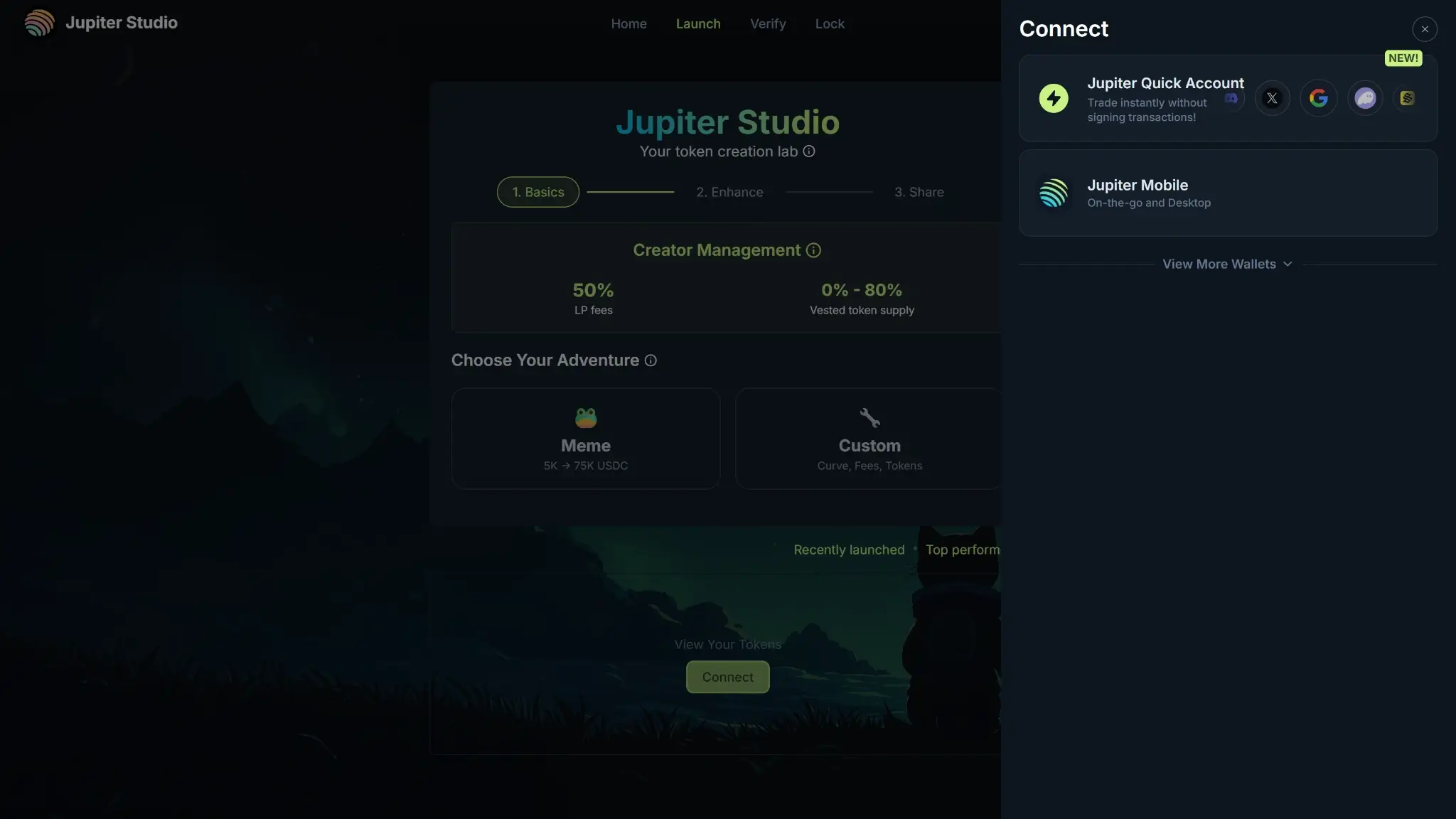
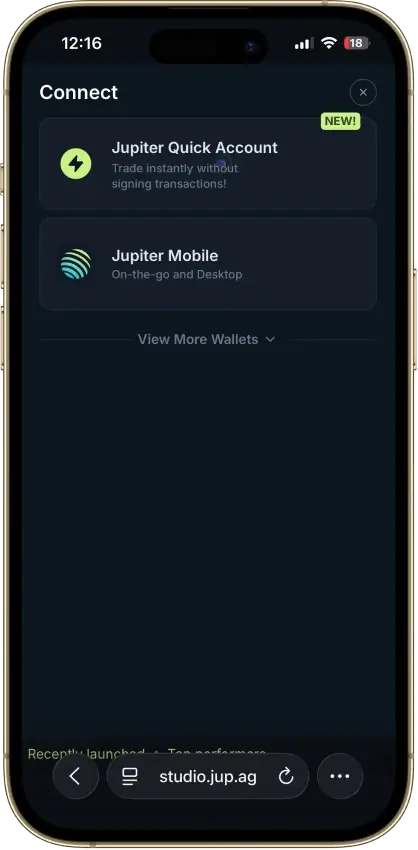
Connecting a wallet avoids opening a centralized launchpad balance, but a signed transaction can still transfer assets into contracts and pools. Self-custody does not reverse a bad approval, a poor trade, or a failure in the program handling the assets. Keep the distinction between control of the wallet and control of assets committed through it.
Activity and User Reports
DefiLlama maintains a Studio-specific fee series whose latest returned daily observation was Oct. 27, 2026. Its adapter reads selected Meteora curve swaps and specified DAMMv2 fee-claim transfers. It filters the supported quote assets, so the series provides more specific activity evidence than a generic Jupiter exchange counter.
Those fee events are not a count of launched coins, a graduation rate, or a trader-success measure. Dashboard revenue and holders-revenue labels also use their own calculations. They should not be interpreted as promised payments to holders of every Studio-created token.
Available Studio community examples are dominated by projects promoting their own tokens. They include a positive creation account and a creator acknowledging thin liquidity, without enough independent matching outcomes to establish a recurring service pattern. Jupiter swap and mobile complaints about other products cannot substantiate a Studio-specific support or execution failure rate.
Support and Losses
Jupiter’s public support hub has an Open a Support Ticket route alongside documentation and community links. This establishes a contact channel, without a measured Studio response or resolution time.
The hub also discusses conditional compensation for some Ultra execution problems. That scope should not become a Studio token-loss guarantee. Poor token demand, creator selling, and a pool’s market losses require different analysis from an interface-routing fault, and a support link does not itself create a repayment right.
Alternatives



The crypto launchpad model determines whether entry means registering for a sale or buying through a live curve. Jupiter Studio’s configuration controls address the latter workflow. Comparing them with a registration allocation requires examining the different purchase and delivery rights, without assuming either model protects the investment.
Final Verdict
Jupiter Studio combines Solana token creation with selectable quote assets, fee settings, and creator allocations. Those controls give a creator choices beyond a fixed launch preset, while curve completion and migration can interrupt trading for buyers. The advertised LP-fee share also needs a clear denominator before it can describe the creator’s earnings. The product suits creators and buyers prepared to inspect a coin’s configuration. Its retail and developer accounts of liquidity locking conflict, its fee documentation should not be reduced to a universal 1% charge, and curve completion does not guarantee a selling window. The historical 5.5 rating is retained from the earlier assessment and has not been recalculated.

CryptoSlate may earn a commission when you use partner links, at no extra cost to you. Our reviews, ratings, and editorial decisions remain independent of advertisers. Read How CryptoSlate Makes Money for funding details.