


- MNT subscription or USDT allocation lottery
- Qualifying subaccount balances can count
- Commitments funded from the Funding Account
Bybit Launchpad Overview
- Crypto Launchpad Name
- Bybit Launchpad
- Platform Type
- CEX / IEO Launchpad
- Access Model
- Exchange Account
- KYC Level
- Full KYC, Varies By Region
- Core Sale Types
- IEO
- Native Token Dependence
- None For Base Access
- Allocation Model
- Lottery, Pro-Rata Subscription, Snapshot-Based, Mixed By Sale
- API / Public Data Access
- Limited
- Status
- Live
Bybit Launchpad Screenshots
Screenshot 1 of 8
Bybit Launchpad Pros and Cons
Pros
- Unused commitments return without a claim
- New tokens stay within the Bybit account
- One USDT commitment covers qualifying tickets
Cons
- Commitments cannot be canceled
- USDT credit guidance names two accounts
Who Bybit Launchpad Suits
| User | Assessment |
|---|---|
| Existing Bybit users with qualifying balances | They can use the documented account flow, provided they meet the selected sale’s snapshot and funding requirements. |
| Users considering an MNT holding | Allocation weight comes with exposure to MNT while maintaining the required average balance. |
| USDT holders seeking a lottery entry | The documented route avoids an MNT holding requirement, but qualification and tickets do not guarantee an allocation. |
| Users who need flexible access to funds | A commitment cannot be canceled, and the assets remain locked until after distribution. |
| Users seeking a particular token | A historical card or past listing does not establish a current offer or an available exit market. |
The choice between routes should follow the campaign’s terms and the assets you already intend to hold. Buying MNT solely to qualify adds an asset exposure that the USDT route does not require. Their different assets and allocation methods also make the minimum balances an inadequate comparison of total participation cost.
MNT Subscription and the USDT Lottery
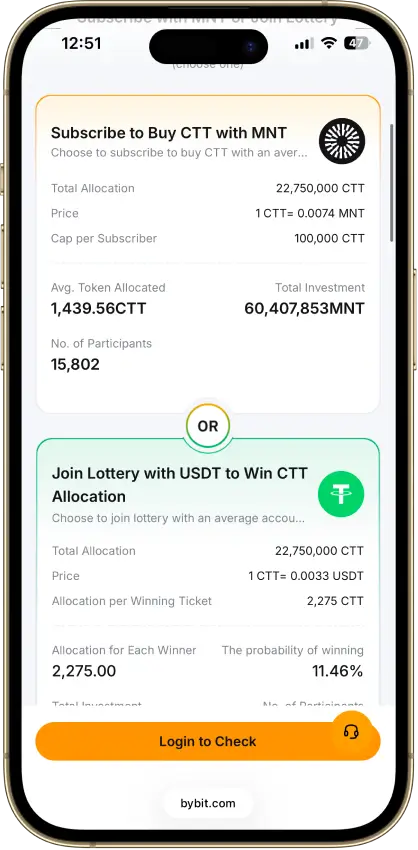
Bybit’s MNT FAQ requires an average daily balance of at least 50 MNT during the snapshot period. Hourly snapshots contribute to that average, which determines the maximum commitment. Allocation is proportional to the amount committed, subject to a cap per subscriber. A large commitment can therefore leave part of the commitment unused.
The USDT FAQ requires an average daily balance of at least 100 USDT. It describes a single 100-USDT commitment covering all qualified tickets, so extra tickets do not each require another 100 USDT under these instructions. Each winning ticket provides the allocation defined by the sale.
Beyond the initial ticket, Bybit’s USDT FAQ allows extra tickets through one path only, either VIP status or asset and trading tasks. The asset-holding task measures the USDT value of all available tokens in Funding and the Unified Trading Account (UTA), with collateral excluded, so it differs from basic USDT qualification. Bybit’s MNT FAQ treats Crypto Loan collateral differently by counting MNT pledged for a loan toward the average balance. That pledged MNT can therefore contribute to MNT subscription qualification without increasing the USDT asset-holding task balance.
Bybit’s USDT task rules exclude trading volume generated through an application programming interface (API), as well as Derivatives trading volume. Including those transactions in a trading total can overstate progress toward a task. Since tasks and ticket counts vary by event, the selected campaign’s requirements determine what counts.
Users choose one participation method for an event. Under the MNT instructions, additional commitments can be made during subscription within the snapshot-derived maximum, but Bybit’s MNT and USDT FAQs prohibit canceling a commitment. Once committed, those assets cannot be transferred, withdrawn, or traded until after distribution.
Snapshot Balances and Funding Commitments
An eligible snapshot balance does not itself subscribe to a sale. Bybit counts specified balances across Funding and UTA. Qualifying subaccount balances contribute to the main account’s snapshot, while the main account makes the entry. The FAQs also recognize specified subaccount Spot volume for relevant tasks.
The snapshot guide includes qualifying Copy Trading and Grid Bot balances. The documented rules also count selected Launchpool and Flexible Easy Earn balances, while excluding Fixed Term Easy Earn, Dual Asset, and Liquidity Mining. Each metric has its own asset and account scope. Holding an asset in a product that counts for a snapshot does not make that position immediately available to commit.
Actual commitments come from the Funding Account. Users holding qualifying assets elsewhere may need to redeem or transfer them before subscribing. A qualifying average does not guarantee that the amount needed to subscribe is available in Funding.
Bybit averages balances across the campaign’s snapshot period. Moving funds in at the last moment does not recreate balances at earlier snapshots.
Distribution, Unused Funds, and Account Destinations
Bybit describes automatic return of unused commitments to Funding during the distribution period. That includes nonwinning USDT commitments. The process differs from a sale that leaves a separate external-wallet reclaim transaction for the buyer, although an actual account credit and its timing were not tested.
The generic USDT FAQ gives conflicting instructions for the newly allocated token. One passage names UTA, while another names Funding. Other Bybit guides favor UTA, but repeating Bybit guidance does not resolve the contradiction. For a current sale, its distribution instructions need to identify the receiving account.
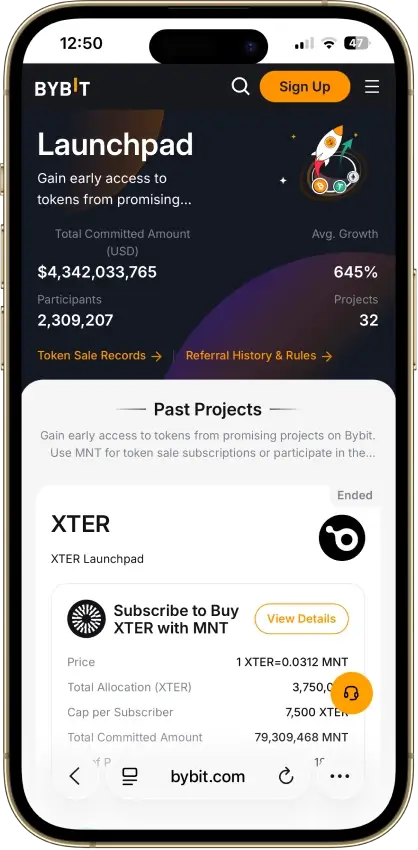
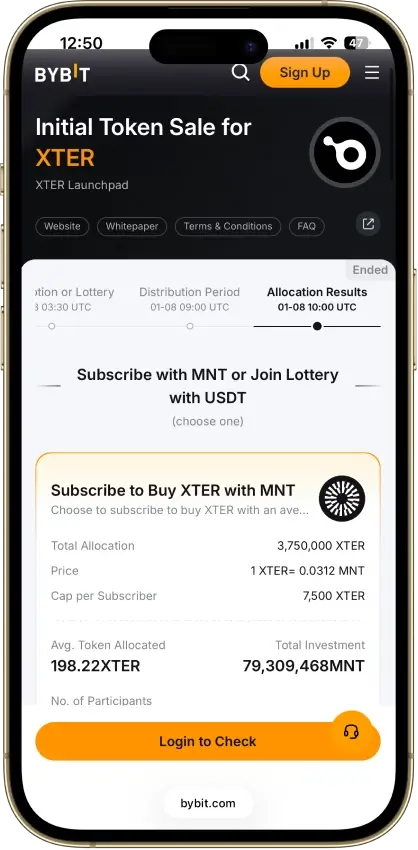
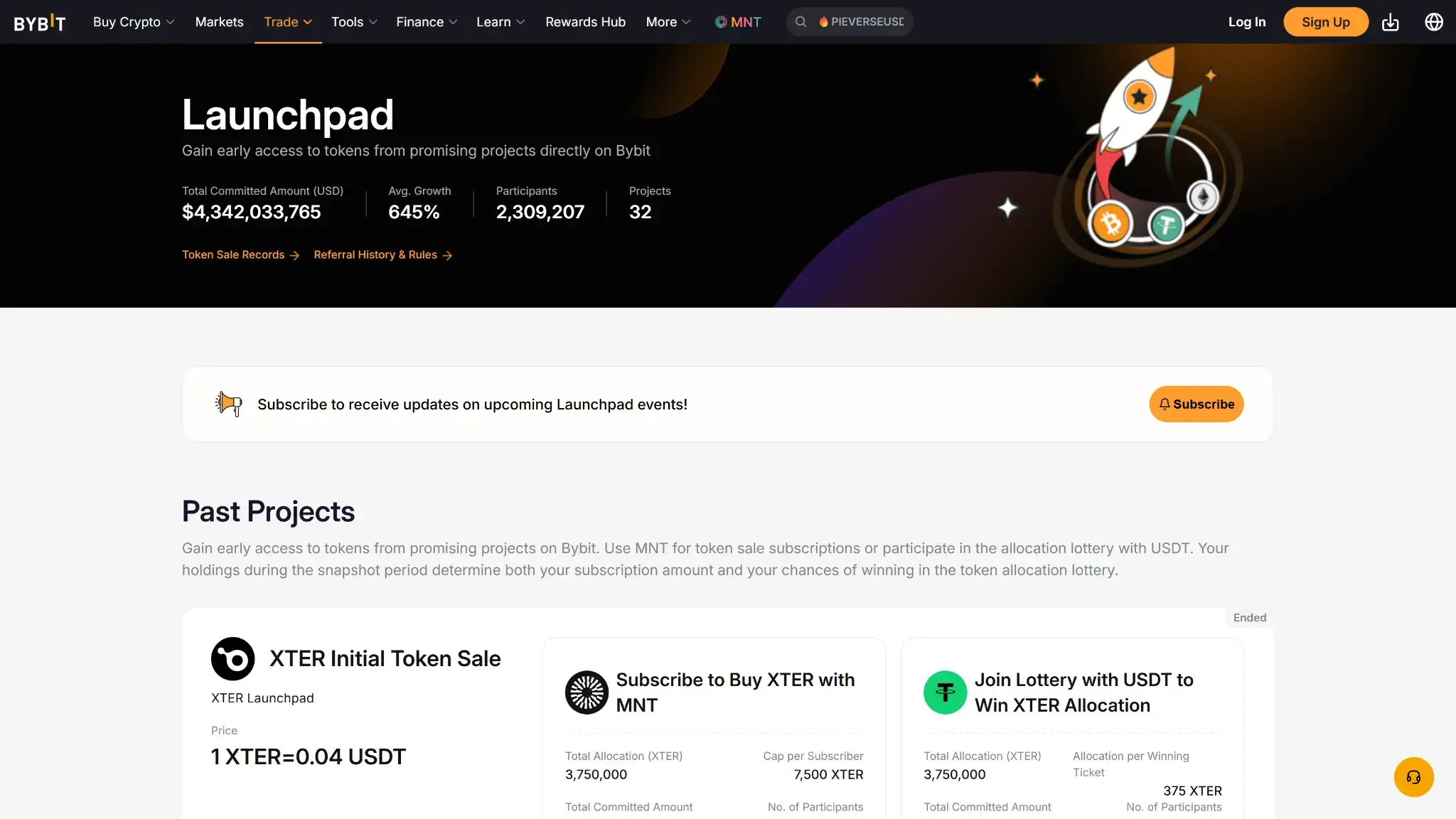
The historical XTER campaign gave a more specific destination: its Distribution tab specified the Spot Account, or UTA after an account upgrade, for new tokens from both routes and Funding for unused commitments. Those instructions belong to the ended Launchpad 3.0 campaign and do not resolve the generic conflict for a 3.1 sale.
Allocation, account credit, and an executable sale are separate stages. The campaign determines its distribution and release terms, while selling also needs an available market with buyers for the position. An account credit alone does not establish the price or size at which a position can be sold.
XTER History and the Current Catalog
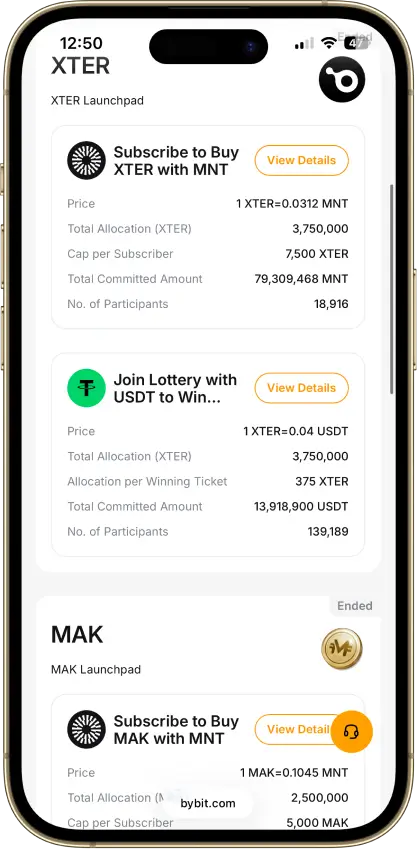
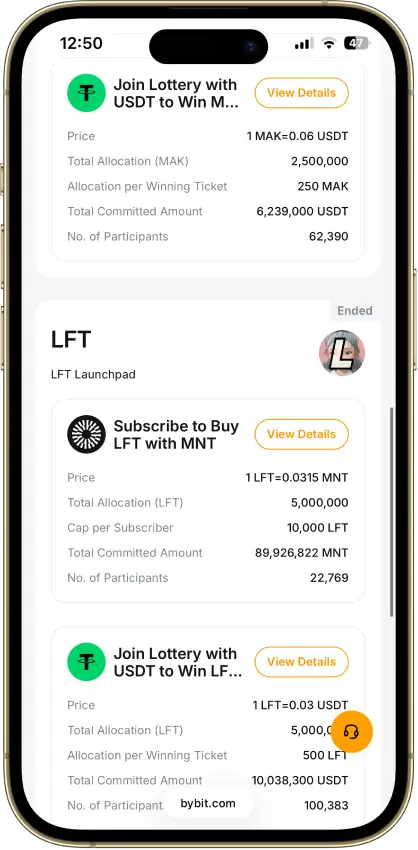
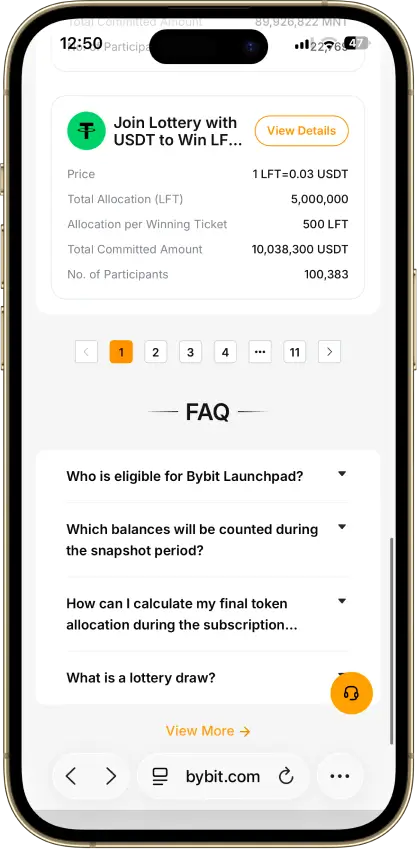
The public catalog’s first page showed XTER, MAK, and LFT marked Ended on Oct. 27, 2026. That logged-out first page excludes later catalog pages and an eligible account’s view, so it cannot establish the latest completed sale, a full launch count, or closure of Launchpad.
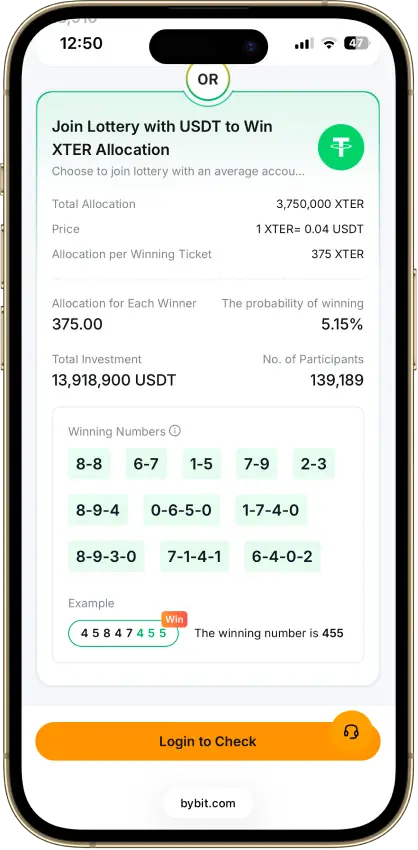
The ended XTER page displays a 5.15% lottery winning probability for that campaign. It is Bybit’s figure from the Jan. 2025 event, not the probability of a future sale or independent verification of its draw. The campaign’s token network and no-lock-up wording likewise belong to that event.
Bybit’s Jul. 28, 2026 notice scheduled XTER Spot and Convert removal for Aug. 4, 2026 at 8:00 am UTC. It allowed XTER withdrawals to continue without stating an XTER withdrawal-retirement deadline. The notice’s separate retirement and conversion provisions for AO do not apply to XTER. Internal token delivery at the sale therefore did not ensure an enduring exchange market for XTER.
Xterio’s issuer homepage still lists Bybit as a place to buy XTER. That link conflicts with the exchange’s dated removal notice and does not prove a current executable market. A past allocation or issuer link therefore does not establish whether XTER can still be traded or withdrawn on Bybit.
Costs and Capital Exposure
A universal Launchpad entry-fee schedule is not disclosed in the participation FAQs. A general trading-fee table does not establish a sale’s participation charge. Participation costs need to be considered through the selected sale, the account’s actual fee quote, and any transfers used to acquire the funding asset.
The MNT route exposes the user to the asset while maintaining the qualifying balance. The USDT route has different allocation uncertainty, and acquiring or transferring USDT can still create costs. These differences prevent a blanket claim that one route is cheaper for every participant.
After commitment, the lock removes the option to trade or withdraw those funds until after distribution. A small final allocation can leave much of the committed amount unused during that period. Automatic return simplifies the documented settlement process, while the lock still limits how the capital can be used before it ends.
Allocation Controls and Exchange Custody
Bybit’s FAQs describe verification, balance snapshots, route restrictions, and measures against bulk-account participation. They do not measure how many bots are excluded, whether screening improves project outcomes, or whether buyers receive better investment outcomes than on other launchpads.
Participation also depends on exchange custody and account controls. The documented process credits a Bybit balance instead of requiring a direct purchase from a project contract. That reduces external-wallet tasks but places the committed assets within the exchange’s operating environment.
Attackers stole funds from a Bybit Ethereum cold wallet on Feb. 21, 2025. The Federal Bureau of Investigation (FBI) independently documented the theft, but that exchange-level event does not by itself establish a Launchpad-specific exploit or participant loss. Bybit’s subsequent security statements describe its response and cannot certify that present custody risk has been eliminated.
Four Reddit threads concern Launchpad experiences in 2021–2022, include unverified allegations, and sometimes contain contrary recovery context. They do not establish a current failure pattern or a measured support-response record.
Bybit Alternatives
-


Polkastarter
POLS eligibility and conflicting lock terms shape IDO access.
-

Binance Launchpad
A qualifying BNB balance sets what you can commit, while competing demand determines the allocation. Other Binance launch products change how you fund participation and receive tokens.
-
Kucoin Spotlight
GNOT’s buyback required opt-in and available tokens, while Zama allowed bid cancellation. Those rights apply at different stages of participation.
-

Legion
Deposit-first sales can leave unused funds to reclaim, while accepted purchases follow the project’s claim and vesting rules.
Final Verdict
Bybit Launchpad can suit an existing exchange user who understands the selected snapshot test and can leave committed assets locked. The documented automatic return of unused funds and internal token credit reduce separate wallet tasks. Before committing, choose the allocation route, make funds available in Funding, and read the campaign’s distribution terms. Conflicting generic USDT account guidance and XTER’s later removal notice limit how much confidence a past campaign can provide about the next purchase or eventual exit. Among token-sale participation models, Bybit offers account-based settlement with fewer separate wallet tasks, but requires acceptance of exchange custody, commitment locks, and campaign-specific delivery.

CryptoSlate may earn a commission when you use partner links, at no extra cost to you. Our reviews, ratings, and editorial decisions remain independent of advertisers. Read How CryptoSlate Makes Money for funding details.