
Quick Take
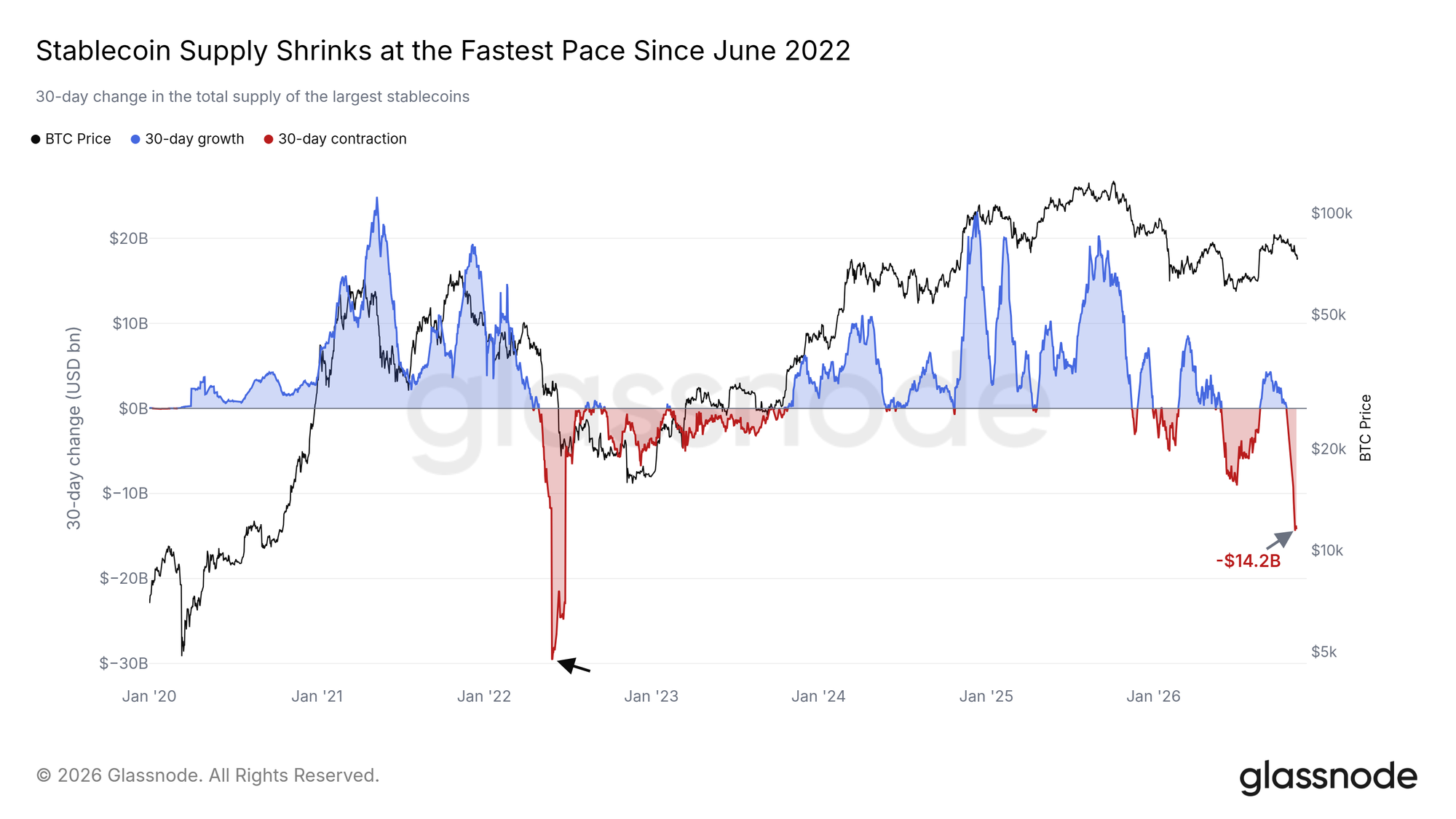
- Bitcoin faces a fresh liquidity squeeze as stablecoin supply falls $14.2 billion and apparent demand contracts by 284,000 BTC.
- Weak US buying and $1.6 billion in ETF outflows have compounded losses among recent Bitcoin investors, threatening a sustained recovery.
- Bitcoin risks a decline toward $70,000, while a rebound toward $75,600 could prompt underwater holders to sell at breakeven.


Bitcoin is facing a fresh liquidity squeeze as mounting losses among recent buyers threaten to derail its recovery.
Stablecoin supply has contracted by $14.2 billion over the past month, its sharpest decline since June 2022, while Bitcoin's apparent demand has fallen by 284,000 BTC, approaching levels last seen during the March 2025 market turmoil.
The deterioration has left Bitcoin vulnerable to another decline toward $70,000, with investors who purchased at higher prices potentially adding to selling pressure if a recovery fails to attract fresh capital.
Bitcoin's shrinking liquidity pool compounds demand collapse
The retreat in stablecoin supply marks a sharp reversal from the conditions that supported Bitcoin's previous rally.
According to Glassnode's Nov. 11 report, the aggregate supply of dollar-linked tokens declined by $14.2 billion over 30 days, the fastest contraction since the 2022 market crisis.
30-day change in supply of major USD stablecoins, with unresolvable points omitted. Historical readings are approximate monthly and selected event-date samples digitized from the Glassnode chart, rounded to $0.5B.
 CryptoSlate
This corroborates CryptoQuant's earlier research, which showed that Tether's USDT had lost $6.6 billion in market capitalization over 60 days, more than twice the $3.2 billion decline recorded following FTX's collapse in December 2022.
The reversal is particularly striking against the liquidity expansion of the previous two years. USDT's 60-day supply growth peaked at $20.6 billion in December 2024 and generally ranged between $10 billion and $16 billion during much of 2025.
The contraction has coincided with a sharp deterioration in Bitcoin's apparent demand.
CryptoQuant's apparent demand indicator fell to negative 284,000 BTC over 30 days, its weakest reading since March 28, 2025. The measure estimates the difference between newly issued and newly active supply and the amount the market absorbs.
Comparable readings of negative 309,000 BTC in March 2025 and negative 273,000 BTC in June 2026 occurred during earlier market downturns followed by recoveries.
Bitcoin subsequently recovered from its June lows even as the Coinbase Premium Index remained predominantly negative, suggesting the indicator alone was insufficient to capture the rebound's strength.
However, the current downturn has unfolded alongside persistent institutional selling and a broader withdrawal of dollar liquidity.
CryptoQuant found that the Coinbase Premium Index remained negative for 30 consecutive days, averaging approximately minus 0.14%. Glassnode's adjusted measure separately recorded its deepest 30-day discount since February.
US spot Bitcoin exchange-traded funds have also recorded $1.6 billion in net outflows across 20 trading sessions.
That combination leaves Bitcoin increasingly dependent on buyers willing to absorb supply without the additional support previously provided by expanding stablecoin issuance and ETF inflows.
Bitcoin's recent buyers risk deeper losses toward $70,000
The liquidity contraction is occurring as investors who entered the market during the August and September rally increasingly find themselves holding Bitcoin at a loss.
CryptoQuant data shows that the unrealized profit margin of coins held for one to three months has collapsed from 33% on Sept. 22 to negative 6%. The 39% reversal has left these investors with an average acquisition price near $79,500, against Bitcoin's market price of approximately $74,600 when the research was compiled.
Previous corrections during the current cycle have frequently pushed this profitability measure toward negative 12% before stabilizing. More severe downturns drove it to negative 18% during July to September 2024, negative 19% in April 2025, and negative 23% in July 2026.
At the latest $79,500 acquisition price, a negative 12% margin would put Bitcoin near $70,000, roughly 6% below CryptoQuant's reference price.
Glassnode's broader short-term holder data reveals that only 35% of Bitcoin held by investors who acquired their coins within the past 155 days remains profitable, compared with nearly all such supply at September's high.
Their aggregate cost basis stands near $75,600, while substantial concentrations of Bitcoin purchased between August and October sit at prices extending to $83,600.
A recovery toward those acquisition levels could encourage investors to exit at breakeven, adding to selling pressure in a market already struggling to attract fresh capital.
Mentioned in this article






Editorial credits