
Quick Take
- LlamaRisk says Aave’s main cap and rate batches executed, preserving room for earlier borrowing while GHO cap cuts remained queued.
- Suppliers still need available pool cash and healthy accounts.
- Selected collateral retains zero borrowing power, while conflicting rate tables prevent a verified universal 10% ceiling.


Emergency cap cuts at Aave preserve borrowing room to return to pre-Binance hot-wallet levels, even as LlamaRisk estimates they remove roughly $3.8 billion of unused capacity.
In an Oct. 30 update, risk service provider LlamaRisk said it had executed lower borrowing ceilings and temporary interest-rate changes on Aave V3 and V4. GHO borrow-cap cuts on the Core and Prime markets remained queued.
The measures follow an Oct. 29 emergency freeze, after LlamaRisk’s initial assessment described the exploiter’s Aave position as overcollateralized and subject to normal liquidation.
How much borrowing room remains
Aave V4’s draw caps apply to individual credit lines through which a lending market, called a spoke, draws assets from a shared hub. While a reserve remains frozen, those ceilings cannot enable new borrowing.
LlamaRisk’s cap methodology starts with the larger of borrowing before the exploit and borrowing at its observation time, then adds roughly 2%, with asset-specific rounded ceilings. It targets the larger borrowing paths with more than $10 million borrowed before the incident and more than $10 million of spare capacity.
That approach can sharply reduce an old ceiling while keeping it above earlier debt.
| Asset | Listed cap | Borrowing before exploit | Room above earlier borrowing |
|---|---|---|---|
| USDT | 2,560 million USDT | 2,504.7 million USDT | 55.3 million USDT |
| USDC | 2,270 million USDC | 2,215.9 million USDC | 54.1 million USDC |
Debt repayments can leave more room beneath the same ceiling. Core USDC’s listed cap was approximately 248.4 million USDC above debt as of Oct. 30 because borrowing had fallen below its pre-exploit level.
Core WETH listed ceiling of 1.79 million WETH was above then-current debt of 1,749,730 WETH. LlamaRisk said current debt was the sizing basis because it included the exploiter’s 19,762 WETH loan.
Separately, the queued GHO changes would cut Core’s ceiling from 150 million to 105 million GHO and Prime’s from 85 million to 35 million, a combined reduction of 95 million GHO.
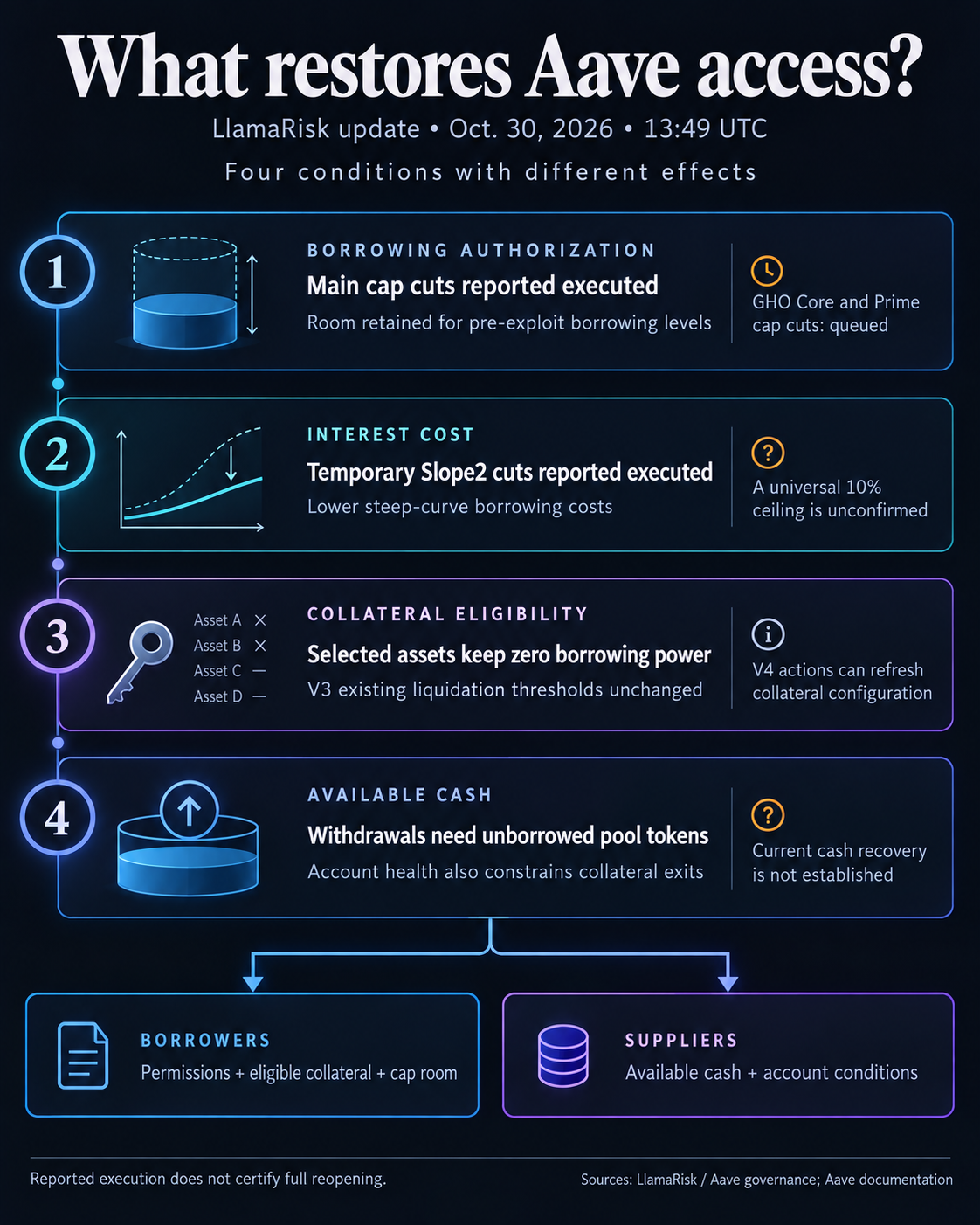
Cash availability and borrowing costs
During the freeze, new supply and borrowing were blocked while withdrawals, repayments, and liquidations remained enabled. Users also could not supply extra collateral to frozen reserves.
Aave’s withdrawal guidance limits exits to available, unborrowed liquidity. A supplier whose deposits secure a loan must also preserve the position’s health.
At 00:26 UTC on Oct. 30, LlamaRisk put Core USDC utilization at 97.8%, with several other reserves displayed at 100%.
Reopening supply can allow cash to enter the relevant asset pool again, while repayments can return borrowed assets to it. Borrowing and supplier withdrawals consume that pool’s available liquidity.
LlamaRisk also reported executing temporary Slope2 reductions. The recommendation lowers the steep part of Aave’s borrowing-rate curve above its optimal utilization point. The proposed base rate, first slope, and optimal point stay unchanged, leaving modeled rates at or below that point unaffected.
A higher rate cannot attract fresh deposits into a reserve that rejects supply, while lower interest growth can ease pressure on borrowers without repaying their principal or supplying the cash needed for withdrawals.
Although LlamaRisk describes a universal 10% borrowing ceiling as the objective, its modeled full-utilization table lists 20% for Core DAI, 34% for Core USDtb, 25% for Monad mUSD and 19% for Ethereum Core frxUSD. Plasma GHO’s proposed second slope is 5.25% in the summary and 11.5% in the specification.
LlamaRisk’s later execution update does not identify which conflicting settings were deployed, so borrowers cannot use the broad 10% description as a confirmed ceiling for every affected reserve.
Collateral rules differ for new and existing positions
LlamaRisk’s rollback plan describes four waves, with only the V4 collateral-configuration wave explicitly marked as already executed in the 13:49 UTC update. T
For new borrowing, the plan keeps USDT, USDC, USDT0, POL, WAVAX, sAVAX, XAUt, PAXG and OP, including wrapped and bridged versions, at zero collateral borrowing power. On V3, the zero loan-to-value setting also applies in E-Mode, while the equivalent restriction is a zero collateral factor on V4.
Under the terms LlamaRisk describes, the same tokens can otherwise be supplied, withdrawn, borrowed and repaid once the relevant market restrictions are removed, subject to liquidity and normal account constraints.
On V3, liquidation thresholds remain unchanged, so the LTV reduction itself does not change existing health factors. On V4, a new borrow, collateral withdrawal, or collateral toggle moves an existing position onto the zero-factor configuration.
Aave’s V3 Pool documentation adds another withdrawal condition: zero-LTV reserves must be disabled as collateral or fully withdrawn before withdrawing other assets.
Preserving earlier aggregate borrowing levels leaves room under the ceilings. Existing users still need the relevant market permissions and collateral configuration, while suppliers need enough unborrowed tokens for their exits.
Those conditions, together with the rate actually deployed on each reserve, determine what reopening delivers.
Mentioned in this article






Editorial credits