

 Launched in 2021
- Solana swaps and direct liquidity management
- Standard and concentrated liquidity pools
- LaunchLab tokens graduate into Raydium pools
Raydium Overview
- Decentralized Exchange Name
- Raydium
- Launch Year
- 2021
- KYC
- No
- Products
- Spot, Futures or Perps, Simple-buy Broker
- Staking
- Yes
- Copy Trading
- No
- Derivatives
- Yes
- Proof of Reserves
- No
- Trading Fees
- 0.005% - 4%
- Payout Time
- Fiat: Instant - 5 days
Raydium Screenshots
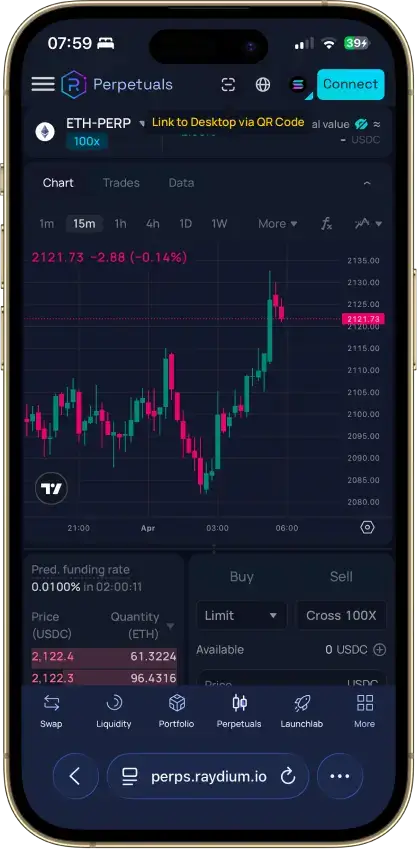
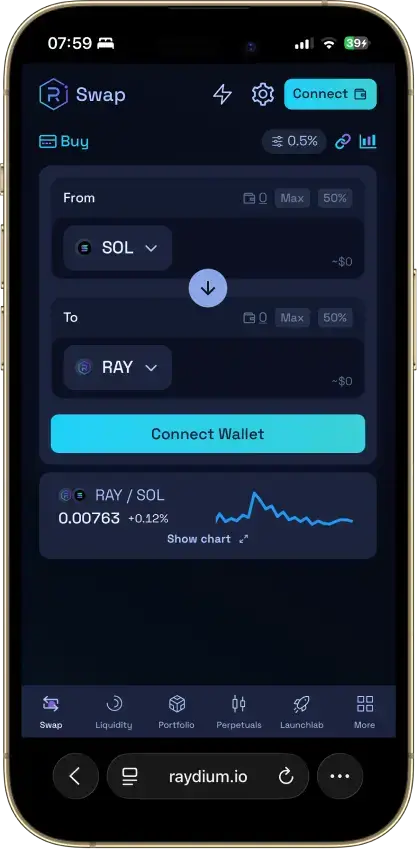
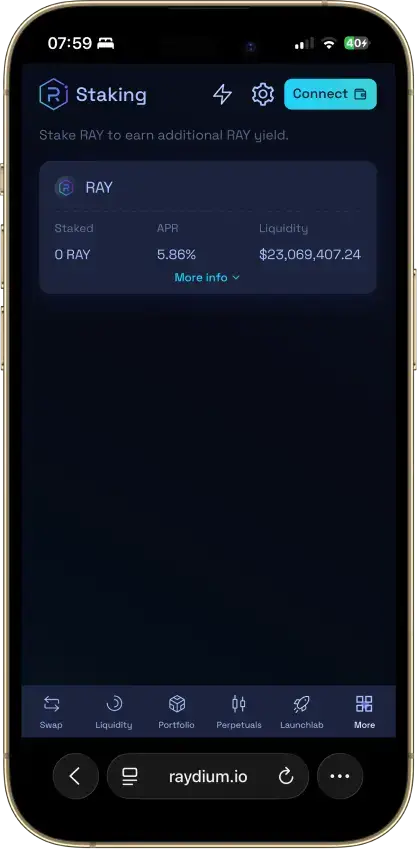
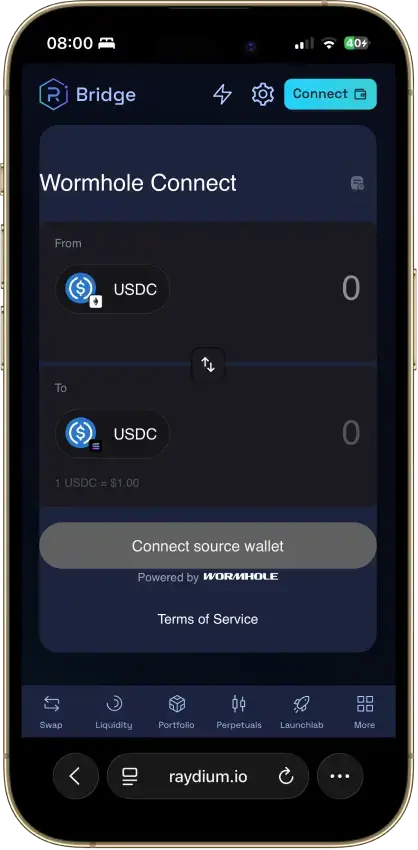
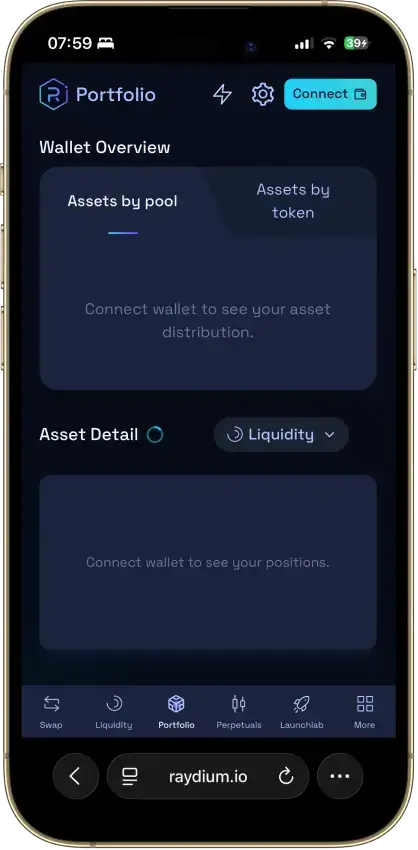
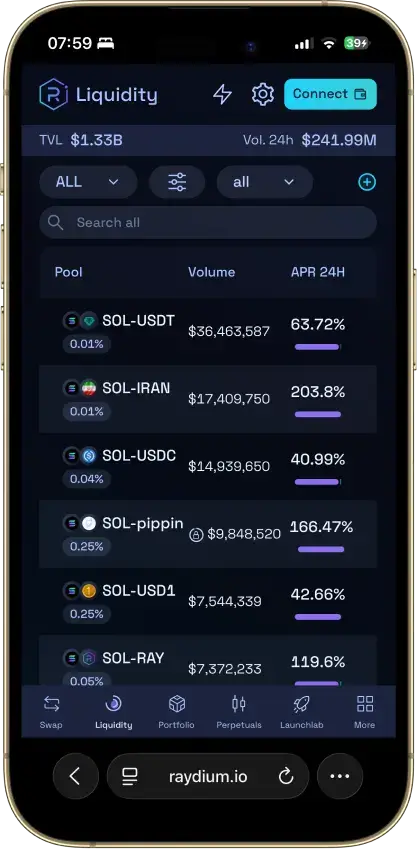
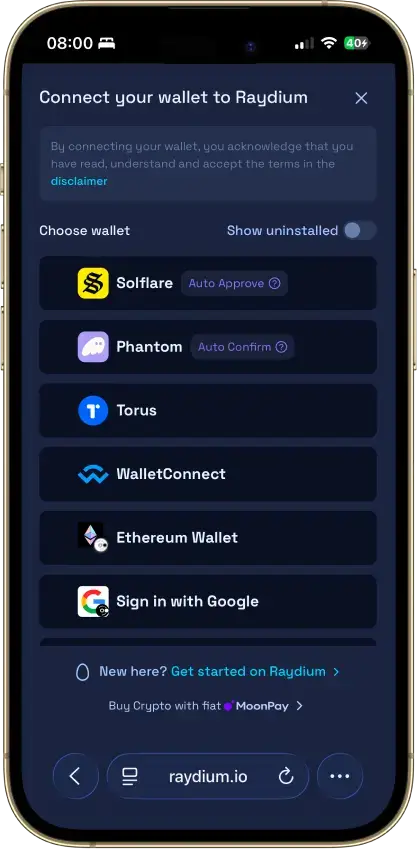
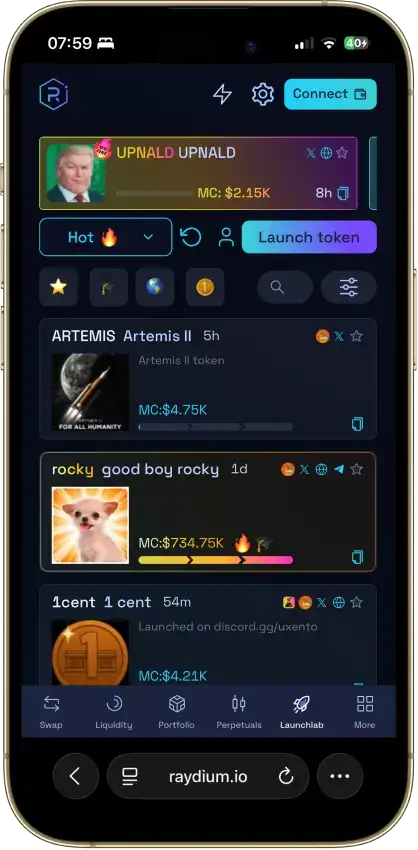
Screenshot 1 of 8
Raydium Pros and Cons
Pros
- Post-only orders on the perps book
- Swap and liquidity transaction APIs
- Upgrade and admin controls documented openly
- RAY staking without providing a token pair
- Audits listed for its pools and LaunchLab
Cons
- Creator fees can sit on top of pool fees
- Burn and Earn permanently locks principal
- Perps add Orderly vault dependencies
Is Raydium Worth It?
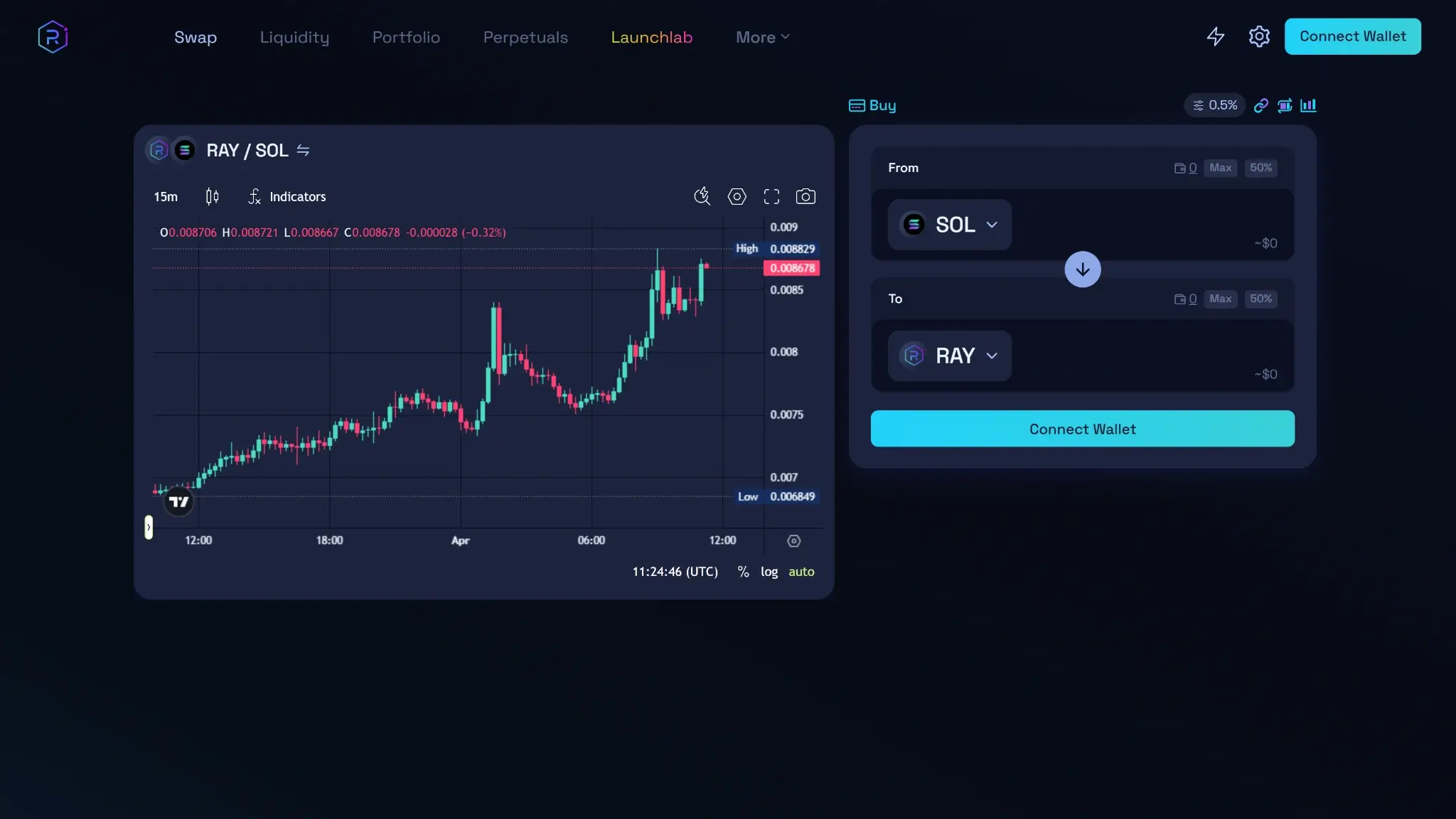
Raydium is worth considering when you already hold Solana assets and want direct access to pool trading or liquidity management. Concentrated positions let you choose a price range, while standard pools avoid that range-setting task. The choice matters because it changes both how capital is used and when fees accrue.
It takes more work to judge a token and its exit liquidity than to find it in a search box. Users who mainly want a market quote should compare an aggregator, and anyone needing bank deposits or withdrawals should check an account-based exchange before relying on Raydium for the whole journey.
Who Is Raydium Best For
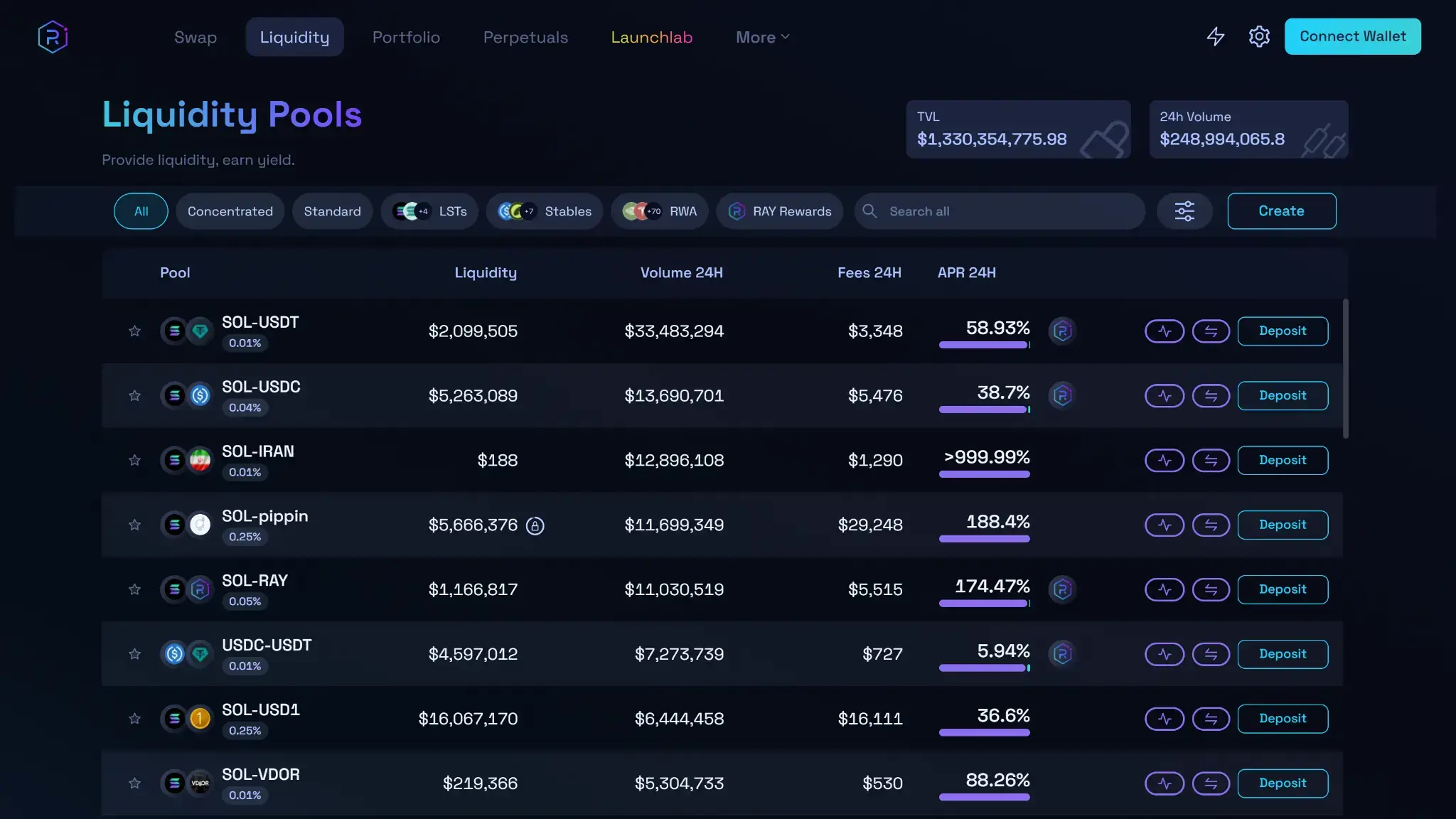
Raydium’s appeal depends on whether you plan to trade against pools or supply their liquidity. Those are different uses of the same tokens.
- Beginner Buying First Crypto
Requires wallet setup, SOL for transactions and a separate fiat purchase route
- Fee-Sensitive Spot Trader
Pool quotes are useful, but base percentages alone do not establish the cheapest route
- Derivatives Trader
Orderly-powered markets introduce margin, funding and vault withdrawal rules
- User Who Needs Bank Cash-Out
Needs an eligible external provider accepting the chosen token and network
- Altcoin Hunter
Permissionless markets offer access but require mint, authority and liquidity checks
- Staking / Earn User
RAY staking and pool strategies have different reward sources and principal risks
- Low-KYC User
Core spot swaps use a wallet, subject to interface restrictions
- User Who Wants Cleaner Tax Exports
Must reconcile wallet activity with separate pool and perps records
A liquidity provider can manage pool exposure without moving to a separate centralized trading account. Fee income must be weighed against changes in the value and composition of the deposited assets.
For a first purchase funded from a bank, compare beginner crypto exchanges before adding wallet transfers and decentralized trading to the process.
Raydium Fees and Pricing
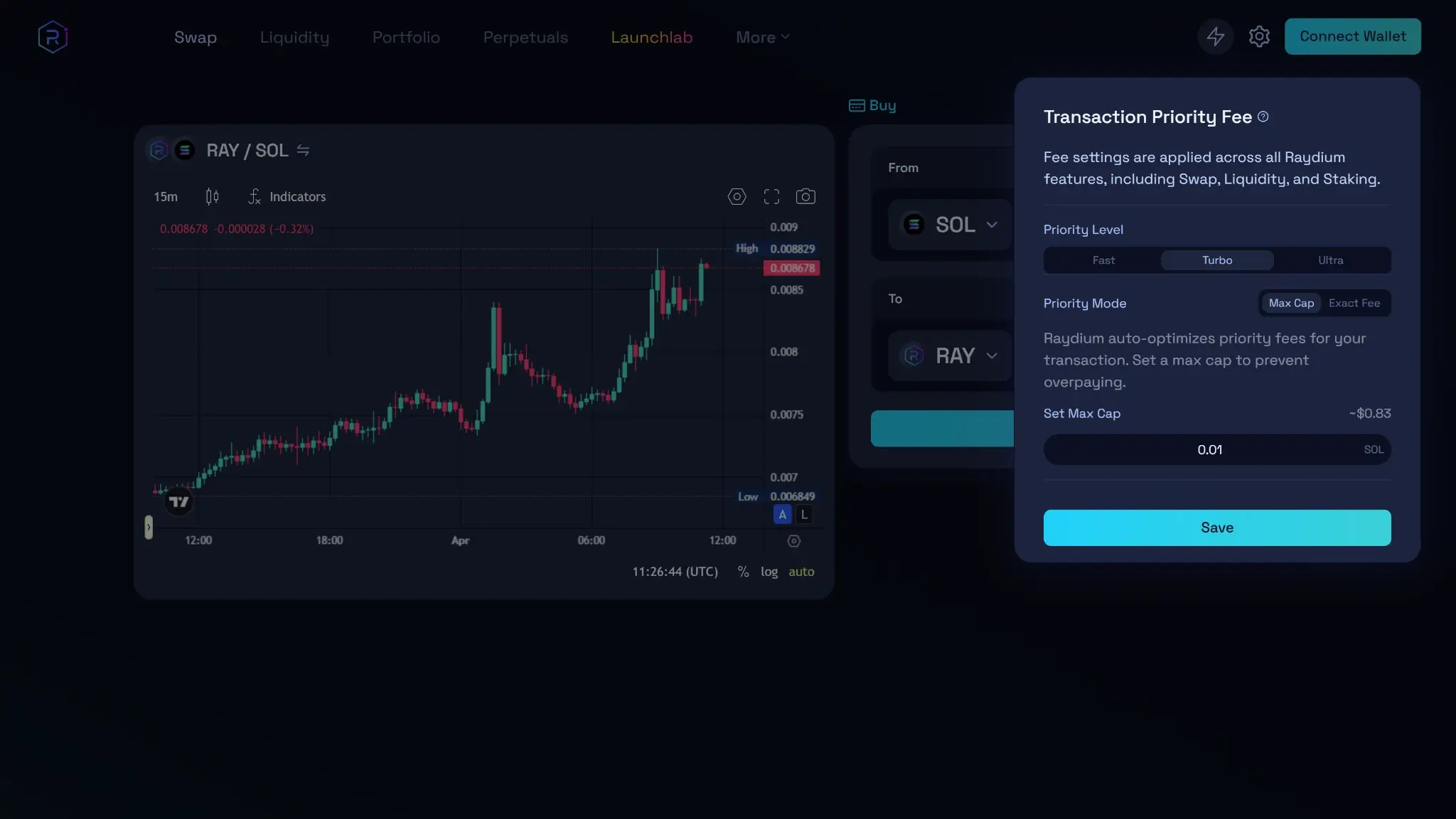
Raydium has no single percentage that describes every trade. Spot costs depend on the pool and token, while the perps account uses maker/taker pricing and additional position charges.
- CPMM Spot Pools
Published base configurations span 0.005–4%, before any enabled creator fee or other costs
- CLMM Spot Pools
Published base configurations span 0.01–4%, with a dynamic surcharge possible on enabled pools
- Older AMM v4 Pools
Standard base trading fee of 0.25%
- Perps Maker / Taker
Published April 2026 schedule starts at 0% maker and 0.045% taker, with volume-based taker discounts
- Perps Withdrawal
Raydium publishes a 1 USDC withdrawal fee. Check the actual route for additional applicable costs
- Wallet Transfer
Solana transaction cost and any applicable token transfer charge
- Fiat Purchase Or Cash-Out
External provider’s quote, spread, payment and withdrawal charges
The smallest listed pool base rate is not a promise that the website offers a trade at that all-in cost. Some configurations include a separate creator charge, and pool eligibility matters. The perps figures are a published schedule, so confirm the fee shown for the current account and order.
Hidden Costs To Watch On Raydium
A swap’s expected output reflects more than the pool’s base fee. Larger orders can move further along the pool’s pricing curve, and several charges can apply to one route.
- Creator fees can sit alongside the CPMM base fee.
- Eligible CLMM pools can add a volatility surcharge.
- Token transfer fees can affect the amount received.
- Network and priority costs remain separate.
- A failed transaction that reaches processing can still consume a network fee.
Compare the final expected output at the amount you intend to trade, and retain enough SOL for transaction costs. Raising slippage tolerance permits a worse execution price within that setting. It does not reduce a fee.
Perps Maker Fees And Volume Discounts
Maker pricing applies when an order adds liquidity and is subsequently filled. A limit order that immediately crosses the book is a taker order. Post-only instructions reject an order that would take liquidity, which helps control that distinction but does not guarantee a fill.
At the published base taker rate, opening and closing an unchanged $1,000 notional costs $0.90 in trading fees. This example excludes funding, collateral conversion, liquidation charges and withdrawals. The percentage applies to position notional rather than only the margin deposited.
The published discounts depend on rolling trading volume. Orderly’s share is already included in the listed taker charge, so adding it again would overstate that trading fee. Funding and any collateral borrowing costs still need their own calculation.
Deposits, Withdrawals, KYC and U.S. Availability
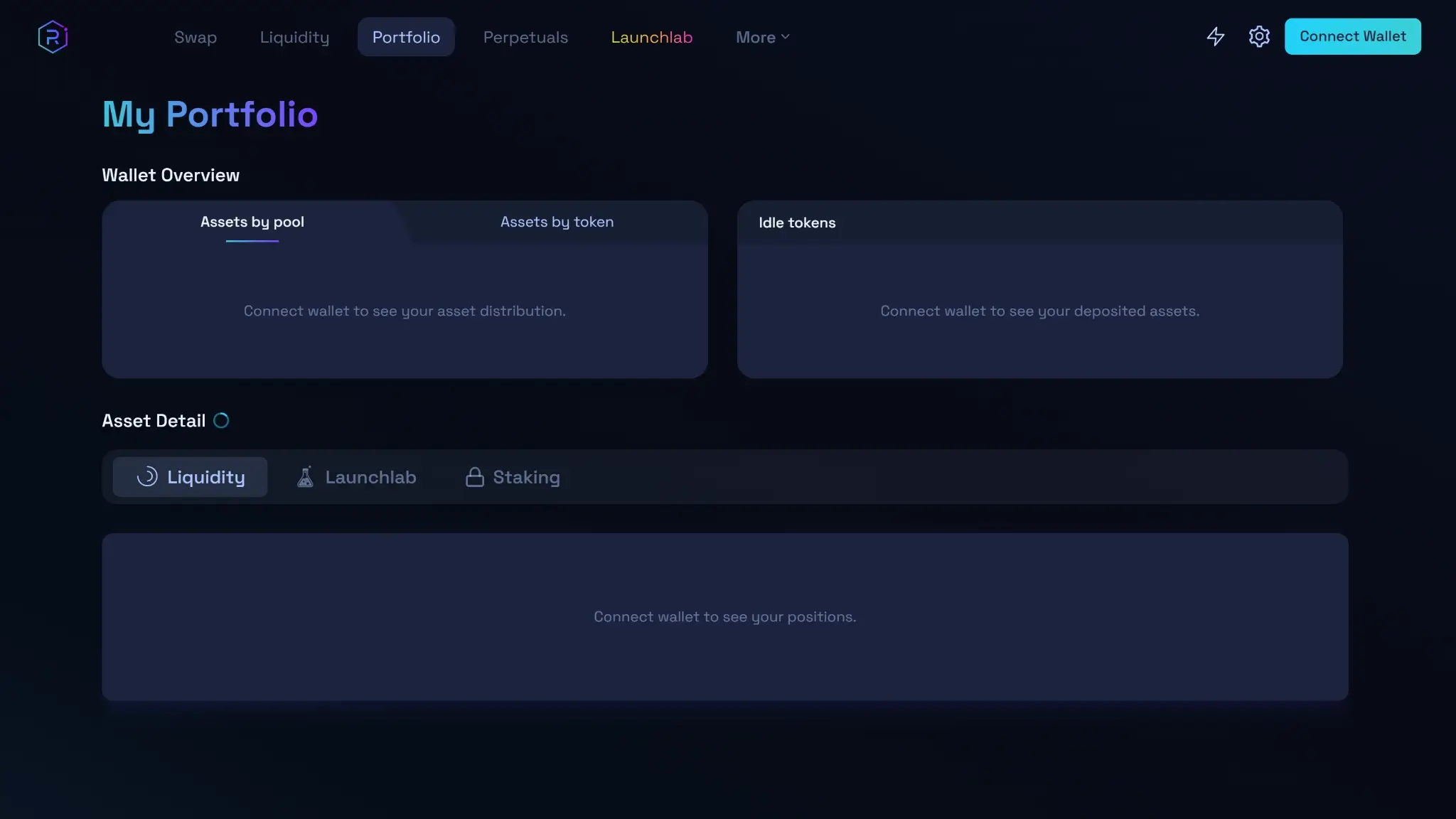
Buying tokens with money, connecting a wallet and funding perps are separate steps. Completing one does not establish eligibility or withdrawal access for the others.
- Spot Wallet Connection
Compatible Solana wallet, without a standard identity-document onboarding flow
- Bank Transfer
Requires a separate provider with a supported bank route
- Card Purchase
Payment-provider verification, accepted card and regional eligibility
- Perps Funding
Wallet authorization and a deposit into the trading vault
- Crypto Cash-Out
A receiving service that accepts the exact token and network
The interface disclaimer names Raydium Holding Foundation. A separate RAY token whitepaper identifies a Cayman Islands entity called Raydium Foundation. That token filing should not be read as authorization for every trading product or as a deposit-protection scheme.
What U.S. Users Need To Check Before Signing Up
The main-interface restriction summary appears in Quick Facts. A working wallet connection or a token available elsewhere does not override those terms. Perps and fiat providers have separate eligibility conditions, and using a VPN does not change them.
Users seeking bank-funded trading should compare crypto exchanges by the account and payment services available in their location. A provider that sells crypto to a wallet may not offer a matching sale-to-bank route.
Payment Rails, Networks, And Limits
Funds can become unavailable for different reasons: the receiving service may reject a network, a position may need collateral, or liquidity may be deliberately locked. Choose the receiving route before sending assets.
Fiat And Wallet Funding Routes
For spot trading, funding generally starts outside Raydium’s pools. Compare the amount that reaches the wallet after the provider’s charges.
- Exchange Withdrawal
Solana network, correct token mint and the exchange’s withdrawal fee
- Wallet Purchase Provider
Verification, supported payment method, quote and delivery asset
- Bridge
Source and destination networks, output token and bridge completion conditions
- Existing Solana Wallet
Available tokens and SOL for the transaction
- Perps Deposit
Supported vault asset and chain, current caps and deposit costs
A token with the same ticker on another network is not automatically interchangeable with its Solana version. Do not send a native asset from an unsupported chain to a wallet or vault based only on the ticker.
Withdrawal Networks And Fees
An ordinary wallet transfer has no Raydium account-withdrawal queue. Contract positions must first release their assets, and some commitments are intentionally irreversible.
- Wallet Token Transfer
Uses the supported Solana token and incurs applicable transaction costs
- Ordinary Pool Withdrawal
Removes the position’s available assets, whose composition and value can have changed
- Burn & Earn
Principal remains permanently locked under the current program
- RAY Unstaking
Requires the unstake transaction and associated network funding
- Perps Withdrawal
Limited by withdrawable collateral, route liquidity and applicable withdrawal costs
- Bank Cash-Out
Requires a separate off-ramp after assets reach a supported wallet or account
Orderly’s withdrawal flow can involve additional crosschain costs when destination liquidity needs rebalancing. Neither a vault balance nor a submitted withdrawal request guarantees immediate delivery to the wallet.
Verification Levels And Withdrawal Limits
Raydium does not use one identity tier to determine every product’s withdrawal allowance. Wallet control, payment verification and margin requirements answer different questions.
- Connected Spot Wallet
No standard document review, but the wallet must authorize transactions
- Fiat Provider Account
Provider-specific identity and payment checks, with its own review time
- Funded Perps Account
Deposit caps, asset eligibility and available margin determine usable funds
- Open Liquidity Position
Exit depends on the position and whether liquidity was permanently locked
- Restricted Access
Interface or provider restrictions can block an otherwise supported route, regardless of wallet balance
Confirm the actual withdrawable figure before arranging an external payment. Closing a position, settling profit or loss and converting collateral may be necessary before the funds can leave.
Is Raydium Safe?
Raydium provides public information about program audits and administrative controls, but the 2022 key compromise and a 2026 exploit of retired pools remain material to the trust assessment. Perps also require a separate assessment of Orderly’s vaults, pricing and settlement system.
Controls
Raydium publishes a three-of-four signing threshold and a 24-hour delay for program upgrades. Its separate three-of-five treasury and configuration authority does not carry the same delay. The upgrade timer therefore does not mean every fee or operational parameter change waits a day.
Those authorities make the programs changeable. Wallet signing gives the user control over authorizing a deposit, while the deposited funds remain exposed to the program and its permitted administrative actions.
- Spot Swap
Pool program, transaction instructions, token behavior and execution price
- Liquidity Provision
Pool assets, changing position composition and program controls
- Burn & Earn
Permanent principal lock and continued fee-generating activity
- RAY Staking
Staking program and RAY market value
- Perps
Orderly vaults, margin logic, price inputs and crosschain infrastructure
A code audit is not an insurance policy. Do not assume that an incident, failed trade or liquidation creates a right to reimbursement.
Proof Of Reserves Or Audits
Raydium lists audits for named programs, including its pool systems, Burn & Earn and LaunchLab. Its index also lists a 2026 review of CLMM limit orders and dynamic fees. Each report concerns its stated code and scope, rather than every later update or token traded through the site.
Orderly publishes a separate audit collection, including Solana vault reports. Raydium’s active Immunefi bounty covers specified contracts and qualifying impacts, with exclusions. Neither that bounty nor Raydium’s program audits should be extended automatically to the whole perps service, frontend or third-party integrations.
Incidents And Remediation
In December 2022, a compromised PoolOwner key was used to remove roughly $4.4 million from eight constant-product pools. Raydium’s postmortem said concentrated-liquidity pools and RAY staking were unaffected. It described revoking the compromised authority, removing sensitive administrative paths and moving control to multisignature arrangements.
Raydium subsequently ran a compensation process whose claims window closed in May 2023. That historical response does not establish that every loss was fully reimbursed.
On June 10, 2026, Raydium acknowledged a separate exploit involving roughly $1.34 million in five retired AMM V3 pools. It said its current programs were unaffected and committed treasury funds to compensation. Completion of those payments was not verified for this review. The incident adds a reason to check the exact pool program holding a position, including older pools no longer accessible through the main interface.
Supported Assets and Markets
Raydium’s spot market is built around Solana tokens. A token’s presence does not establish how much can be bought or sold without moving its price.
- Listed Assets
Supported Solana token mints with available pools or routes
- Number Of Markets
Changes as permissionless pools appear. A count does not measure usable depth
- Fiat Currencies
No native fiat trading balance for spot swaps
- Stablecoins
USDC and USDT routes depend on the selected pools and available liquidity
- Perps Markets
Orderly-powered contracts, distinct from Raydium’s spot token catalog
- Regional Access
The interface restrictions in Quick Facts apply independently of token availability
Verify the mint address and token controls before buying. A token can have transfer charges or restrictions, and a small successful purchase does not establish that a larger sale will receive an acceptable quote.
App, UX and Customer Support
Raydium asks users to make wallet, token and position decisions themselves. Support is most useful when the problem can be tied to a transaction or a specific product.
UI And Navigation
Swap, liquidity tools and Perps commit funds in different ways. Check whether the action exchanges tokens, deposits them or permanently locks a position before approving it.
Our September 16 research did not complete a live quote comparison, so this review makes no claim that Raydium gives better execution than an aggregator. A January 2026 user review complained about repeated quote computation, while older comments also described delays. That limited sample does not establish the current failure rate.
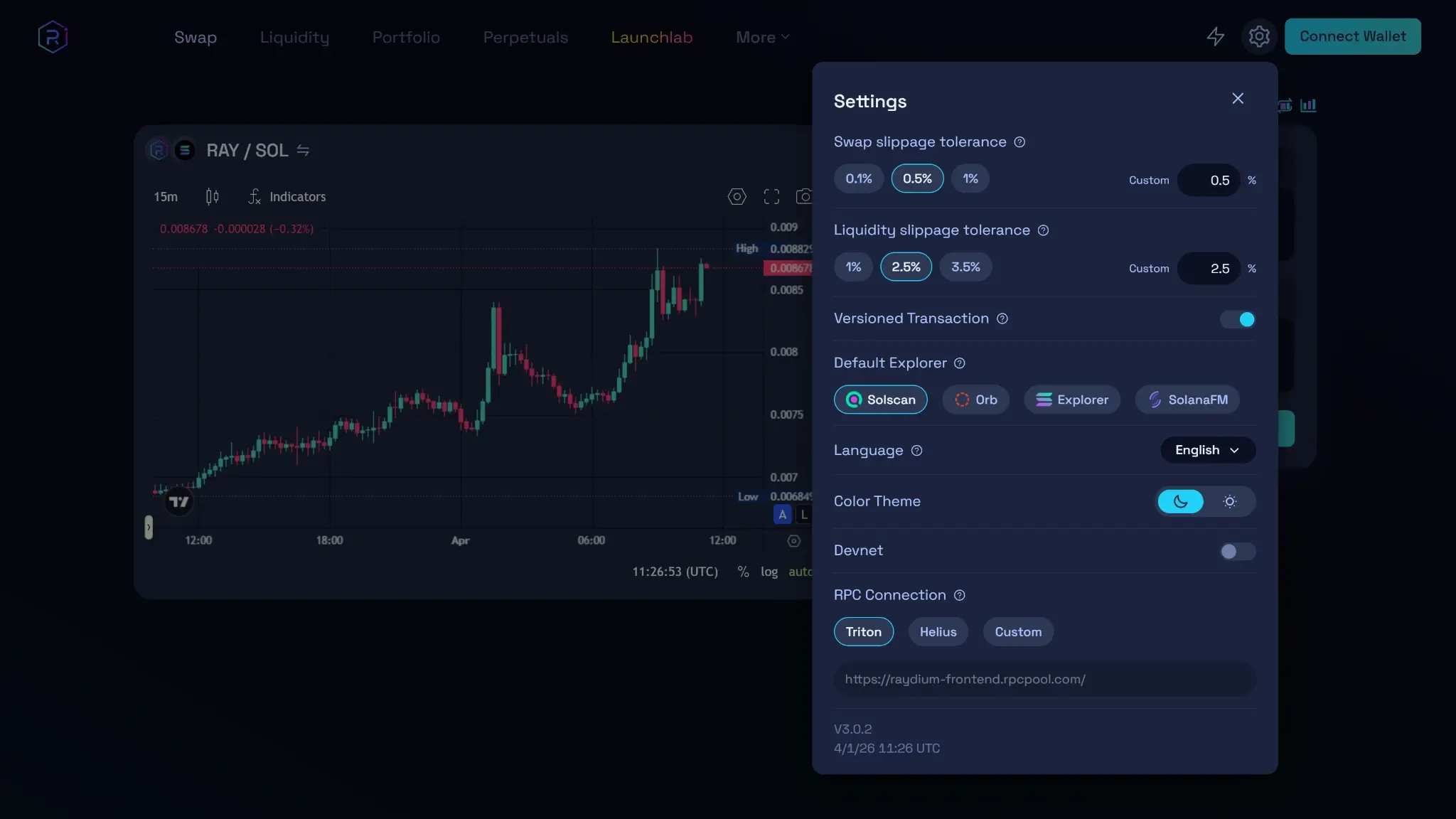
For records, retain wallet transaction identifiers and reconcile liquidity deposits, withdrawals and rewards separately. Perps fills, funding and realized profit or loss need the trading account’s records as well. Wallet transfers alone cannot describe all those events, and a complete native CSV export was not verified for this review.
Mobile App
Raydium’s documented mobile route is its website through a compatible wallet browser. It does not offer its own native mobile app. Follow official site links and distinguish the wallet publisher from Raydium when choosing software.
Reliability And Status Page
A delay can begin at the website, the quoting service, the wallet connection, Solana processing or the perps provider. Identify which step failed before retrying.
- Status Coverage
No comprehensive end-to-end uptime figure verified for this review
- Outage Communication
Check official announcements alongside the affected chain or provider
- Trading Delays
A quote failure and a submitted transaction failure require different checks
- Transfer Delays
Vault liquidity and off-ramp processing can delay an exit independently of the website
A failed quote does not mean a transaction reached the chain. Refreshing the website will not reverse a submitted transaction or release margin supporting an open position.
Customer Support
Raydium’s official community channels and documentation are the starting point for product help. Technical integration issues also have a GitHub route.
- Swap Or Pool Error
Transaction identifier, token mint and selected pool or route
- Perps Balance Or Order
Account record, order identifier and the relevant Orderly-powered activity
- Wallet Access
The wallet’s recovery process and the user’s own backup
- Fiat Purchase
The provider that processed the payment
- Suspected Fake Support
Verify the channel through Raydium’s official site before responding
No support response time was measured for this review. A support conversation cannot recover a lost private key or reverse an already completed transfer because the destination was wrong.
Features And Services
Raydium combines token trading with tools for creating and funding markets. Its newer standard pools are called constant-product market makers, or CPMM: their relative token reserves determine the swap price. Concentrated liquidity market makers, or CLMM, let providers restrict their capital to a chosen price range.
- Spot Swaps
Exchanges supported Solana tokens against available pool liquidity
- Standard Pools
Prices swaps from the pool’s relative token reserves, without a user-selected range
- Concentrated Liquidity
Allocates a position to a chosen price range, with additional capabilities on eligible pools
- LaunchLab
Uses a formula to adjust token prices as trading progresses, before qualifying launches move into a pool
- Burn & Earn
Permanently locks eligible liquidity while preserving transferable rights to its fees
- RAY Staking
Deposits RAY to earn variable RAY rewards
- Perpetuals
Provides access to Orderly’s shared order book through a Raydium interface
Older AMM v4 pools still coexist with newer pool types. Their historical OpenBook connection is no longer an active source of shared order-book liquidity.
Liquidity, LaunchLab And Burn & Earn
A concentrated position earns trading fees while its liquidity is active within the chosen range. Moving outside that range stops fee accrual until the position becomes active again. It also changes the assets held, so a high displayed fee return does not establish a profit after price movement.
Burn & Earn makes a more permanent commitment. Eligible liquidity is locked and cannot be redeemed through the current lock program. A Fee Key NFT gives its holder the right to collect the associated fees, but selling or transferring that key does not release the underlying principal.
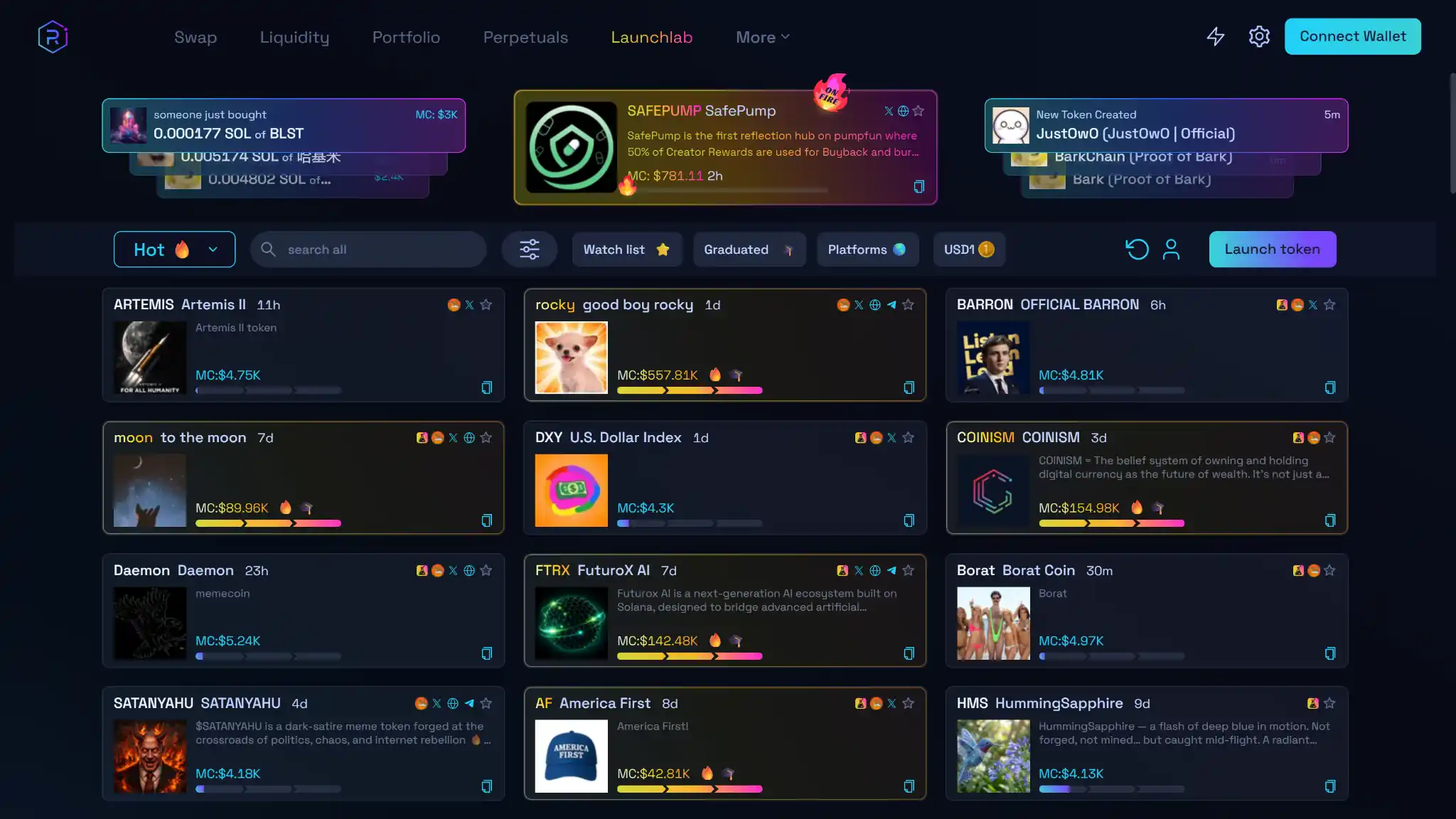
LaunchLab initially prices purchases and sales through a bonding curve, a formula that adjusts price as tokens are bought or sold. Qualifying launches then move into a funded constant-product pool, where the token reserves determine prices. Platform settings determine parts of the fee allocation and who receives the relevant Fee Key. Graduation or locked liquidity cannot prevent a token issuer from retaining other powers, nor guarantee demand for the token.
Staking And Rewards
RAY staking avoids managing a two-token pool position, but still exposes the deposit and rewards to RAY’s price. It should be evaluated separately from providing liquidity.
- Available Asset
RAY
- Headline Yield
Variable rewards, without a fixed return
- Platform Commission
Not disclosed as a fixed rate in the staking guide
- Reward Asset
RAY
- Payout Frequency
No fixed payout timetable disclosed in the staking guide
- Unstaking
Uses a signed unstake transaction. No fixed completion promise
- Regional Limits
Subject to the interface restrictions in Quick Facts
Keep SOL available for the relevant transactions. Holding or staking RAY is not a prerequisite for an ordinary spot swap, so buying the token solely to gain access is unnecessary.
Perpetuals And Collateral
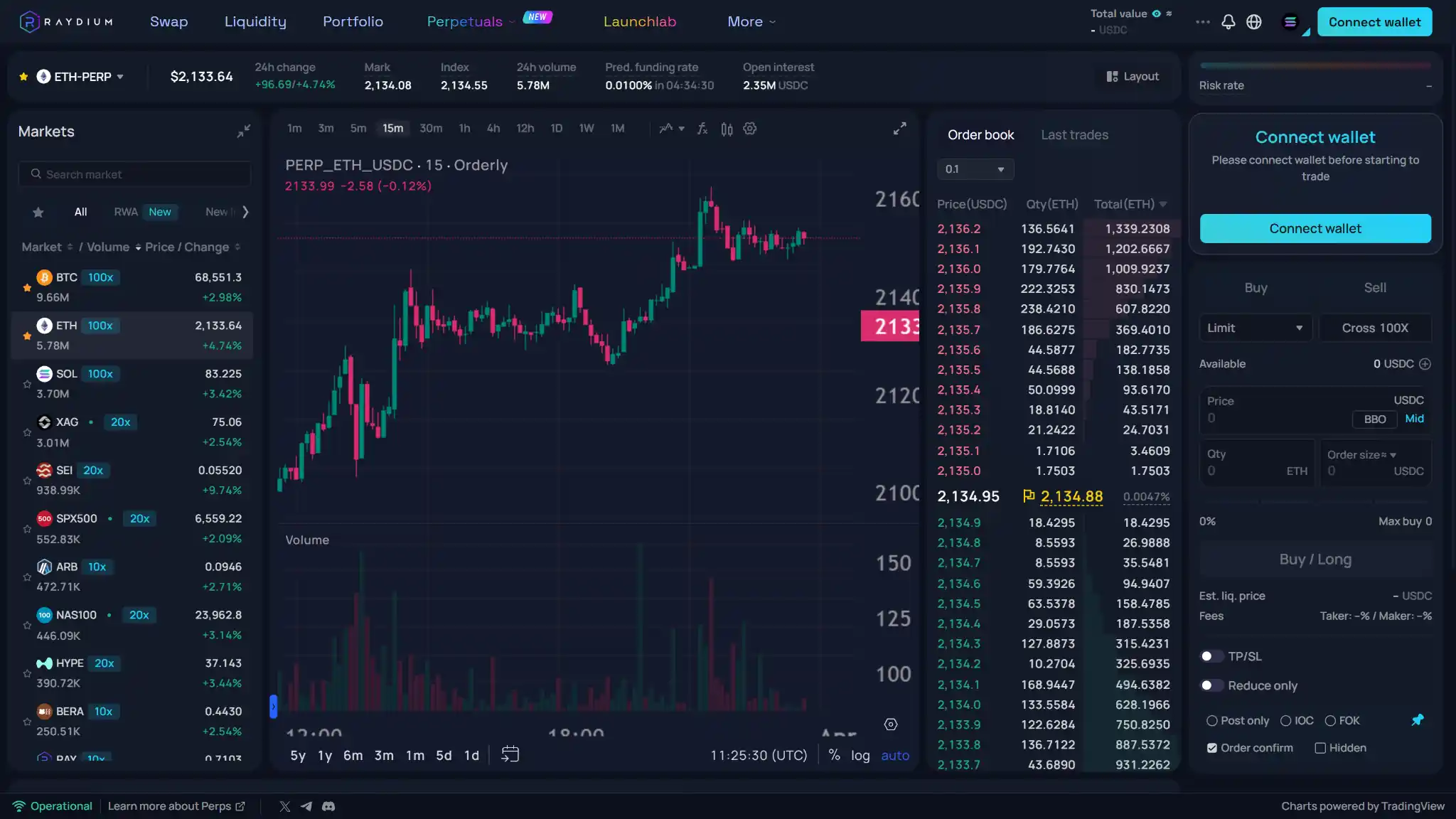
Raydium Perps advertises positions with exposure up to 100 times the required initial margin on eligible markets. Actual limits depend on the market and position, and multiplying exposure also magnifies the effect of adverse price movement on collateral.
Collateral enters Orderly vaults. Matching takes place offchain, with settlement on Orderly’s Layer 2 network and communication between supported chains. This introduces infrastructure and pricing dependencies beyond a direct Solana pool swap.
Raydium’s perps guide describes cross-margin use, where positions can draw on shared collateral. Non-USDC assets may receive discounted collateral values, and losses denominated in USDC can produce borrowing costs or automatic conversion charges. Check the margin mode and withdrawable amount in the actual account before opening a position.
Wallet And Self-Custody Options
Core spot access uses a compatible Solana wallet. Raydium does not provide the recovery phrase for that external wallet, and its support cannot recreate lost keys.
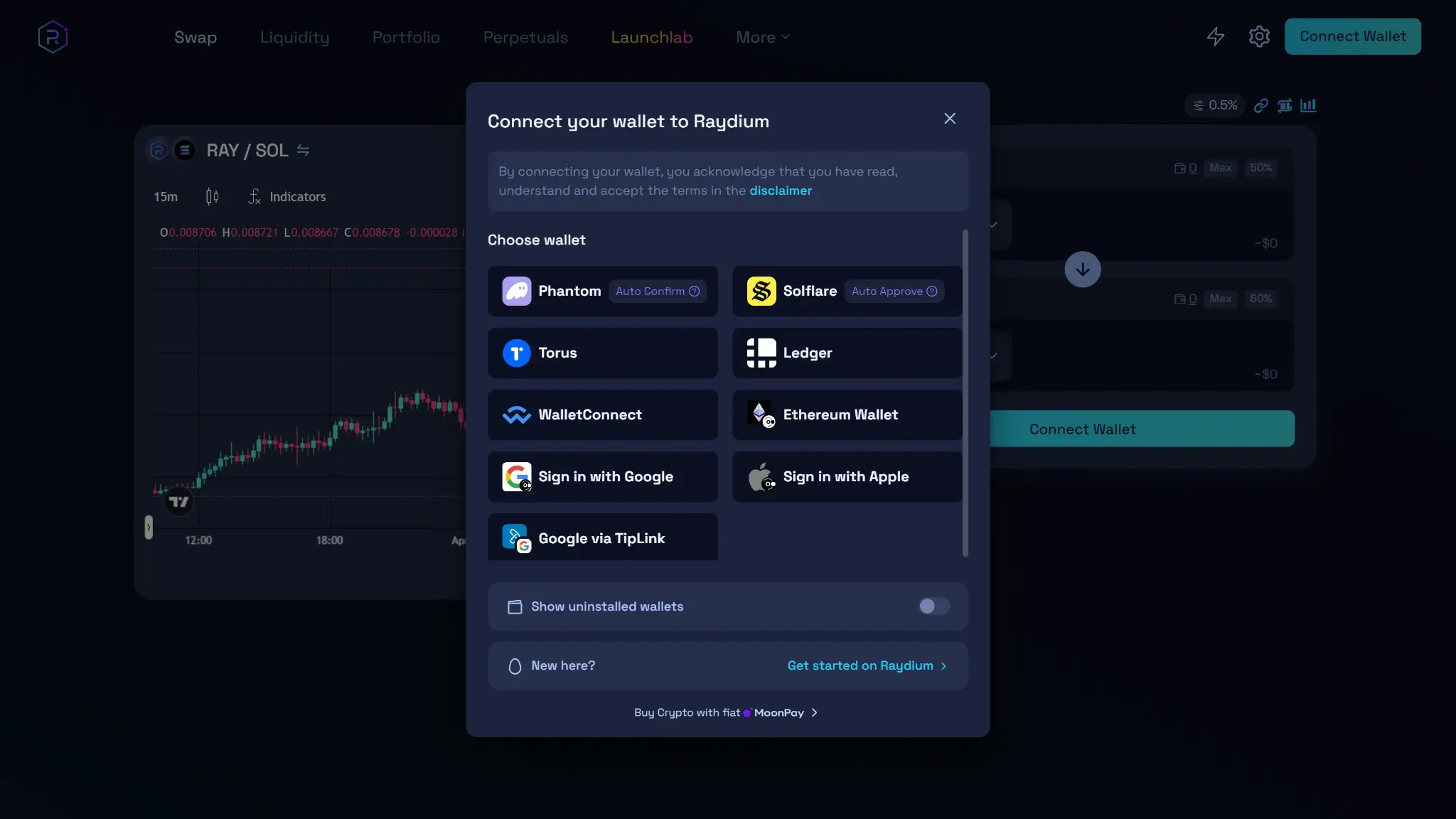
After a swap, received tokens can sit in the wallet. Supplying liquidity, staking RAY or depositing perps collateral moves assets into the relevant program or vault. Keeping control of a signing key does not remove those contracts’ withdrawal conditions or administrative powers.
API And Programmatic Trading
Raydium offers tools for obtaining quotes and constructing transactions. Developers using perps need Orderly’s trading interfaces as well as the wallet and authentication flow appropriate to their integration.
- REST API
Spot pool data, quotes and transaction-building services, plus separate Orderly trading endpoints
- WebSocket
Orderly provides market and account streams. This does not establish identical spot API functionality
- Sandbox
Orderly documents a testnet. Spot developer environments need separate configuration
- Order Types Supported
Spot swaps and eligible-pool limit orders, with separate perps order types
- Key Controls
Wallet signatures authorize spot transactions. Orderly uses authenticated trading keys for private requests
The API offering is more than read-only market data. A returned transaction still needs authorization and submission, and its quote can change before execution. Building a transaction is not evidence that it will land successfully.
Alternatives to Raydium
-


Jupiter
Raydium requires picking and managing a specific pool; a trader who wants an aggregated comparison across available Solana routes should compare Jupiter's Ultra and Manual modes instead.
-

Pump.Fun
A token still on a Pump.fun launch curve hasn't reached a Raydium-style pool yet; that earlier stage is covered separately by Pump.fun's review.
-

Hyperliquid Labs
Raydium's own perps interface runs on Orderly infrastructure with separate margin/withdrawal rules; a trader comparing native onchain order-book perps directly should weigh Hyperliquid's HyperCore terms instead.
The most useful comparison depends on what Raydium doesn’t do for you: aggregate routes across a wider set of Solana pools, host a token before it reaches a pool, or provide native onchain perpetuals margin terms.
Jupiter: Raydium requires picking and managing a specific pool; a trader who wants an aggregated comparison across available Solana routes should compare Jupiter’s Ultra and Manual modes instead.
Pump.fun: A token still on a Pump.fun launch curve hasn’t reached a Raydium-style pool yet; that earlier stage is covered separately by Pump.fun’s review.
Hyperliquid: Raydium’s own perps interface runs on Orderly infrastructure with separate margin/withdrawal rules; a trader comparing native onchain order-book perps directly should weigh Hyperliquid’s HyperCore terms instead.
Within the decentralized exchange category, Raydium’s main attraction is control over Solana pool positions. For an occasional swap, access to those tools alone is not a reason to accept a worse quote or an unfamiliar token.
Final Verdict
Raydium fits experienced Solana pool users who can assess token liquidity, layered fees and the exit conditions of each position.
CryptoSlate may earn a commission when you use partner links, at no extra cost to you. Our reviews, ratings, and editorial decisions remain independent of advertisers. Read How CryptoSlate Makes Money for funding details.