


Overview
Introduction
A prop firm, short for proprietary trading firm, is a company that trades its own capital or evaluates external traders for access to a rules-based trading program. Traditional firms hire or contract traders to place live trades for the firm. Many online firms use simulated evaluation and funded-stage accounts, then pay cash rewards tied to the participant's results. The account label alone does not tell you which model applies.
Key takeaways
What Is a Prop Firm in Trading?
“Prop firm” is shorthand for proprietary trading firm. In the traditional model, the company trades its own capital for its own benefit instead of managing money for outside clients.
Market makers, quantitative trading companies, and specialist trading desks can all operate as traditional prop firms. Traders work under employment, contractor, partnership, or ownership arrangements. The firm supplies capital and technology. It also controls data access and risk limits. Trading gains and losses belong to the business, while compensation follows the trader's agreement.
“Prop firm” now also refers to companies that sell trading evaluations to the public. Participants pay for a simulated account and trade within predefined rules. Passing can lead to a funded-stage account and cash rewards. Some firms later allocate live capital or copy selected trades, while others keep the participant in simulation throughout. The shared label therefore covers distinct company models. This retail program model is one branch of prop trading, not a direct substitute for an institutional trading job.
Traditional Prop Firms vs Modern Online Prop Firms
Traditional firms recruit traders to contribute directly to the firm's trading operation. Modern online firms open a standardized evaluation to a much larger group of remote participants. Passing the evaluation can create a contractual right to continue trading under program rules, but it does not automatically create an employment relationship or a live brokerage account.
| Model | How It Works |
|---|---|
| Traditional proprietary firm | Recruits employees, partners, or contractors to trade company capital in live markets. Compensation may include salary, bonus, or a share of trading gains. |
| Modern online prop program | Sells or provides access to a standardized evaluation. Qualification can create payout rights in a simulated or live funded stage, subject to continuing rules. |
| Main risk-control difference | Traditional desks combine human oversight with position and capital limits. Online programs usually enforce automated drawdown, daily-loss, consistency, position, and strategy rules. |
| Main revenue difference | Traditional firms seek gains from trading and related market services. Online firms can combine fees, retained reward share, copied exposure, and live trading gains. |
Simulated retail programs often use institutional phrases such as “trade our capital.” The phrase can describe live allocation. It can also refer to virtual buying power used only to calculate performance rewards. Check the account model in the firm's terms.
How Do Modern Prop Firms Work?
An online firm first defines the product it is selling. That includes the account environment, supported markets, evaluation route, rules, fees, and contractual source of any reward. The firm also decides whether participant activity will remain simulated or inform separate live trading.
The operating model then has four parts:
- Offer and administer the program. The firm supplies the platform, market data, account tier, rules, and customer support.
- Assess the participant. A prop firm challenge or verified performance record tests whether the participant meets the required objectives without a breach.
- Control the funded stage. The firm issues the contract, performs identity and conduct reviews, and decides whether the account is simulated, live, or connected to separate copied exposure.
- Settle rewards and manage risk. The firm calculates eligible performance, approves or rejects payout requests under the agreement, and controls any live capital placed at market risk.
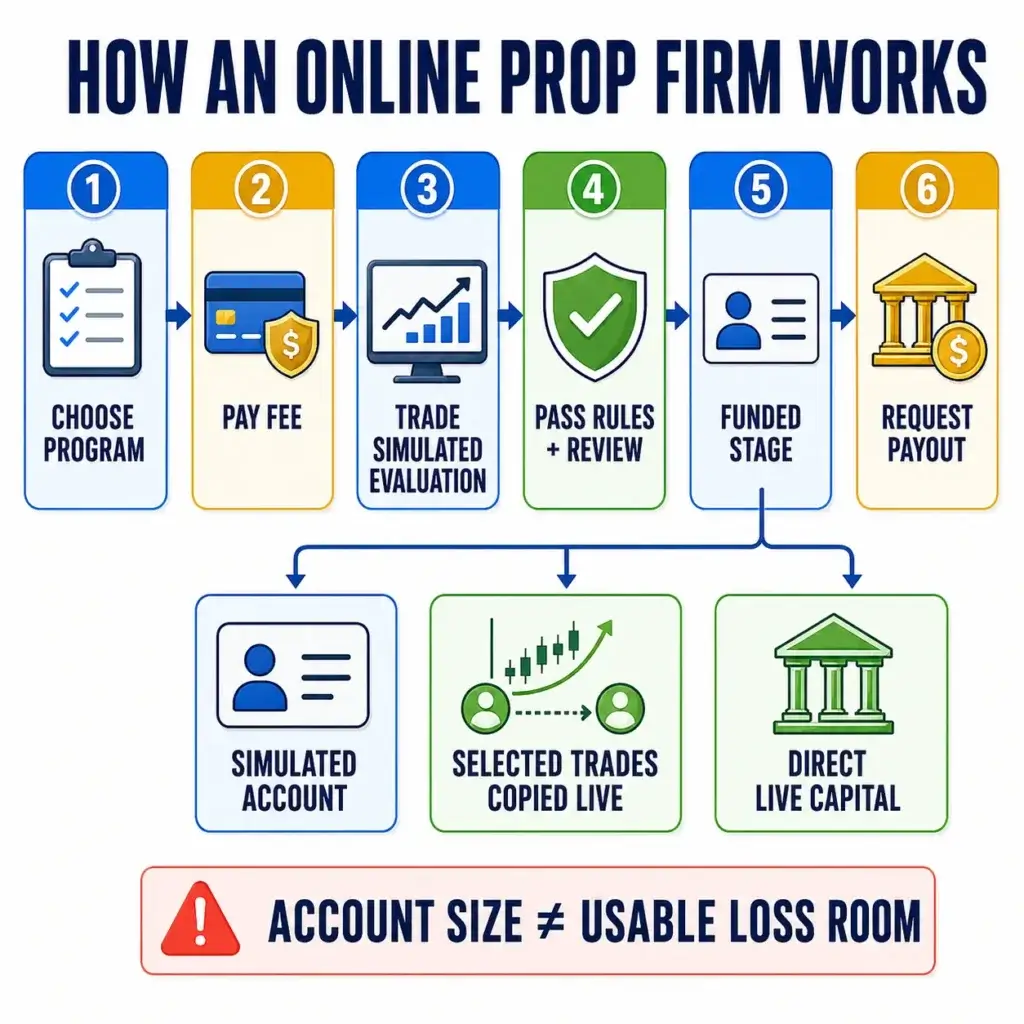
The participant experiences this as a path from program selection to evaluation, review, funded status, and possible payout. The firm remains the party that controls the product and its rules throughout.
What Does an Advertised Account Size Mean?
The advertised balance usually describes an account tier, nominal buying power, or a simulation reference. The participant does not own that amount and cannot withdraw it. A nominal $100,000 account with a $10,000 maximum-loss rule initially provides $10,000 of loss room.
Position sizing in a funded trading account starts with the closure threshold, not the headline balance. Nominal size, usable loss room, and withdrawal-eligible profit are separate figures.
Which Prop Firm Rules Control the Account?
The rules determine whether a strategy fits the program and whether a profitable account remains open. A strategy that fits one program can breach another even when both accounts show the same nominal balance.
| Rule | Practical Effect |
|---|---|
| Profit target | Sets the gain required during an evaluation. The trader must reach it without violating a loss rule. |
| Maximum drawdown | Defines the largest permitted decline under the firm’s formula. A breach normally ends the account. |
| Daily loss limit | Caps the decline within the firm’s trading-day window. Open and closed losses may both count. |
| Static drawdown | Fixes the loss threshold to a starting reference, so the failure line normally stays in place. |
| Trailing drawdown | Raises the loss threshold after gains, which means early profit may not create permanent extra room. |
| Consistency rule | Restricts how much performance can come from one day or trade. A large winning day can delay qualification or payout. |
| Position limit | Caps contracts, lots, or exposure. Exceeding it can be a breach even when the trade is profitable. |
| Minimum activity | Requires a set number of days or trades before qualification or payout. |
| News and holding rules | Restrict trading around events, overnight sessions, or weekends. |
| Prohibited conduct | Can bar copying, latency exploitation, coordinated hedging, account sharing, or other named behavior. |
Daily drawdown calculations deserve special attention because companies define the reset time and included losses differently. Some use balance, some use equity, and others include floating profit or loss at a fixed snapshot. Each reference point can place the failure threshold at a different level.
A program may quote crypto continuously while still enforcing platform maintenance windows and restrictions on weekend or news trading. CFD-style position limits may also apply. The contract controls when and how the instrument may be traded.
Are Prop Firm Accounts Live or Simulated?
A funded account can be simulated. “Funded” often denotes the participant's status and reward eligibility, while the agreement determines whether any order reaches a live market. A firm can also keep the participant in simulation and copy selected exposure into a separate live account.
A simulated funded account can create a contractual cash-payment obligation without placing the participant's orders in a live market. A live account instead places firm capital at market risk and creates actual positions owned by the firm.
How Do Prop Firms Make Money?
Traditional firms seek revenue from proprietary trading and related market services, including market making. Online firms can combine several sources:
- Evaluation purchases and recurring subscriptions
- Reset, activation, data, or platform fees
- A retained share of performance rewards
- Gains from live capital allocated to selected traders
- Gains from copying or hedging selected trading signals
- Ancillary software, education, or partnership revenue
Evaluation fees and other prop firm revenue can pay for infrastructure, assessment, data, and platform access. The full mix is rarely disclosed, so participants may not know what proportion comes from fees, copied exposure, or live trading.
Do not assume that failed challenges fund every payout or that every profitable trader is copied into live markets unless the firm discloses it. Check whether the company explains its account model and the contractual source of rewards. The terms should also identify conditions that could delay or cancel payment.
How Do Profit Splits and Payouts Work?
A profit split states how qualifying performance is divided between the participant and the firm. The payout formula determines which gains are eligible, when a request can be made, and what happens to the account buffer after withdrawal.
Some firms raise buying power after sustained rule-compliant performance. Prop firm scaling plans can also change position limits, drawdown, payout caps, and the firm's exposure over time.
What Can You Trade Through a Prop Firm?
Programs may cover forex, futures, equities, options, commodities, indices, and crypto-linked instruments. The product name does not reveal whether the participant trades the underlying asset, an exchange-traded contract, a CFD, or a simulated price feed.
A BTC symbol might represent a simulated CFD or derivative position with no Bitcoin custody or on-chain settlement. Some crypto-focused programs instead connect to an exchange environment or use perpetual futures. Review the contract specification, trading environment, settlement method, and leverage. Then check trading hours and the named counterparty before treating the exposure as equivalent to owning a coin.
Crypto prop trading programs may use exchange-connected products or simulated crypto-linked contracts. Custody, execution, instrument type, and settlement determine what exposure the participant actually receives.
Futures programs use standardized derivatives with defined expiry and settlement terms. Forex and CFD programs add leverage and counterparty terms. Crypto perpetuals have no scheduled expiry, which changes funding costs and round-the-clock risk.
Benefits and Constraints of Online Prop Programs
The model can give an experienced trader access to larger nominal exposure without depositing the full account balance. In exchange, the firm controls position size, trading windows, permitted losses, and payout conditions.
| Potential Benefit | Corresponding Constraint |
|---|---|
| Program cost can be lower than funding an equivalent personal position | Repeated evaluations, resets, and subscriptions can accumulate |
| Loss rules impose a defined stopping point | The account can close after a brief breach even if the strategy later recovers |
| Larger nominal balance can support more position flexibility | Usable loss room is much smaller than the headline balance |
| Successful performance may qualify for payouts or scaling | Payouts depend on contract terms and the firm’s solvency |
| Simulation limits direct market loss during evaluation | Simulated fills and psychology may differ from live execution |
| Firm rules can reinforce discipline | The same rules can conflict with an otherwise valid strategy |
Additional costs may include data, platform access, account resets, and activation. Tax treatment also affects the result, as can forfeited rewards and rejected payout requests. Each payment buys access to a contractual program whose conditions remain in force after the evaluation.
Prop Firm vs Broker vs Asset Manager
These businesses can all place trades, but they act for different economic owners and provide different services.
| Business | Economic Role |
|---|---|
| Prop firm | Trades company capital for the firm’s benefit or operates a trader-evaluation and capital-allocation program. |
| Broker | Executes, routes, or facilitates orders for customer accounts and may provide custody, margin, or other account services. |
| Asset manager | Invests client or fund capital under a mandate and receives compensation defined by the management agreement or fund documents. |
A company can perform more than one role through separate entities. Check which legal entity signs the program agreement and which entity, if any, provides brokerage or live-account services.
Who Is an Online Prop Program For?
An online prop program is most relevant to a trader who already has a tested method and can adapt it to fixed risk constraints. The trader should know expected drawdown, average holding period, normal losing streak, position size, and how the strategy behaves around volatile events.
A challenge target can encourage a beginner without a tested edge to take oversized positions. The participant then pays to expose weaknesses under the program's time and risk rules. A prop program cannot replace basic trading education.
Consider a prop program only if you can answer these questions:
- Can the strategy remain inside the firm's daily and total loss formulas?
- Can you stop trading after reaching a personal loss limit?
- Do the permitted markets and holding periods match the strategy?
- Can you afford every program cost without relying on a payout?
- Are you comfortable with a simulated account if no live allocation occurs?
- Have you tested the rules across losing and volatile periods?
How to Check a Prop Firm Before Paying
Start due diligence with the contract and legal entity. The full process in how to choose a prop firm turns the checks below into a shortlist.
- Identify the company. Record the legal name, registration jurisdiction, address, operating history, and contracting entity.
- Classify the product. Determine whether you are buying education, software, a simulated evaluation, a contractor opportunity, brokerage access, or live capital allocation.
- Confirm the account environment. Look for direct language on simulated accounts, fictitious capital, live orders, liquidity providers, and trade-data use.
- Calculate usable loss room. Model daily, static, and trailing thresholds using equity after costs and open losses.
- Add every cost. Include evaluation fees, subscriptions, resets, activation, data, platform access, payout charges, and currency conversion.
- Read the prohibited-conduct clause. Check news trading, automation, copying, hedging, IP or device rules, account sharing, latency strategies, and coordinated trading.
- Rebuild the payout formula. Identify eligibility dates, consistency tests, buffer requirements, caps, review rights, and dispute procedures.
- Check change rights. Find out whether the firm can amend rules for active accounts and how notice is delivered.
- Review payout evidence carefully. Screenshots and social posts do not prove that every eligible request will be paid under the same conditions.
- Set a total budget. Decide the maximum program spend before the first attempt and do not fund retries from expected future payouts.
Regulatory status depends on the service, instrument, location, and legal entity. A simulated evaluation company is not automatically regulated as a broker. A business handling customer funds or offering regulated trading services may trigger different obligations. Registration alone does not establish that program terms are fair, stable, or enforceable in the participant's jurisdiction.
Review Current Prop Firm Programs
Once the account model and risk rules are clear, current prop firm programs can be filtered by supported market, evaluation structure, cost, and payout conditions. The shortlist still needs to be checked against the provider's current agreement before payment.
Before choosing between a prop program and self-funded trading, calculate the full cost, loss control, withdrawal rights, and counterparty exposure of both routes.
FAQ
What is a prop firm in simple terms?
A prop firm is a company that trades for its own benefit or evaluates traders for a performance-based trading program. Traditional firms usually deploy live company capital. Many online firms use simulated accounts and pay qualifying traders under a reward contract.
How do prop firms work?
Online prop firms usually charge for an evaluation and apply profit and risk rules. Successful participants move to a funded stage that can be simulated or live. Payout eligibility continues to depend on the firm’s trading and conduct rules.
Do prop firms give traders real money?
Traditional prop firms and live funded accounts place company capital at market risk. Many online funded accounts use virtual capital but pay real cash rewards based on simulated performance. The agreement should state which model applies.
How is an online prop firm different from a traditional prop firm?
A traditional prop firm recruits traders or builds systems to place live trades for the business. An online prop firm can sell standardized evaluations and grant payout rights under a simulated or live funded-stage agreement. The participant is usually a customer during evaluation, not an employee of a trading desk.
Are prop firms the same as brokers?
Prop firms and brokers perform different functions. A broker executes or facilitates trades for customer accounts. A prop firm trades for itself or operates a trader-evaluation and capital-allocation program. Related companies can provide both services through separate legal entities, so check the name on each agreement.
Are prop firms legal and legitimate?
Legality depends on the jurisdiction, instruments, account model, and services offered. A legitimate firm should disclose its contracting entity and account environment. It should also state the fees, rules, payout terms, and dispute process without presenting simulated capital as a customer-owned live balance.