


Overview
Introduction
A prop firm scaling plan is a contract-defined process that changes one or more account parameters after an eligibility test or review. One plan may increase the displayed balance or assigned allocation. Another may leave the account label unchanged and release more futures contracts as balance grows. Scaling can occur entirely in simulation. A larger balance therefore does not prove live capital or proportionately more room before failure. Assess the transition through its new loss floor and position limit, then record the payout terms and next target.
Key takeaways
- What it is. A scaling plan changes specified account parameters after the trader meets a rule or passes a review.
- Why it matters. Account balance and usable loss room can move by different amounts. Position capacity and payout terms can change separately.
- Main risk or limitation. A large maximum allocation can hide a difficult path or a fixed loss allowance. Approval can remain discretionary as well.
What Is a Prop Firm Scaling Plan?
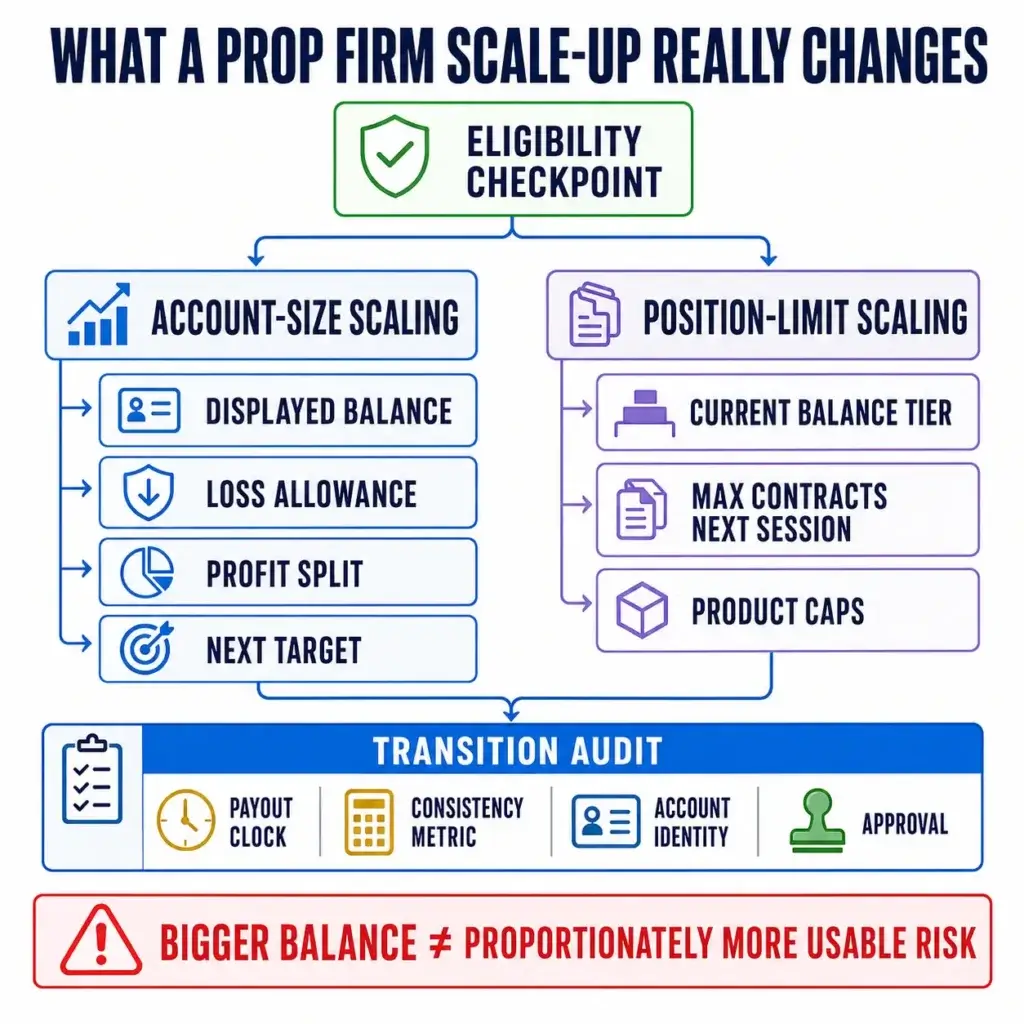
A prop firm scaling plan governs changes to a funded account after the initial qualification stage. It is different from scaling into or out of a market position. The account plan changes contractual limits. Trade scaling changes the size of an individual position.
| Parameter | Possible Change |
|---|---|
| Displayed balance | Fixed increase, percentage increase, replacement tier, or no change |
| Capital status | Simulated buying power, direct-live allocation, or mixed routing |
| Position capacity | More lots, contracts, shares, or product-specific exposure |
| Loss rules | New dollar allowance, new reference balance, new active floor, or unchanged limit |
| Profit split | Higher participant share at a stated tier or under a separate review |
| Payout | New cap, timing rule, retained buffer, or qualification requirement |
| Next checkpoint | New profit target, review date, qualifying cycle, or approval process |
| Aggregate ceiling | Limit per account, product, trader, or total relationship |
The term “scaled account” does not identify which row changed. A firm can increase a simulated account label while keeping the profit split fixed. It can raise a contract cap while leaving the nominal balance untouched. It can also declare a trader eligible for review without creating an unconditional right to the next tier.
Treat each scale-up as a contract amendment or account replacement. Save the accepted rules and identify the exact product and funded stage. Record the before-and-after values before increasing position size.
Account-Size Scaling and Position-Limit Scaling Are Different
Account-size scaling changes a balance or allocation assigned to the account. The increase may use a fixed amount or a percentage of the prior tier. A milestone ladder can instead assign a new level. The label can remain simulated, so “$125,000 scaled account” need not mean that $125,000 sits in a participant-accessible market account.
Position-limit scaling changes the maximum size permitted under the rules. A futures program can use current balance to release more contracts for the next session. A forex or CFD program can change lot limits or maximum exposure. This process can expand buying power without changing the account label.
| Scaling Method | What to Verify |
|---|---|
| Fixed account increment | Dollar amount added and whether it uses the initial or current tier as its base |
| Percentage account increase | Percentage, rounding, new ceiling, and whether loss limits change with it |
| Milestone ladder | Profit target, number of checkpoints, split changes, and rules at each tier |
| Scheduled review | Minimum elapsed period, required cycles, request process, and approval rights |
| Rolling balance tier | Balance snapshot, effective session, maximum position, and downgrade rule |
| Discretionary allocation | Published eligibility conditions and the firm’s remaining decision rights |
Transition timing depends on whether the plan replaces an account or updates a position ladder. An account replacement may wait for payout processing and document acceptance. A contract ladder may delay the new cap until the next trading session. Product-specific caps can override the general ladder.
Establish how funded account status works because a nominal balance can represent program buying power instead of participant-owned cash. A scale-up changes only the fields named in the applicable agreement.
What Makes an Account Eligible to Scale?
“Reach 10% profit” is not a complete scaling rule. The terms must identify the measurement base and eligible profit, followed by the timing window and approval process.
| Eligibility Input | Exact Question |
|---|---|
| Product and stage | Which purchased product and funded stage qualify? |
| Measurement base | Does growth start from the original balance, current tier, or rolling checkpoint? |
| Eligible result | Is the trigger gross, net, closed, retained, or already disbursed profit? |
| Time | Must a number of months, cycles, sessions, or profitable periods pass? |
| Payout history | Are one or more processed requests required? |
| Ending condition | Must the current balance or final cycle remain positive? |
| Account state | Must every position and pending order be closed? |
| Conduct | Do activity, consistency, strategy, or identity checks apply? |
| Transition path | Is the change automatic, requested, reviewed, or discretionary? |
| Rule version | Does purchase, reset, or acceptance date determine the rule set? |
Plans can measure profit from retained account growth or processed payouts. The same $5,000 trading result may qualify immediately in one model. Another may count it only after a withdrawal is approved, while a third may exclude it.
Automatic transitions take effect when the stated record crosses the threshold. Request-based transitions require the trader to submit a scale-up request at a defined point. Discretionary plans preserve a decision for the firm even after the numerical conditions are met. The distinction should be stated in the agreement, not inferred from a progress bar.
Rule versions matter because firms can revise products without moving existing accounts onto the new ladder. Record the purchase or reset date and the version accepted at funded status. Recheck it at every scale-up instead of relying on a current help-center summary that may govern later purchases.
What Changes at the Scale-Up?
A provider can change one field and leave every other field untouched. The transition record should therefore include both the new value and anything that explicitly stays fixed.
| Transition Field | Before-and-After Record |
|---|---|
| Account identity | Same login, replacement account, merged accounts, or new legal stage |
| Capital status | Simulated, direct live, copied exposure, or unchanged routing |
| Displayed balance | Old amount, new amount, and calculation base |
| Position capacity | Old cap, new cap, effective session, and product exceptions |
| Loss rules | Active floor, dollar allowance, reference value, update time, and lock point |
| Profit split | Old share, new share, and first result to which it applies |
| Payout | Next request date, cap, retained buffer, and effect on tier balance |
| Next target | Required amount, qualifying-profit definition, and measurement period |
| Approval | Automatic trigger, trader request, manual review, or continuing discretion |
| Total allocation | Per-account cap and aggregate cap across the participant’s accounts |
Consider a hypothetical account whose label rises from $100,000 to $125,000. The firm could raise the loss allowance proportionally or keep the old dollar allowance. It could also issue a replacement account with a different floor, leave the profit split unchanged, and raise the next target. The balance increase answers none of those questions on its own.
Does Drawdown Reset After Scaling?
Drawdown resets only when the applicable terms define the new reference value and dollar allowance, plus the active floor. A percentage printed beside the old account is insufficient. The scale-up can produce a proportional reset or fixed allowance. It can also continue a trailing floor or create a replacement account with new initial values.
The following numbers are hypothetical.
| Scenario | Calculation and Result |
|---|---|
| Before scale-up | $100,000 nominal balance and $10,000 usable loss room create a 10% effective loss-room ratio. |
| Proportional reset | $125,000 nominal balance and $12,500 usable loss room preserve the 10% ratio. Both amounts rise 25%. |
| Fixed allowance | $125,000 nominal balance with the old $10,000 room reduces the effective ratio to 8%. The label rises 25%, but room rises 0%. |
The basic calculation is:
usable loss room = current equity after any withdrawal − controlling loss floor
Then calculate:
effective loss-room ratio = usable loss room ÷ nominal account balance
The controlling floor is the highest active restriction when daily and total limits overlap with trailing or product-specific rules. If the account is replaced, identify which value becomes the new starting reference. If the floor trails equity, record when it updates and whether it locks after reaching a stated level.
A payout can alter this calculation before or after the scale-up. Current equity may fall while the loss floor stays fixed, which reduces usable room. A replacement account can instead start from new values. Apply the detailed rules for how the active loss floor moves to the exact post-scale account. The previous tier cannot supply the new values.
How Payouts and Consistency Affect Scaling
Payouts can prove eligibility or reduce a rolling balance. They can also trigger a new account. The same request can help satisfy one condition while reducing room under another.
| Interaction | What Can Change |
|---|---|
| Processed payout requirement | A request may count only after approval and settlement. |
| Disbursed-profit target | Qualification may use money already paid instead of profit shown on screen. |
| Rolling balance tier | A withdrawal can reduce the balance that sets the next position limit. |
| Loss floor | A payout can move equity closer to a fixed or trailing floor. |
| Account replacement | The scale-up can close the old account and create a new record. |
| Payout clock | The waiting period for the next request can restart on the scale date. |
| Consistency metric | Prior results can carry forward, reset, or be assessed under a new tier. |
| Retained buffer | Profit left in the account can support loss room without counting as qualifying profit. |
The rules for how payout eligibility works determine when a trading result becomes a processed request. A scaling plan may count the approved amount or retained balance. Another may use a separate net-growth figure, so label the input precisely.
A plan can also require steady performance while using a separate scale target. Record how consistency is measured and whether the metric restarts at the new tier. A trader can qualify on total profit yet fail a consistency test if too much of that result came from one period.
A rolling balance can make tier status reversible. A payout may move the account into a lower position tier for the next session. In an account-size ladder, the balance tier can stay intact while the payout clock restarts. The governing rule must identify the outcome.
Measure Effective Risk, Not the Headline Balance
The scale-up is useful only to the extent that it changes sustainable risk capacity. Four calculations turn the headline into a workable risk record.
| Calculation | Hypothetical Worksheet |
|---|---|
| Usable loss room | $106,000 current equity − $100,000 controlling floor = $6,000 |
| Effective loss-room ratio | $6,000 ÷ $125,000 nominal balance = 4.8% |
| Planned stopped loss | 2 contracts × $10 tick value × 20 ticks + $40 estimated costs = $440 |
| Room used by one stopped position | $440 ÷ $6,000 = 7.3% |
| Scale-up target burden | $10,000 required qualifying profit ÷ $6,000 starting room = 1.67 |
The first calculation shows how far equity can fall before the controlling floor is reached. The ratio then shows whether the nominal balance grew faster than that room. A lower ratio means the larger label carries less failure tolerance per dollar of displayed balance.
Position-limit scaling also needs a usable-room test because doubling the maximum contracts does not double sustainable size when room stays fixed. Multiply contract count, tick value, and stop distance, then add estimated costs. Divide that amount by usable loss room before deciding whether the new cap changes actual position planning.
The target-burden figure tests the path to the next tier by relating required profit to starting loss room. A required $10,000 gain against $6,000 of room produces a burden of 1.67. Another plan with a lower maximum ceiling can be more workable if it requires less qualifying profit for each dollar of usable room.
Permitted size can still exceed a strategy-specific risk budget. Strategy volatility and slippage need separate limits, as do correlated exposure and losing-streak tolerance.
Why the Maximum Scaling Ceiling Can Mislead
A ceiling describes the highest published tier. Eligibility and the likelihood of reaching it depend on the path. That path can include repeated targets and waiting periods, plus payout requirements and manual reviews. An aggregate cap can also apply across every account held by the participant.
Treat theoretical completion time as an assumption set. It requires a return sequence and payout choices, timely approvals and unchanged rules, plus a breach-free path. Remove any one assumption and the result changes.
Assess the starting tier and next checkpoint before looking at the maximum. Record target burden and post-scale drawdown, followed by payout effects and approval terms. A smaller ceiling can suit a strategy better when it preserves more usable room or imposes a more workable checkpoint.
Scaling Plan Checklist
Use the accepted rule set as the source for this record. Promotional summaries can omit transition details.
| Check | Record Before Purchase |
|---|---|
| Product and stage | Exact account type that can scale |
| Capital status | Simulated balance, live allocation, or another account model |
| Trigger formula | Measurement base and definition of qualifying profit |
| Review timing | Minimum period, eligible cycles, and request date |
| Payout input | Number or value of processed requests required |
| New balance | Amount, percentage, calculation base, and account replacement |
| Active floor | New dollar allowance, reference value, update time, and lock point |
| Maximum position | New cap, effective session, and product exceptions |
| Payout effect | Change to tier balance, loss room, buffer, cap, or request clock |
| Consistency | Carry-forward or reset rule at the transition |
| Next target | Dollar amount, percentage base, and eligible result definition |
| Approval | Automatic, requested, reviewed, or discretionary |
| Aggregate ceiling | Limit per account and across every account held |
Save the agreement and scaling schedule accepted at purchase, then use them to recheck the record before every payout and scale-up. Either event can change the next tier. The broader process used to choose a prop firm from the full rule set adds execution and counterparty review, plus cost and dispute checks beyond scaling.
After the worksheet is complete, current prop firm programs can be filtered by scaling method and effective risk. Maximum allocation can remain a secondary field. The contract available at checkout remains controlling.
FAQ
What is a prop firm scaling plan?
A prop firm scaling plan is a contract-defined process that changes specified account parameters after an eligibility test or review. The change can affect the displayed balance, live allocation, maximum position, loss allowance, profit split, payout terms, or next target. A plan must identify the exact product, stage, trigger, and approval process before a trader can determine what the scale-up provides.
Does scaling mean the trader receives real capital?
Scaling can occur entirely in simulation, and a larger displayed balance can remain buying-power notation. Direct-live allocation requires separate terms that establish market execution and firm-controlled capital. Position-limit scaling can also release more contracts without changing the account’s capital status. The scale label alone does not establish whether any participant instruction reaches a market.
Does drawdown increase when a prop firm account scales?
Only when the post-scale rules increase the dollar allowance or reset the controlling floor. A percentage limit can be recalculated from the new balance, stay tied to an older reference, or operate through a trailing value. The account can also be replaced with new initial conditions. Calculate usable loss room from current equity and the active floor after the transition.
Can a payout reduce a scaling tier?
A payout can reduce the next session’s maximum position when a withdrawal lowers the balance in a rolling-tier plan. It can also move equity closer to a loss floor or restart a qualifying clock. Other plans preserve the balance tier while counting processed payouts toward the next scale-up. The applicable product rules determine which outcome occurs.
How long does it take to scale a prop firm account?
Scale timing depends on the product rules and the trader’s own result sequence. The path can require calendar periods and profitable cycles, followed by processed payouts, a positive ending balance, and manual approval. Reaching the top also depends on payout choices and a breach-free record. A theoretical fastest path remains an assumption set.
Is a higher scaling ceiling always better?
A higher ceiling can still be inferior when it sits behind demanding profit targets or long review periods, fixed loss allowances, or discretionary approval. The next checkpoint matters more than a distant maximum. Assess usable loss room and target burden, then position capacity, payout interaction, and aggregate caps at each tier. A lower ceiling can fit a strategy better when the route preserves more workable risk capacity.