

Overview
Introduction
Prop firms make money in different ways because the label covers two businesses. A traditional proprietary trading firm uses its own capital in live markets and keeps the net trading result. A retail evaluation program earns program income and owes real rewards. It separately decides whether selected risk ever reaches a live market.
Those cash flows cannot be reduced to “traders lose, so the firm wins.” A failed simulated trade does not transfer money to the provider. The relevant cash event may be an evaluation payment or subscription. Other possibilities include a reset, activation, upgrade or retained deposit. That receipt still has to cover rewards and the firm's cost base before it can become profit.
Public terms can establish the customer charge and account stage. They can also identify the reward obligation and responsible entity. Those company-specific documents rarely reveal an audited revenue mix, payout reserve, profit margin or liquidity position.
Key takeaways
- What it is. Traditional prop firms earn from live market activity, while retail evaluation programs collect program charges and owe rewards under provider-controlled risk models.
- Why it matters. Customer cash and simulated P&L remain separate, while live trading results and reward obligations enter the profit calculation independently.
- Main risk or limitation. A price list or nominal account size cannot establish profitability, while payout totals cannot prove liquidity or solvency.
How Do Prop Firms Make Money? The Short Answer
The prop firm business model changes with the contract and execution model. Traditional firms put balance-sheet capital at risk through market making, arbitrage, directional trading and quantitative strategies. They earn money when realized trading gains and other revenue exceed market losses, trader compensation, financing and operating costs.
Retail evaluation providers sell access to an assessment or program. A trader operates under contractual rules and may qualify for a real reward. The provider can also sell resets, activations, upgrades and other services. Some firms use selected trader data or move chosen exposure into live markets. Others keep the participant experience simulated.
| Business Model | Core Economics |
|---|---|
| Traditional proprietary trading firm | Uses firm capital in live markets and keeps the net result after trading losses, hedging, trader pay and operating costs. |
| Retail evaluation-funded program | Receives product-specific customer payments, provides an evaluation service, owes eligible rewards and may add separately disclosed live trading or ancillary income. |
A retail provider's visible charges show possible cash inflows. They do not show how much of each dollar is earned revenue or operating profit. A refundable amount can remain a liability. A market-data charge can be passed to an exchange. A simulated commission can change account performance without being cash paid to the firm.
Profit-split economics depend on whether the underlying account is live or simulated and on which result the agreement allocates. In a live account, the firm's share can allocate real market profit. In a simulated account, the percentage primarily defines how much of an eligible result becomes a real reward. No market gain necessarily exists behind the unpaid portion.
Understanding what a prop firm is starts with its legal structure and account model because those determine which capital is at risk and who owes each obligation.
Five Ledgers That Should Not Be Mixed
A useful prop firm analysis keeps five records separate. Combining them can turn a simulated result into imaginary revenue or turn a customer payment into imaginary profit.
| Ledger | What It Records |
|---|---|
| Customer cash | Evaluation payments, subscriptions, resets, activations, deposits, upgrades and other amounts received from participants. |
| Simulated account P&L | The performance record produced inside a rules-based environment. It is not cash held for the trader or an automatic market gain for the firm. |
| Trader reward liability | The real amount that becomes payable when eligible performance satisfies the funded agreement. |
| Realized live-market P&L | Gains or losses from positions, hedges or copied exposure that the firm actually places with its own capital. |
| Operating profit | The remainder after rewards, refunds, returned deposits, market losses, direct service costs and operating expenses. |
Consider an account with $1,000 of eligible simulated profit and an 80% trader reward share:
Reward obligation = $1,000 × 80% = $800
The remaining $200 is not evidence that the firm earned $200 in a live market. The simulated account did not necessarily create a real $1,000 gain. The split establishes an $800 reward obligation under the simple example.
If the firm independently copied some exposure and earned or lost money, that result belongs in the live-market ledger. The firm's trade can differ in size and execution price from the simulated order. Its timing or hedge treatment can diverge too. Its market P&L cannot be derived from the trader's dashboard.
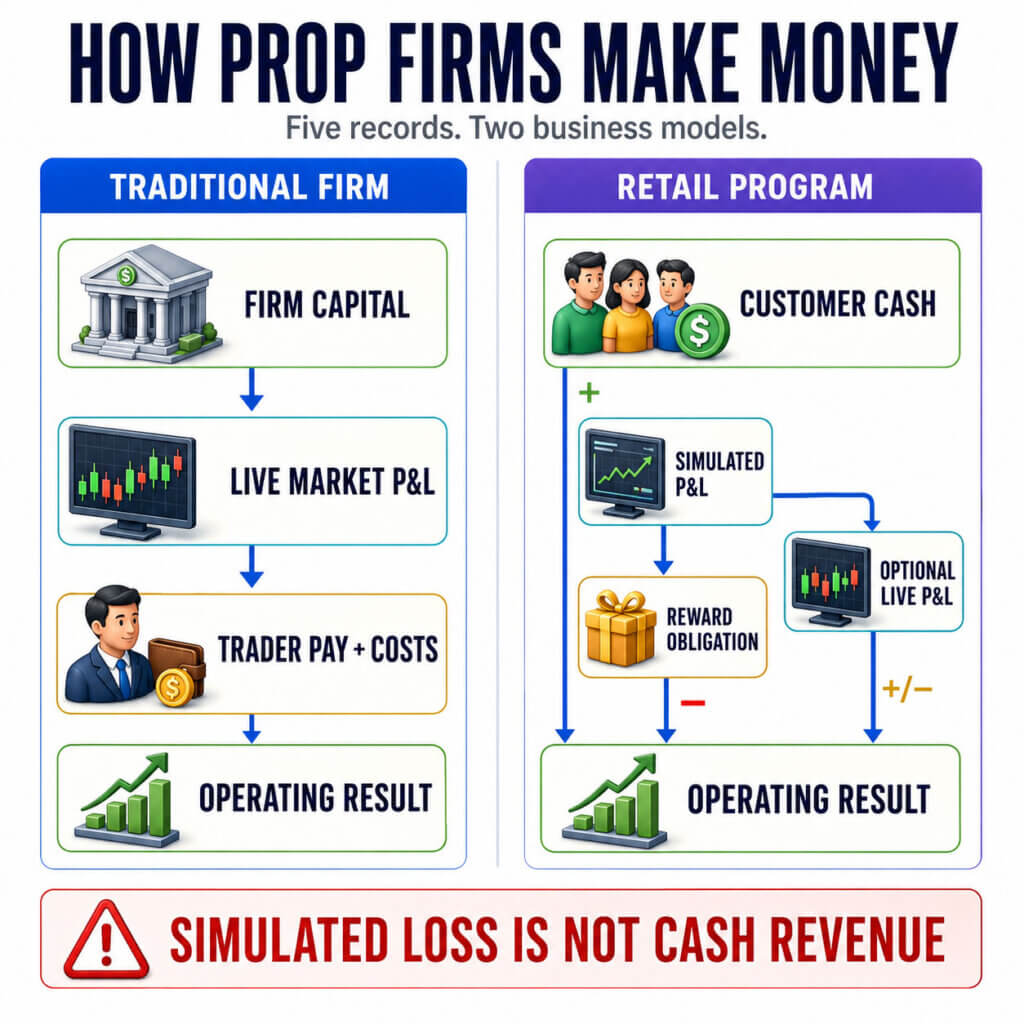
Customer cash can support general corporate operations, including reward payments, but a reader usually cannot trace one evaluation payment to one payout. Legal entities can also divide the process. One company may sell the evaluation while an affiliate signs the funded agreement and owes the reward.
Operating profit appears only after the other ledgers and the cost base are reconciled. Gross sales, a cumulative payout counter or a large nominal account total cannot supply the missing expenses and liabilities.
Revenue Sources in Retail Prop Programs
Retail providers use different payment structures. A charge that exists at one firm may be absent at another, and two products from the same firm can use different billing or refund terms.
| Possible Revenue or Cash-Flow Line | What to Verify |
|---|---|
| One-time evaluation payment | Service supplied, refund conditions, tax treatment and when the firm becomes entitled to retain the payment. |
| Recurring subscription | Rebilling date, cancellation rule, duration, included resets and what event ends the subscription. |
| Reset or repeat attempt | Whether a reset is sold, credited through rebilling or replaced by a completely new purchase. |
| Activation or reactivation | Which product and stage trigger the charge, whether it is optional and whether another price path waives it. |
| Upgrade or add-on | Price, covered account, changed term and whether an outside supplier receives part of the payment. |
| Refundable deposit | Return conditions, retention conditions, legal entity holding the cash and whether any safeguarding arrangement exists. |
| Trading-related charge | Whether it is real cash, a simulated P&L adjustment or a pass-through cost to a broker, exchange or platform. |
| Separate proprietary trading | Which capital is placed at risk, which trades are selected and whether gains and losses are disclosed. |
| Data or ancillary income | The contractual right, commercial counterparty, current activity and any revenue evidence. |
The market label does not determine the revenue or execution model. For futures, the charges can combine subscriptions or activation with exchange-data pass-through and stage-dependent brokerage costs. In forex or CFD accounts, spreads, swaps and commissions may be simulated adjustments rather than cash income. Crypto models can use one-time evaluations or refundable deposits while keeping the participant account simulated, even when exchange data or separate proprietary trades are involved. Each contract must establish who receives a charge and whether any order reaches a live market.
Evaluation Fees, Subscriptions and Repeat Attempts
When a customer buys a one-time evaluation, the refund terms determine when the firm may retain the cash. FTMO, Breakout and the reviewed The5ers products use one-time charges, while Topstep's standard Trading Combine bills monthly until the trader passes or cancels.
Repeat activity creates another sale when a provider sells a reset or fresh evaluation. Breakout's current fee structure states that failure closes the evaluation and another attempt requires another purchase, creating a potential incentive conflict.
That disclosure proves the revenue line exists without revealing repurchase frequency or margin. Processing, acquisition and service costs reduce the gross receipt.
HyroTrader's Aug. 7, 2026 terms instead define a Refundable Challenge Deposit. The provider can retain it after defined failures or breaches and must return it after other outcomes, so the terms do not establish earned revenue at entry.
Activation Charges and Paid Upgrades
Post-pass charges depend on the product. Topstep's Standard path charges for Express Funded Account activation, while a higher monthly price removes it. The reviewed The5ers Futures terms apply an activation charge only to the Day Trade route.
An upgrade can alter the reward share or drawdown, while another add-on can supply deeper data. Breakout sells a permanent 90/10 reward-share upgrade for the selected account. Topstep sells optional Level 2 data in supported simulated products. Neither price reveals the outside supplier cost.
Sticker price also understates repeated customer expenditure when subscriptions and resets apply, with activation charges adding another possible cost. Readers assessing program cost can examine the full cost of an attempt after recording every required and optional charge.
Trading-Related Charges and Ancillary Income
The presence of a commission, spread, swap or data charge does not identify its recipient. Breakout's evaluation uses notional trading charges that the trader does not pay as cash. Topstep applies simulated evaluation costs, while live-account exchange data can pass directly to the exchange.
Once a provider places its own position, the result enters the live-market ledger. FTMO may use selected account data in separate own-capital trading, while Breakout's funded entity can record or route a selected idea. Neither disclosure means every participant trade reaches a live market.
Execution incentives, services and commercial data rights can create ancillary income. Breakout's funded entity may receive third-party financial incentives related to trader ideas. HyroTrader reserves rights to commercialize anonymized simulated-trading data. These rights do not disclose current revenue.
How Traditional Proprietary Firms Earn Trading Revenue
Traditional firms earn trading revenue only when real market activity produces a positive result. Strategies can include directional, arbitrage, relative-value, event-driven and quantitative trading. The common thread is firm capital exposed to real prices and execution.
In market making, the firm quotes both sides and receives the spread when its prices attract offsetting business. Inventory changes or hedging can add gains and losses. The spread compensates for inventory and adverse-selection risk as well as broader market risk. It is not guaranteed profit.
Scale and technology can make small per-trade edges meaningful, but exchange, clearing, financing, infrastructure and data costs reduce them. Model errors, sudden price moves, illiquid hedges and operational failures can produce losses. Capital held as margin also has a cost.
Trader compensation combines fixed pay with a variable performance share under some desks. Both reduce the firm-level result. This differs from a retail reward calculated on a nominal simulated account.
Virtu's 2025 filing reported net trading income, execution commissions and technology-related revenue. Its costs included brokerage, exchange, clearing, financing, data and employee compensation. The audited figures illustrate one company, not an industry-wide mix.
Simulated, Mirrored or Live: Where the Market Risk Sits
The trader-facing account and the firm's market exposure must be checked separately. Real-time market data can feed a simulator. A real payout can follow simulated performance. Neither fact proves that the participant's order reached an exchange.
| Trader-Facing Account | Firm’s Possible Market Risk | What to Verify |
|---|---|---|
| Simulated with a reward obligation | No automatic position from the displayed trade. The firm still has reward, refund and operating obligations. | Whether every stage is simulated, which entity owes the reward and which conditions make it payable. |
| Simulated with selective mirroring or hedging | The firm chooses whether to place a separate trade, copy a signal or hedge aggregate exposure. Its position can differ from the simulated order. | Selection discretion, sizing, broker or exchange, aggregation, ownership of data and whether the reward depends on copying. |
| Direct live account | Firm-controlled capital or margin is exposed to actual market gains, losses and trading costs. | Broker or exchange relationship, account ownership, capital allocation, risk limits and compensation terms. |
Topstep separates its simulated Trading Combine and Express Funded Account stages from a discretionary Live Funded Account using real capital. The simulated tiers use nominal account sizes.
FTMO can select account data for separate own-capital trading while paying rewards independently. Breakout can record or route a selected idea. HyroTrader keeps every participant phase simulated while reserving commercial data rights.
This is why what funded status actually means has to be established from the agreement. The word “funded” can describe a contractual reward stage without identifying the firm's live-market position.
Where Do Prop Firms Get Capital and Payout Money?
A traditional firm can use founder or partner capital, retained earnings, outside equity, debt and brokerage financing. The mix depends on its legal structure, strategy and counterparties. Its trading capital is not customer money under the ordinary proprietary model.
A retail provider can use owner capital, outside investment, borrowing, retained earnings and earned program cash. Trading gains and documented ancillary income can add resources. Rewards, refunds, deposit returns and market losses reduce them.
Public terms establish reward obligations but do not trace each payout to one source or publish a ring-fenced waterfall. A provider can pay from a general corporate account funded by several sources.
Breakout and HyroTrader separate evaluation and funded-stage entities, so sales at one company do not establish another company's payout coverage. Intercompany and reserve information would be needed to connect them.
Eligible simulated performance can create a real obligation under the rules for how trader payouts are calculated. That obligation need not be funded one-for-one by a copied trade.
What Makes a Prop Firm Profitable?
Profit is the remainder after revenue and obligations have been recognized along with market results and costs. A broad educational bridge is:
Economic result ≈ retained evaluation payments + subscriptions + account-lifecycle receipts + retained deposits + net actual trading result + documented ancillary income − trader rewards − refunds and returned deposits − direct service and market costs − operating costs
This simplified equation is not a GAAP formula. Revenue-recognition timing, taxes, reserves and capitalized software can alter the reported result. Group transfers and chargebacks can change it too.
Customer acquisition can be substantial. Affiliate payments, advertising, discounts, card processing and chargebacks reduce contribution margin. Platform licenses, market data, hosting, fraud controls, KYC, support, compliance, payroll and taxes add costs. A live-risk book can produce gains or losses.
Reward and refund terms can leave cash in the business months before the related payment becomes due. A refundable amount may remain returnable throughout that period. Large gross sales can coexist with weak cash reserves when obligations are larger or arrive sooner than expected.
The5ers' current program terms illustrate why a visible deduction does not reveal margin. The firm publishes a withdrawal commission on several cash-like methods, but the public rule does not disclose how much offsets payment and banking costs or other administration.
Revenue measures earned inflows, while profit subtracts expenses. Liquidity measures whether the firm can meet payments when due. Solvency measures whether its assets and earning power can support liabilities over time. A payout counter, review score or nominal account total cannot establish these measures.
No reviewed retail provider publishes enough audited revenue and expense data to calculate a complete margin. The missing reserve and reward obligations also prevent a payout-coverage calculation. An exact industry profitability claim would fill those fields with assumptions.
Does a Prop Firm Profit When a Trader Fails?
On a simulated account, failure ends or changes the service without moving the displayed loss into the firm's bank account. The economic effect comes from the product terms and any associated customer payment.
A firm may retain a non-refundable evaluation payment when the attempt ends. A subscription may rebill while another attempt remains active. A provider can sell a reset or require a fresh purchase. A refundable deposit can become retainable after a defined failure. In each case, the customer payment still carries acquisition and processing costs plus ongoing service expenses.
Loss rules can filter behavior and cap the conditions under which a reward becomes due. If the provider moves selected exposure live, the same rule can control which risk it is willing to observe or trade from. As a result, how prop firm drawdown works affects the business model as well as the trader's account.
A fee-led program can benefit from retained charges, while credible rewards and stable rules support repeat demand. A firm using live capital also needs profitable risk selection and control. The resulting incentive depends on which revenue and risk model applies.
How to Read a Prop Firm's Business-Model Claims
Start with the evaluation agreement and funded-stage contract, then save both with their dates. The documents can involve different entities and payment rights. Their execution models can differ too.
| Claim to Find | What It Establishes |
|---|---|
| Payment type and refund right | Whether cash is a fee, subscription, deposit or refundable charge and when it may be retained. |
| Recurring billing | When another payment occurs and what event stops it. |
| Account stage | Whether evaluation and funded activity are simulated, live or governed by separate terms. |
| Execution model | Whether participant orders are routed or used only as a performance record. |
| Copying or hedging discretion | Whether the firm can select signals, aggregate exposure or decline to place a market trade. |
| Responsible legal entity | Which company sells the evaluation and which company owes rewards. |
| Reward obligation | How simulated or live performance becomes a real payment right. |
| Charge recipient | Whether a commission, data fee or platform cost goes to the firm or an outside supplier. |
| Data rights | Whether trade information can be analyzed, shared or commercialized. |
| Financial claim | Whether a revenue, payout or profit statement is audited, provider-reported or promotional. |
| Rule-change clause | Which version applies, how notice works and whether a funded contract can change. |
A posted price establishes the customer charge while leaving costs and margin unknown. A cumulative payout figure establishes only what its methodology supports. A nominal account size establishes no cash allocation unless the agreement identifies live capital.
Conflicting marketing and contract language should be resolved in favor of the controlling agreement, while the conflict itself remains relevant. A provider that calls a stage live in promotional copy but simulated in its terms has not supplied a safe basis for a live-execution claim.
Apply this checklist before examining firms CryptoSlate has scored, then record the payment type, execution model, reward entity and evidence limits.
FAQ
Do prop firms make money when traders lose?
A prop firm can retain a fee or deposit when the agreement permits it, and a trader may buy another attempt after failure. The simulated trading loss itself is not cash revenue. Gross customer payments still have acquisition and service expenses as well as processing and reward costs before they become profit.
Do prop firms trade with real money?
Traditional proprietary firms do. Retail programs vary. An evaluation can be simulated, a funded-stage account can remain simulated and the provider can separately mirror or hedge selected exposure. A direct live account uses firm-controlled capital or margin in a real market. The agreement must identify which model applies.
Where do prop firms get money for payouts?
Retail providers can pay rewards from available corporate resources, including owner capital and retained program revenue. Retained earnings or financing can add resources. Actual trading gains and ancillary income may add more. Public terms rarely trace one payout to one source, and none of the reviewed providers published a complete fee-to-payout waterfall.
Are prop firms profitable?
Private retail-provider profit cannot be inferred from fees, account sales or payout totals. A reliable answer requires revenue and expenses for the same entity and period, together with reward liabilities, reserves and market results. Liquidity and solvency remain separate from accounting profit.
How do traditional prop trading firms make money?
They use firm capital in live markets and seek net returns through market making or arbitrage. Directional and relative-value positions supply other approaches, including options and quantitative strategies. Trading gains must exceed market losses and hedging. Financing and execution add costs, as do technology, compensation and other operating expenses.
Is a $100,000 funded account real capital?
A $100,000 label can be a nominal balance or buying-power reference inside a simulated account. It does not prove that the provider placed $100,000 into a brokerage account. A direct live agreement should identify the actual capital or margin structure and the firm that owns it.
