


Overview
Introduction
Prop firms can operate legitimate businesses, but the label is not a complete trust verdict. A specific offer still needs an identifiable legal entity and an accurate account description. Its payout obligation and operating record must also support what is being sold.
A registered company can sell a simulated service, and a regulated group can place one prop product outside its brokerage relationship. Verified payments do not prove that every displayed balance is payable or that a future claim is protected. Assess legality and regulation first, then consider payment history and contract fairness. Suitability is a separate personal judgment.
Key takeaways
- What it is. A legitimate prop firm offer names a verifiable counterparty and describes both the account model and payment terms accurately.
- Why it matters. The same prop-firm label can cover an own-capital desk or a consumer challenge whose account may be live, simulated, hybrid, or broker-linked.
- Main risk or limitation. A registration or license cannot guarantee solvency, while review scores and payout screenshots cannot guarantee fair enforcement or future payment.
Are Prop Firms Legit?
Some prop firms are identifiable operating businesses, and a simulated evaluation can support a documented service contract. The useful question is whether one specific product deserves trust, not whether every business using the label belongs in the same category.
A legitimate offer aligns its marketing with the checkout terms and names the entity taking the fee. The agreement should state whether trading is simulated or internally booked. If instructions can reach a market, it should also explain whether the firm copies them at its discretion or routes them through a broker. The same document should identify what creates a payout right and what can cancel it.
Four evidence layers organize that test:
| Claim | Evidence That Tests It |
|---|---|
| The business is identifiable | Legal name, company number, registered address, officers, checkout beneficiary, and current filings |
| The account works as described | Evaluation and funded agreements, execution disclosure, account ownership, platform relationship, and stage changes |
| Profit can become payable | Eligible-profit definition, split, review conditions, timing, deductions, termination treatment, and payout obligor |
| The operation supports the offer | Document history, reachable support, verified payments, complaint patterns, platform continuity, and current legal records |
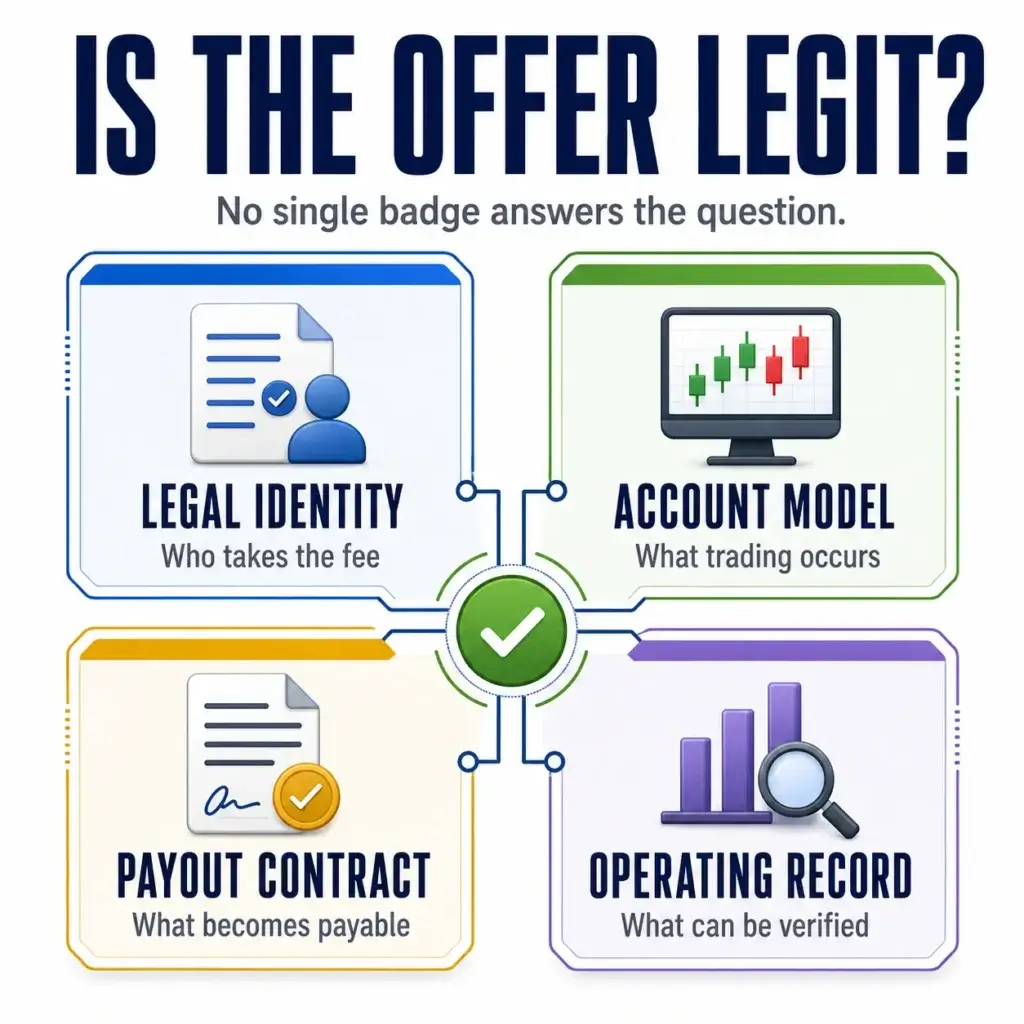
An active company record establishes existence, while a payout receipt establishes one historical payment. Neither proves current liquidity or future performance. Stop and investigate if the evidence is missing or contradictory.
What Does “Legit” Mean for a Prop Firm?
The word often carries several conclusions that the evidence cannot support at once. Break the question into parts before reaching a verdict.
| Question | What a Yes Would Establish |
|---|---|
| Is there an identifiable business? | A legal counterparty exists and can be matched to current records |
| Is the offer legal? | The relevant activity is permitted for that entity in the trader’s jurisdiction |
| Is the product regulated? | A named entity has the required permission for the named service and territory |
| Is the account described truthfully? | The agreement discloses simulation, routing, ownership, and stage changes accurately |
| Is payment contractually defined? | The agreement states when a result becomes eligible and who owes the payment |
| Does the firm have an operating record? | Current evidence supports continuity, document stability, and historical performance of obligations |
| Are the terms fair or suitable? | The price, discretion, loss limits, dispute route, and product fit meet the reader’s own standard |
Passing one test does not answer another. Incorporation does not establish brokerage permission, and a regulator entry may cover an affiliate outside the prop agreement. One approved withdrawal proves only that transaction. Contracts and registries establish formal facts, while product behavior and complaint patterns add operating context.
Which Prop Firm Model Are You Assessing?
The business relationship determines the trader's rights. Traditional desks use firm capital, while retail challenges sell evaluation access and may pay rewards on simulated performance. Broker-linked and hybrid programs sit between them.
| Model | What Must Be Verified |
|---|---|
| Traditional proprietary desk | Employer or contracting entity, compensation, capital source, market access, and activity-specific permissions |
| Broker-linked allocation | Entity holding the trader’s money, entity supplying allocation capital, applicable license, and separation between balances |
| Live-capital program | Broker or futures commission merchant, account control, routing, compensation agreement, and who absorbs losses |
| Retail simulated challenge | Simulation disclosure, fee status, passing conditions, funded-stage agreement, and reward terms |
| Hybrid or selectively routed program | Account ownership, internal booking, discretionary copying or hedging, and the contractual payment formula |
Own-account trading differs from selling a consumer a nominal balance. Regulatory duties can change when the firm handles customer money or orders. Market access may add other obligations. A live-capital program can use firm money without making the trader the account owner, while a hybrid program may copy only selected activity.
Breakout shows why corporate ownership and the funded-stage counterparty require separate checks. Breakout’s entity and funded-stage structure records Kraken ownership, while Breakout Trading Group, LLC sells the evaluation and Payward Oceanic Ltd. is named for the funded arrangement. That ownership does not turn the program into a regulated brokerage relationship.
The models grouped under what a prop firm is can give traders different rights, so a purchase decision must rest on the agreement for the exact product and stage.
Are Prop Firms Legal and Regulated?
Each prop firm inherits the legal position of its exact entity and activity in the relevant jurisdiction. A firm trading only its own capital presents a different question from one accepting customer deposits. Routing customer orders and operating a brokerage account can add separate duties, while selling a simulated evaluation may fall under another framework.
A corporate registry can confirm the entity, its filed address, officers, and filing history. It does not establish financial-services permission, solvency, or payment capacity.
A license covers a defined perimeter. Match the legal name and number, then check the domain and current status. The listed permissions and territory should also agree. The UK's Financial Services Register lets a user inspect the exact firm and its permissions. A parent or broker partner's license does not cover another entity by default.
Kraken Funded makes the product boundary concrete. Its disclosure names Payward Oceanic Ltd. in the British Virgin Islands and places the program outside the user's regulated Kraken trading relationship. Compensation is a performance fee, while the trader does not own the account or positions.
Country rules can diverge. Belgium's 2024 retail prop-trading warning addresses challenge firms using demo trading and states that the described companies lacked authorization to provide investment services there. That position does not establish that every prop model is unlawful elsewhere.
Regulation supplies one due-diligence input by establishing permission and oversight for a defined activity. It does not guarantee profit or prevent business failure. The contract still controls payout and termination.
Can a Simulated Funded Account Be Legitimate?
A simulated funded account can be legitimate when the provider discloses how it works and pays according to the stated contract. Simulation describes execution and ownership. A service agreement can support rewards even when no trader-owned live account exists.
The word funded can mislead when it is left undefined. A $100,000 displayed balance may be notional buying power instead of deposited cash. The provider may copy or hedge selected instructions, keep the record simulated, or change the model later. None of those choices gives the trader ownership.
An evaluation pass can create only eligibility for a separate funded-stage contract, while challenge profit remains non-payable. Identity and conduct checks may follow. Minimum activity or a payout window can also apply.
What funded status means depends on the current agreement because execution and ownership can remain separate from compensation.
A simulated account becomes a serious trust problem when the firm markets it as trader-owned live capital or hides the simulation until after payment. Presenting a nominal balance as protected funds raises the same warning. Truthful simulation is not a scam.
How to Verify a Prop Firm Before Paying
Start verification from the transaction by saving the checkout screen and identifying the entity taking the money. Examine the trading name and rating only after that.
| Check | What It Establishes |
|---|---|
| Contracting party | Full legal name, company number, address, and the entity taking the fee |
| Funded-stage party | Whether the evaluation seller or a different company promises the later account and payout |
| Corporate record | Active status, filing history, officers, accounts, insolvency notices, and address changes |
| Regulatory record | Exact entity, license number, status, permissions, territory, domain, and disciplinary history |
| Account model | Whether trading is simulated, internally booked, selectively routed, broker-linked, or live |
| Payout obligation | Eligible profit, split, timing, review powers, deductions, caps, and termination treatment |
| Governing law | Which law applies and where a claim must be brought or arbitrated |
| Agreement version | Which product rules applied on the purchase date and how changes are communicated |
This sequence follows how CryptoSlate weighs evidence. Primary contracts and official records establish the product's terms and legal identity, while reviews and complaints supply narrower operating context.
Match the Trading Name to the Legal Entity
Match the contract's full company name and number to an official registry. Check the address and officers, then review the filing history for recent changes. A similar trading name is not enough because clone sites can use credible names.
The payment beneficiary needs its own check. Record any difference between the checkout recipient and evaluation seller, then identify a separate payout obligor.
Registry status does not determine where a dispute will be heard. The5ers’ contract and jurisdiction details identify a UK company and an Israeli entity, while the current terms select Israeli law and Tel Aviv courts. A UK company record does not by itself place a dispute in the UK.
Identify the Account Model
Find explicit language about simulation and live execution. Then check internal booking and account ownership. Any copying or hedging rights also matter. Do not infer routing from a familiar platform or real-time price feed. A platform connection proves access to software, not that the trader's order reached a market.
Review every account stage because the model may change. An evaluation and first reward account may be simulated. A live account might appear only after a separate call-up. The opposite can also occur when a firm uses a live linked account for assessment before it supplies an allocation.
Read the Payout and Termination Terms
Start with the event that creates an eligible payment. Record the profit definition, share, minimum, cap, schedule, and review period. Add KYC, fees, any reserve requirement, and permitted methods. Then read the treatment of a rule breach, inactivity, suspension, closure, chargeback, or account merger.
The full rule set matters because a profit target alone cannot establish payout eligibility. Drawdown and consistency limits may remain active within prop firm rules. Trading-day and position rules can do the same. News restrictions and automation controls may add further gates, along with conduct rules and identity checks.
Check the License Claim Precisely
Use the named authority's register to match the entity, license number, domain, and contact details. Then inspect the permissions and permitted jurisdictions. Confirm that the permission covers the prop service rather than brokerage, education, payments, or corporate registration alone.
A mismatch does not always prove fraud. It can identify an affiliate or an outdated record. It may also show that the product sits outside the regulated perimeter. The mismatch still requires an explanation before payment.
Save the Agreement Version
Download the terms and rulebook. Keep the refund policy and privacy notice as separate files. Save the funded agreement where available. Record the product name and purchase date. Add the revision date and notice process. A live web address can change after purchase, making a local copy the clearest record of the accepted terms.
What Counts as Payout Evidence?
Payout evidence has different strengths, so the useful question is what each form can establish.
| Evidence | What It Can Prove |
|---|---|
| Dashboard profit | A result appears under the platform’s accounting rules |
| Provider payout counter | The firm reports an aggregate total under its own methodology |
| Testimonial or review | One person reports an experience, or several reports form a pattern |
| Payout screenshot | An image displays a claimed transaction or account event |
| Verified receipt or transfer | A specific payment occurred between identifiable parties |
| Repeated dispute pattern | Similar complaints recur and deserve investigation |
| Audited financial statement | Historical finances for the audited entity and period |
| Court or insolvency record | A formal claim, order, proceeding, or company status exists at a stated date |
The agreement determines whether dashboard profit becomes eligible through its payout formula and review powers. Deductions or termination can alter the result, so a profitable display does not establish money held for the trader.
A verified transfer proves one historical payment, but its scope ends there. It cannot explain the payment's purpose or the treatment of other requests. It also reveals nothing about current reserves or later capacity. Provider counters and certificates are supporting evidence unless independently reconciled. Leaderboards and influencer posts share that limitation, as do review scores.
Several current complaints about the same delay or rule dispute can identify an operational pattern. They do not rewrite the contract or prove insolvency by themselves. Prop firm payout rules separate eligibility and review from approval and settlement.
Scam, Business Failure, and a Bad Contract Are Different
An accurate finding should match the evidence. Calling every unfavorable outcome a scam erases the distinction between deception and financial failure. It also confuses strict terms with ordinary product risk.
| Finding | Evidence Needed |
|---|---|
| Impersonation or fictitious offer | False identity, cloned domain, fabricated license, diverted payment, or authoritative warning |
| Deceptive operating business | Material marketing claim conflicts with the contract, product behavior, court record, or regulator finding |
| Insolvent or failed business | Formal insolvency record, shutdown, unpaid obligations, or verified inability to continue |
| Disclosed but unfavorable contract | Current terms clearly grant broad discretion, impose costly rules, or limit recovery |
| Unsuitable product | The disclosed price, risk controls, platform, or strategy restrictions do not fit the trader |
A regulator warning is high-weight evidence about the named entity and conduct. Its domain and date define the scope, as does the issuing jurisdiction. An allegation and a complaint are not final findings. An interim order and settlement also differ from a dismissal or final judgment. Each procedural state supports only its own conclusion and should not be expanded into a wider verdict.
An identifiable company can fail without proven fraud when it loses a platform or payment provider. A broker relationship can end, and working capital can run short. A harsh contract can be enforceable while offering poor value. A legitimate service can also be unsuitable for a trader whose strategy conflicts with its drawdown or conduct rules.
Missing information supports only the conclusion that public materials cannot verify the offer. Do not pay until the legal entity and account status are supplied. The payout obligation must also be clear. Missing information is not proof of criminal conduct.
Prop Firm Red Flags That Require Action
Red flags become more useful when they are tied to a response.
Stop Before Paying
| Signal | Why It Matters |
|---|---|
| No legal entity in the checkout terms | The counterparty, registry record, governing law, and claim route cannot be verified |
| Payment recipient is unexplained or unverifiable | The money may not reach the company named in the agreement |
| Contact details differ from the official record | A cloned or impersonated firm may be using an existing company’s identity |
| Guaranteed passing, income, returns, or payout | Trading and contract eligibility cannot be guaranteed |
| Core rules appear only after payment | Drawdown, conduct, payout, refund, and termination risk cannot be assessed in advance |
| A new tax or release fee is demanded to obtain a payout | Sending more personal money does not validate the original claim |
The UK's clone-firm guidance recommends checking contact details against the official register instead of trusting the details supplied by the caller or site. The domain and email should match exactly. The phone and address should also match.
Verify Before Proceeding
The claims “registered” and “licensed” need exact matching. So does “regulated group.” Review unexplained affiliates and recent legal-entity changes. Platform migrations and material rule revisions also require attention. Recurring payout delays or broad conduct clauses should trigger document review. Ask which entity owes the payout and whether existing accounts retain their original terms.
Repeated complaints are most useful when they describe the same issue under the same product. Match the time period and contract clause. Check whether the provider supplies a consistent explanation and whether the terms support it. Do not treat one angry post or one success story as a firm-wide result.
Treat as Context Only
A polished site or large Discord group can support the view that an operation is active. Influencer endorsements and high review scores offer similar context. Fast chat and a familiar platform add little more. Each signal can be bought or imitated. Paid endorsements and selectively posted success stories reveal little about contract performance. None replaces the legal-entity and account-model checks. The contract and operating record still control.
Repeated countdowns and permanent “last chance” offers create manufactured urgency even when the business is operating. They pressure the buyer to skip due diligence. Preserve the terms and evaluate the offer on its contract instead of its deadline.
What Happens If a Prop Firm Closes or Denies a Payout?
Identify the payout obligor before tracing any failure. The public-facing name and evaluation seller may differ from the funded-stage company. The broker and platform can be separate again, as can the payment processor. A platform outage can block access without changing who owes the payment. A parent company can remain active while the entity named in the prop agreement faces a claim.
Simulated balances are not automatically customer funds held in a segregated brokerage account. If the contract describes the evaluation fee as payment for a service and the displayed balance as notional, an unpaid reward may be a claim against the contracting company instead of cash owned by the trader.
An active company can still lack enough assets to meet its liabilities, so registration does not solve that risk. UK insolvency guidance for creditors, for example, explains that a customer owed money may have to register as a creditor and can recover only part of the claim or nothing. Other jurisdictions use different procedures and priorities.
The practical route depends on the payment method and contract. Governing law and the dispute clause narrow the options. Company status and the trader's location also matter. A card dispute and formal complaint have different deadlines. Arbitration and a court claim do too. An insolvency filing brings its own evidence requirements. None guarantees recovery.
Evaluation fees and payout liabilities sit on different sides of how prop firms make money. Execution and operating costs add further variables. A visible fee or payout total cannot establish the firm's margin or liquidity.
Do Futures, Forex, and Crypto Prop Firms Carry the Same Risks?
The evidence framework remains the same, but the market changes what must be checked. Futures programs may use simulated evaluation and reward stages before a separate live account at a futures commission merchant. Forex programs often use currency or CFD contracts, and the onboarding entity can change by residence. Crypto programs may connect to an exchange or use simulated crypto-linked prices. Internal booking is another possibility.
Market access and a familiar platform name do not settle account ownership. A live exchange feed does not prove that a particular instruction reached the exchange. A broker relationship does not prove that the prop account receives customer-account protections. The agreement should identify routing and counterparties. It should also state who owns losses and how compensation works.
Apply the same test to every market. Check the exact entity and account model, then verify permissions and the payment obligation. Finish with the operating record for the product offered in the trader's jurisdiction.
Prop Firm Legitimacy Checklist
Save this record before paying. A blank or contradictory field is a reason to obtain an answer in writing.
| Before Paying | What to Record |
|---|---|
| Exact legal entity | Company name, number, address, officers, status, and current filings |
| Payment recipient | Beneficiary shown at checkout and its relationship to the contract party |
| Account model | Simulated, internal, selectively routed, broker-linked, or live |
| Funded-stage party | Entity that grants the later status and owes any performance payment |
| License claim | Authority, entity, number, permissions, territory, domain, and current status |
| Product record | Plan name, purchase date, agreement version, and revision date |
| Fees and refunds | Challenge, activation, data, platform, reset, withdrawal, and refund terms |
| Trading rules | Loss limits, consistency, position, news, automation, activity, and conduct clauses |
| Payout obligation | Eligible profit, share, minimum, cap, timing, review, deductions, and KYC |
| Governing law | Dispute forum, complaint route, notice address, and filing deadlines |
| Dependencies | Broker, exchange, platform, data vendor, and payment processor |
| Exit treatment | What happens after suspension, termination, inactivity, merger, or closure |
Preserve the checkout terms and rulebook. Keep the refund policy and privacy notice as separate files. Save the funded-stage agreement if available. Record the event that creates a payout right. An evaluation pass may create eligibility for a later stage. Dashboard profit is only a platform result. A payout request invokes the contract, and approval confirms that the firm accepted it for payment.
Recheck the documents when the firm changes its entity or platform. A rule revision or payment-method switch deserves the same step. A review written under an earlier product version cannot override the agreement offered today.
Where to Research Current Prop Firms
After applying the checklist, use current prop firm scores to find CryptoSlate's documented account and rule research. The same reviews cover payout terms and ownership. Regulator warnings are recorded separately where applicable. Inclusion or a score is not a guarantee. Confirm every material term against the agreement for the exact product and stage. The purchase date and jurisdiction must also match.
FAQ
Are prop firms legal in the United States?
United States obligations depend on the firm’s exact activity and instruments. The legal entity and its relationship with the trader matter too. A business trading its own capital presents a different question from a company accepting customer funds or orders. Brokerage and simulated evaluation add other legal questions. Check the exact product and applicable federal and state requirements instead of relying on the label.
Are prop firms regulated?
Some entities or activities are regulated, while some retail challenge services are sold outside the perimeter applied to customer brokerage accounts. A group can contain both regulated and unregulated products. Verify the exact company and permission. The jurisdiction and domain should match, as should the service. Regulation can establish oversight for that activity, but it cannot guarantee a payout or prevent every failure.
Do prop firms actually pay traders?
Some prop firms have made verifiable payments, but historical payment does not make every displayed balance payable. The agreement defines eligible profit and review conditions. It also sets timing and deductions while naming who owes the payment. One receipt proves one transaction. It does not establish total payout volume or current reserves. Another request may not qualify.
Is a simulated funded account a scam?
A simulated account can support a contractual reward program when the provider discloses the simulation accurately and follows the agreement. A serious warning appears when marketing presents notional buying power as trader-owned live capital or hides simulation until after payment. Misstating what passing creates is a separate warning.
Are futures prop firms legit?
Some futures prop businesses are identifiable operating firms, but the stages can differ. An evaluation and initial reward account may be simulated before any later live account. Verify the entity and platform first. Then check the account stage and payout agreement. The loss rules and any live-account counterparty remain separate checks. A futures label does not settle those facts.
Are forex and crypto prop firms legit?
Legitimate offers can exist in both markets. Forex programs may use CFDs and location-specific entities. Crypto programs may use exchange-linked execution or simulation. Internal booking is another model. Check the legal entity and market-access description. Account ownership and the payout obligation should agree. Regulatory claims must match them. Do not infer live routing from a price feed or familiar exchange name.