


Overview
Introduction
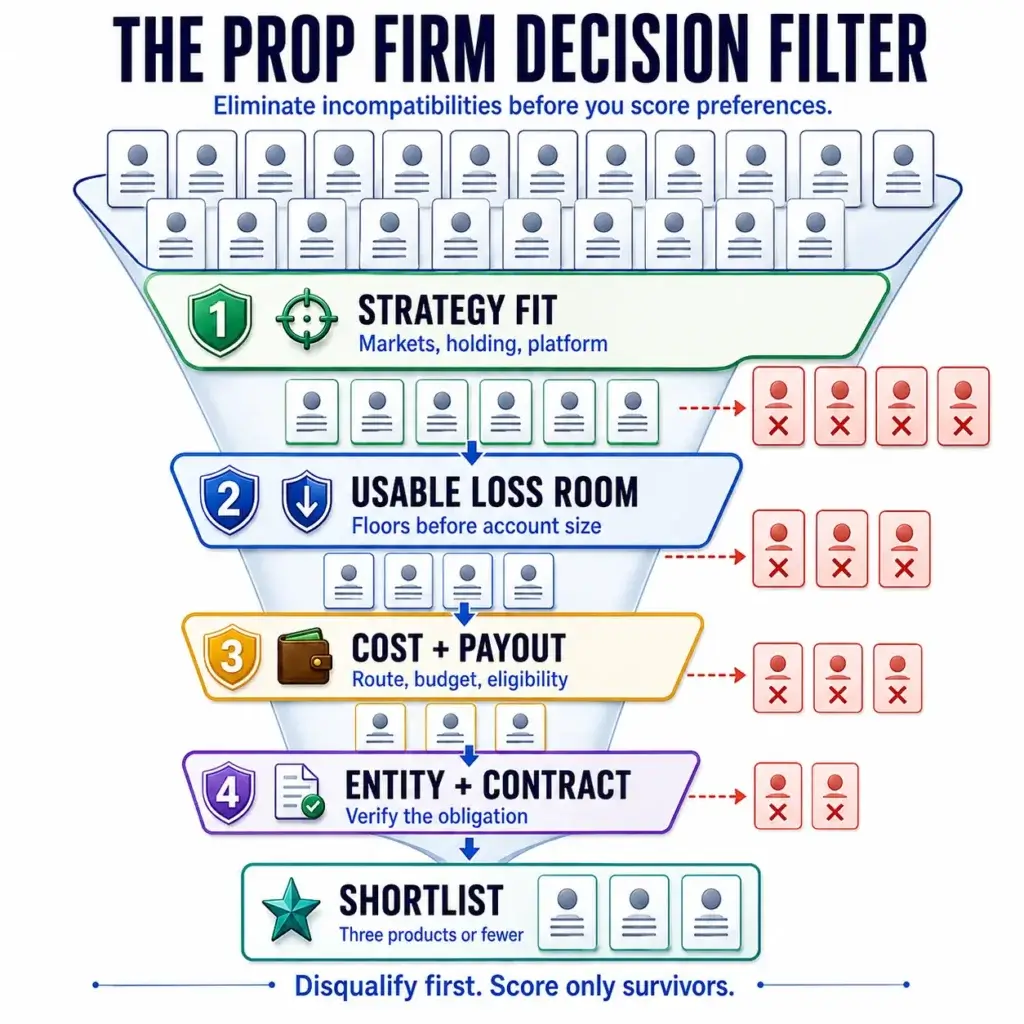
Choosing a prop firm means finding an exact product whose rules fit how the trader already operates and whose maximum unsuccessful cost is affordable. Start with hard requirements. Remove any product that fails one. Only then score preferences such as route length or payout convenience. This method cannot establish future strategy performance or guarantee payment. It prevents an attractive headline from hiding a structural mismatch.
Key takeaways
- What it is. A prop firm selection method removes incompatible products before scoreable preferences can influence the shortlist.
- Why it matters. Nominal balance and advertised profit split reveal little until active loss floors and the complete cost route are tested.
- Main risk or limitation. Product terms and operating evidence can change, while a careful selection process still cannot guarantee passing or payout approval.
Start With How You Actually Trade
The strategy record should lead the selection process because it defines normal behavior before product marketing can change the standard. A trader who needs weekend crypto exposure has a different hard requirement from a futures day trader whose positions close before the session ends. Both need the product to support their usual risk controls.
Actual records from the intended market and session should include both routine and adverse periods. A short run of favorable results does not establish normal behavior. The useful sample includes periods when the method lost money or incurred worse fills. It should also include periods with fewer valid setups because those conditions are more likely to expose a mismatch.
| Strategy Requirement | What to Record |
|---|---|
| Market and instrument | Exact contract, pair, asset, exchange connection, and quote currency |
| Trading session | Entry window, exit window, and server-time assumptions |
| Holding period | Average duration plus overnight, weekend, or session-close exposure |
| Trade frequency | Normal activity and the longest period without a valid setup |
| Entry and stop method | Required order types, typical stop distance, and position increment |
| Daily loss behavior | Normal loss, worst observed loss, and recovery pattern |
| Losing sequence | Largest consecutive-loss run and its cash effect |
| Aggregate exposure | Positions that can respond to one common market driver |
| Event exposure | News, data releases, exchange maintenance, and funding windows |
| Technology | Platform, API, automation, EA, data, and connection needs |
| Execution costs | Commission, spread, swap, funding, slippage, and currency conversion |
A paid evaluation should not be the first test of a strategy or platform workflow. If the method has no relevant record, unpaid simulation is the next step. Product selection begins after the trader can say which behaviors must remain possible and which can be changed without altering the method.
Requirements remove incompatible products, while preferences order only those that survive every gate. An available instrument is a requirement when the strategy depends on it. A preferred dashboard color is not. Lower fees may be desirable, but they remain a preference until the trader has set an affordability limit that turns cost into a hard boundary.
Apply Hard Disqualifiers Before Scoring Anything
A hard disqualifier makes the product unusable even if every other feature looks favorable. Scoring it alongside a high split or low fee creates a false equivalence. Ten points for price cannot repair a rule that prohibits the strategy's normal holding period.
| Hard Requirement | Remove the Product If |
|---|---|
| Residence and identity | Country, age, entity, payment, or KYC eligibility excludes the trader |
| Market access | The required instrument or market is unavailable |
| Platform behavior | Needed order types, automation, or API access are unsupported |
| Holding rules | Normal overnight, weekend, session-close, or event exposure is prohibited |
| Risk capacity | Tested loss behavior cannot fit inside usable room after a reserve |
| Exposure limits | Position, leverage, notional, or aggregate caps make normal sizing impossible |
| Conduct rules | Copying, hedging, device, location, or account-ownership terms conflict with intended use |
| Route cost | The maximum unsuccessful spend exceeds the pre-set budget |
| Agreement | The contracting party, obligation, termination power, or dispute route is unacceptable |
Apply each requirement to the exact product and stage. A firm can sell several account sizes through different platforms, with separate rules for evaluation and funded status. A company-level answer cannot establish product fit.
CryptoSlate's method to decode every account rule records the calculation base and threshold, then adds the clock, stage, version, and consequence. Use that record for every surviving product before any preference score is assigned.
Treat an unresolved material term as a failed gate until it is resolved. If the agreement and help center define the same condition differently, a support answer may clarify how the provider intends to apply it. Preserve that answer. The conflict still needs a documented resolution because support language may not change the governing contract.
By fixing the rejection reason, hard disqualifiers prevent shortlist drift when promotions change. A lower price should not return a rejected product to consideration. The product can re-enter only if the disqualifying term itself changes and the new version is verified.
Compare Usable Loss Room, Not Account Size
The advertised balance identifies the account's scale, while the active breach floors determine loss capacity. Immediate risk capacity comes from the distance between the current monitored value and the closer floor. Costs and adverse execution need their own reserve inside that distance.
remaining daily room = current monitored value − daily breach floor

remaining overall room = current monitored value − overall breach floor

usable loss room = the smaller remaining amount − execution reserve
The exact monitored value can be balance, equity, or another contract-defined measure. The floors can be static or move after a reset, account high, closed profit, or withdrawal. The execution reserve depends on the intended market and observed order behavior. No universal percentage produces the right reserve.
The following products are hypothetical and do not reproduce one provider's current terms.
| Product | Illustrative Starting Terms |
|---|---|
| Product A | $100,000 nominal balance, $6,000 usable loss room, $8,000 first-stage target |
| Product B | $50,000 nominal balance, $5,000 usable loss room, $4,000 first-stage target |
One way to expose the difference is the target burden:
target burden = required profit for the stage ÷ starting usable loss room

Product A = $8,000 ÷ $6,000 = 1.33

Product B = $4,000 ÷ $5,000 = 0.80
Product B has the smaller target relative to its starting room in this example, despite the smaller account label. That result does not make it the better product. Its daily threshold can be tighter. A moving floor, incompatible platform, restricted holding period, or weaker funded-stage agreement can still remove it.
Use the starting ratio as a first screen, then recalculate it as the product applies its static or trailing loss-floor formula to gains and losses. Account separately for any lock or payout shift. Apply the selected product's reset as written.
Account size can still affect position limits or instrument access, but that benefit must be named directly. A larger label deserves no score by itself. Record the usable room and the rule it came from.
Match Every Rule to the Strategy
Rules become useful selection inputs only after they are mapped to normal strategy behavior. The question is not whether a condition sounds strict. It is whether the documented method can comply without changing its entries, exits, holding logic, or loss distribution.
| Rule | Strategy Question |
|---|---|
| Daily loss | Can the normal worst day fit before the exact reset and monitored-value test? |
| Overall drawdown | Does the tested peak-to-trough decline fit after costs and the execution reserve? |
| Trailing floor | Can open or closed gains raise the threshold before a normal reversal? |
| Profit target | How large is the target relative to starting usable room? |
| Minimum days | Does normal opportunity frequency satisfy the definition of a qualifying day? |
| Consistency | Can ordinary winning days create concentration that keeps the stage pending? |
| Position limit | Can the strategy use its normal size after lot or contract rounding? |
| News and holding | Are entries, exits, pending orders, and profit treatment allowed in required windows? |
| Automation | Are the intended tools and account-control methods permitted? |
| Inactivity | Can the longest normal gap between setups keep the account open? |
| Prohibited conduct | Could the intended method resemble copying, hedging, latency use, or another restricted behavior? |
Use the current rulebook, agreement, checkout summary, and dashboard definition for the same product. A favorable FAQ for another account size or platform is not evidence for the selected route.
Every threshold record needs its consequence because similar wording can lead to different account risk. A condition can trigger a warning, pause, extra requirement, profit adjustment, reset, review, or closure.
Rebuild the map at every stage because passing an evaluation can remove the target while activating a new balance. Payout conditions and exposure limits may also change. A product that fits the challenge but fails the funded-stage test remains incompatible.
Choose an Evaluation Model Only After Checking the Rules
One-step and two-step labels describe the route shape, while the underlying terms determine required profit and permitted loss. Post-qualification terms require a separate review. Direct-access and instant-funded labels need the same rule test because immediate reward eligibility can come with different costs or thresholds.
| Model Question | Why It Changes the Route |
|---|---|
| How many targets apply? | Establishes the number of profitable stages before funded status |
| Does each stage reset? | Determines whether balance, floor, and progress start again |
| Which loss method applies? | Shows whether risk capacity stays fixed or moves |
| Are days or concentration tested? | Can keep a profitable stage pending |
| Which charges recur? | Changes the maximum unsuccessful route cost |
| What changes after qualification? | Separates evaluation appeal from funded-stage fit |
A two-stage route can ask for more total profit across both targets, but a reset can separate the risk taken in each stage. A single stage removes one target while keeping all its risk in one continuous run. Route shape alone does not determine difficulty.
After both structures survive the disqualifier test, single-phase evaluation routes can be reviewed through their current rules and CryptoSlate scores. The commercial list supplies products, while this guide supplies the selection method.
Avoid counting the targets as a simple sum when a reset separates the stages. Also avoid treating fewer phases as a free benefit. Check what changed in the loss floor, target, cost, activity test, funded split, and payout process when the phase was removed.
Calculate the Cost of an Unsuccessful Route
Decide affordability before the first payment by setting a maximum number of paid attempts or resets. Assume that none produces a payout. This converts a low entry price into the complete amount the trader is willing to lose while testing the route.
maximum unsuccessful route cost =
entry and subscription charges
+ platform and data charges
+ activation charges
+ planned resets or retries
+ payment and currency-conversion charges| Cost Input | Amount to Record |
|---|---|
| Entry | Price for the exact size and evaluation model |
| Subscription | Recurring charge and billing date while the account remains active |
| Reset or retry | Price, included features, and whether progress restarts |
| Platform and data | Required access, exchange data, or device costs |
| Activation | Charge due after passing or before the next account starts |
| Payment | Card, crypto, transfer, processor, or conversion charge |
| Refund | Exact amount, eligibility event, and exclusions |
| Stop budget | Maximum attempts and total amount accepted as unrecoverable |
A refundable fee remains cash at risk until the stated refund condition is met. A discount lowers one recorded input. It does not change loss room or remove later charges.
Use the full cost of an attempt to review current entry routes after every fee is recorded. A product with the lowest checkout price can still have a higher maximum route cost once subscriptions or activation are included.
Expected-value calculations need a credible personal probability for every stage and payout condition. An industry pass-rate claim cannot supply that number. The safer planning decision is the maximum unsuccessful spend, funded entirely from money that does not depend on a future payout.
Read Payout Terms as a Process
Profit split and advertised speed describe only parts of a payout. The complete process begins with eligible funded-stage profit. It continues through timing and account conditions before review reaches settlement.
| Payout Input | What It Controls |
|---|---|
| Eligible profit | Which funded-stage result can enter a request |
| First-request clock | Earliest date and the event that starts the clock |
| Qualifying activity | Trading, profitable, or consistency days required |
| Concentration | Whether one day or trade can delay eligibility |
| Open exposure | Required state of positions and pending orders |
| Split and cap | Shareable result and any maximum amount |
| Buffer | Equity that must remain after withdrawal |
| Review | Conduct, identity, strategy, or account-state checks |
| Settlement | Minimum, currency, fee, payment rail, and processing sequence |
| Account after payment | New balance, loss floor, scaling status, or access condition |
A larger split can apply to a smaller eligible result. A faster request window can still require qualifying days. A payout cap can matter more than the headline percentage. Read each input as part of one account-specific sequence.
Funded profit becomes withdrawable only after the account meets its payout eligibility conditions and the request clears every required review. The approved payment must then settle. Use the product's current agreement for the actual values.
Purchase expectations should begin with funded-stage eligibility because challenge profit is not withdrawable. The next account can have a new clock and new loss floors before its first result becomes eligible.
Verify the Entity, Agreement, and Evidence
Selection requires a record of who makes the promise, which document contains it, and whether the product delivered matches the product sold. Reputation is an evidence input. It is not a substitute for the contracting entity or payment obligation.
| Evidence Layer | Minimum Record |
|---|---|
| Legal identity | Entity name, jurisdiction, address, and checkout counterparty |
| Product identity | Model, size, platform, market, stage, and purchase cohort |
| Governing terms | Agreement title, retrieval date, version, and document hierarchy |
| Checkout | Final price, included services, refund, billing, and payment descriptor |
| Account model | Simulated, copied, selectively routed, or live execution status |
| Termination and disputes | Suspension power, appeal route, applicable law, and forum |
| Operating evidence | Product age, documented payouts, platform behavior, and material changes |
| User patterns | Repeated themes around KYC, support, payout review, or closure |
| Preserved record | Saved agreement, rulebook, cart, receipt, and material support answers |
Registration establishes only the fact recorded by that registry. A license applies only within its stated scope. A broker, exchange, or technology partner does not automatically assume the prop firm's payment obligation. State each relationship precisely.
A valid identity record reconciles the agreement with both the commercial summary and checkout. Resolve any change in product name or account model before paying. The same applies if the governing entity changes. Terms that can be changed without notice deserve separate attention because the saved version may be needed later.
A firm passes the identity and counterparty test only when its contracting entity, commercial promise, and payment obligation reconcile across checkout and governing documents. One registration, review score, or payout screenshot cannot establish that chain alone.
Repeated third-party accounts of the same KYC delay or platform behavior are most useful as patterns that identify a question to investigate. They still cannot establish the rule applied to the reader's exact product. The agreement and account record remain primary.
Test the Product Before Paying
A rehearsal should reproduce the conditions most likely to change the strategy's result. General demo trading is insufficient when it omits the provider's reset clock or moving floor.
| Test Condition | What to Reproduce |
|---|---|
| Instrument and session | Intended market, liquidity window, and normal holding period |
| Platform | Order entry, stop behavior, data, automation, and connection recovery |
| Rule clock | Exact reset time, timezone, and open-position treatment |
| Loss floor | Daily and overall calculation through gains and losses |
| Exposure | Position increment, aggregate cap, and correlated positions |
| Costs | Commission, spread, funding, swap, and stressed slippage |
| Activity | Minimum days, inactivity, and concentration conditions |
| Conduct | News, holding, copying, hedging, location, and device restrictions |
The rehearsal should include a losing sequence and a worse-than-normal fill. Test a profitable move that changes a trailing floor before reversal. If the product permits positions across its reset, observe how the new reference is calculated.
An evaluation rehearsal must reproduce every applicable stage from purchase through passing, failure, reset, and review. Test only the stages that apply to the selected product.
Send support one precise scenario instead of a broad question. Name the product and stage, then provide the account values and timing. Save the response with the governing documents. An answer that avoids the calculation leaves the hard requirement unresolved.
Score Only Firms That Survive
Preference scoring begins after every hard gate passes. Keep no more than three products in the final shortlist. A larger field encourages repeated checking without improving the decision.
| Scoreable Preference | Evidence to Use |
|---|---|
| Rule tolerance | Usable room, target burden, update method, and fit with normal losses |
| Route cost | Maximum unsuccessful spend and non-refundable charges |
| Payout process | Eligibility, review, split, cap, buffer, and settlement |
| Platform quality | Required order behavior and observed stability in rehearsal |
| Evidence quality | Contract consistency, operating history, and documented patterns |
| Support quality | Accuracy and speed on one product-specific calculation |
Choose personal weights before assigning points. A swing trader may place more weight on holding permission. A futures scalper may care more about data quality and order behavior. Changing the weights after seeing a favorite product's result defeats the exercise.
Score evidence, not slogans. “Fast payout” becomes a first-request date under stated conditions. “Generous drawdown” becomes a starting room and update formula. “Low cost” becomes the maximum unsuccessful route. Leave a field unscored when the evidence is missing.
The score orders only surviving products and cannot rescue a disqualified product or forecast a payout. If only one product survives, the decision is whether that product is acceptable, not whether it wins by default.
When a Prop Firm May Be the Wrong Choice
The filter can end with no product. That is a valid result when the market cannot supply the required conditions at an acceptable cost.
| Condition | Better Next Step |
|---|---|
| Strategy has no comparable record | Continue unpaid simulation and record normal losses |
| Every product breaks a hard requirement | Wait for a suitable product or use another account structure |
| Route cost exceeds the budget | Do not purchase or reduce the planned paid attempts |
| A material contract term remains unresolved | Preserve the question and wait for a clear answer |
| Rules require a different loss distribution | Reject the product instead of changing risk to fit marketing |
| Future payout is needed for affordability | Use only capital whose loss does not depend on payment approval |
| Personal capital fits the method | Assess whether outside rules add enough value to justify their cost |
Personal capital removes the evaluation contract but does not remove market loss. Unpaid simulation removes the fee but cannot reproduce every execution condition. Each alternative has its own limits.
Rule-bound simulated accounts with performance-based rewards serve a different purpose from live market access with trader-controlled withdrawals. The product is relevant only when its account model provides the purpose the trader actually needs.
Final Checkout Checklist
Repeat the hard checks at checkout because the cart can differ from an earlier sales screen. Stop if the product name or governing entity changes without explanation.
| Final Check | Confirm Before Payment |
|---|---|
| Contracting entity | Same legal name appears in checkout and governing agreement |
| Exact product | Size, model, market, platform, and stage match the researched route |
| Rule version | Current documents are saved with retrieval date or version |
| Risk values | Monitored value, daily floor, overall floor, update method, and reset are known |
| Conduct | Required holding, news, automation, location, and account-control behavior is permitted |
| Cart total | Recurring, data, platform, payment, conversion, and activation costs are recorded |
| Eligibility | Residence, age, KYC, payment method, and entity type qualify |
| Payout process | First request, qualifying result, split, cap, buffer, review, and rail are recorded |
| Support evidence | Material product-specific answers are saved with the rulebook |
| Stop budget | Maximum attempts and maximum unsuccessful spend remain unchanged |
Do not treat urgency as a new selection factor. A temporary discount does not alter strategy fit, loss room, payout eligibility, or the agreement.
Once the worksheet leaves a defensible shortlist, current prop firm rankings provide CryptoSlate's scored market view and current product routes. Apply the hard requirements again to the exact account before payment.
FAQ
How do you choose a prop firm?
Write down the markets, holding behavior, risk pattern, platform needs, and maximum unsuccessful budget before reviewing products. Remove any product that fails a hard requirement. For the survivors, calculate usable loss room, map the exact rules to the strategy, total every route cost, read the payout process, and verify the contracting entity. Rehearse the product conditions, then score no more than three survivors using weights chosen in advance.
Which prop firm rules matter most?
The most important rule is the one that conflicts with the intended strategy or can end the account under normal behavior. Daily and overall loss floors determine immediate capacity. The monitored value, reset clock, and update method determine how those floors work. Position limits, holding restrictions, minimum days, concentration, automation, and prohibited conduct also matter when they affect the method. Every rule needs its stage and consequence.
Is a one-step prop firm better than a two-step firm?
One-step and two-step products distribute their targets and risk across different route shapes. A one-step route removes a target stage but can use a different target or loss floor. Its fee, concentration test, and funded split can also change. A two-step route adds another qualification stage, often with a reset between them. Assess usable room and target burden for each stage, then include every non-refundable cost and the funded-stage terms. Phase count becomes a preference only after both products pass the hard requirements.
How much should a prop firm challenge cost?
The affordable amount is the maximum total the trader accepts losing without relying on a future payout. Include entry and subscription charges, platform or data costs, activation, planned resets, payment fees, and currency conversion. Set the maximum number of paid attempts before the first purchase. A refundable fee remains at risk until its refund condition is met. A low entry price alone does not establish the complete route cost.
How can you tell whether a prop firm is legitimate?
Verify the legal entity at checkout, the agreement that creates the obligation, and the exact product or account model being sold. Save current terms and reconcile them with the commercial summary. Check termination rights and the dispute route. Use documented operating history and repeated user-report patterns as supporting evidence. Registration, partnerships, review scores, and payout screenshots each answer a limited question, so none proves legitimacy on its own.
Should beginners use a prop firm?
A beginner should not use a paid evaluation as the first test of a strategy, platform, or loss limit. Unpaid simulation can establish normal trade frequency, holding behavior, costs, losing sequences, and peak-to-trough decline. Once that record exists, the same hard-disqualifier method applies. A prop product may suit a trader who wants its specific rules and reward structure, but the account label does not replace tested skill or make losses affordable.