


Overview
Introduction
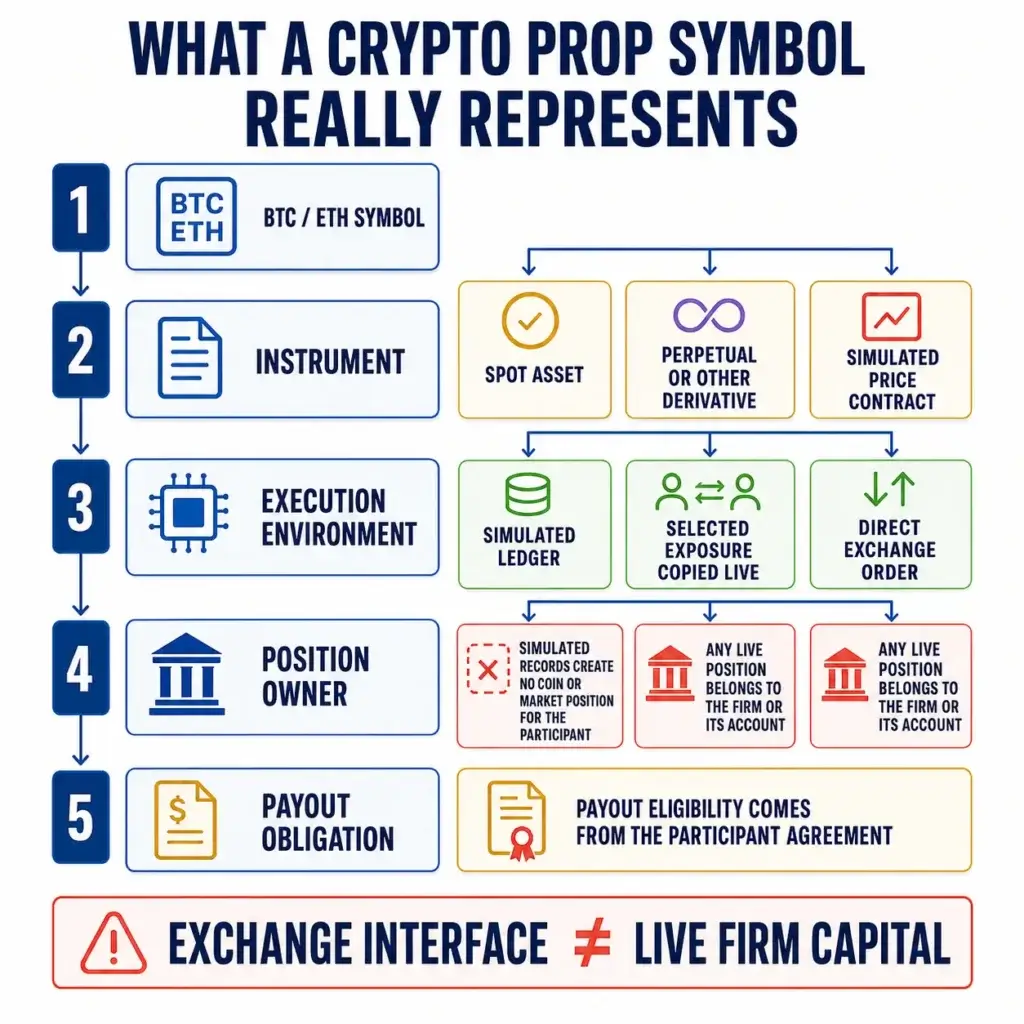
Crypto prop trading is proprietary trading in crypto markets or participation in a crypto-focused funded-trader program. An institutional desk can place live spot or derivative positions with company capital. A retail program can instead record the participant's trades in simulation and pay contractual rewards for eligible results. Live exchange prices and an exchange-branded interface do not prove that the participant owns coins or controls live firm capital. Neither a crypto payout method nor a funded label proves it.
Key takeaways
- What it is. Crypto prop trading covers company-owned crypto trading and online programs that assess traders for rules-based buying power and payouts.
- Why it matters. The same BTC or ETH symbol can represent an owned spot asset, a derivative position, or a simulated ledger entry. That distinction changes asset ownership and trading costs. It also changes liquidation risk and payout rights.
- Main risk or limitation. A nominal funded balance can obscure the usable loss room and whether any participant order reaches a live market.
What Is Crypto Prop Trading?
In traditional prop trading, a business places positions for its own economic benefit. A crypto prop desk may make markets, arbitrage exchange prices, trade spot-perpetual spreads, or take directional and volatility risk. The firm owns the positions and absorbs the live market result.
Online crypto-funded programs use the same label for a different relationship. A participant normally pays for or qualifies through an evaluation. The account then enforces automated loss rules, and eligible performance may lead to rewards. The displayed account can remain simulated during both evaluation and funded stages.
| Model | What Happens |
|---|---|
| Institutional crypto prop desk | A firm allocates capital to a trader, team, or model. Orders reach live markets and the resulting positions belong to the firm. Compensation follows an employment, partnership, or contractor agreement. |
| Online crypto-funded program | A participant trades under standardized program rules. The account may be simulated, copied into a separate live account, or directly connected to live firm capital. Payment follows the funded-trader agreement. |
Institutional desks own live market positions and operate as trading businesses. Online funded programs sell an assessment and reward product that may also inform the firm's trading. The shared “crypto prop trading” label does not make their capital structure or legal relationship identical, and it does not prove the same execution model.
What Do Crypto Prop Traders Actually Trade?
A platform symbol identifies a quoted market but not the position behind it. A BTC or ETH market may denote an owned spot asset or a derivative. It may instead be a simulated contract or a price feed used to score an evaluation. The contract specification determines what exists behind the symbol.
| Instrument | What the Position Represents |
|---|---|
| Spot crypto | A live purchase or sale of the asset. The firm or its exchange account owns and custodies any coin acquired. A simulated spot symbol creates no coin ownership. |
| Margin spot | A live spot position financed with borrowed funds. Interest, collateral, margin calls, and liquidation terms can apply. |
| Perpetual futures | A derivative with no scheduled expiry. The trader receives price exposure without owning the underlying coin. Funding payments and liquidation mechanics apply. |
| Dated futures or options | A derivative with an expiry, settlement method, contract size, and other product-specific terms. |
| CFD-style or simulated symbol | A provider-defined price contract or ledger entry. It can track a crypto market without creating an exchange position or custody of the asset. |
| On-chain position | A wallet interacts with a protocol or liquidity pool. Gas, smart-contract behavior, block timing, and wallet controls affect execution. |
A program that advertises hundreds of crypto pairs may therefore provide broad price coverage without holding hundreds of assets. Confirm the instrument, collateral currency, settlement method, and position owner before treating market count as usable access.
How Does a Crypto-Funded Program Work?
Crypto enters the generic funded-account process wherever the product defines a market, reference price, trading clock, or payment method.
- Select the program and instrument. The participant chooses an account tier, determines whether each symbol is live or simulated, and then identifies any spot or derivative contract.
- Trade the evaluation. Orders are usually recorded in a simulated account. The trader must reach the target without breaching loss or conduct rules, including any restrictions on position size and holding period.
- Complete the review. The firm can check identity and devices before granting funded status. It can also assess trade patterns, prohibited strategies, and agreement acceptance.
- Enter the funded stage. A funded trading account can remain simulated, use exchange-priced simulation, feed selected exposure into a separate live account, or use direct live execution.
- Build payout eligibility. Closed performance and request timing establish the starting amount. Consistency and account-buffer rules can change it, while a conduct review can block payment.
Continuous crypto trading does not remove the firm's own clock. A provider can define its own UTC reset and daily snapshot, plus maintenance and holding restrictions, even when the underlying exchange trades around the clock.
Are Crypto Prop Orders Live, Simulated, or Copied?
Account status and execution must be checked separately. “Funded” can mean that the participant has become eligible for rewards. It does not confirm that a brokerage or exchange account contains the nominal balance shown on screen.
An exchange-connected interface can still sit on a demo-account contract. The HyroTrader account terms define the service as demo trading and assign no monetary value to the displayed capital. An API or exchange screen therefore cannot settle the capital question.
Four structures appear in crypto-funded programs:
| Account Structure | Capital and Execution |
|---|---|
| Simulated funded account | The participant’s order is recorded on a virtual ledger. Eligible simulated results can create a real contractual payout. |
| Exchange-priced simulation | The simulator uses live or near-live exchange data, but the participant’s order does not enter that exchange. |
| Copied or hedged exposure | The participant remains in simulation while the firm decides whether to reproduce some exposure in a separate account. |
| Direct live account | The participant’s permitted orders place firm capital into live spot or derivative positions owned by the firm. |
The agreement should identify the account environment and the entity that owes an approved payment. It should also state how the firm can use trade data and reject simulated fills. Any right to route exposure at the firm's discretion matters because live and simulated funded accounts differ in execution and ownership even when their dashboards look similar.
Breakout's routing terms allow the firm to record a funded trade internally or route it externally at its discretion. The participant cannot infer the chosen path from the order ticket.
Why Perpetual Futures Change the Risk
Perpetual futures are common in crypto because they provide long or short price exposure without an expiry. They are derivatives, so the position does not give the trader ownership of the underlying asset, whether Bitcoin or Ether.
Five variables affect the result:
| Variable | Effect on the Position |
|---|---|
| Position size | Borrowing can make the total market exposure larger than the collateral supporting it. |
| Funding | Periodic payments move between long and short positions to help align the contract with its spot reference. |
| Mark price | An exchange can use a calculated mark price for unrealized P&L and liquidation while the chart displays the last traded price. |
| Maintenance margin | A position can be reduced or liquidated when the account no longer supports the required margin. |
| Trading fees and slippage | Entry, exit, and forced-liquidation costs reduce realized performance. |
Because exchange liquidation and a prop-firm rule breach use different thresholds, a position can remain above the exchange's maintenance margin while the account breaches the firm's daily loss rule. It can also reach an exchange liquidation threshold before the wider prop drawdown is exhausted.
Simulated programs may model these mechanics without reproducing live slippage, partial fills, latency, and market impact. The agreement should state how fees, funding, mark price, and liquidation are represented in the program ledger.
How Does Drawdown Work in a 24/7 Crypto Market?
Prop-firm drawdown measures the account against the provider's failure threshold and can end access before exchange liquidation. Possible reference points include balance and equity, as well as a trailing high or daily snapshot. Crypto adds funding and continuous open P&L, while weekend liquidity and the provider's reset clock create separate timing risks.
Consider a hypothetical $100,000 account with a 6% maximum loss and a 3% daily loss limit:
| Figure | Practical Meaning |
|---|---|
| $100,000 nominal size | Reference balance or buying-power tier, not participant-owned cash |
| $6,000 maximum loss | Starting distance from the account’s total failure threshold |
| $3,000 daily loss | Separate decline permitted during the provider’s defined day |
| $20,000 BTC perpetual position | Notional derivative exposure, not $20,000 of Bitcoin custody |
If trading fees and funding count against equity, they reduce both daily and total room. An open loss can also count before the position closes. A daily reset at 00:00 UTC can occur while the position remains open, creating a new reference level without a market close.
The prop firm drawdown calculation should be rebuilt with the intended position size, normal losing streak, funding cost, and reset time. Sizing a trade from the $100,000 headline can produce more risk than the $6,000 loss allowance supports.
Weekend trading requires the same analysis because liquidity can thin while spreads widen. The program or connected platform may also enter maintenance while the market stays open. A stop order cannot guarantee a specific fill in a fast live market.
Crypto-Specific Costs and Counterparties
The evaluation price covers only initial access. Trading and payment can introduce additional deductions before a result reaches the participant.
| Cost or Dependency | What to Check |
|---|---|
| Evaluation and activation | Initial fee, subscription, reset, activation, data, and platform charges |
| Trading costs | Maker or taker commission, spread, slippage, financing, and forced-liquidation charges |
| Perpetual funding | Payment interval, reference rate, whether simulated funding is included, and how it affects equity |
| Payout costs | Profit split, conversion rate, minimum request, network fee, payment-provider charge, and account buffer |
| Price source | Exchange, index constituents, mark-price formula, outage handling, and disputed candles |
| Technology | Terminal stability, API permissions, rate limits, maintenance, and order-rejection rules |
| Counterparties | Contracting firm, simulator, broker or exchange, custodian, stablecoin issuer, and payment provider |
A reward paid in USDC or another crypto asset can still arise from simulated performance. The payment method does not prove that the trades settled on-chain. It adds stablecoin and network requirements, plus wallet and conversion costs, to the payout process.
The firm remains the contractual counterparty for a reward unless the agreement assigns that obligation elsewhere. Exchange solvency or custody protection does not automatically cover a separate evaluation company using the exchange's name and interface. Data licensing does not change that distinction.
Crypto Prop Program vs Self-Funded Crypto Trading
A funded program limits the participant through contract rules. A personal account places capital ownership and the market result directly with the trader.
| Crypto Prop Program | Self-Funded Crypto Trading |
|---|---|
| The participant pays program costs and may receive nominal buying power without depositing the displayed balance. | The trader deposits or transfers the capital used for every position. |
| The account can be simulated, copied, or live. | A live exchange or wallet account creates actual positions under the provider’s terms. |
| Daily loss, total drawdown, strategy, holding, and conduct rules can close access. | The trader sets strategy limits, while exchange margin and liquidation rules still apply. |
| Only eligible performance can be requested under a payout contract. | Available account assets can be withdrawn, subject to exchange, custodian, or protocol controls. |
| Direct loss is often limited to fees and unpaid rewards in simulation. | The trader absorbs the market loss and all custody or counterparty exposure. |
Both routes retain provider risk because a prop participant depends on the firm paying valid requests. A self-funded trader depends on an exchange or custodian, while wallet security and smart-contract behavior can add separate risks.
What Should You Check Before Paying?
Start with the instrument and contract, then work outward to the platform and payment path.
- Name the instrument. Record whether the symbol is spot or a derivative. Note any simulation or borrowed-margin layer separately.
- Classify both account stages. Confirm whether evaluation and funded trading use pure simulation, exchange-priced simulation, copied exposure, or direct live execution.
- Identify the execution provider. Check first for a simulator or internal ledger. Then identify any broker, exchange, or market maker involved in live routing.
- Record every price reference. Record the last and index prices. Then identify the mark price and the value used for drawdown.
- Model margin and liquidation. Calculate total exposure and maintenance margin. Add likely slippage and the firm's lower failure threshold.
- Add every cost. Start with program charges and trading fees. Add funding, currency conversion, network charges, and payout deductions.
- Read the continuous-market rules. Check the reset and weekend schedule. Then record maintenance and event restrictions, plus any rules for holding periods, automation, or APIs.
- Trace the counterparties. Identify the contracting entity and execution provider. Record any custodian, payout asset, network, and payment provider separately.
- Rebuild payout eligibility. Record the first request date, split, cap, and minimum. Then check the consistency test and account buffer, followed by review rights and reasons for rejection.
- Read change and dispute clauses. Determine how active-account rules can change and where a payment or execution dispute is handled.
After these checks, crypto-focused prop firms can be filtered by instrument, account model, cost, and payout terms. The current agreement still controls the product bought at checkout.
FAQ
What is crypto prop trading in simple terms?
Crypto prop trading is a firm trading crypto markets for its own benefit or an online program assessing traders for rules-based crypto buying power and payouts. The retail account may be simulated even after the trader receives funded status.
Do crypto prop firms use real money?
Firms can place company capital into live positions or keep participant accounts in simulation under a reward contract. Some also copy selected simulated exposure into a separate live account.
Do crypto prop traders own the coins they trade?
Usually not in a firm-controlled account. A spot purchase, if live, belongs to the firm or its account. A perpetual future provides price exposure without coin ownership. A simulated symbol creates no asset or market position.
Can you trade spot crypto through a prop firm?
Some programs list spot markets, but the account terms must show whether the order creates a live exchange purchase or a simulated result. If the position is live, check whether borrowed margin applies.
How is crypto prop trading different from forex prop trading?
Crypto can trade continuously and often uses perpetual futures with funding payments. Mark-price liquidation and stablecoin collateral add account-level concerns, while exchange APIs create another dependency. Forex-funded programs commonly use currency or CFD products with defined sessions and rollover costs. Their price sources and counterparty structures also differ.
Can crypto prop trading accounts be liquidated?
A live margin position can be liquidated under the exchange’s rules. Separately, the prop account can close after a daily or total drawdown breach. Position and conduct rules can close it as well. Either event can end the position or program access.
