
Clacton by-election: 2nd place
Final Results
Scheduled deadline: Aug 13, 2026, 16:00 UTC


48 more outcomes Other final results
- Natasha OsbenNo
- Tony MackNo
- Andrew PembertonNo
- Laurence FoxNo
- Piers CorbynNo
- Adham AlkhatipNo
- Rees CowneNo
- Kai StephensNo
- Luke WorleyNo
- John StevensNo
- William CloustonNo
- Pamela WalfordNo
- Person JNo
- Person KNo
- Person LNo
- Person MNo
- Person NNo
- Person ONo
- Person PNo
- Person QNo
- Person RNo
- Person SNo
- Person TNo
- Person UNo
- Person VNo
- Person WNo
- Person XNo
- Person YNo
- Person ZNo
- Person AANo
- Person ABNo
- Person ACNo
- Person ADNo
- Person AENo
- Person AFNo
- Person AGNo
- Person AHNo
- Person AINo
- Person AJNo
- Person AKNo
- Person ALNo
- Person AMNo
- Person ANNo
- Person AONo
- Person APNo
- Person AQNo
- Person ARNo
- OtherNo


Market Resolution
Polymarket reports Count Binface as the winning outcome for the Clacton by-election: 2nd place prediction market with a final probability of 100%. Scheduled deadline: Aug 13, 2026, 16:00 UTC. Final reported trading volume was $749.15K.
Polymarket · Final sync
 Next French Presidential Election


 Brazil Presidential Election

 Presidential Election Winner 2028


Market Analysis
Count Binface Leads as Clacton’s Missing Majors Fracture the Opposition
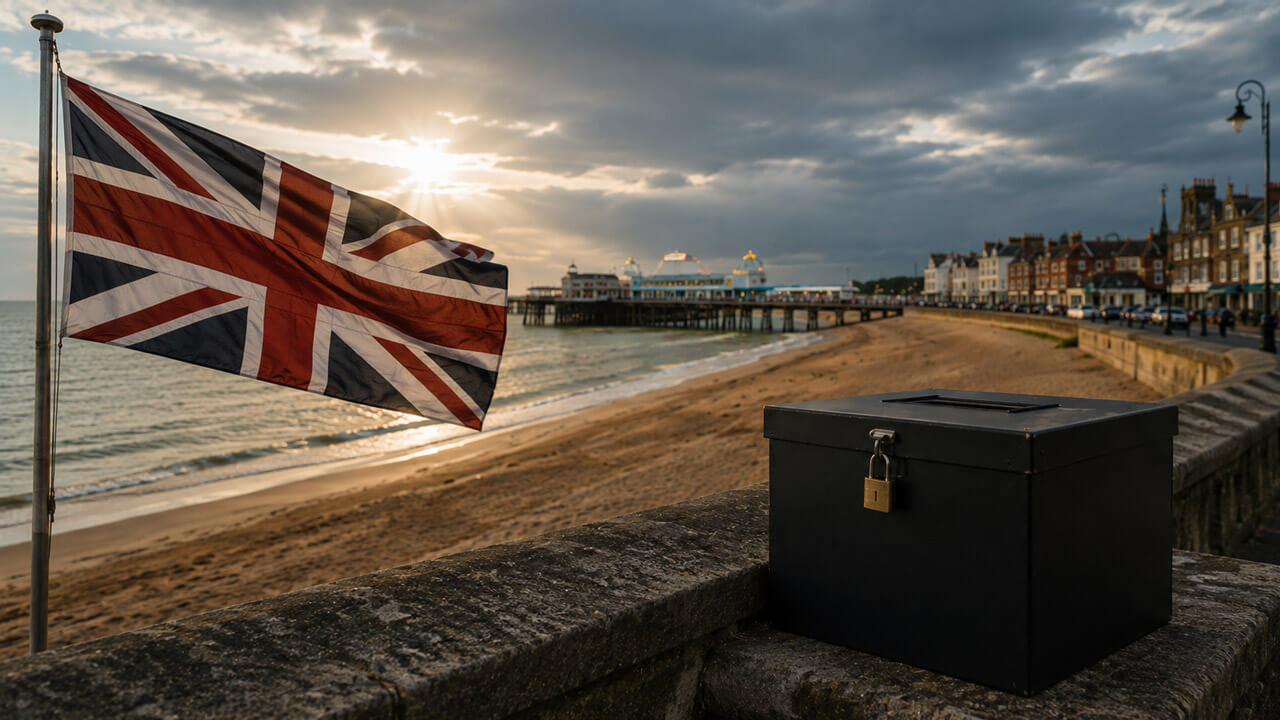
Clacton’s runner-up contest has become a coordination test across an unusually crowded ballot. Count Binface’s lead assumes a conspicuous protest candidacy can gather displaced major-party voters before any rival converts local organization or campaign visibility into a concentrated bloc.

Count Binface’s 60% price rests on a specific structural thesis: when familiar party choices disappear, a fragmented electorate may coordinate around the ballot’s most conspicuous protest candidacy. The official field contains 34 names and no nominees from Labour, the Conservatives, the Liberal Democrats or the Greens. That combination creates an unusually low and unpredictable threshold for second place.
The missing major parties leave nearly half the 2024 vote without a direct successor
UK Parliament records that Nigel Farage won Clacton in 2024 with 46.2%, followed by the Conservatives on 27.9% and Labour on 16.2%. Those two opposition parties therefore accounted for 44.1% of the previous vote, yet neither has a nominee on the final ballot published by Tendring District Council.
That historical support cannot be transferred mechanically to any 2026 candidate. Its relevance lies in the scale of the electorate now lacking its previous partisan option. The market-implied story is that these voters will scatter across minor-party, independent and protest candidates, allowing Count Binface to secure second with a share far below the 27.9% achieved by the 2024 Conservative runner-up.
This interpretation also assumes Farage’s presence keeps Reform-aligned voters concentrated around the former MP. Parliament says Farage represented Clacton from July 2024 until July 2026, while the official candidate statement confirms he is standing again. A competitive challenge to Farage could change the tactical incentives across the ballot; the current runner-up hierarchy implicitly gives that scenario limited weight.
A 34-candidate ballot rewards coordination more than broad popularity
With 34 candidates, modest differences in recognition, organization or voter motivation can determine second place. Count Binface at 60% stands far ahead of John Stevens at 11.9% and William Clouston at 11.6%, while every other listed outcome is below 5%. This distribution implies confidence that one candidacy will become the common destination for enough otherwise dispersed opposition voters.
The hidden assumption is that ballot-level visibility translates into votes across Clacton’s electorate. The supplied evidence contains no constituency polling, canvass returns or published campaign-performance measures supporting a 60% probability for any runner-up. The price therefore relies heavily on field structure and inferred voter coordination. Evidence that Stevens, Clouston or another candidate has stronger volunteer coverage, endorsements, direct-mail reach or local support would weaken that inference.
Turnout could let a disciplined campaign outrun the market leader
Tendring District Council says almost 80,000 electors are eligible and 51 polling stations have been booked. In a crowded by-election, the decisive question may be which candidate can mobilize a few thousand dependable supporters. Broad awareness has less value if those voters do not complete registration, postal voting or election-day turnout.
The administrative calendar creates measurable tests. New registrations close on 28 July, postal-vote applications on 29 July, and proxy-vote or Voter Authority Certificate applications on 5 August. A rival campaign demonstrating effective mobilization around those deadlines would support a higher floor for its vote. Conversely, continued absence of visible organization among the challengers would reinforce the market’s coordination thesis.
John Stevens and William Clouston are the clearest counter-signal
Stevens and Clouston together account for 23.5% of the displayed prices, making them the principal alternatives to Count Binface. Their presence shows that the market assigns meaningful probability to a candidate-specific campaign overcoming the protest-vote focal point. The factual record supplied here does not establish which of them has superior local organization, so stronger claims about their bases would be speculative.
The main failure mode for the leader is consolidation: one rival gains endorsements, campaign coverage or evidence of concentrated support while the protest vote divides among several recognizable names. Laurence Fox, Rees Cowne, Kai Stephens, Nigel Farage and others each carry smaller probabilities, illustrating how many routes exist for vote fragmentation or an unexpected finishing order.
The official count will resolve a timetable mismatch
The council has fixed polling day for 13 August 2026, after publishing the final nominations on 17 July. Polymarket’s displayed close date is 30 June 2027, so that metadata extends well beyond the scheduled election. The council’s declaration is the stated settlement source and provides the relevant real-world result.
Concrete repricing catalysts include verified constituency polling, candidate withdrawals, major endorsements, campaign-finance or staffing disclosures, and evidence of postal-vote mobilization. Absent those signals, the hierarchy remains an inference from an exceptional ballot: Farage anchors one side, the major opposition parties leave a vacuum, and Count Binface is priced as the candidate most likely to coordinate enough of the remainder to finish second.
Sources
Market Details
- Resolution criteria
- A by-election for the United Kingdom parliamentary constituency of Clacton is expected to be held soon following the announced resignation of incumbent Nigel Farage.
- Platform
-


- Category
- Politics › Global Elections
- Scheduled deadline
- August 13, 2026, 4:00 PM UTC
- Settlement source
- tendringdc.gov.uk
- Market rules summary
- Multi-outcome Polymarket event. Each listed option is represented by its Yes price on the underlying market. View full rules
Frequently Asked Questions
What was the final result of the Clacton by-election: 2nd place prediction market?
Polymarket reports Count Binface as the winning outcome for the Clacton by-election: 2nd place prediction market with a final probability of 100%. The final market snapshot includes $749.15K volume and $363.73K open interest. CryptoSlate last synced the final market data at Aug 14, 2026, 10:17 UTC.
How does the Clacton by-election: 2nd place prediction market resolve?
A by-election for the United Kingdom parliamentary constituency of Clacton is expected to be held soon following the announced resignation of incumbent Nigel Farage. Multi-outcome Polymarket event. Each listed option is represented by its Yes price on the underlying market. The settlement source listed for this market is Tendringdc.
Related Global Elections Markets
 Who will win the 2026 Vancouver mayoral election?


 Who will win the 2026 Toronto mayoral election?


 Next Premier of Quebec