Quick Take
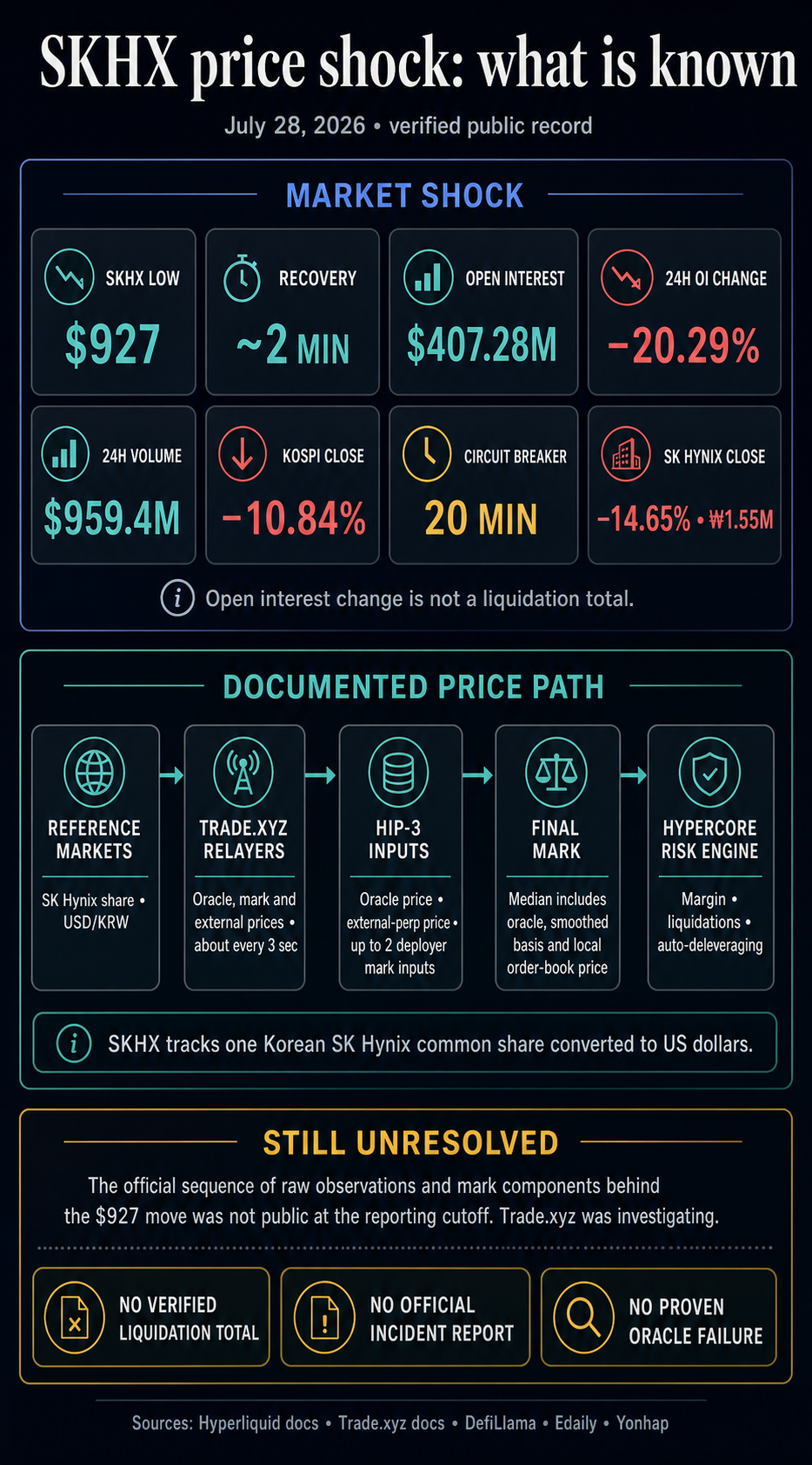
- SKHX briefly fell to $927 before recovering within about two minutes during South Korea’s pre-market window.
- Open interest later stood at $407.28 million, down 20.29% over 24 hours, DefiLlama data showed.
- TradeXYZ is investigating the price inputs; no official incident report was available at the cutoff.


A two-minute price shock in a Hyperliquid market tied to South Korea’s SK Hynix has put the mechanics and oversight of equity-linked perpetuals under scrutiny.
SKHX, a TradeXYZ-operated perpetual on Hyperliquid that tracks the US dollar value of one Korean SK Hynix share, briefly sank to $927 during South Korea’s pre-market window before recovering within roughly two minutes, according to local media.
A later DefiLlama snapshot put open interest at $407 million, down 20% over 24 hours, while 24-hour trading volume reached $959 million. Open interest measures the rolling value of outstanding positions, incorporating changes in both position size and price.
The underlying market was already under severe pressure. South Korea’s KOSPI closed 10.84% lower after a 20-minute marketwide circuit breaker, while SK Hynix’s Korean shares finished down 14.65% at 1.55 million won, Yonhap reported.
TradeXYZ’s contract specification defines SKHX as the dollar value of one SK Hynix common share, calculated by converting the Korean share price at the prevailing USD/KRW rate. TradeXYZ documents an external-pricing window from 8:00 a.m. to 8:50 a.m. Korean time. SKHX is separate from the company’s US-listed depositary receipt and from tokenized shares.
From price input to liquidation
Hyperliquid’s HIP-3 specification gives a market deployer control over its oracle definition, oracle prices, leverage limits and settlement. The deployed market uses HyperCore’s order books and margin system.
TradeXYZ says its relayers compute and transmit the XYZ market’s oracle, mark and external prices about every three seconds. HyperCore handles matching, margining, liquidations and auto-deleveraging. In the documented design, TradeXYZ supplies the bespoke price inputs and HyperCore applies its risk machinery to the resulting mark.
The HIP-3 deployer API accepts an oracle price, an external-perpetual price and as many as two deployer-supplied mark-price inputs. HyperCore contributes a local price derived from the best bid, best offer and latest trade. TradeXYZ says the final mark is the median of the oracle, a smoothed oracle-to-market difference, and that local order-book price.
The rulebook shows how SKHX pricing is meant to work. The plunge to $927 is still a black box, with the raw observations and mark-price ingredients absent from the public record. DefiLlama names Pyth Lazer as the oracle provider. TradeXYZ says its relayer and updater carry prices into HyperCore. The incident-level handoff between those systems remains the missing piece.
BlockMedia reported at 18:41 Korean time that Hyperliquid said TradeXYZ was investigating and planned an update after reaching a conclusion. At that cutoff, the reviewed sources contained no official incident report or event-specific account of compensation, insurance impact, a halt, a cap change, or slashing.
HIP-3’s allocation of controls is clear even as responsibility for this price shock remains open: the deployer operates the oracle settings, and HyperCore executes the market and risk functions. TradeXYZ’s findings will determine whether the episode reflected the published design under extreme conditions or a price-feed safeguard that needs revision.

Hyperliquid is +5.85% over the past 24 hours and currently sits at rank #10 by market cap.
Mentioned in this article

Editorial credits