

Overview
Introduction
USDT and USDC, the two largest stablecoins, are crypto tokens issued by private companies, Tether and Circle, and each is meant to stay worth $1. Other designs back the same $1 target with crypto collateral or software that adjusts supply, and a few track gold.
Holding one gives you a claim on an issuer's reserves and rules, with no bank deposit or government guarantee behind it.
What Are Stablecoins?
Stablecoins are cryptocurrencies, so they move through wallets, exchanges, smart contracts, and blockchain networks like any other token. What sets them apart from coins like Bitcoin (BTC) or Ether (ETH) is a fixed target price, usually $1.
Behind each token, a company or a smart contract system decides how new tokens get created, what backs them, and how holders get their money back, and those rules differ from token to token. That makes a stablecoin only as dependable as its backing, its redemption route, its issuer's controls, and the trading liquidity around it.
A stablecoin's market cap grows when its issuer creates tokens and shrinks when it retires them, so the order of the largest stablecoins by market cap moves with demand for each one.
Top Stablecoin Crypto Assets by Market Cap







How Stablecoins Keep Their Peg
A stablecoin holds its price through some mix of backing assets, redemption rights, and trading incentives. If a token can reliably be created and redeemed near $1, traders have a reason to push its market price back toward that level whenever it drifts.
With a fiat-backed stablecoin, the cycle starts when an approved customer sends dollars or cash-equivalent assets to the issuer. The issuer mints new tokens to that customer, and the tokens then circulate on blockchains, exchanges, payment apps, and decentralized finance (DeFi) protocols. When a holder redeems, the issuer pays out dollars and burns the returned tokens, so supply shrinks again.
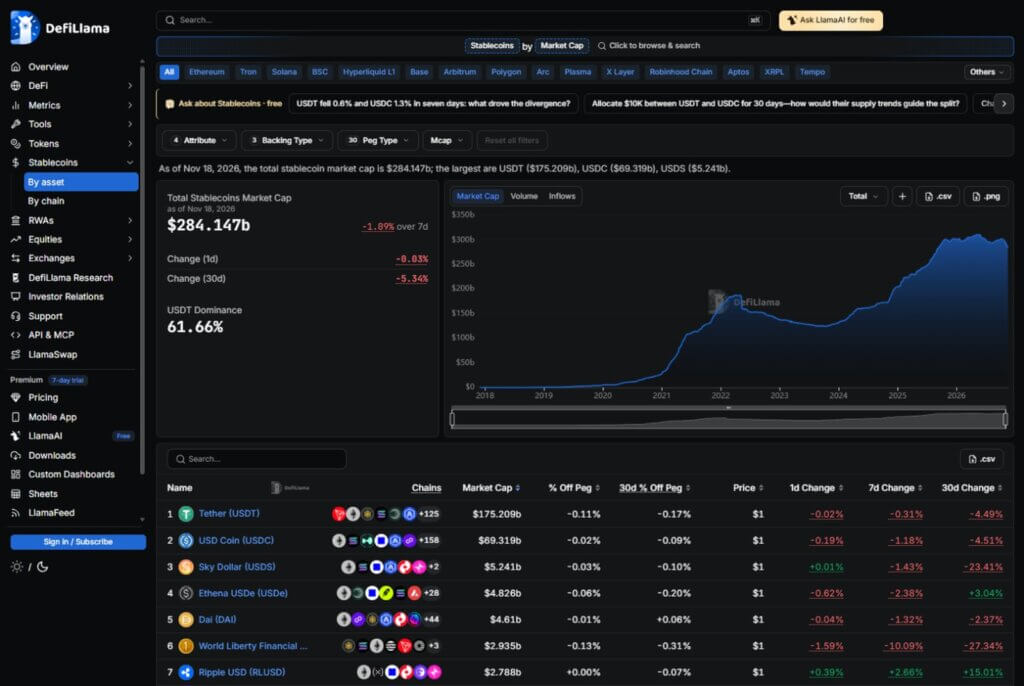
As of Nov. 18, 2026, DeFiLlama's stablecoin dashboard put the total stablecoin market cap at about $284 billion, with USDT holding nearly 62% of it.
Day to day, a token might still trade at $0.998 or $1.002 on an exchange because of thin liquidity, network congestion, fees, or redemption limits, and arbitrage pulls it back. Above $1, a firm with an issuer account can mint new tokens at $1 and sell them on the market, and that added supply pushes the price down. Below $1, the same firm can buy tokens cheaply and redeem them with the issuer for $1 each, which takes supply off the market and lifts the price.
Say the issuer charges a hypothetical 0.1% to mint or redeem. At $1.002, minting 1 million tokens costs $1,001,000 with the fee, and selling them brings in $1,002,000, a $1,000 gain. At $0.998, buying 1 million tokens costs $998,000, and redeeming them returns $999,000 after the fee, the same $1,000 gain. Between $0.999 and $1.001, the fee eats the whole gap, so a small drift can last until ordinary trading moves the price.
Tether's actual terms are close to that example, with a 0.1% fee to acquire USDT, the greater of $1,000 or 0.1% to redeem it, and a $100,000 minimum. Circle, by comparison, says qualified businesses with a Circle Mint account convert USD to and from USDC at no additional cost. A February 2024 Federal Reserve note found that fiat-backed issuers tend to mint and burn only with institutional customers, so retail holders rely on exchanges and support the peg only through their trading there.
When that direct route through the issuer stalls, the pull weakens. On Mar. 10, 2023, Circle said it couldn't wire out $3.3 billion of USDC reserves held at Silicon Valley Bank, and the next day it said issuance and redemption were limited to US banking hours. USDC fell below 90 cents on secondary markets and recovered over about three days, according to the same Federal Reserve note.
Mint and redeem arbitrage pulls a stablecoin back toward $1 from either side
Approved firms can mint or redeem a fiat-backed stablecoin with its issuer at $1. When the market price drifts past the issuer's fee, buying and redeeming or minting and selling pays, and the trade pushes the price back toward $1.
Small drifts inside the fee band can last, wider ones get traded away, and the pull depends on approved firms being able to mint and redeem.
Hypothetical prices and fee. Real trades also pay exchange fees and slippage, take time to settle, and move the price as they fill. Issuer fees and minimums differ, so the band width differs too. Only approved customers can mint or redeem directly, and the pull stalls when issuance or redemption pauses.
Sources and evidence
Sources
Supporting facts
- A February 2024 Federal Reserve note says direct customers of stablecoin issuers can engage in arbitrage trading, profiting off differences between the primary exchange rate and the exchange rate on secondary markets to maintain the peg of a stablecoin. [1]
- The same note says excess sell pressure on de-pegged stablecoins and excess demand for stablecoins trading at a premium should theoretically lead to redemption or issuance on the primary market. [1]
- The note says fiat-backed stablecoin issuers tend to mint and burn new stablecoins only with institutional customers, so retail traders rely on secondary markets to access the stablecoin. [1]
- Reported statement Circle says USDC is backed by cash and cash-equivalent assets so that it is redeemable 1:1 for USD, and that qualified businesses can apply for a Circle Mint account to convert USD to and from USDC at no additional cost. [2]
- Tether's fee page lists a 100,000 USD minimum acquisition or redemption, a 0.1% fee per acquisition, and a fee per redemption of the greater of $1,000 or 0.1%. [3]
- In a hypothetical case with a 0.1% issuer fee and 1 million tokens, buying at $0.998 and redeeming at $1 nets $1,000, minting at $1 and selling at $1.002 also nets $1,000, and the trade breaks even at $0.999 and $1.001. [1] [3]
Method
Hypothetical 1 million tokens and a hypothetical 0.1% issuer fee, or $1,000. Below the peg, -998,000 + 1,000,000 - 1,000 = 1,000 dollars. Above the peg, -1,000,000 - 1,000 + 1,002,000 = 1,000 dollars. Break-even prices are 1 minus and plus 0.001, so $0.999 and $1.001. The scale is linear from $0.997 to $1.003. Arithmetic asserted in gen.py. Mechanism from the Federal Reserve note, fee examples from Tether and Circle.
Scope
Hypothetical prices and fee. Real trades also pay exchange fees and slippage, take time to settle, and move the price as they fill. Issuer fees and minimums differ, so the band width differs too. Only approved customers can mint or redeem directly, and the pull stalls when issuance or redemption pauses.
 CryptoSlate
Types of Stablecoins and What Backs Them
Stablecoin types differ mainly in what supports the peg, and the six main types are paired below with the assets or rules behind each one.
- Fiat-backed
Cash, bank deposits, or Treasury bills held by the issuer, redeemable near 1:1
- Crypto-backed
Crypto collateral locked in a protocol, often worth more than the tokens minted
- Commodity-backed
A commodity such as gold, held in custody and audited
- Algorithmic
Software that expands or shrinks supply, often without full high-quality reserves
- Hybrid or synthetic dollar
A mix of collateral, hedging, protocol incentives, or yield strategies
- Yield-bearing or rewards-linked
A token or wrapper that passes through yield while tracking a target value
Fiat-backed tokens need a working redemption path and a sound banking setup, crypto-backed tokens need collateral that keeps its value through a sell-off, and algorithmic designs need sustained market confidence. Crypto-backed tokens also face smart contract, oracle, and liquidation risk.
So the type tells you which checks a token needs, and those checks, more than the label, show how safe it is.
Stablecoin Examples Including USDT, USDC, DAI, and PYUSD
These tokens cover the fiat-backed, crypto-backed, commodity-backed, and hybrid types above, and the right column says what each one's design shows.
- USDT
A dollar stablecoin traded on many centralized exchanges and blockchains
- USDC
Circle’s dollar token, used in wallets, exchanges, apps, and institutional payments
- DAI and USDS
A DeFi-native line with crypto collateral, governance, and newer exposure to off-chain assets
- PYUSD
PayPal’s dollar token, issued through a regulated partner
- PAXG and XAUT
Gold-linked tokens that track a commodity
- USDe
A synthetic dollar built on hedged positions and protocol rules
- Frax USD
A hybrid design shaped by collateral changes and earlier algorithmic models
Not every stablecoin tracks the dollar. Euro stablecoins follow the euro, so the issuer, the reserves, and the regional rules you check all change with them.
Before you pick one, check what backs it, who controls redemption and on what terms, where it trades with the most liquidity, and which networks both the sender and the receiver support.
What Stablecoins Are Used For
The simplest use is on exchanges, where stablecoins act as quote currencies, the dollar side that other coins are priced and traded against. A trader sells BTC into USDT or USDC, waits in that dollar balance, and buys another asset later, with no trip back to a bank account in between. Anyone who wants to step out of a volatile market for a while can do the same without leaving crypto entirely.
Outside trading, the same tokens move through payments, DeFi, and betting apps.
- Moving value between exchanges that support the same token and network
- Supplying collateral, liquidity, or swap routes in DeFi protocols and decentralized exchanges
- Paying contractors, merchants, or apps that accept crypto
- Spending through crypto card programs that support the token in your country
- Funding accounts on some prediction markets, which price outcomes and pay winnings in dollar stablecoins, so a payout holds its value between the bet and the result
An on-chain payment settles quickly and plugs into other apps. You still handle chain fees, address accuracy, issuer risk, platform custody, and any local tax or reporting duties.
For businesses and treasury teams, stablecoins can speed up settlement with partners abroad or on crypto platforms. They also add operational work, since wallets, signing policies, exchange limits, and redemption routes all become part of cash management.
Stablecoins vs. Cash, Bank Deposits, CBDCs, and Volatile Crypto
Stablecoins look like dollars on a screen, though the legal claim and the system that records ownership both differ from cash or a bank balance.
Each alternative below comes with the main way it differs from a stablecoin.
- Cash
Money itself, with no issuer or blockchain in between
- Bank deposit
A liability of a regulated bank, where a stablecoin is a company’s or protocol’s
- Central bank digital currency (CBDC)
Central bank money, with no private issuer
- BTC or ETH
A free-floating price with no target
- Exchange balance
An account entry on a platform, with no token in your own wallet
In a July 2022 fact sheet, the Federal Deposit Insurance Corporation (FDIC) said it insures only deposits held in insured banks and doesn't insure assets issued by non-bank entities such as crypto companies. So in the US, a stablecoin holder relies on issuer reserves, redemption rules, platform custody, and market liquidity.
Depegs, Reserves, Freezes, and Other Stablecoin Risks
Stablecoin risk depends on where in the system a failure happens. Reserve risk arises where dollars come in, price risk where tokens trade, and redemption risk at the exit, while network risk applies on every chain the token touches. So a token can hold its price on one exchange while withdrawals are paused on another, and an issuer can stay solvent while a user loses funds to a wrong-network transfer.
The second column below gives what to check for each risk.
- Reserve risk
Backing assets that are high quality, liquid, segregated, and reported regularly
- Redemption risk
Direct redemption for ordinary holders, or exchange sales only
- Depeg risk
How far the token has traded from its target under stress, and how fast it recovered
- Issuer control
Freeze and blacklist powers under legal or policy rules
- Smart contract risk
Contracts, oracles, and liquidation systems that can fail or be exploited
- Chain risk
Congestion, outages, high fees, or confusing token standards
- Platform custody
Who controls withdrawals or private keys, a wallet, exchange, lender, or app
- Yield risk
Added lending, smart contract, borrowing, liquidity, or counterparty exposure
If reserves are hard to value or slow to sell, the token can slip below its target when many holders try to exit at once.
Some fiat-backed issuers can also block addresses or freeze tokens to comply with legal orders, sanctions, or their own policies. That power may be necessary for regulated payments, and it reaches tokens in a self-custody wallet too.
Where you hold a stablecoin shapes the risk as well. Crypto wallets let you hold and send stablecoins outside exchange accounts. A custodial wallet may add recovery options and compliance controls, while a self-custodial wallet leaves key management and signing risk with you.
Lending USDC or USDT through a protocol, adding it to a liquidity pool, bridging it across chains, or using it in a strategy built on borrowed money each add ways to lose money. A wallet balance faces none of those, and the losses can hit even while the stablecoin itself stays near $1.
Sending on the wrong network is a mistake no stablecoin design can fix. USDT sent over a network the receiving exchange doesn't support may never show up in the account, even when the blockchain shows the transfer as successful. Recovery depends on whether the recipient controls that address on that network, and many exchanges don't recover wrong-chain deposits.
USDT vs. USDC and Stablecoin Regulation
USDT trades across a wide range of global exchanges and transfer networks, while USDC is common in US-regulated, payment, and app settings. Those differences affect fees, withdrawal routes, supported chains, and how quickly you can move between crypto and bank-linked platforms, so neither wins on every count.
Regulation decides which issuers can serve a market, what reserves must back a token, what disclosures are required, and how exchanges and apps can offer it. Clearer rules cut some risks, though the user-level ones remain.
In the US, the Guiding and Establishing National Innovation for U.S. Stablecoins (GENIUS) Act became Public Law 119-27 on Jul. 18, 2025. It requires permitted payment stablecoin issuers to hold reserves of at least 1:1 in identifiable assets. On Feb. 25, 2026, the Office of the Comptroller of the Currency (OCC) proposed rules to implement the act for payment stablecoin issuers under its jurisdiction. Comments are due 60 days after the proposal appears in the Federal Register.
In the EU, the Markets in Crypto-Assets Regulation (MiCA) sets uniform rules for crypto-assets and treats asset-referenced tokens (ARTs) and e-money tokens (EMTs) separately. The European Securities and Markets Authority (ESMA) keeps an interim MiCA register that lists the issuers of each type and updates it weekly.
Under either set of rules, these checks still fall to you.
- Which issuer can serve your jurisdiction
- Whether your exchange, wallet, or app supports the token
- How often its reserve reports come out and what they cover
- Whether its freeze powers and compliance controls are documented
- How local rules classify it, as a payment stablecoin, an e-money token, an asset-referenced token, or something else
FAQs
Are stablecoins safe?
Only in the narrow sense that they aim to hold a steady price. You can still lose money if the issuer fails, a bridge holding the token is exploited, or a yield product built on it collapses, so judge each token, issuer, and platform on its own.
Can a stablecoin lose its peg?
Yes, in either direction. During the March 2023 banking stress, a Federal Reserve note found that USDT traded at a premium while USDC and DAI fell below $1. USDT’s market cap grew by $9 billion over the same period.
Are stablecoins FDIC insured?
Generally not. FDIC insurance pays out only when an insured bank fails, and the FDIC says it doesn’t protect against the default, insolvency, or bankruptcy of non-bank firms, including crypto custodians, exchanges, brokers, and wallet providers.
What are stablecoins backed by?
It depends on the token, so check the issuer’s own reserve reports. Circle, for example, posts monthly attestation reports on USDC’s reserves on its Transparency page. The word “stablecoin” alone doesn’t tell you what a reserve holds.
What is the difference between USDT and USDC?
Tether issues USDT and Circle issues USDC, each under its own reserve and redemption terms. USDT is the larger of the two, at about $175 billion in market cap against about $69 billion for USDC as of Nov. 18, 2026, according to DeFiLlama.
What happens if I send a stablecoin on the wrong network?
Contact the receiving exchange’s support with the transaction hash, since some exchanges retrieve wrong-chain deposits for a fee that can exceed the amount sent. A small test transfer before a large one catches the mistake while it’s still cheap.
