


Overview
Introduction
Passing a prop firm challenge means meeting every active objective and risk condition, then clearing the provider's review for the next account stage. No risk plan guarantees that outcome. A workable plan translates the current rules into cash values and fits a tested trading method inside them. It leaves room for costs and open-position movement, including execution that differs from the intended price.
The hypothetical calculations below do not reproduce a provider's terms. They offer no recommendation on position size or account product. The applicable agreement and dashboard determine the actual inputs.
Key takeaways
- What it is. A passing plan converts the challenge's current loss floors and completion conditions into personal daily and trade-level limits with an aggregate exposure cap.
- Why it matters. The advertised account balance can be far larger than the amount current equity may lose before the closer daily or overall threshold is reached.
- Main risk or limitation. Correct sizing cannot make an untested strategy profitable or neutralize execution gaps and costs, while rule changes or provider review can still affect the result.
Make Sure the Strategy Fits Before Paying
A paid evaluation should test a method that already has a documented record under similar market conditions. The challenge fee should not finance the first experiment with a new strategy or instrument in an unfamiliar session. A method can be profitable in a personal account and still be incompatible when challenge loss floors or holding restrictions cut across its normal behavior.
Start with recent trading records from the instrument and session the challenge will use. A longer sample normally says more than a handful of favorable trades, but no fixed lookback proves future performance. The purpose is to describe how the method has behaved, including the periods that placed the most pressure on capital.
| Strategy Record | Why It Matters |
|---|---|
| Markets and instruments | Confirms that the product lists the exact contract, pair, or crypto market the method needs |
| Average and longest holding period | Tests overnight, weekend, session-close, swap, and funding restrictions |
| Typical trades per day | Shows whether minimum-day rules or inactivity conditions distort normal activity |
| Normal and worst daily loss | Establishes whether the method fits inside a personal daily stop |
| Largest recorded losing streak | Tests how quickly repeated full-risk losses would consume usable room |
| Peak-to-trough decline | Supplies a strategy-level drawdown reference without replacing the account formula |
| News-event exposure | Identifies whether entries, exits, pending orders, or profit treatment may be restricted |
| Automation and order needs | Tests platform support, EA or API permissions, and prohibited-strategy clauses |
| Typical costs and slippage | Prevents the planned stop from understating the cash loss |
An account is incompatible when the method's normal operation violates a required clause. Reducing size can address some loss constraints. It cannot create access to a missing instrument or permit a prohibited holding period. Unsupported orders and banned automation remain unusable.
The full evaluation lifecycle has to fit because the target and minimum-day condition cover only part of the route. The process continues through review and a separate funded-stage transition, both explained in how a prop firm challenge works . A trading method should remain compatible through every stage.
Turn Every Challenge Rule Into a Current Number
A challenge percentage is unusable until its base and monitored value are known, along with its clock and consequence. A 5% daily limit can describe a fixed cash amount or a percentage of reset balance. Some rules instead deduct from starting equity. The account can monitor balance or equity, while another net value may apply. Open positions and costs can therefore change the result before a trade closes.
Build one account record for the exact product on its selected platform. Match the account size and stage. Do not combine a rule from one plan with a help article for another.
| Rule Input | What to Record |
|---|---|
| Current monitored value | Balance, equity, net liquidation value, or another contract-defined figure |
| Daily breach floor | Current account value that triggers the daily consequence |
| Overall breach floor | Current account value that triggers the phase or account consequence |
| Update method | Static, reset-based, end-of-day trailing, or intraday trailing |
| Clock | Reset time, timezone, trading session, and treatment of open positions |
| Equality test | Whether touching the threshold is enough or the value must cross it |
| Included costs | Commission, spread, swap, funding, platform charges, and adjustments |
| Activity conditions | Minimum days, profitable days, inactivity, deadlines, and billing periods |
| Concentration conditions | Best-day or best-trade calculation, checkpoint, and result |
| Exposure controls | Position, contract, lot, notional, leverage, and aggregate limits |
| Conduct conditions | News, holding, copying, automation, hedging, location, and account ownership |
| Consequence | Pause, added requirement, profit adjustment, reset, failure, closure, or review |
The dashboard should supply the current values, while the governing documents define what those values mean. A rule can change after a reset or new phase. Qualification and payout can introduce further transitions, so the record must be rebuilt each time.
CryptoSlate's method to decode the full rule set separates the measurement from the threshold. It records the clock alongside the applicable stage and consequence, preventing a familiar label from hiding a materially different calculation.
Calculate Usable Loss Room
The account's immediate risk base is the distance from current monitored equity to the closer active loss floor. If both daily and overall limits apply, calculate each distance separately. The smaller value controls. Then reserve capacity for costs and execution movement.
remaining daily room = current monitored equity − daily breach floor

remaining overall room = current monitored equity − overall breach floor

usable loss room = the smaller remaining amount − execution reserve
An execution reserve accounts for losses that can exceed the planned stop. Include commission and spread together. Add overnight charges and funding, then allow for slippage and price gaps. A delay between a trigger and liquidation may require further room. Its size depends on the instrument and session, plus the order type and observed execution. A single universal reserve would be misleading.
The following example is illustrative and does not reproduce one provider's combined rule set.
| Illustrative Input | Value |
|---|---|
| Current monitored equity | $100,000 |
| Daily breach floor | $97,500 |
| Overall breach floor | $94,000 |
| Execution reserve | $500 |
The remaining daily room is $100,000 − $97,500 = $2,500. The remaining overall room is $100,000 − $94,000 = $6,000. The daily floor is closer, so the calculation starts with $2,500. After the $500 reserve, usable loss room is $2,000.
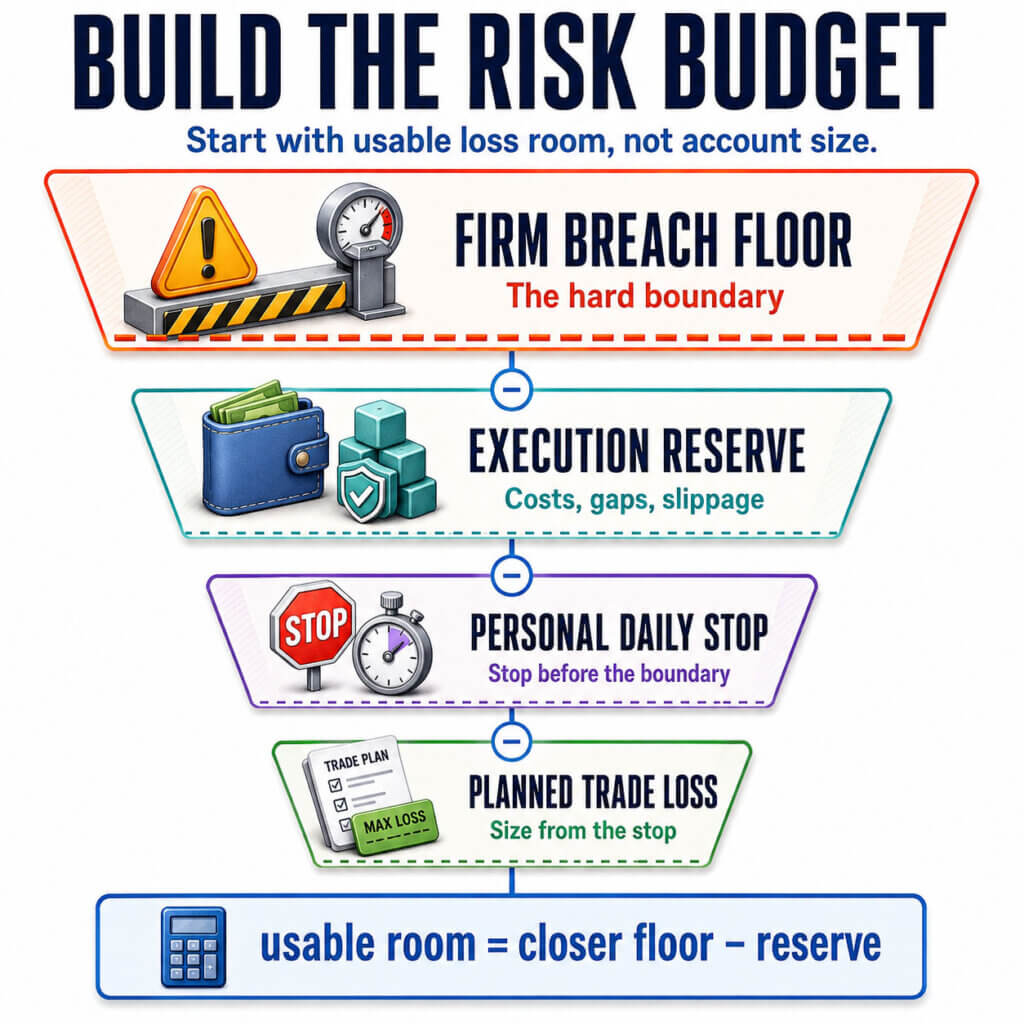
The $100,000 account label is not loss capacity because the active thresholds leave much smaller amounts. In this example, the daily threshold leaves $2,500 while the overall threshold leaves $6,000. A position plan based on either the nominal balance or the larger overall room can breach the daily rule while appearing conservative.
Usable room must be recalculated whenever the monitored value or an active floor changes. An intraday high can lift a high-water floor. A profitable close can move an end-of-day trailing threshold at the next update. A daily reset can establish a new reference while a position remains open. The dedicated guide to how each loss floor moves covers those formulas and lock points.
Build the Prop Firm Risk Management Plan
The firm supplies the account-closing or session-stopping boundary. The trader still needs personal limits that trigger before that boundary. Four values should remain separate.
| Risk Layer | Function |
|---|---|
| Firm breach threshold | Contractual boundary that can pause or end the account |
| Execution reserve | Capacity for costs, gaps, slippage, and monitoring delay |
| Personal daily stop | Trader-selected point where new exposure ends for the session |
| Planned trade loss | Cash loss expected if one position reaches its stop, including costs |
Recorded loss patterns and instrument execution determine how much distance the plan needs between these layers. Current room and the consequence of an overrun also affect that distance, so no standard spacing applies.
Set the Personal Daily Stop
A personal daily stop belongs inside usable room because the firm may use equity as its monitored value. Calculate the stop in cash and track it against the same value. Closed P&L omits open losses and may exclude costs that have not posted. Several stops can also execute together and consume more daily room than one position suggests.
The stop can be lower than the strategy's worst historical day if the account cannot absorb that day. In that case, the trader must reduce size or reject the product. Raising the personal limit to accommodate an unusually bad day defeats the fit test.
Once the personal daily stop is reached, it becomes a limit on new decisions as well as cash loss. Canceling unnecessary pending entries and preventing new orders can stop additional exposure. Existing positions still require treatment under the written plan and account rules. A personal stop remains separate from a provider's automated liquidation threshold.
Calculate Position Size From the Stop
Position size begins with a cash-loss limit for the trade and the loss per unit at the stop.
planned trade loss = stop distance × cash value per unit × position size + estimated costs

net risk available for size = personal trade-loss limit − estimated costs

position size = net risk available for size ÷ loss per unit at the stop
Consider an illustrative trade with a $425 cash-loss limit and a $4 loss per unit at the stop. Estimated costs are $25, so the calculation is ($425 − $25) ÷ $4 = 100 units.
The example produces a mathematical ceiling of 100 units before account constraints are applied. Position caps and margin rules can require less. The same applies to minimum lot increments or whole-contract requirements. If the platform only permits a size above the cash limit, the trade does not fit the plan. Rounding up changes the risk.
The trading method should fix stop distance before position size is calculated because every number in the formula assumes that distance. Moving the stop closer solely to obtain a larger position changes the trade. Leaving the stop unchanged and increasing size after a loss changes the cash-loss limit. Both actions break the original calculation.
Leave Room for Costs and Gaps
A stop order is an instruction whose fill can differ from the trigger price. Fast markets and thin liquidity can worsen the result. Exchange maintenance or platform problems can add risk around session openings. Market orders can cross available prices, while stop orders can execute after the trigger has moved.
The reserve should be tested under the session and instrument the strategy uses. A quiet-session estimate should not be carried into a volatile event window without adjustment. Funding and swaps can also post while a position remains open. The current equity check should include any charge the firm includes.
Plan for Losing Streaks and Stop Conditions
The strategy's record supplies the starting test for a losing-streak plan. Count consecutive losses and the largest same-day sequence. Record the worst observed slippage and any market condition where losses cluster. The next sequence can be worse, so historical results describe the test case without setting a guaranteed maximum.
A simple exhaustion check shows how quickly planned losses would consume current usable room:
full-risk loss capacity = usable loss room ÷ planned trade loss, rounded downIf usable room is $2,000 and planned trade loss is $400, the arithmetic gives five full-risk losses before costs beyond the reserve or a moving floor. This arithmetic measures stress capacity only. The personal daily stop should end exposure well before five losses are taken.
| Stop Trigger | Required Action |
|---|---|
| Personal daily stop is reached | End new exposure for the account’s current session |
| Aggregate open risk exceeds plan | Reduce or cancel exposure before another entry |
| A rule or dashboard value becomes unclear | Pause and obtain an account-specific answer in writing |
| Platform, data, or connection behavior differs from rehearsal | Stop new orders until the failure is understood and the account state is confirmed |
| Size increases after a loss without a new calculation | Return to the written limit and review the deviation |
| A trailing floor or reset changes usable room | Recalculate before the next order |
| Several losses share one setup error | Suspend that setup until its execution and assumptions are reviewed |
Earlier losses reduce remaining room, so recovery trades must use the same risk budget as every other position. Increasing size places more cash at risk precisely when the account has less capacity. The next position must satisfy the original calculation using current equity and the active floor.
A profitable session still needs a stop condition because every new trade adds exposure after the planned objective. The same applies after every challenge condition is complete. The account agreement determines whether open positions must be closed before review.
Pace the Profit Target Without Forcing Trades
A profit target is only a completion threshold, while market opportunities remain unscheduled. Dividing it by a preferred number of days creates pressure without creating a setup. A fixed quota can lead to low-quality entries and late-session size increases. It can also keep trading open after the personal stop should apply.
Pacing should begin with the strategy's normal opportunity rate. If the method produces no valid setup on a given day, minimum trading days do not automatically justify a trade. The account's definition of a qualifying day controls. Some products count a day with a closed trade. Others require a minimum result and duration, with trade size as another possible condition.
A consistency condition can keep the evaluation pending after a large winning day, even when the stated target is met. Its numerator and denominator define the calculation. The applicable window and consequence define when it is tested and what happens next. The specialist guide to prop firm consistency calculations explains those variants.
As current equity approaches the target, the original size calculation remains the relevant control because accumulated progress increases what a reversal can erase. Reducing exposure can be consistent with a risk plan if the method permits it. Increasing exposure because the remaining target looks small changes the loss distribution at the most vulnerable point.
After the account satisfies every active completion condition, check the product's close-out instructions. Confirm the state of open positions separately from pending orders. Another trade taken solely to enlarge the result adds unnecessary exposure. Evaluation profit remains an account result until funded-stage terms make a payout eligible.
Rehearse the Exact Conditions and Use a Daily Routine
Rehearsal should reproduce the challenge conditions closely enough to test the calculations and workflow. Use the intended instrument and session, plus the intended order types and size. Reproduce the applicable commission and spread, along with swaps or funding. Apply the provider's exact reset time and timezone. Match the normal holding behavior and use the same daily and overall floor formulas. Enforce activity and consistency conditions, then add the conduct rules.
A useful rehearsal includes losing sequences as well as profitable ones. Test the strategy's recorded losing streak and a wider-than-expected fill. Add a correlated-position move and an open trade across the daily reset when the product permits it. For a trailing rule, test how a new high changes the floor before a reversal.
| Checkpoint | What to Verify |
|---|---|
| Before the session | Current equity, active floors, reset time, remaining days, and account status |
| Before each trade | Setup validity, stop, cash loss, costs, aggregate exposure, and prohibited windows |
| After each close | Actual loss or gain, commission, remaining daily room, and any new high-water value |
| Before another entry | Personal daily stop, correlated positions, pending orders, and current position cap |
| At the provider reset | New reference values, open-position treatment, charges, and changed floor |
| At session end | Dashboard figures, rule status, deviations, and the next session’s starting assumptions |
The record behind each decision should show pre-trade equity and the active floor. Add planned cash loss and actual fill, then finish with costs and post-trade room. This makes a failed attempt diagnosable and exposes a calculation that changed after a reset.
Support answers should address one precise scenario for the exact product and stage. Save the answer with the current agreement and rulebook. Preserve the checkout terms separately. If the answer conflicts with a governing document, the material condition remains unclear until the firm resolves it.
What to Do Near the Profit Target
The final distance to the target can be smaller than the normal winning trade. That does not require a larger position or a new setup. Use the same entry standards and stop logic that produced the account's current result. Keep the cash-loss limit unchanged.
Check every completion condition before treating the stage as finished. Minimum or profitable days can remain incomplete. A consistency test can require more qualifying profit. The account can remain pending, with that status shown on the dashboard, until the scheduled review occurs. Open positions and pending orders can change equity. Costs and a reset can do the same while the account remains active.
Once every condition is met, follow the product's instructions for closing positions and requesting review. Preserve the account state. Additional trades add loss and conduct risk without creating a right to a faster review.
What Happens After You Pass?
Passing can make the account eligible for provider review. Identity checks may follow before a separate agreement or account activation. The result does not automatically create a live trading allocation or payable profit.
| Stage | What Can Happen |
|---|---|
| Completion check | Targets, loss limits, trading days, concentration, and open positions are reviewed |
| Conduct review | Trading methods, account ownership, location, copying, automation, and restricted activity can be checked |
| Identity review | KYC and residence eligibility can be completed or repeated |
| Agreement step | A separate funded-stage or compensation agreement can be presented |
| Account activation | A new simulated, copied, selectively routed, or live account can begin under new values |
| Payout eligibility | A new clock, qualifying result, buffer, review, and settlement process can apply |
The funded label leaves both the execution model and capital source unresolved. Account ownership depends on the applicable agreement, as explained in what funded account status means .
Only funded-stage eligible profit can enter the payout process. First-request timing and qualifying-day rules determine when a request can be made. Concentration and open-position conditions can keep it pending or change the eligible result. Splits and buffers affect the payable amount. Review and settlement then determine how payout eligibility is calculated .
Rebuild the risk record before the first funded-stage trade. The profit target may disappear as a new balance and loss floor take effect. Position limits may change. Conduct review and payout rules can also become active.
Review a Failed Attempt Before Paying Again
The event that ended an account supplies useful information once its cause is identified. Without that diagnosis, an immediate repurchase can repeat the same error and turn fees into the cost of unstructured practice.
| Cause | What to Establish |
|---|---|
| Rule error | Which condition, calculation, clock, or document was misunderstood |
| Size error | Whether planned trade loss, costs, or aggregate exposure exceeded the written limit |
| Execution error | Whether the entry, stop, fill, connection, or platform behavior differed from rehearsal |
| Strategy error | Whether the method moved outside its tested range under comparable conditions |
| Discipline error | Which decision departed from the plan after a loss, gain, deadline, or near-target state |
Start with the account event that produced failure, then reconstruct monitored equity and the active floor immediately before it. Account for open positions and pending orders, then add costs separately. Determine whether the rule calculation was correct. If it was, identify which risk layer failed.
A revised plan should change the input responsible for the failure. Size errors may require smaller exposure, while rule errors call for a corrected account record. An execution problem needs a platform or order-handling test. Strategy errors require more unpaid observation. A discipline error requires a concrete control that prevents the same action.
Test the revision before another purchase. A lower fee or new provider cannot correct a plan that still fails under the same conditions.
Where to Review Current Challenge Options
After the risk system is defined, single-phase evaluation options can be assessed by actual loss room and target structure. Check fees against the funded-stage terms. One phase removes a target stage, but the remaining rules can still make the product incompatible.
Use current prop firm programs to narrow the market and platform. Then select an account model and apply the same calculation to the exact product before paying. Scores and product summaries do not replace the governing agreement or current dashboard values.
FAQ
How do you pass a prop firm challenge?
Meet every active objective without crossing the account’s risk or conduct conditions. Activity conditions must also be satisfied before the provider’s review. Start by calculating the closer daily or overall loss floor. Reserve room for execution costs and set personal daily and trade-level limits. Size each position from its stop. Use a tested strategy and track aggregate exposure, then recalculate after resets or new trailing values.
How much should you risk per trade in a prop firm challenge?
The cash limit should fit inside current usable loss room after an execution reserve and personal daily stop, so no universal percentage is safe across products. It should reflect the strategy’s recorded losing streak and stop behavior. Costs and correlated exposure also affect the limit. Position size is then derived from the cash limit and loss per unit at the stop, subject to the account’s position and margin rules.
How hard is it to pass a prop firm challenge?
Difficulty depends first on the target and usable loss room. The drawdown method and activity requirements add constraints. Consistency rules affect pacing, while costs alter the room available. No comparable industry-wide pass rate establishes one answer. A challenge becomes structurally incompatible when the strategy’s normal loss sequence or required trading behavior cannot fit the product without changing the method.
How long should it take to pass?
No fixed timetable is reliable because valid opportunities do not arrive on a schedule. Minimum trading days can set the earliest possible completion, while the strategy’s normal frequency and the account’s activity definition affect pacing. A daily profit quota can force unnecessary exposure. The stage should remain open until every condition is met through trades that satisfy the written plan.
What happens after you pass a prop firm challenge?
The provider can review the account’s objectives and conduct before offering another agreement or account. Identity and eligibility checks can follow. The next stage may remain simulated or use another execution model. Its balance and loss floors can differ, as can exposure limits and payout conditions. Evaluation profit is not automatically withdrawable, and the first payout clock normally begins under the funded-stage terms.
What should you do after failing a prop firm challenge?
Reconstruct the account state immediately before failure and first classify any rule or size error. Test separately for an execution or strategy failure, then record any discipline departure. Change the input responsible for the failure and rehearse the revised plan under the same product conditions. Buying another attempt before identifying the cause risks repeating the same mistake and treating paid evaluations as unstructured practice.
