


Overview
Introduction
An account agreement uses prop firm rules to measure performance and control permitted trading. The same terms determine progression and payout eligibility, with separate clauses for profit targets or loss floors. Trading-day and position-size rules often sit beside restrictions on holding periods or automation. Identity checks and withdrawal conditions can apply as well.
The rule name alone does not settle how it works. A daily loss limit can pause trading until the next session or permanently close an account. A news policy can permit open positions while excluding part of the profit. Each rule must align with the purchased product and current stage under the governing document version. Its calculation and consequence must come from that same source.
Key takeaways
- What it is. Prop firm rules measure accounts and restrict activity while determining progression or payout eligibility.
- Why it matters. A profitable account can remain pending or fail when a loss limit is missed or a conduct condition blocks eligibility.
- Main risk or limitation. Common rule names and percentages are not universal because products can use different calculations and clocks, with stage-specific consequences.
What Do Prop Firm Rules Control?
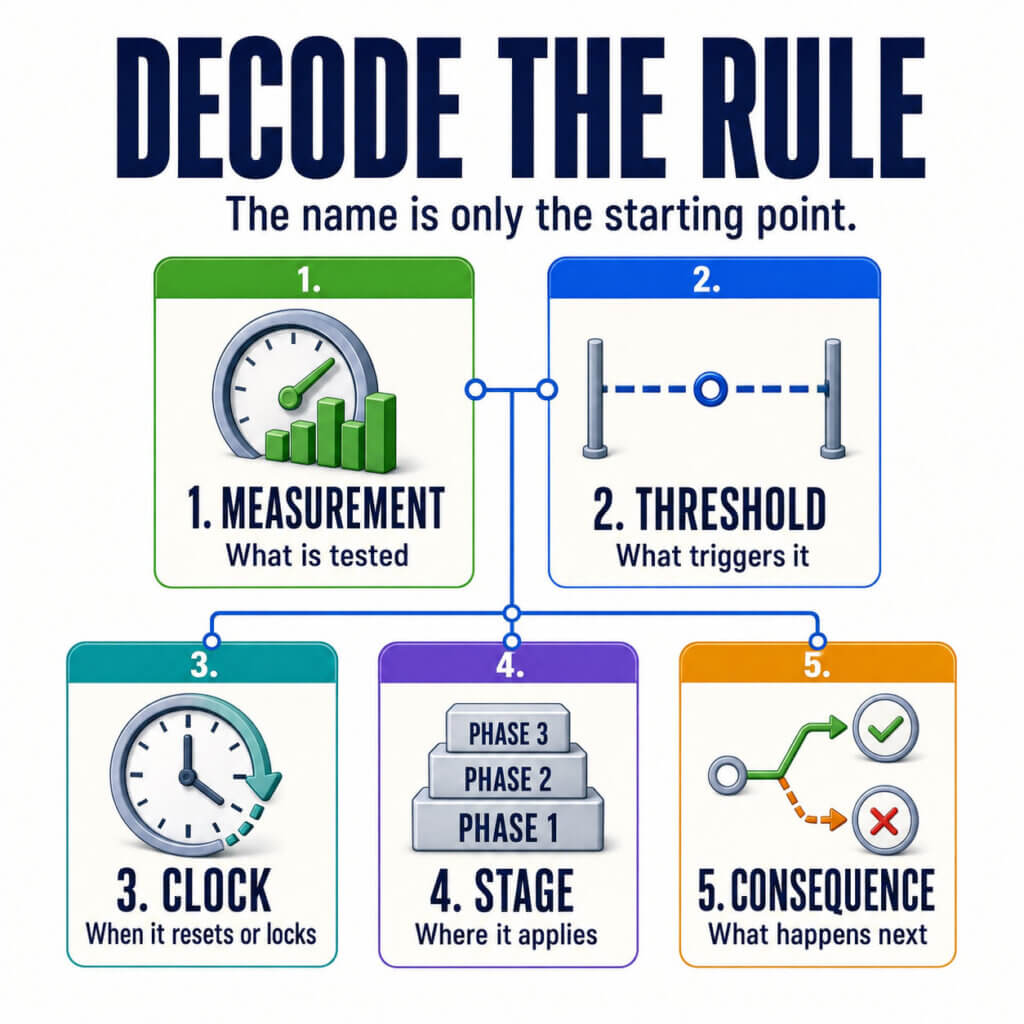
Every prop firm rule controls five parts of the account relationship. It specifies a measurement and trigger. It also sets the clock and applicable stage before defining what follows. Every material rule should answer all five questions.
| Field | What to Identify |
|---|---|
| Measurement | The balance, equity, profit, day, position, trade, behavior, or identity fact being tested |
| Threshold | The number, event, pattern, or prohibited action that triggers the condition |
| Clock | When the rule is observed, reset, trailed, locked, reviewed, or carried forward |
| Stage | The exact product, evaluation phase, funded account, scale level, or payout cycle it governs |
| Consequence | A pause, profit adjustment, added requirement, phase failure, account closure, payout denial, or wider termination |
Start with the source that governs the exact plan and account stage. A checkout summary can describe one plan while the general terms cover several. A public rulebook may explain the evaluation, while a separate funded agreement controls the next stage. Help articles and dashboards can supply operational details. An email or changelog can amend the record. An account notice can do so too, but only through the controlling agreement's change process.
Treat the signed agreement as controlling unless it incorporates another document or valid amendment. If two current sources conflict, the boundary is not operationally clear until the firm identifies the term that applies to the purchased account in writing.
A dashboard number can represent an informational balance or a live monitored value. The contractual figure may be captured at a scheduled review. Differences arise while positions remain open or charges are pending. A trailing floor can also update between checkpoints. Match every dashboard number to the agreement's named input and checkpoint before using it as a safety margin.
OneFunded's current rule disclosures show how conflicting sources defeat this process. CryptoSlate's Aug. 25, 2026 review found opposite high-impact-news instructions in the contract and public rulebook. Separate help articles also used initial balance and start-of-day equity as different daily-loss bases. A trader cannot calculate a safe boundary from contradictory instructions.
Profit Targets, Daily Loss, and Maximum Drawdown
Profit targets and loss limits determine whether an evaluation advances. Another active condition can keep it pending or end it.
Profit Targets
The account advances only after it meets the phase's defined profit target. Evaluation profit remains non-payable. The agreement may require a clear target with no active breach. It may also impose a minimum day count or a distribution condition.
Record the starting value and determine whether the target uses balance or closed profit. Check how commissions and swaps enter the result, including any funding costs or adjusted trades. The threshold wording matters too, because reaching a target and finishing above it at review can be different tests.
Daily Loss and Maximum Loss
Daily loss and maximum loss protect separate boundaries within the same account. A daily rule covers a named session or reset window. An overall rule sets the lowest permitted account value across a phase or account lifetime. Both can monitor equity, so an open loss can trigger a breach before the position closes.
The stated percentage gives the allowance, while the calculation defines its boundary. A usable rule identifies the anchor and update method. It names the reset time and treatment of open positions or charges. It must state whether equality triggers the limit, then name the consequence. A static floor stays fixed. An intraday-trailing floor can rise with a new high during the session. An end-of-day-trailing floor usually updates after a specified close. Some floors stop moving at a lock point.
The contract determines whether a loss trigger pauses or ends the account. One product can use a daily threshold as a temporary session lock, while another closes the account when equity touches the floor. The agreement determines how prop firm drawdown works , including whether the floor stays static or trails equity. Payout terms can also lock or move that floor.
Profit Concentration
A consistency rule measures concentration within a defined result. The unit can be a day or an individual trade. The calculation must name its numerator and denominator. It must also define the measurement window and checkpoint, then state the consequence. A score above the limit can keep a phase incomplete or raise its target. Other contracts may exclude profit or delay a payout. Some treat the score as a breach.
The same trades can produce different prop firm consistency calculations when one product uses net profit and another uses positive-days profit. A fixed target or payout-cycle profit can change the percentage again.
Minimum Trading Days, Time Limits, and Inactivity
Activity rules use several clocks that should not be treated as synonyms.
| Clock | What It Controls |
|---|---|
| Minimum trading days | The number of separate days needed before a stage can complete |
| Profitable days | Days that meet a stated profit, size, duration, or closed-trade condition |
| Target deadline | The time allowed to meet an evaluation objective |
| Subscription period | Billing, renewal, reset access, or the life of a purchased attempt |
| Inactivity timer | How long an account can remain without qualifying activity before closure |
| Payout-cycle days | Activity needed before a withdrawal request becomes available |
An evaluation can have unlimited time to reach its target and still expire after inactivity. It can also have no minimum trading-day rule while the funded stage requires qualifying days for a payout. A promise of “no time limit” answers only the target deadline unless the terms also remove inactivity and billing clocks.
The firm's definition determines whether a calendar date counts as a trading day. A login or open position may not count. The rule can require a closed trade or minimum position size. It may also require a minimum duration or daily profit. Server time controls the boundary, so one local evening can fall across two account days.
Purchase and activation can start different clocks within how a prop firm challenge works , while a reset or qualification changes which conditions remain active.
News, Overnight, Weekend, and Session Rules
A label such as “news trading allowed” or “weekend holding allowed” omits material conditions. Identify the permitted action and its time window. Then check the market and stage, followed by result treatment.
| Rule Question | What to Check |
|---|---|
| Can a new position be opened? | Event classification, affected instruments, and restricted minutes before or after it |
| Can an existing position be closed or changed? | Manual exits, stop-loss or take-profit changes, partial closes, and forced action |
| Can pending orders remain active? | Entry orders, attached orders, cancellation requirements, and automatic fills |
| Can a position stay open? | Overnight, weekend, maintenance, settlement, and session-close treatment |
| Does the result count? | Full profit, adjusted profit, excluded profit, retained loss, and review powers |
| Which clock applies? | Event calendar, server timezone, exchange session, and daylight-saving changes |
A policy can allow an open position through an announcement while prohibiting new orders or modifications. It can leave losses intact while removing some profit. Another plan can permit unrestricted evaluation trading and apply a narrower funded-stage adjustment.
Overnight holding does not override swap and funding charges or margin and loss-limit calculations. Weekend permission does not guarantee execution while a market or platform is closed. Futures accounts can require positions to be flat before a session cutoff. A crypto program can operate continuously while still using a firm-created daily reset and maintenance window.
Commercial lists of firms that permit news trading or weekend positions become stale when products change. The account-specific agreement supplies the decision for a purchase already made.
Copy Trading, Bots, HFT, Hedging, and Arbitrage
Strategy clauses often use the same broad label for materially different behavior. Record the permitted user and accounts before relying on an “allowed” badge. Then identify the software and trade direction. Platform and stage can change the permission.
| Activity | Questions the Rule Must Answer |
|---|---|
| Copy trading | Are the accounts owned by one trader, can trades come from another person, and which software or direction is permitted? |
| EAs and bots | Which platforms allow automation, who created the code, and does approval survive a stage change? |
| HFT and rapid execution | Is the restriction based on speed, order volume, server load, queue behavior, or simulator-fill exploitation? |
| Hedging | Is offsetting exposure allowed inside one account but prohibited across accounts, users, or firms? |
| Arbitrage | Does the clause target latency, stale prices, feed differences, simulator behavior, or coordinated positions? |
Copying between a trader's own accounts is not the same as copying another person's signals. Some contracts permit a local copier across eligible accounts but prohibit cloud copiers or account management. They can also prohibit identical cross-user activity and trades placed to bypass allocation limits. A firm can require the strategy used after qualification to remain consistent with the evaluation record.
Permission to use an EA does not authorize every automated method. The terms can allow user-developed tools on one platform while barring third-party pass systems and high-frequency order floods. Separate clauses may prohibit latency exploitation or software that cannot be reproduced in the firm's expected environment. A platform's technical support for a bot is not contractual approval.
Read the account boundary in the hedging clause before treating the practice as permitted. A long and short position within one account can be allowed while economically offsetting positions across accounts are treated as coordinated trading. Read the prohibited-practice definition to determine what arbitrage covers. The ordinary market meaning of the word may not match the contract.
Conduct, Identity, and Account-Ownership Rules
Account access and payout eligibility can depend on identity or account ownership as well as numerical targets. Country eligibility and device behavior may also matter. The firm can examine location or strategy continuity, including cooperation with a review.
Account sharing and undisclosed account management can breach the agreement even when every trade stays within the loss limits. KYC may be optional during an evaluation and mandatory before a funded account is enabled. A firm can request documents or a video interview. It can also ask for an explanation of coordinated entries before approving a stage or payout.
An IP or device alert can support an investigation, as can a location change, but neither proves misconduct by itself. Travel and shared networks can explain legitimate changes in location data. Mobile connections or VPN use can do the same. The controlling terms should define notice duties and the response process. They should state the deadline and the account status during review.
Challenge Rules and Funded Rules Can Differ
Qualification can activate a new account and balance under a separate agreement with its own review process. That change can produce a different rule set. Passing does not carry evaluation profit forward or waive ongoing restrictions by default.
| Evaluation | Funded or Payout-Eligible Stage |
|---|---|
| Profit target and phase objective | Often no pass target, while payout or scaling conditions appear |
| Minimum evaluation days | May disappear or become qualifying days within a payout cycle |
| Evaluation loss floors | Can restart on a new balance, retain a percentage, or use another method |
| Evaluation consistency test | Can disappear, continue, or reset after an approved payout |
| Broad evaluation permissions | Can narrow through exposure limits, strategy continuity, or conduct review |
| Optional identity review | Can become mandatory before access or payment |
| Non-payable evaluation result | Can become contract-defined eligible profit after approval |
Make a before-and-after record for the exact product by noting which rules disappear or continue after qualification. Then record any reset or new condition. A matching label does not prove the rule stayed the same.
A funded-stage agreement can keep the account simulated or move it to live allocation. Some agreements permit the firm to copy selected activity. Those account-model questions are separate from the rule list. What funded account status means depends on execution and ownership terms, as well as the compensation clause.
What Happens When a Rule Is Broken?
The functional outcome is more reliable than a generic soft-breach or hard-breach label. Those terms are not standardized across prop firms.
| Outcome | What It Means |
|---|---|
| Temporary trading lock | New trading is paused until a named session, time, or review ends |
| Profit exclusion or adjustment | Some result is removed or credited under another formula while the account remains active |
| Eligibility gate | Passing, scaling, or payout remains pending until another condition is met |
| Phase reset | The current attempt restarts under the contract, sometimes with a fee or warning |
| Account breach or closure | The current account is disabled and positions can be closed |
| Payout denial | A request is rejected or reduced under eligibility or conduct terms |
| Relationship-level termination | Related accounts, profit claims, refunds, or future access can end under a serious conduct clause |
Reaching a profit target before the minimum-day count can leave the phase open until the required days accrue. A concentration score above its limit can require more qualifying profit. A temporary daily lock can lift at the next session. By contrast, touching a hard equity floor can close the account immediately.
Use “soft breach” only when the applicable firm defines the event that way. Otherwise name the outcome. The agreement should connect every material threshold or prohibited action to a stated consequence and review process.
How Several Rules Can Affect One Profitable Account
One illustrative sequence shows why the full rule set applies at the same time. It is not an industry-standard account.
| Moment | What the Active Rule Does |
|---|---|
| The account reaches its profit target after two days | The stage remains pending when three qualifying days are required |
| A smaller third day completes the day count | A concentration condition can still require more distributed profit |
| A later gain occurs inside a restricted event window | The contract can exclude or adjust the gain, or apply another stated consequence |
| Open equity then touches a hard overall floor | The account can close even though its closed balance remains above its starting value |
The account can be profitable while it remains ineligible, and it can be closed while its closed results still look positive. Each step answers a different question. Profit targets measure progress, while activity rules measure qualifying participation. Strategy rules control behavior. Loss floors determine survival.
How Payout Rules Interact With the Account
Rule compliance and dashboard profit do not create an immediate payment. The agreement's payout terms should define eligible profit and request timing. They should set qualifying days and concentration tests, along with any buffers or deductions. Caps and review powers need clear terms. The agreement should also identify the required checks and the entity that owes payment.
After a payout request or approved withdrawal, the remaining account can use different values. A payment can reduce balance or move a drawdown floor. It may also lock that floor or restart day counts. A consistency window can reset, while a position tier can fall or a new review period can begin. A request and approval can have separate dates. The same applies to a deduction and final settlement.
Eligible profit can differ from dashboard profit because how prop firm payouts work involves a separate review and approval before settlement. The current account agreement determines which trading and risk conditions remain active during that process.
How to Read and Save the Rules Before Paying
The rule incorporated into the account's contract controls, subject to its amendment clause and any valid later notice. A current help article can explain today's product without proving that the same version governs an older purchase.
| Record | What to Save |
|---|---|
| Exact product | Plan name, account size, market, platform, add-ons, and purchase date |
| Checkout summary | Price, reset terms, refund treatment, and the entity taking payment |
| Dated rulebook | Full document or capture, publication date, and URL |
| Signed agreement | Evaluation terms, incorporated documents, governing law, and change clause |
| Funded agreement | New entity, account model, compensation, rules, and termination terms |
| Time settings | Server timezone, daily reset, event calendar, and session cutoff |
| Active dashboard | Current balance, equity, loss floors, objectives, day count, and rule status |
| Written clarification | The exact question, full answer, date, account identifier, and support channel |
| Change evidence | Email, dashboard notice, changelog, amended agreement, and effective date |
| Stage record | Pass, reset, scale, payout, migration, inactivity, and account-closure dates |
Save the product selector and checkout terms before payment. Preserve the full agreement and rulebook as separate files. Record which documents the agreement incorporates. A screenshot of one summary card cannot capture a detailed conduct or payout clause.
Read the amendment terms to learn how notice and grandfathering affect the account. One contract can promise that ordinary changes will not affect an active program, while reserving exceptions for law or abuse. Another can treat continued dashboard use as acceptance. Immediate-posting language and a separate product-protection clause can also point in different directions.
When a material term is ambiguous, ask one narrow question tied to the exact account. Name the plan and stage. Include the account size and platform. Quote the rule and calculation input, then state the scenario separately. Preserve the answer, but check whether support can amend the contract. Recheck the record before qualification or scaling. Repeat the check before a payout. Do the same after platform migration or a return from inactivity.
Rule clarity does not establish the counterparty's identity or payment capacity. Those remain separate factors in how to assess firm legitimacy .
How Crypto, Forex, and Futures Rules Differ
The five-field decoder remains the same, while the market changes the inputs and clocks.
| Market | Extra Fields to Check |
|---|---|
| Crypto | Exchange or simulated feed, 24/7 access, API rules, funding costs, maintenance windows, and firm-created resets |
| Forex and CFDs | Server timezone, swaps, weekend gaps, instrument availability, leverage, and residence-specific entities |
| Futures | Contract counts, tick values, exchange sessions, settlement cutoffs, data fees, and dollar or tick-based trailing floors |
A live price feed does not prove that the trader's instruction reached a market. Platform access does not establish account ownership. The agreement should identify the monitored value and whether trades are simulated or sent to a market. It should also state order restrictions and costs, followed by the consequence for the exact stage.
Prop Firm Rules Checklist
Save this record before paying. A blank or contradictory material field is a reason to obtain an answer in writing before trading near the boundary.
| Before Paying | What to Record |
|---|---|
| Product scope | Plan, account size, market, platform, add-ons, purchase date, and current stage |
| Controlling source | Signed agreement, incorporated rulebook, funded terms, and valid amendments |
| Measurement | Balance, equity, closed profit, open profit, day, trade, position, or behavior |
| Threshold | Percentage, cash value, count, window, pattern, or prohibited action |
| Clock | Timezone, reset, trailing update, lock point, review time, and carry-forward rule |
| Stage | Evaluation, verification, funded account, scale level, or payout cycle |
| Consequence | Pause, adjustment, pending status, reset, closure, denial, or termination |
| Profit conditions | Target, eligible profit, concentration test, and treatment of charges |
| Loss conditions | Daily and overall floor, reference value, equity treatment, and payout effect |
| Activity conditions | Minimum days, profitable days, deadline, renewal, and inactivity timer |
| Holding conditions | News window, overnight, weekend, session close, and pending orders |
| Strategy conditions | Copying, automation, HFT, hedging, arbitrage, and position limits |
| Conduct conditions | Ownership, KYC, devices, location, account sharing, and review response |
| Change process | Notice method, effective date, grandfathering, exceptions, and acceptance rule |
Do not reduce the review to the headline account size or profit target. The usable risk buffer and activity clocks can decide the result. Conduct rules and payment conditions can also take effect before the nominal balance matters.
Where to Research Current Prop Firm Rules
After decoding the contract, use current prop firm rule sets to find CryptoSlate's current provider research and scores. Reviews can record product-specific loss and activity terms. They can also cover strategy and payout rules. Inclusion or a score cannot override the agreement for the exact purchase and stage. Account details and jurisdiction still control.
FAQ
What rules do prop firms usually have?
Most firms set a profit target and loss limits, while some also require minimum trading days or restrict position size. News and holding conditions can sit alongside separate terms for strategy or automation. Identity checks may affect inactivity and payout eligibility. Familiar labels do not make the calculations universal, so check the exact product and stage against the current document version. Then identify the measurement and threshold, followed by the clock and outcome.
Can you be profitable and still fail a prop firm account?
Yes, because closed profit does not override every other condition on the account. Open equity can cross a hard loss floor. A position can breach an exposure cap. Conduct violations can also close the account while its closed balance remains positive. A profitable account can stay open but remain ineligible because its minimum-day or consistency requirement is incomplete. Payout eligibility can also remain pending.
Do prop firm rules change after you get funded?
Qualification often activates a separate funded-stage rule set for the trader’s account. A profit target may disappear. Exposure limits or strategy continuity can take its place. KYC and payout cycles often gain importance. Conduct review can do the same. Loss floors can restart on a new balance or use another method. Qualification can also activate a separate agreement, so the funded-stage rules should be read as a new contract state.
What happens if you break a prop firm rule?
The controlling agreement ties each broken rule to a specific outcome. A temporary lock or profit removal can leave the account active. Delayed eligibility and a phase reset have different effects. Serious conduct clauses can support account closure or payout denial. They may permit termination across related accounts. Soft breach and hard breach are not standardized categories. Use the named functional consequence and check whether a warning or review applies. The agreement should also set any appeal or response period.
What are minimum trading days in a prop firm?
Minimum trading days are the number of separate qualifying account days required before a stage or payout can complete. A day may require a closed trade or minimum duration. Some plans also specify position size or profit. The account’s server timezone sets the boundary. Minimum days differ from profitable days and target deadlines. Subscription periods and inactivity timers use different clocks.
Are funded account rules different from challenge rules?
Funded-stage rules often introduce conditions that did not apply during the challenge. Challenge rules focus on reaching a target within evaluation limits, while qualification can remove that target and introduce payout timing or buffers. Exposure limits and strategy continuity may also change as identity review or scaling becomes active. Loss-floor behavior can reset under the funded agreement. No universal transition applies, so the exact funded agreement and current account dashboard control.
