


- No-KYC signup with just an account key
- Monero funding for prepaid spending
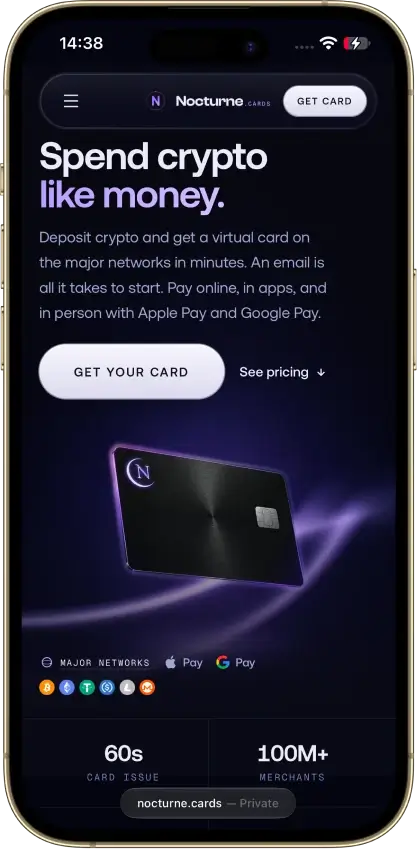
- Apple Pay on Aurora with no routine ID upload
Nocturne Card Overview
- Crypto Card Name
- Nocturne Card
- Card Type
- Prepaid
- Digital Wallets
- Apple Pay, Google Pay
Additional details
- Availability
- 18+; sanctioned or prohibited jurisdictions excluded
- Fees
- $25 Shadow, $45 Aurora, $10 Eclipse; 0.49% deposit; 2.5%–5% card load
- Daily Spend / ATM Limit
- No ATM withdrawals; spending limits vary by card
- Funding Source
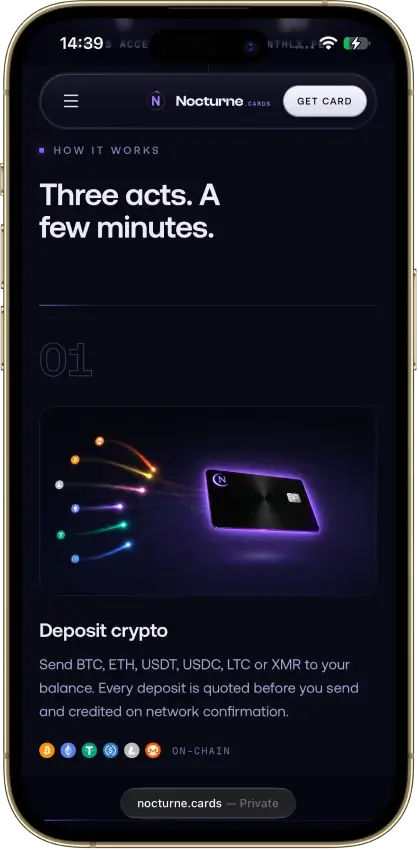
- BTC, ETH, USDT, USDC, LTC, XMR
- Virtual Card & Shipping
- Virtual only; Google Pay on Shadow and Aurora, Apple Pay on Aurora
Nocturne Card Screenshots
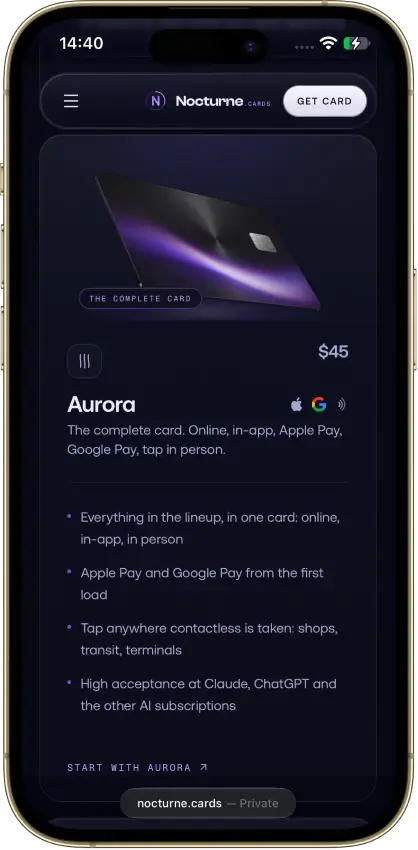
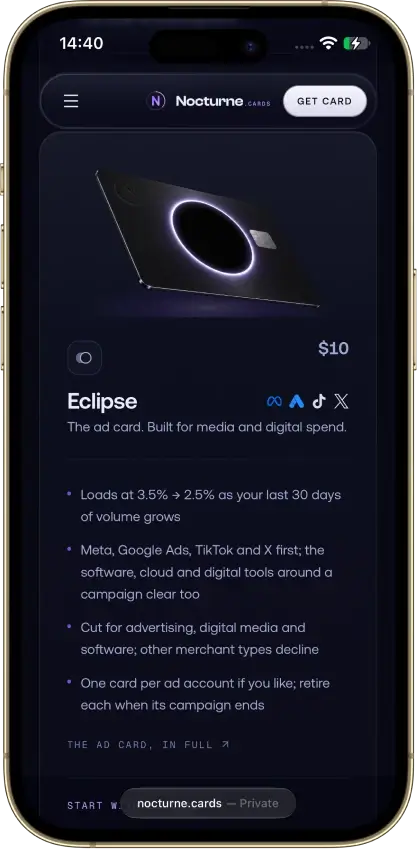
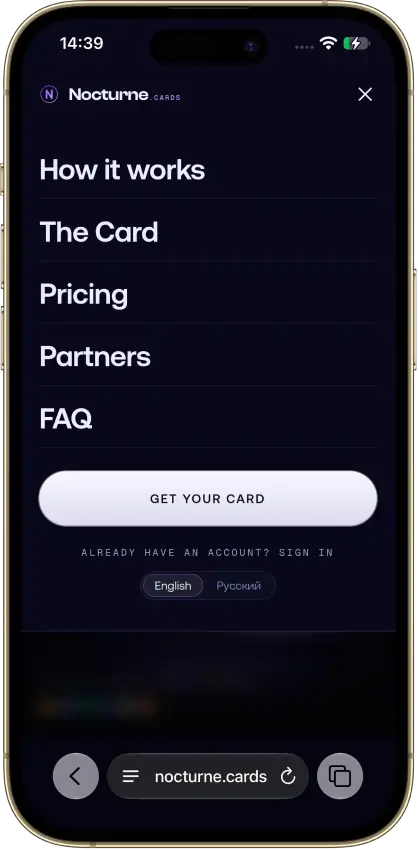
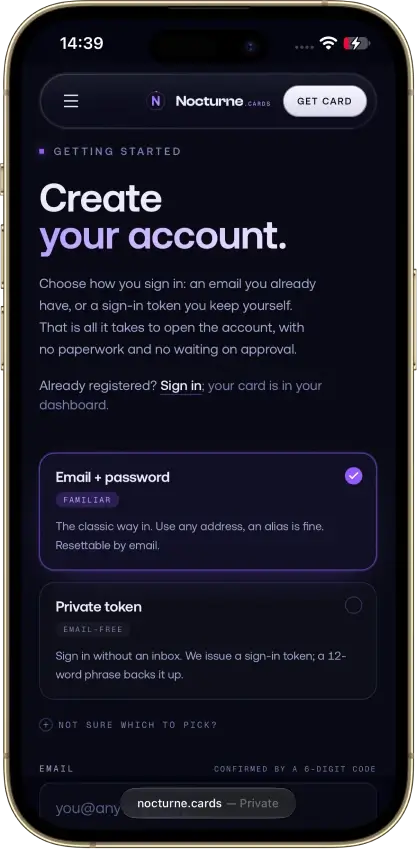
Screenshot 1 of 8
Nocturne Card Pros and Cons
Pros
- No routine identity-document uploads
- Freeze and unfreeze cards in the dashboard
- Deposit, load, and return fees itemized
- Lower load fees at higher volumes
- No monthly subscription
Cons
- 5% to 3.5% load fee on top of the 0.49% deposit
- No ordinary crypto or cash withdrawals
- Issuing institutions are not disclosed
- 3-D Secure approved without asking you
- Fuel pumps and some airline codes always decline
What the Nocturne Card Is and How It Works
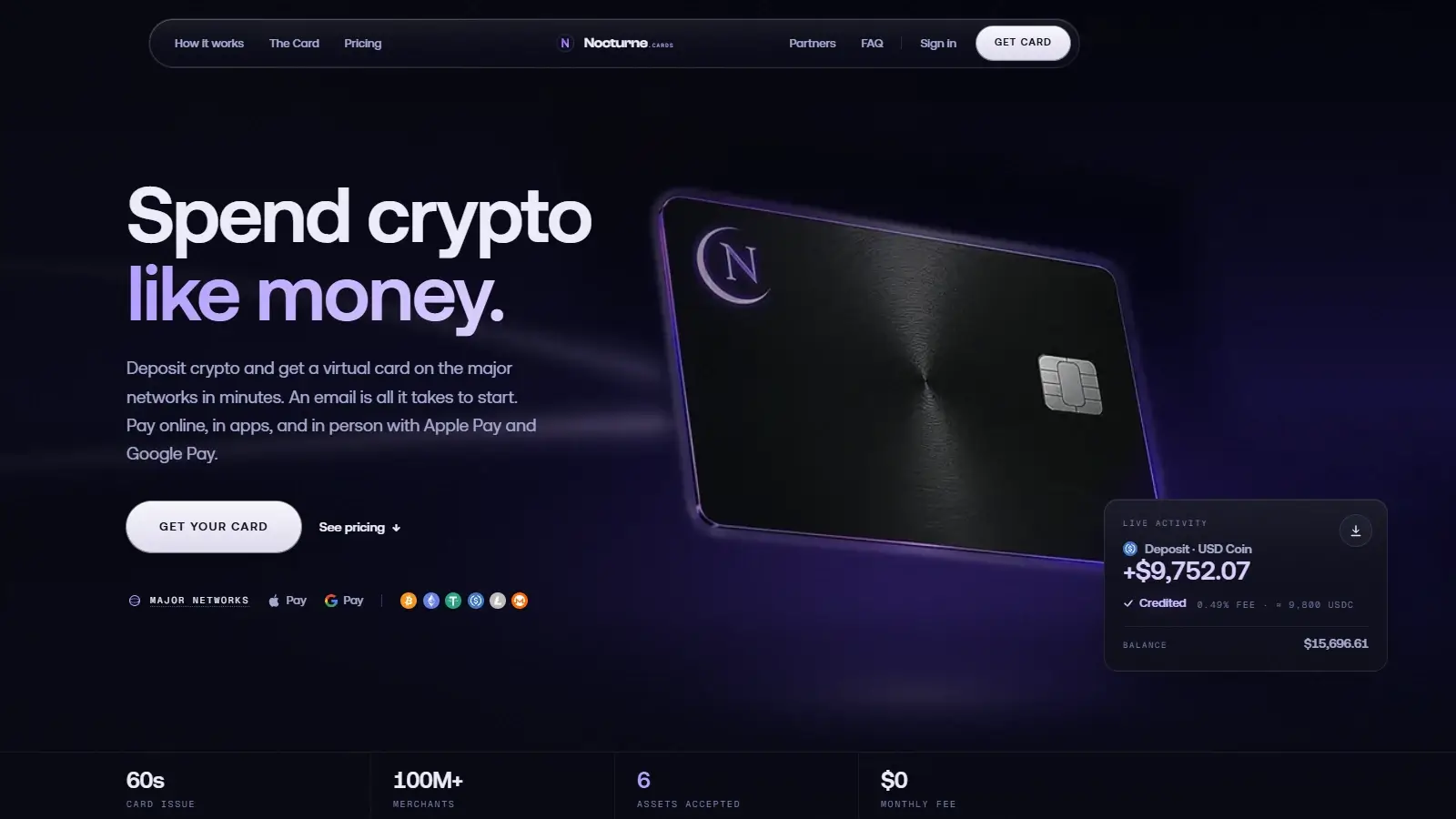
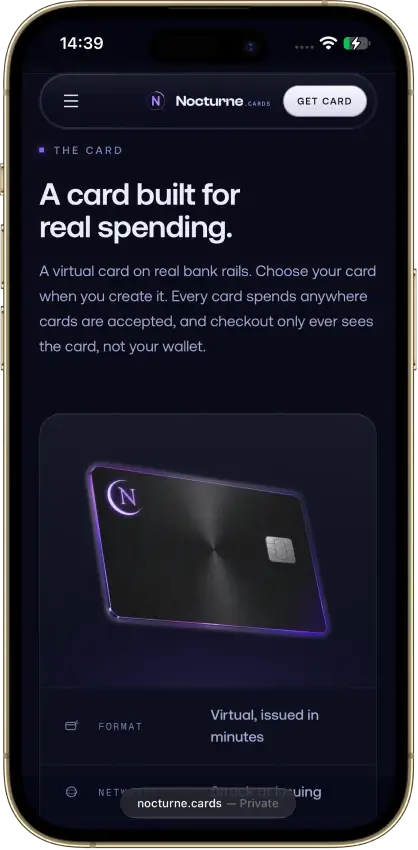
Nocturne uses a preload model. Crypto converts into a USD account balance when credited. You pay the card’s creation charge, move money onto that card, and spend from its prepaid balance. An account key restores access to that account, but does not give you self-custody of deposited funds.
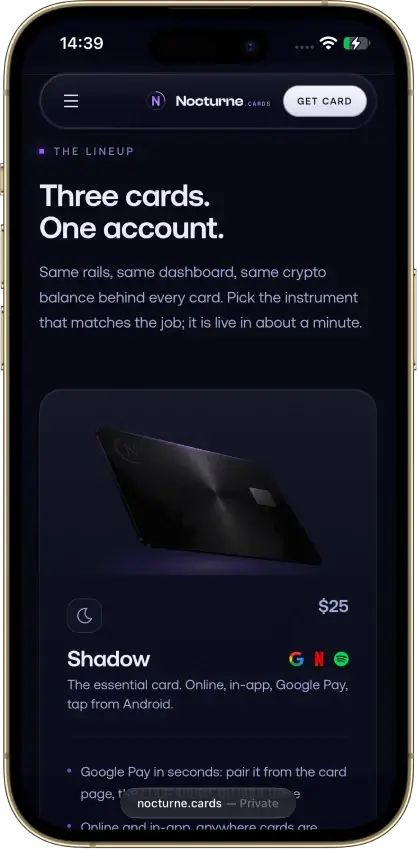
Shadow and Aurora cover consumer spending, while the two Eclipse cards are for advertising.
| Card | Creation | Intended Use | Starting Load Fee |
|---|---|---|---|
| Shadow | $25 | Online and in-app purchases, Google Pay | 5% |
| Aurora | $45 | Consumer spending, AI subscriptions, phone wallets | 5% |
| Eclipse | $10 | Advertising and campaign software | 3.5% |
| Eclipse X | $10 | Advertising variant including X Ads | 5% |
Standard Eclipse’s lower load fee only helps advertising, digital media, and software spend, because other merchant types decline on it. Nocturne says X Ads requires Eclipse X. It also says ChatGPT and Claude decline Eclipse, and it markets Aurora for those AI subscriptions without promising that every checkout will accept it.
Moving from Shadow to Aurora costs $30 and creates a new card, so buying Shadow and upgrading costs $55 in creation charges, compared with $45 for Aurora directly.
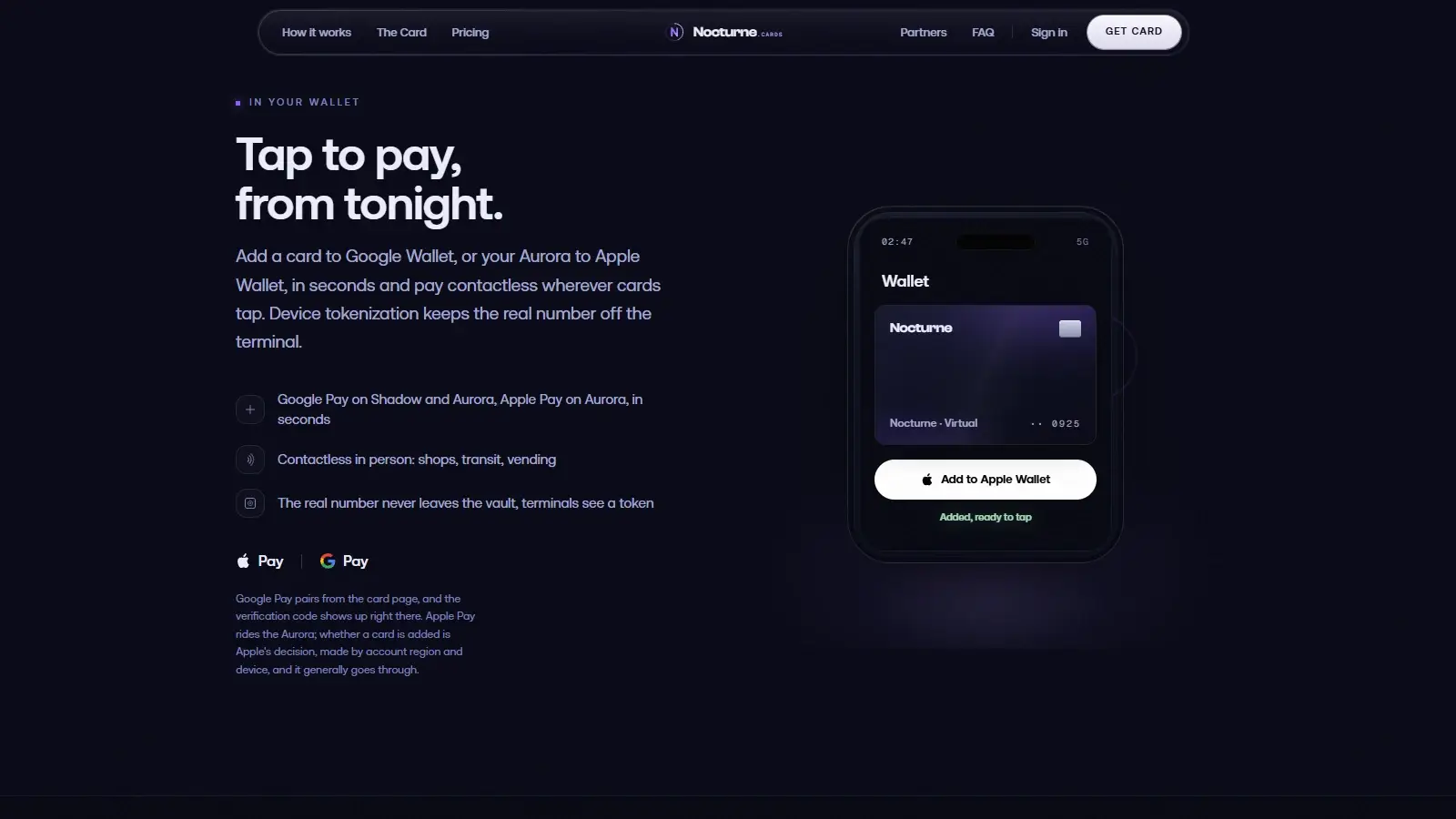
If Apple Pay is why you want Aurora, weigh the order of events first. Apple decides from your Apple account region, device, and network, and you can only try after paying for the card and making its first load. If a phone wallet will not accept an Aurora, Nocturne replaces it free of charge with an Aurora made for phone wallets and, on request, moves the balance across without a fee. A merchant declining a working card does not qualify.
Who It’s For and Who It’s Not
Nocturne suits people who already hold crypto and want to spend through a separate card with limited routine identity collection. You can fund from Monero and, with an account key, avoid supplying an email address. Those features distinguish it from other crypto cards that require a conventional account application.
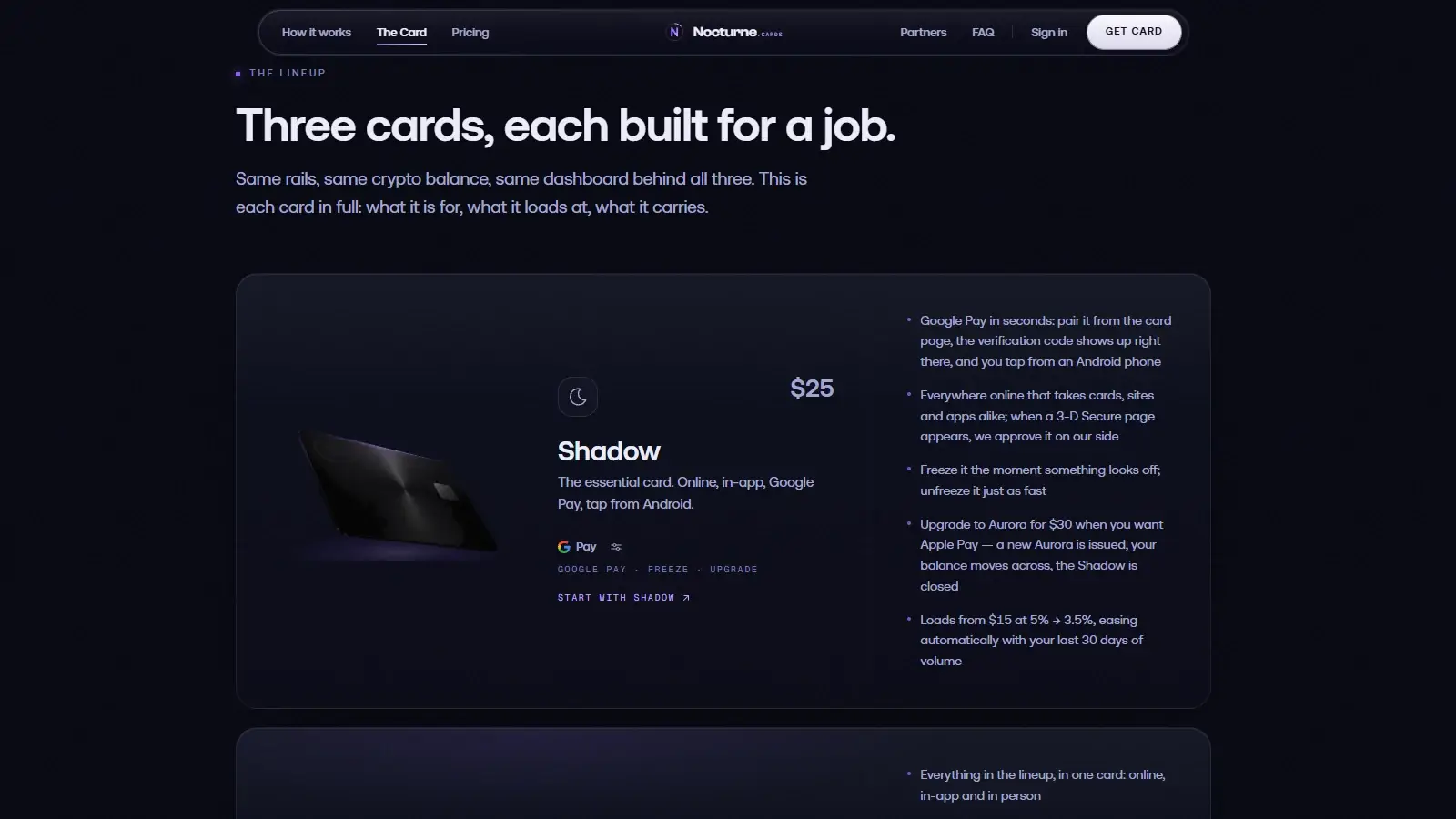
Shadow fits online purchases and Google Pay. Aurora adds the Apple Pay option, although acceptance by Apple and individual merchants remains conditional. Advertisers should compare Eclipse under its own rules.
Funds normally have to be spent through Nocturne’s cards, so it fits a planned purchasing budget better than money you expect to withdraw later. It also offers no ATM cash or physical card, and it does not name its issuing institutions.
Rewards
No recurring purchase-cashback program is disclosed, so budget for the deposit and load charges with no rebate to offset them.
The partner program splits a referral pool between a commission and a card-creation discount. The pool is $5 for Shadow, $14 for Aurora, and $2 for Eclipse. Referral commission has its own payout route.
Fees and Pricing
Nocturne takes most of its fees before the money reaches a merchant. The creation price weighs heavily on a small first deposit, and every reload cuts into what you have left to spend.
| Fee or Charge | Shadow and Aurora | Eclipse |
|---|---|---|
| Creation | $25 Shadow, $45 Aurora | $10 |
| Deposit | 0.49%, plus applicable processor and sender network costs | Same |
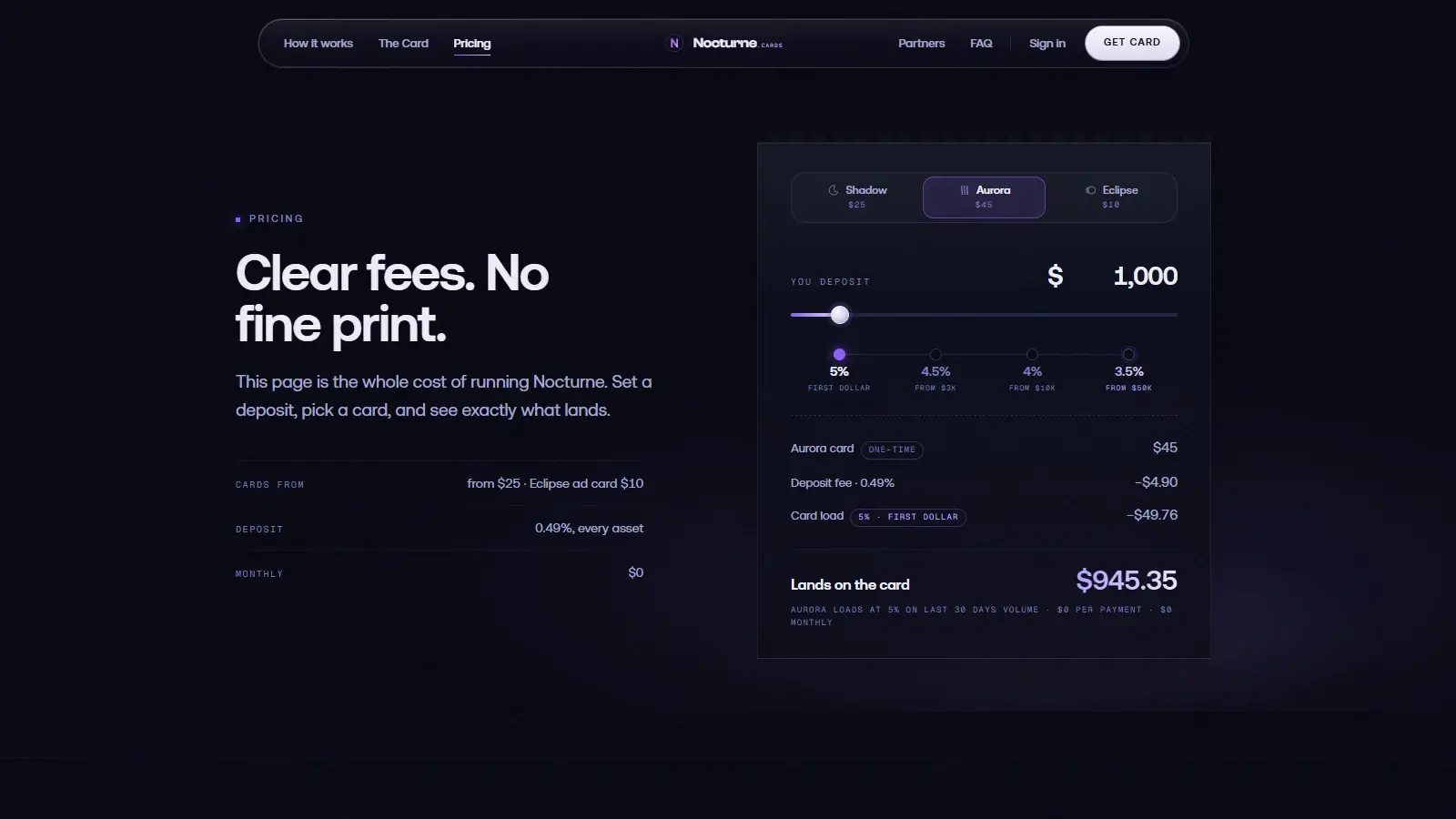
| Card load | 5%, then 4.5% from $3,000, 4% from $10,000, and 3.5% from $50,000 | 3.5%, then 2.5% from $10,000. Eclipse X uses the consumer ladder |
| USD purchase | No Nocturne fee, network cross-border charge possible | Same |
| Declined attempt | $0 or $0.50, depending on the card’s network | $0.25 |
| Non-USD purchase | Network conversion charge, about 1.2% in most cases and 1% to 1.4% by currency and day, per Nocturne | Network conversion within the billed amount, per Nocturne |
| Merchant refund | No refund fee | 1.5%, or 4% on Eclipse X |
| Voluntary card-to-account return | 1% | 1%, with a reserve of up to $5 for 30 days when a card closes |
| Formal dispute | $50 opening charge, up to $800 extra on a loss | Same |
| Monthly subscription | $0 | $0 |
Load tiers use trailing 30-day volume, including the incoming load. Shadow and Aurora share that volume, while standard Eclipse has a separate ladder.
A $100 gross deposit leaves $70.78 to spend with Shadow, or $51.78 with Aurora, excluding extra processor and sender costs. Aurora’s higher price buys the Apple Pay option and its AI-checkout coverage, and neither is guaranteed.
Once the card is created, a $1,000 top-up at the starting tier leaves about $945 for purchases before non-USD conversion.
Over a year of $1,000 monthly purchases on Shadow, with a fifth of the spending in other currencies and monthly stablecoin top-ups, fees come to about 6.3% of what you spend. That counts the creation price, deposits, loads, conversion, and an assumed $0.50 sender cost per transfer.
The billing currency decides whether the network conversion charge applies to a foreign purchase on Shadow or Aurora, and Nocturne adds no markup to it. Its terms add that some card programs can also pass through a network cross-border charge on a USD purchase at a merchant outside the card’s country, itemized on the transaction line. Nocturne puts that charge at about 1.2% in most cases, and between 1% and 1.4% depending on the currency and the day. Two illustrative euro purchases in the Aurora statement it supplied each show about 1.4% of the converted amount, at the top of that range.
Monero and Tron deposits also incur a flat processor network fee, shown on the quote and added to the amount you send, so it takes a larger share of a small top-up.
Limits, Purchase and ATM
The dashboard’s spending ceilings leave plenty of room for an ordinary purchasing budget, and Nocturne says they lift as your volume grows. You are more likely to notice the $15 minimum load, the closed merchant categories, and the monthly activity rule.
Nocturne’s terms add that per-transaction and periodic limits depend on your tier, the network, and the merchant. Aurora allows three live cards per account, and Eclipse allows five.

| Limit | Shadow and Aurora | Eclipse |
|---|---|---|
| Daily spending | $50,000 displayed in the dashboard | $25,000, per Nocturne |
| Monthly spending | $1 million displayed in the dashboard | $500,000, per Nocturne |
| Per transaction | No separate cap, per Nocturne. Tier, network, and merchant can still limit a charge | $25,000, per Nocturne |
| Card balance | $150,000 displayed in the dashboard | Shown in the dashboard |
| Minimum card load | $15 | $15 |
| ATM access | None | None |
| Physical card | None | None |
Closed merchant categories include gambling, automated fuel pumps, selected legacy airline codes, and cash withdrawals. The dashboard also shows Vercel and Starlink among blocked consumer-card merchants. Repeated blocked attempts can lock or retire a card, while account-farming patterns can freeze other cards on the same account. Eclipse adds games-category restrictions and a forfeiture rule for deliberate misuse of a manually opened verification window.
Cash-like purchases also breach the terms even where a charge authorizes, including money orders, person-to-person transfers, gift cards, other stored value, and crypto. They bar using a card or its funds for coin mixers too.
Consecutive declines for insufficient funds freeze a card and can lead to its retirement, with no refund of the creation fee. A frozen card that merchants keep billing can also be retired after one warning, so move subscriptions to a live card first. An overspend becomes a debt that blocks new cards and other loads until repaid.
Keeping a card active takes $29 a month, spent or loaded and kept on it. After three inactive months, the card is retired following a warning and seven-day grace period. The balance returns internally less the 1% return fee, and a replacement means paying the creation charge again. That makes Nocturne less convenient for a backup card you leave untouched for months.
Check the expiry once the card is created. It shows on the card in the dashboard at any time. Validity counts from the day the program issues the card, which can be before you create it, so you may get less than the advertised two-plus years. Eclipse has its own term ending in the twenty-third month.
Eligibility and Availability
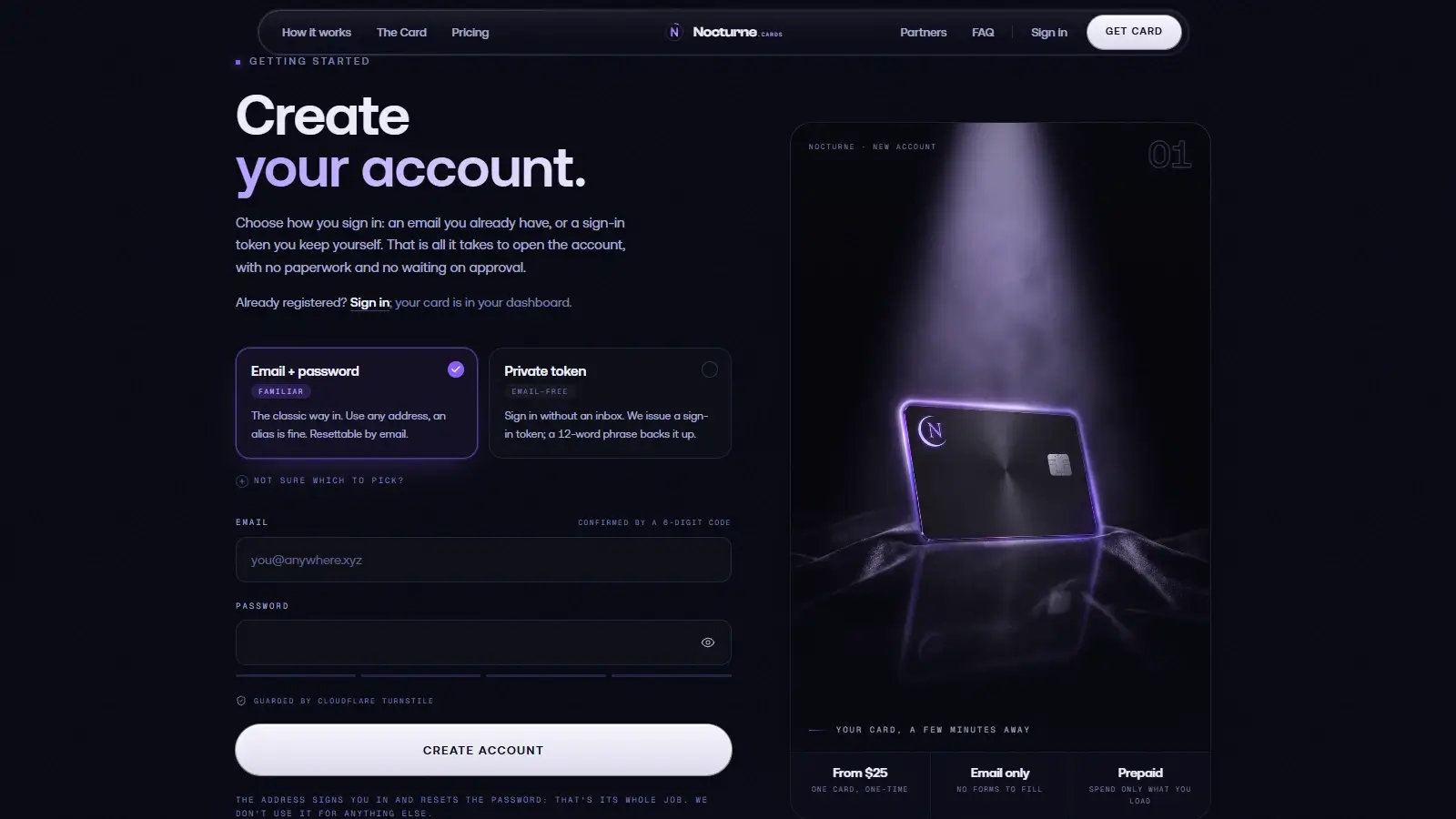
Nocturne skips routine KYC document uploads and accepts email or account-key signup. The email route requires confirmation before funding or ordering. According to Nocturne, key-based accounts must enroll an authenticator for sensitive-action checks because they have no inbox for email codes. They restore from a twelve-word phrase, and if both the session and the phrase are gone, nobody can recover the account.
Applicants must be 18 or older. Nocturne says it collects no residence information during ordinary signup, accepts US residents, and applies no state-level exclusions. Local law and partner rules still apply.
Exceptional identity checks can follow a sanctions match, credible fraud concern, legal obligation, or binding partner requirement, and the affected account or card can be paused until the question is resolved. The processor can hold a flagged deposit while verification is pending, and held funds are neither credited nor returned until that review ends. If verification is declined or fails, the transfer may be returned less network fees or handled as the law requires, and a credit already issued can be reversed. Nocturne can also decline to issue a particular card or withdraw a card program.
Privacy and Identity Exposure
The account-key route avoids an email address as well as routine document uploads. Nocturne still processes funding references, card transactions, balances, support messages, and technical logs. It also shares data needed by payment processors, issuers, and networks, so limited signup data does not make the spending anonymous.
Its updated privacy policy excludes third-party analytics and advertising trackers, following its acknowledgment of earlier Google Analytics use. Nocturne says deposit transaction references are kept for roughly 90 days, while financial records remain for legally required periods. The privacy benefit is less routine identity collection, with transaction processing and exceptional verification still part of the service.
Restricted Countries
Nocturne blocks these countries:
- Cuba
- Iran
- North Korea
- Syria
It also blocks these regions:
- Crimea
- Donetsk
- Luhansk
Syria stays blocked even though the US Treasury ended its Syria Sanctions Program in July 2025 and retains only targeted sanctions. Nocturne says it does not maintain a country-by-country eligibility list, so other prohibited jurisdictions can apply.
Funding Rails
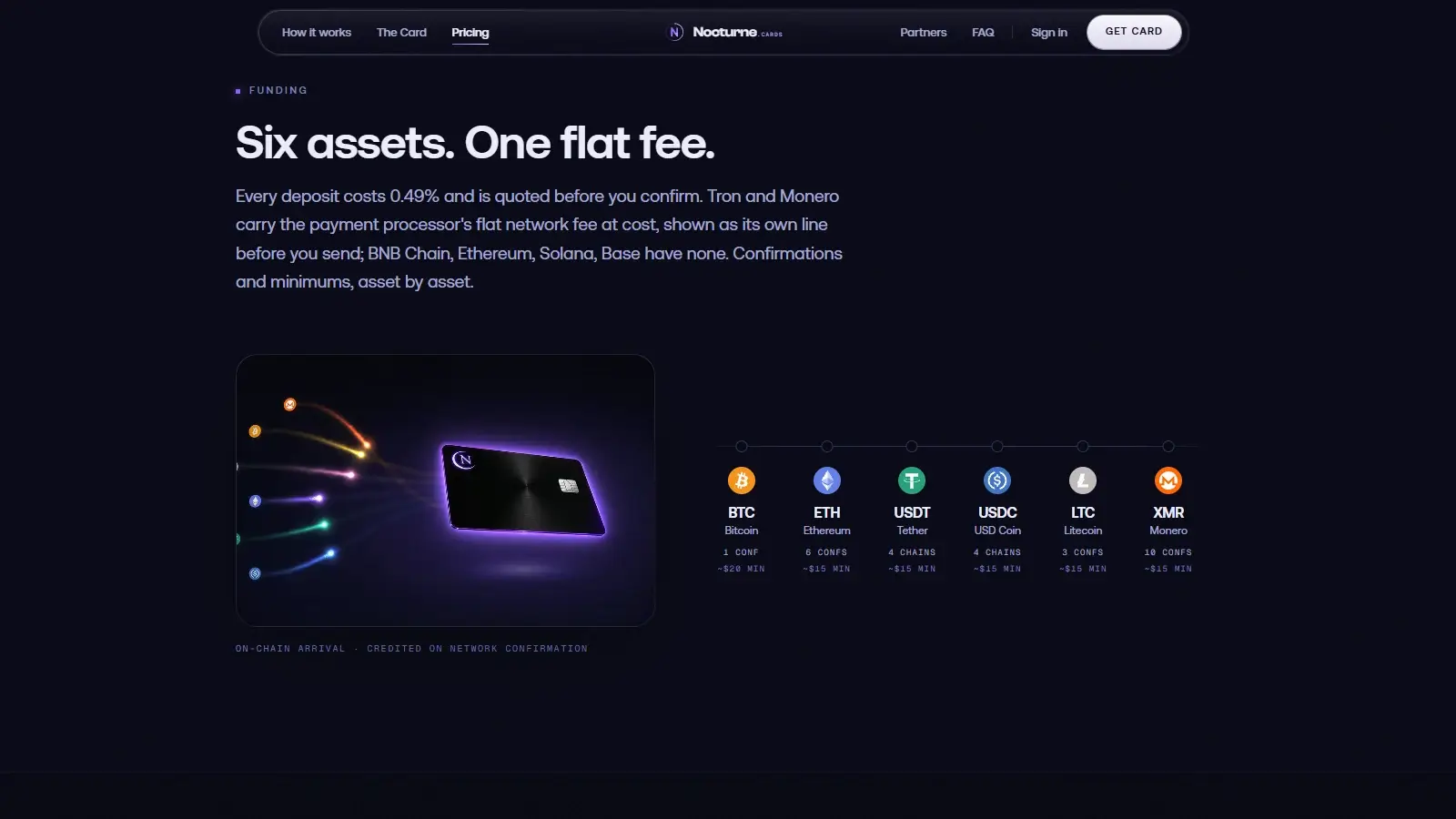
You can fund the USD balance with Bitcoin (BTC), Ether (ETH), Litecoin (LTC), Monero (XMR), and the stablecoins USDT and USDC, through these routes:
| Asset | Listed Networks | Approximate Minimum |
|---|---|---|
| BTC | Bitcoin | $20 |
| ETH | Ethereum | $15 |
| USDT | BNB Chain, Tron, Ethereum, Solana | $15 |
| USDC | Ethereum, Base, BNB Chain, Solana | $15 |
| LTC | Litecoin | $15 |
| XMR | Monero | $15 |
These are deposit minimums. A first card also needs its creation price and a $15 load, so a first Shadow takes about $40 of balance and a first Aurora about $60, and balance cannot be withdrawn.
The processor quotes the amount to send and any extra charge. Nocturne says a generated quote is valid for one hour, after which a late transfer can be credited at its arrival rate. Sender-wallet network costs remain separate. Deposits credit after network confirmation, which Nocturne lists as one confirmation for BTC, six for ETH, three for LTC, and ten for XMR.
Send only the quoted asset, on the quoted network, to the address shown. Transfers of other assets or on other networks cannot be recovered. If less than the quoted amount arrives, Nocturne credits what arrived at the quoted terms, after the flat network fee on Monero or Tron, and you can send the rest to the same address.
Because this is a preload arrangement, your crypto converts at funding. Later purchases spend that USD balance, with no new sale of crypto at checkout.
Security, Custody, and Freeze Risk
Noctavel LLC, a Wyoming company established in 2026, operates Nocturne. It describes itself as a technology company, and its terms say it is not a bank or a licensed money-transmission or e-money institution.
The company says its issuing programs use Visa and Mastercard. Each program has a fixed network, which appears on the card. Nocturne has yet to specify which network Shadow and Aurora each use or identify the issuing institutions.
Nocturne says Noctavel owes the customer’s USD balance, a processor holds stablecoins backing unloaded funds, and prefunded fiat at the issuer backs loaded cards. Nocturne has disclosed neither the institutions nor independent evidence of reserves. Its terms say balances are uninsured and funds held through a partner are at risk if that partner fails. If a card program is discontinued for any reason, its live cards are retired and their unspent balances return to your Nocturne balance without the return fee. Noctavel caps its total liability at the fees you paid in the prior 12 months, and a claim starts with a 60-day notice period and runs individually, not as a class.
3-D Secure is the extra checkout check that normally asks the cardholder to approve a purchase. Nocturne’s platform approves it on its side, with no code to enter, while you leave the check page open, usually for a minute or two. Nocturne explicitly confirmed that someone with the full card details could pass such a checkout, and its terms still hold you responsible for every transaction authorized with your card.
A card only holds what you load onto it, so smaller balances limit what misuse can take. Freezing is instant and free, and closing a card retires the number immediately.
Card details are stored encrypted. After a card’s first load, you can show its number, expiry, and CVV on the card page whenever needed, and each reveal asks for a second check: an authenticator code, or a one-time email code on accounts without an authenticator. You can have a browser remembered for 30 nights, which skips the check there until it runs out or you revoke it in security settings.
The same second lock covers other sensitive actions. Login did not require an authenticator as of Oct. 30.
Ordinary deposited balances cannot be withdrawn as cash or crypto. Voluntary card returns go to the Nocturne account, normally for 1%, including when you close a card yourself. If you close the account yourself, it must first hold a zero balance and no live card, and a residue under $1 is forfeited. Support can move a larger remainder below the $15 load minimum to another account on request.
Settlement through support applies when Nocturne terminates an account, or when either side closes it after a prolonged disruption. Live-card funds return to the account without the 1% fee. Nocturne says it pays eligible balances in crypto, less the network fee, though the terms name no payment method. Compliance holds can delay or prevent payment. The terms set no deadline, and Nocturne says it settles within a few business days of receiving a wallet address.
UX, App, and Support
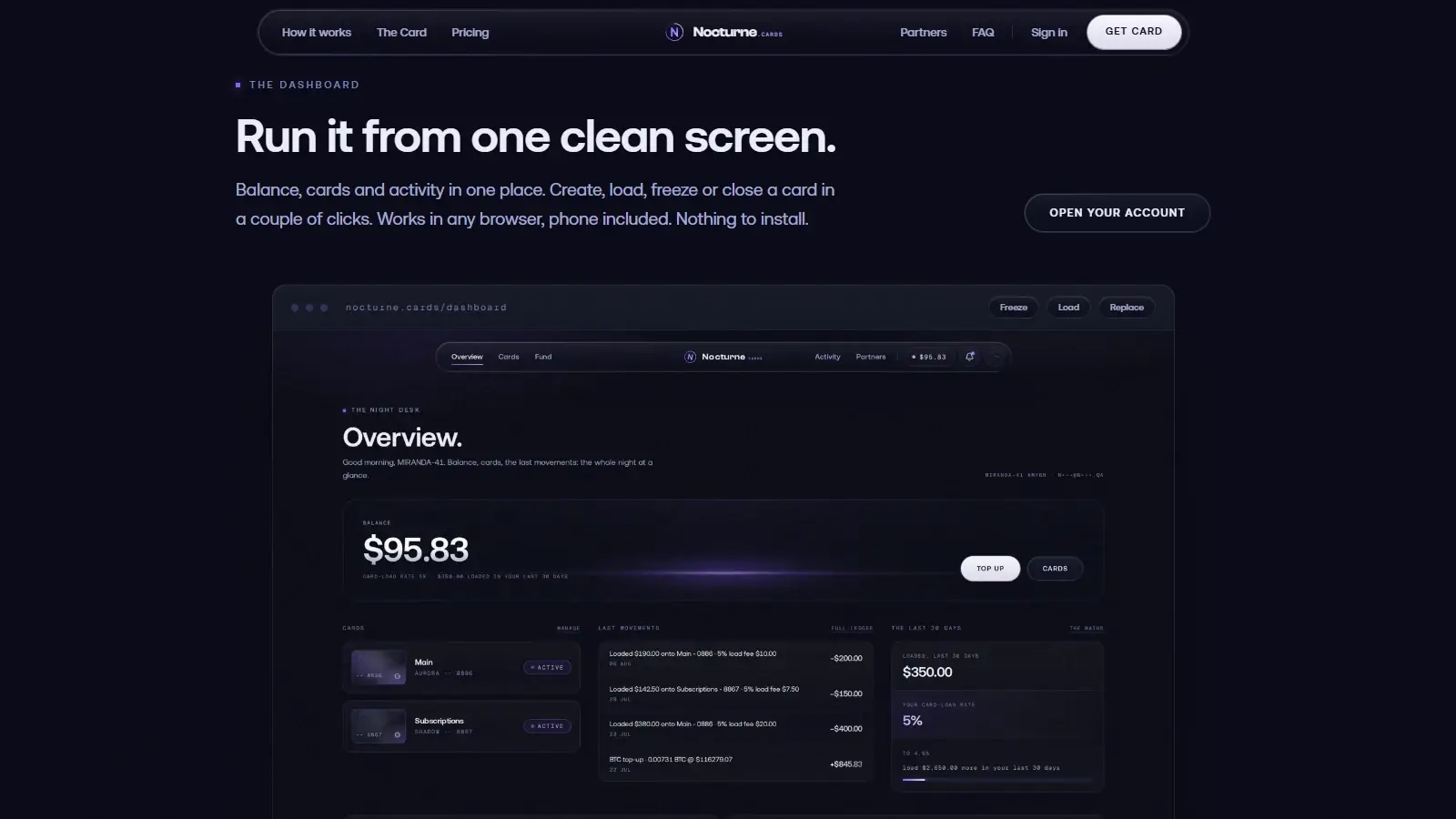
The browser dashboard handles card selection, funding previews, account activity, and security settings without a separate financial app.
Google Pay is supported on Shadow and Aurora. Aurora also offers Apple Pay, with provisioning decided by Apple. If either wallet will not accept an Aurora, Nocturne replaces the card free of charge and can move the balance across without a fee. Either wallet also lets you tap in person, so the cards are not limited to online checkouts.
If a purchase goes wrong, ask the merchant for a refund first, because Nocturne charges no refund fee on Shadow or Aurora and the money returns to the paying card. A refund on a non-USD purchase can still credit fewer dollars than the original debit.
A formal dispute has the opening fee and possible loss penalty shown above, and the network generally allows 120 days from the transaction. Nocturne says the opening fee is non-refundable even if successful, and support needs your written authorization before filing. That go-ahead authorizes debiting those charges from your balance, and Nocturne may ask you to keep enough there to cover the penalty while the case is open.
The network generally rejects a fraud claim on a payment you confirmed yourself through 3-D Secure, and the terms do not say how that applies when the platform completed the check.
Support is available through the dashboard, email, and an optional Telegram bot. Nocturne says staff work around the clock and most replies arrive within an hour. It gives no guaranteed response time.
The six Trustpilot reviews on Nocturne’s profile as of Nov. 5 include three about wallet setup or payments working, one failed payment that worked on a later try, one merchant decline, and one card-issuance complaint.
Tax and Record-Keeping
The preload model places the crypto conversion at funding, with USD card purchases afterward. The IRS treats digital assets as property for US taxpayers, and a sale for dollars can produce a capital gain or loss. Stablecoin funding is not automatically exempt from disposal rules. Treatment elsewhere depends on local law and the transaction.
Nocturne shared a dashboard statement with illustrative figures. The account page shows crypto quantities, USD credits, and itemized fees on loads and returns. The Aurora page shows purchases, conversion charges, and a refund.
One €119.88 purchase shows a $136.51 debit and a later $132.99 credit for the same euro amount, so a foreign-currency refund can return fewer dollars. Record the dollar debit and credit when reconciling it.
Statements and transaction history stay in the dashboard. Nocturne offered no CSV or PDF export as of Oct. 30, so expect to keep records by hand.
Nocturne Alternatives
-


Solcard
Costs less to start, with $10 issuance on its no-KYC Standard Mastercard, though Standard has no phone wallets and adds $0.30 per purchase. Its Full Access tier requires verification, and US residents cannot sign up.
-

RedotPay
Adds a 100 USDT physical card with ATM access, which Nocturne does not offer. You complete KYC first, ATM withdrawals cost 2% to 3%, and US residents cannot use it.
-

Kast Card
Names its card issuer and charges nothing for stablecoin top-ups, against Nocturne’s undisclosed issuers and 5% starting load fee. KAST requires KYC.
Crypto Cards Pillar Scores
- Funding and payment reliability 25% weight Funding routes, conversion and loading, purchase acceptance, wallets and exceptions.6.0 / 10
- Security and customer protection 20% weight Issuer and custody responsibility, payment authorization, holds, recovery, refunds and disputes.4.0 / 10
- Privacy and identity exposure 20% weight Routine identity checks, data use and sharing, tracking, retention and user rights.8.0 / 10
- Accessibility and setup 15% weight Eligibility, enrollment requirements, practical limits and the conditions for keeping the card active.8.0 / 10
- Fees and net value 15% weight Full cost of the stated spending scenario after usable ongoing rewards.4.0 / 10
- App and records 5% weight Everyday management, itemized activity, statements, retrieval and exports.6.0 / 10
Final Verdict
Nocturne combines account-key access, Monero funding, and virtual card management with limited routine identity collection. Those features give crypto holders who value privacy a reason to pick it over a bank-funded card, even with no listed cashback. Shadow is the lower-priced consumer option for online purchases and Google Pay. Aurora adds Apple Pay, with a free replacement if a phone wallet will not accept the card, and the AI-subscription coverage Nocturne markets. Eclipse belongs in a separate advertising-card comparison. Nocturne fits money you plan to spend through its cards. Deposit and load charges reduce what reaches the card, ordinary withdrawals are unavailable, and the issuers remain undisclosed. The platform also completes 3-D Secure checks without asking you. If you need ATM cash, a physical card, or a way to get unused funds back out, look elsewhere.
CryptoSlate may earn a commission when you use partner links, at no extra cost to you. Our reviews, ratings, and editorial decisions remain independent of advertisers. Read How CryptoSlate Makes Money for funding details.