

Quick Take
- Three institutions could shape Cardano funding assessments and seek grants under a proposed framework requiring disclosure and safeguards.
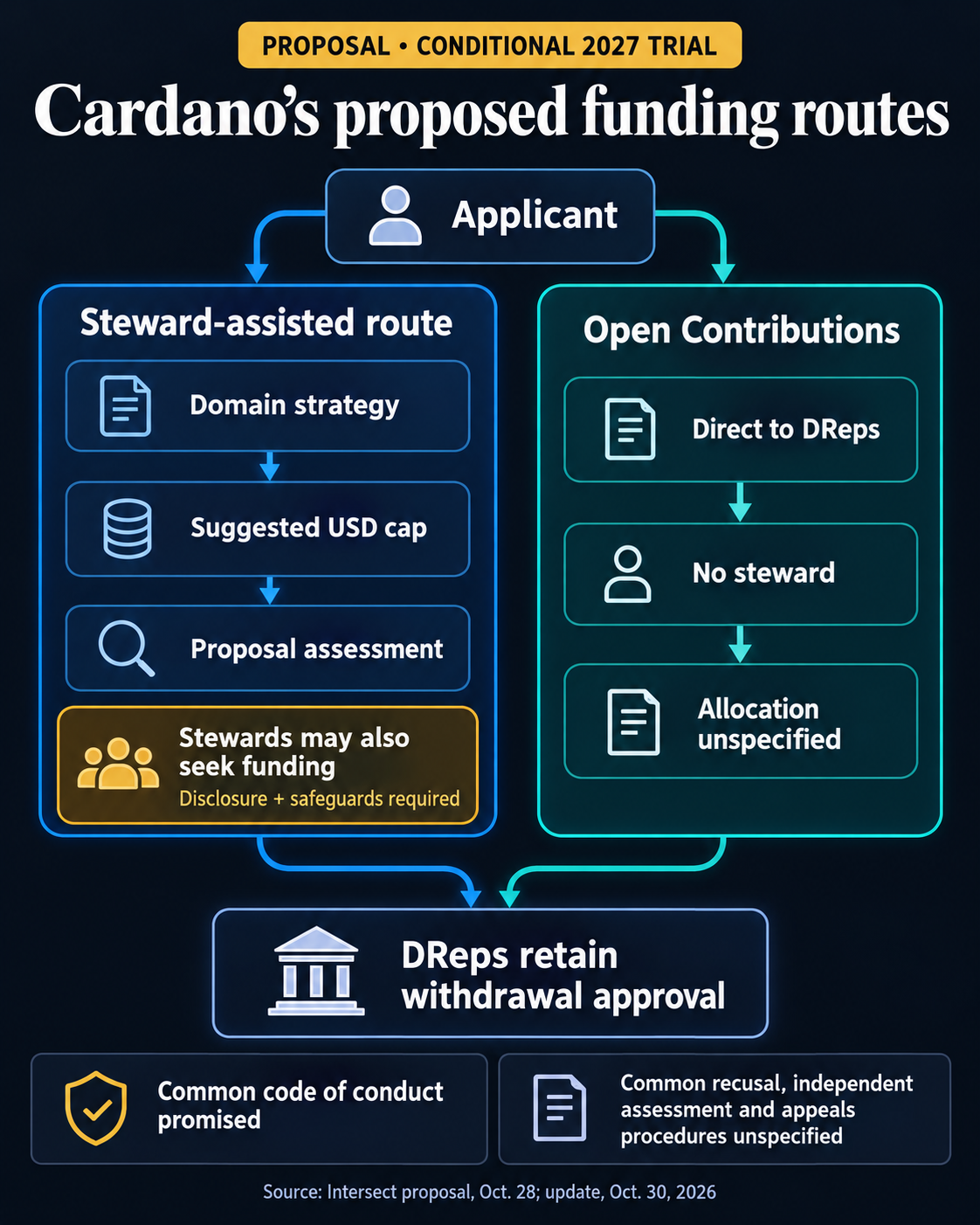
- DReps would retain withdrawal approval, and Open Contributions would let applicants seek funding directly without a steward.
- The proposed 2027 trial leaves direct funding allocations and common conflict procedures unspecified before a tentative November 10 concept submission.


Cardano’s proposed 2027 budget process would let three institutions help design how funding requests are assessed while remaining eligible to seek money from the same spending domains.
The proposed Cardano Ecosystem Budget Process, or CEBP, published by Intersect on Oct. 28, would assign stewardship roles to Intersect, PRAGMA and the Cardano Foundation across six areas of spending. Delegated representatives, or DReps, would retain approval of the stewards, budget distribution and every treasury withdrawal. The institutions’ influence would come earlier, through the plans and assessment processes that help shape those votes.
For independent applicants, the balance depends on how conflicts are handled and how much funding remains available through Open Contributions, a proposed route that would let anyone approach DReps without a steward. The published framework leaves that route’s allocation and common procedures for assessing steward-related funding unspecified.
In its Oct. 30 update, Intersect said feedback remained open ahead of a tentative Nov. 10 submission of the overall concept. The process would run as a trial in 2027 only if DReps approve.
How Cardano budget stewards would shape funding choices
Each proposed steward would help develop its domain’s strategy, recommend a dollar-denominated budget cap in coordination with other stewards, and define how applications are collected and assessed. It could submit proposals itself or support others in bringing them to an on-chain vote.
Delivery oversight would also depend on the structure chosen for each proposal. The framework allows different arrangements, from teams retaining their own administration to more coordinated delivery contracts.
| Proposed steward | Spending domains |
|---|---|
| Intersect | Core Development and Maintenance; Applied Research; Governance Coordination |
| PRAGMA | Developer Support |
| Cardano Foundation | Marketing, Analysis & Events; Adoption & Ecosystem Growth |
| No steward | Open Contributions, allowing direct applications to DReps |
These responsibilities could influence which needs are prioritized, how competing requests are compared and what information reaches voters. DReps would still decide whether the resulting proposals receive funding.
Intersect presents the approach as a response to overloaded DReps facing numerous, hard-to-compare requests with insufficient expert guidance. Common presentation standards and domain expertise could make those decisions easier. The same assessment role makes the treatment of an institution’s own funding proposals consequential.
The proposal expressly allows a steward to receive funding from its domain, provided that funding is transparently declared and accompanied by safeguards. An award would still require DRep approval.
The published framework promises a common public code of conduct in the planned information action, a proposal seeking DRep support for the concept. Common recusal, independent assessment and appeals procedures for funding proposals involving stewards remain unspecified in the published text.
There are existing, narrower provisions. Intersect’s Growth & Marketing Committee working terms, which remain subject to ratification and adjustment, require potential conflicts to be disclosed to committee leadership. They specifically address reviews involving members’ working relationships and allow sanctions for code violations.
The Budget Committee grievance process covers conflicts and concerns about process fairness, with escalation through Intersect’s leadership to its board. The procedure applies specifically to that committee’s activities and stakeholder interactions.
Existing payment oversight applies after funding approval. The existing 2026 budget FAQ says the five-member independent Oversight Committee checks administrative disbursements, with funding selection outside its remit.
The direct route and decisions still ahead
Open Contributions would be the seventh domain, with no steward. Any proposer could go straight to DReps. The Net Change Limit, or NCL, sets the overall treasury withdrawal limit. The framework says the information action setting it would suggest moving a rejected stewarded domain’s proposed budget into that open route.
Those provisions preserve alternatives to the institutional process. Their practical importance will depend partly on the numbers: domain caps and any guaranteed share for Open Contributions remain unspecified. The framework anticipates an allowance to be developed alongside the other budgets.
In DRepTalk consultation feedback, the participant posting as SIPO proposed giving Open Contributions its own explicit share of the overall withdrawal limit. SIPO also sought disclosure of stewards’ roles and relationships with applicants. Those suggestions remain part of the consultation.
DReps’ own commitments would matter too. Intersect says direct on-chain enforcement of the framework is unavailable. It would rely on supporting DReps making a social commitment to follow the process in the relevant domains, including withholding support from withdrawals outside the agreed process.
That could make the agreed application rules influential without introducing a technical barrier to submission. DReps would remain able to reject a domain plan or move to another model, while independent applicants would still need to persuade them to approve funding.
The tentative Nov. 10 action would seek support for the concept and task stewards with preparing detailed domain plans. DReps’ commitment to the framework for 2027 would be sought through the later domain actions.
Intersect envisages a second round in December 2026 or January 2027 covering domain arrangements and the 2027 NCL. The framework sets a goal of at least 51% DRep support for the concept and at least 60% DRep support for each domain’s stewardship mandate. It describes 51% DRep support for the NCL. Those statements concern the proposed information-action process and social commitments. Individual treasury withdrawals would continue to require their own approvals.
The published versions also leave an action-count discrepancy. Six stewarded domains plus an NCL action imply seven; the blog describes eight. Intersect’s forum copy says seven before referring to an eighth. Neither version consistently explains the total.
Existing contracts are separate from those future choices. On Oct. 17, Intersect reported 25 vendor smart contracts worth 204,639,279 ADA from the 2026 budget cycle.
For applicants, the proposed next round would set out how much money each route could offer and how assessment would work when a steward also seeks funding. DReps would retain the final funding decision; the code of conduct and the size of Open Contributions will help determine how much choice applicants have before that vote.
Mentioned in this article


Editorial credits