

Quick Take
- Binance's November 2 update says users can verify Bitcoin backing in its October 31 snapshot.
- Binance says only surplus futures reserves were reallocated; the disclosure does not establish higher ADL probability.
- ADL can reduce profitable futures positions, while eligible Delta Neutral accounts receive lower queue priority rather than immunity.


Binance's latest reserve proof addresses whether a customer's Bitcoin is backed at a dated snapshot. A futures hedge faces a separate test: Binance's futures rules allow Auto-Deleveraging, or ADL, to reduce a profitable short that was offsetting the holding.
In its Nov. 2 proof-completion update, Binance said holders of ten named tokens, including Bitcoin, could independently verify backing of at least 1:1 for the snapshot taken at 00:00 UTC on Oct. 31.
The exchange had disclosed in its Oct. 31 recovery update that some futures insurance reserves helped replenish assets stolen in its security incident. Binance said it released only excess above its required coverage level and that the remaining funds exceeded that requirement. The disclosure alone establishes neither a reserve shortfall nor a measurable increase in ADL probability.
Binance also distinguished its Futures Insurance Funds from user assets: they are its own reserves, outside the user-verifiable PoR view. Those reserves support the handling of bankrupt futures positions and reduce the need to close opposing traders' positions.
Binance said it monitors those funds against stress scenarios and adds company funds when required.
How a profitable hedge can be reduced
The futures insurance FAQ describes several pools assigned to different contract categories, with Binance able to change allocations. An exchange-wide reserve figure therefore cannot automatically describe the protection available to every Bitcoin contract.
The same FAQ defines Maximum Takeover Capacity as a cap on the notional, or face, value of bankrupt positions a fund can absorb at a time. It is a multiple of the fund's current balance, with the predetermined multiplier kept confidential.
That capacity limit differs from the amount available to absorb losses. Its FAQ says ADL can be engaged when takeover capacity is reached or when unrealized losses on positions assumed by the fund exceed the relevant available balance. Waiting for a fund balance to reach zero would miss the capacity constraint described in its guidance.
Neither the amount released nor the information needed to calculate current contract-specific headroom is established by the reallocation disclosure.
Under the ADL priority rules, opposing profitable positions can be selected when the fund cannot accept a bankrupt position. Profitability and leverage affect their place in the queue. A position can therefore be winning on price and still be selected for reduction.
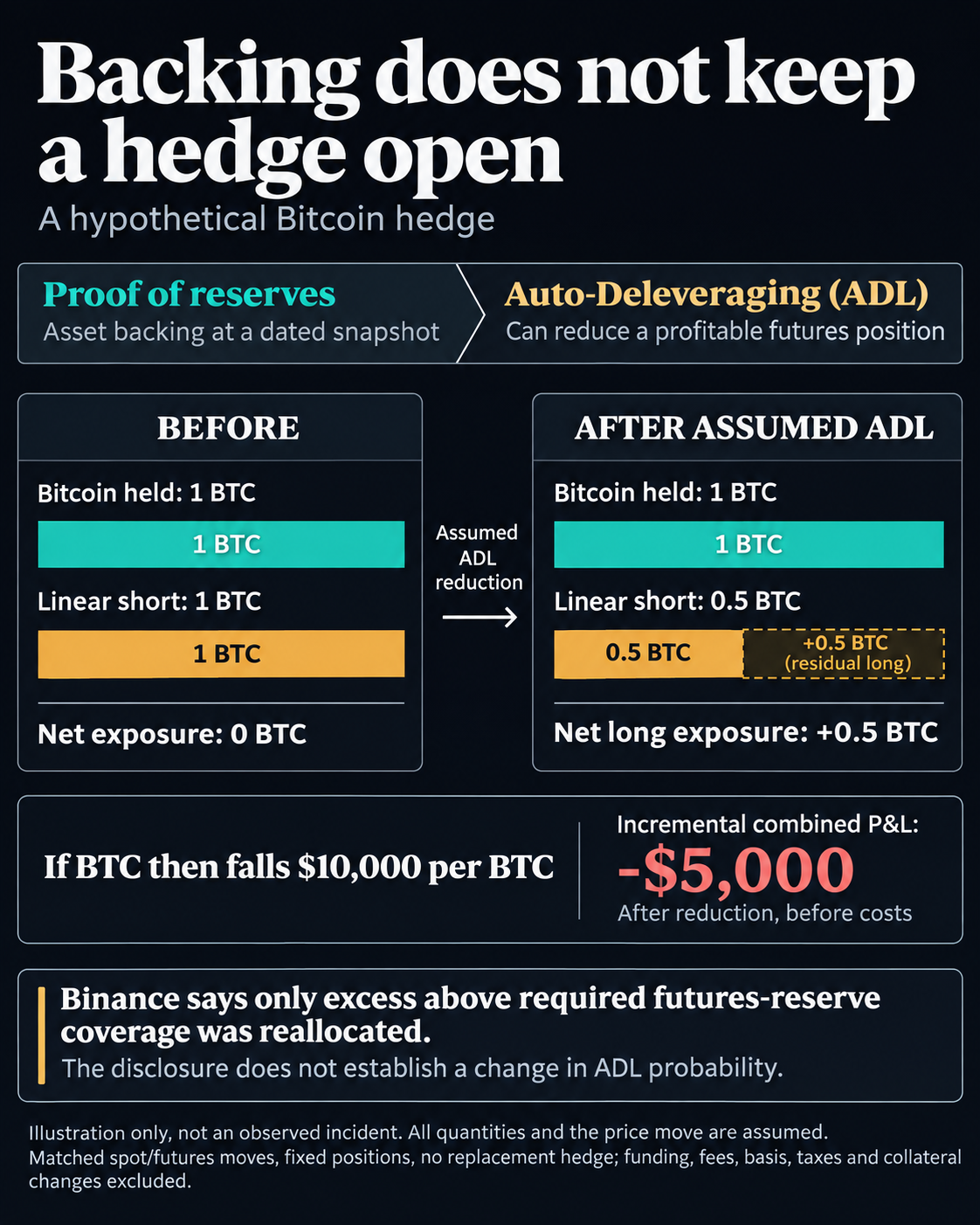
Consider a purely hypothetical trader holding 1 BTC and a linear futures short of 1 BTC. Assume the short has become profitable after a price decline. If ADL cuts it to 0.5 BTC while the underlying holding stays unchanged, only half the holding remains offset.
| Assumed position | Before reduction | After reduction |
|---|---|---|
| Bitcoin holding | 1 BTC | 1 BTC |
| Linear futures short | 1 BTC | 0.5 BTC |
| Net long price exposure | 0 BTC | 0.5 BTC |
If Bitcoin then falls by an assumed $10,000 per BTC, the remaining combined position loses $5,000 on that further move. That calculation assumes spot and futures move together, quantities remain fixed and the trader adds no replacement hedge. It excludes fees, funding, basis differences, taxes and collateral changes.
The $5,000 is an incremental loss after the reduction, not the strategy's total profit or loss. Whatever the closed portion earned does not provide an ongoing offset to later price changes in the holding.
For positions governed by Binance RCH's clearing rules, an ADL-selected position can be reduced or closed at the triggering bankrupt position's bankruptcy price, without specific consent from the affected clearing participant.
This differs from the collateral problem in CryptoSlate's October analysis of fragmented hedges, where an underfunded losing leg can be liquidated while profits sit elsewhere. ADL can remove the profitable opposing leg. Either mechanism can separate positions that were intended to work together.
Account eligibility changes priority
Binance's Delta Neutral Account guidance offers qualifying hedged positions lower ADL priority within the same profit/loss category. It does not exempt those positions from ADL.
Initial qualification requires Portfolio Margin or Portfolio Margin Pro, VIP4 or above and an enabled Delta Mode for the individual account. The gap between the calculated long and short exposures must be less than 5% of the larger side, expressed as a relative difference below 0.05. Enabling a master account does not enable its subaccounts.
The calculation recognizes eligible assets in Cross Margin and Futures accounts, Cross Margin debts and futures positions. Assets in the Spot Account and options positions are excluded. A Bitcoin holding and an offsetting futures short may form an economic hedge without automatically qualifying for this special queue treatment.
There is also a distinction between entry and continuing eligibility: the FAQ says a later fall below VIP4 alone changes nothing, while disabling Portfolio Margin disables Delta Mode.
Contract scope matters alongside account status. Within the Binance RCH rulebook, ADL applies contract by contract: a position in one contract type is not used to cover losses in another. Those rules refer to Default Funds and tie potentially affected positions to the relevant fund's coverage and available capacity.
The FAQs are educational guidance that defer to governing rules and contract specifications. The applicable Binance entity, product terms and account arrangement determine which legal protections govern a position.
Mentioned in this article


Editorial credits