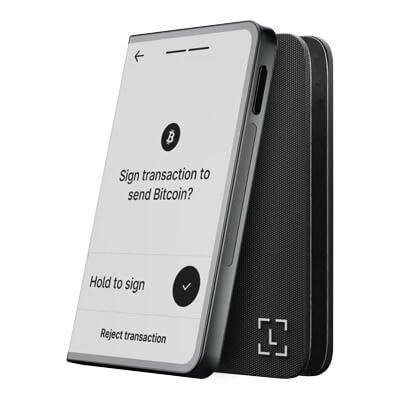



Ledger Stax Overview
Additional details
Ledger Stax Screenshots
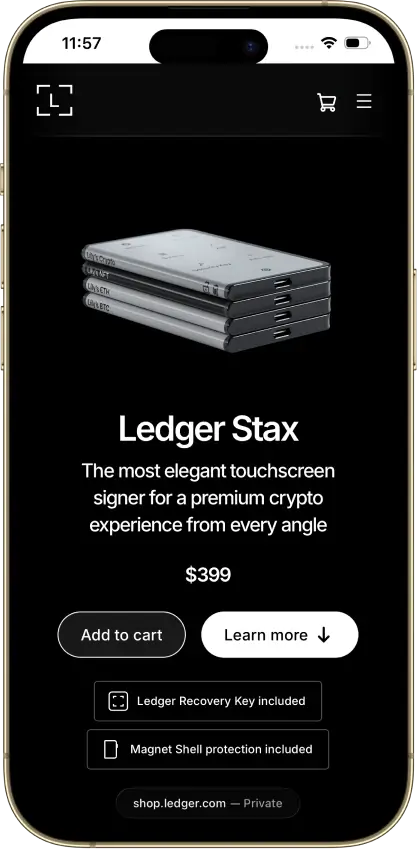
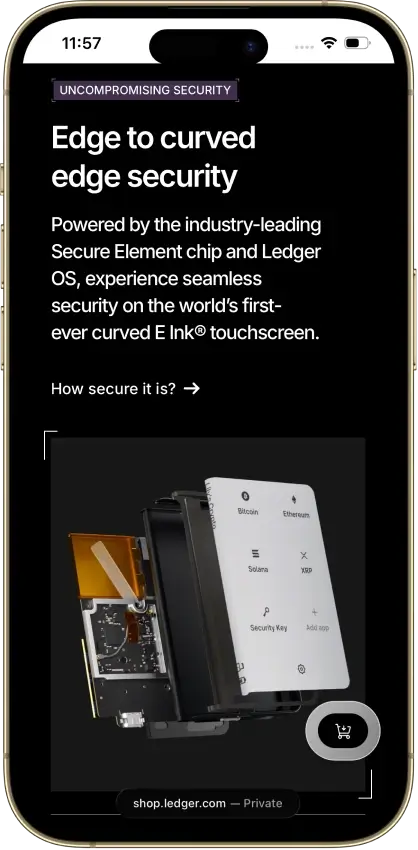
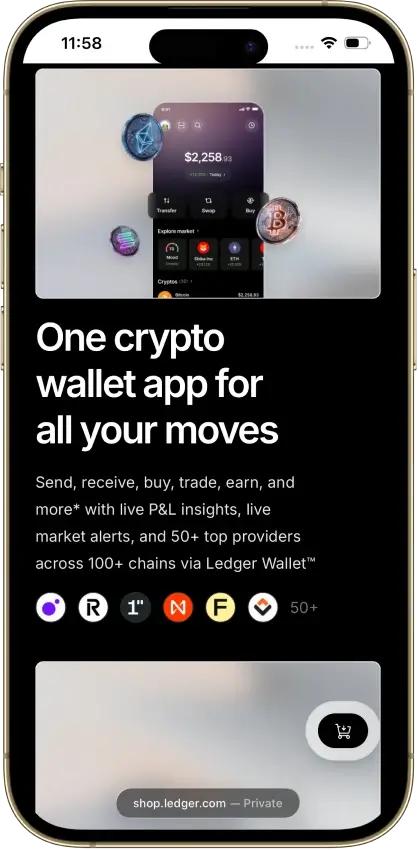

Screenshot 1 of 8
Ledger Stax Pros and Cons
Pros
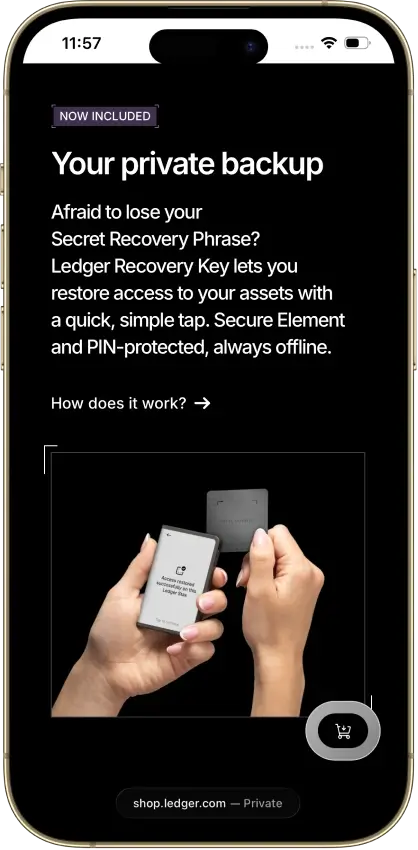
- PIN-protected offline backup card included
- EAL6+ certified Secure Element chip
- Mobile and desktop companion options
- Separate passphrase accounts supported
Cons
- Low-level firmware remains partly closed
- Coin-app updates need separate attention
- Recovery Key excludes extra passphrases
- Connected-service costs vary by provider
Ledger Stax Specs and Key Facts
Ledger's product specifications and service documentation describe the following configuration.
| Feature | Ledger Stax |
|---|---|
| Type and custody | Hardware wallet with user-controlled signing keys and optional provider-assisted recovery |
| Company | Ledger SAS, France |
| Display | 3.7-inch curved grayscale E Ink touchscreen, 400 × 670 pixels |
| Materials and size | Plastic display with anti-glare coating, aluminum/plastic body, 85 × 54 × 6 mm, 44.2 g |
| Secure Element | ST33K1M5, with CC EAL6+ certification applying to the chip |
| Source availability | Public companion/app components, partly closed low-level firmware |
| Connectivity | Bluetooth 5.2 for iOS/Android, USB-C for desktop and Android |
| NFC | Recovery Key backup and Security Key authentication |
| Charging | USB-C or Qi wireless charging |
| Companion | Ledger Wallet, formerly Ledger Live, on Windows, macOS, Linux, iOS and Android |
| Assets | Ledger lists 500+ through its companion and thousands through third-party wallets |
| Recovery | 24-word phrase, included Recovery Key, optional additional passphrase or paid Recover service |
| Purchases, swaps and staking | Integrated providers and network-specific routes with separate costs and conditions |
| Advertised price | $399 in Ledger's published lineup, checked September 12, 2026 |
| US orders | Global-e US Inc. identified as seller in Ledger's terms, subject to order eligibility |
What Is Ledger Stax?
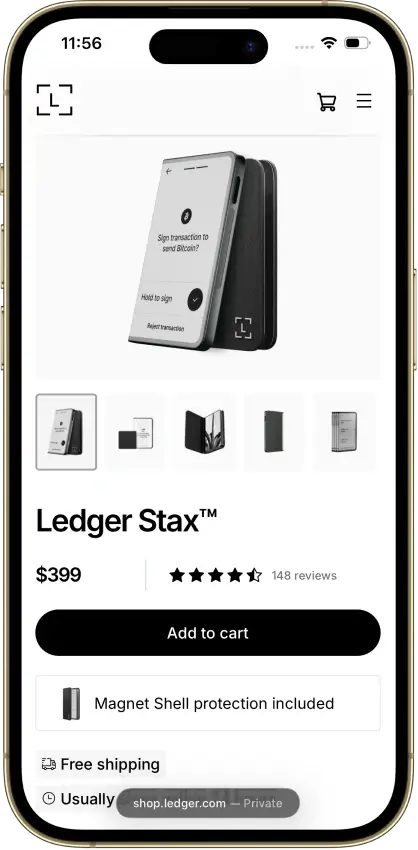
Ledger Stax is a hardware crypto wallet made by France-based Ledger SAS. A connected phone or computer provides the wallet interface, while the device handles private signing operations in its Secure Element. You inspect a requested transaction on Stax before approving it.
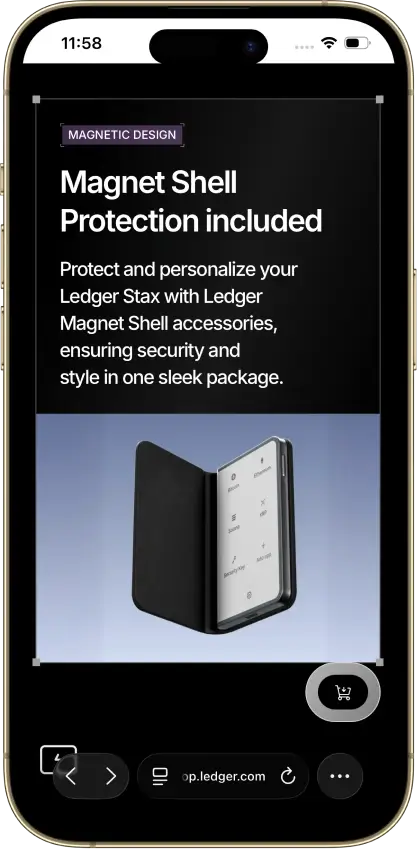
The curved display sits in a chassis with embedded magnets for stacking. Its grayscale plastic display differs from the glass screens familiar from phones. The included Magnet Shell provides a separate cover, and Qi charging adds a way to recharge without occupying the USB-C port.
Security, Custody and Ledger's Track Record
Signing Hardware and Source Code
The Secure Element holds the signing environment and controls the trusted display. Its CC EAL6+ certification concerns the chip's evaluation, not a guarantee that every coin app or transaction parser is free of defects. The screen can only present the details the relevant software has interpreted correctly.
Ledger publishes companion and application components, while portions of low-level Secure Element firmware remain closed under supplier restrictions. Buyers who require a fully inspectable firmware stack should account for that limit before choosing Stax.
Stax uses a device PIN, and three incorrect attempts reset it. Losing the device or triggering a reset makes your recovery arrangement important. The offline card and optional identity-based service introduce different backup dependencies, described below.
Device and Coin-App Disclosures
Ledger's January 2025 MCU-update bulletin included a flaw that could make Stax unusable during a malicious update flow. Stax firmware 1.6.2 was the first release carrying the fix. VulnCheck later cataloged the issue as CVE-2025-15645 using Ledger's report. Its entry is a catalog record, not a separate reproduction. Ledger said funds were not at risk.
In August 2026, Ledger disclosed a command-interleaving issue in shared software used by coin apps. An attacker controlling communications with a vulnerable app could change transaction parameters during review. Decrypt reported an outside-vendor laboratory reproduction against Ethereum app 1.22.1. Ethereum 1.22.2 added safeguards, followed by SDK changes and rebuilt apps.
Two further Ethereum-app fixes arrived in version 1.22.3 on August 25, 2026. One addressed a compromised-host scenario in which a supported transaction descriptor and an unusually large batch could produce a signature for the full batch while displaying only one action. The disclosed demonstration used a private fork. The other involved accepting a token permission in place of a swap payment. That permission retained the approved asset, amount and provider deposit address, and required a later transaction to spend the tokens.
The 2026 coin-app disclosures make app maintenance a separate task from firmware updates. Updating the device operating system alone does not install every app fix.
Customer Data and Connected Websites
Ledger's 2020 customer-data breach and a January 2026 incident at order partner Global-e exposed customer information. For the latter, BleepingComputer reported exposure of some buyers' names and contact details. Ledger said its own systems were unaffected, while Global-e said payment information and account credentials were not compromised. The customer-record exposure can enable targeted phishing.
The December 2023 Connect Kit compromise affected a software library used by wallet-connected websites. A former employee's publishing access was phished, and malicious code reached third-party sites, causing fund drains. Ledger replaced the package.
Supported Assets and Wallet Connections
Ledger lists more than 500 crypto assets through Ledger Wallet alongside thousands through compatible third-party wallets. Those figures describe different interface coverage, with supported functions varying by asset. Check the network and intended operation before moving funds.
Phantom wallet‘s current hardware-wallet table specifically lists Stax for Bluetooth connection on mobile and cable connection through its browser extension. Asset and decentralized-app compatibility must be checked for the intended action. Readable signing also depends on the particular interaction.
Setup, Daily Use and Recovery
Getting Started and Charging
Ledger's setup instructions use Ledger Wallet, the renamed Ledger Live companion. The basic sequence is:
- Install the official companion for your compatible phone or computer.
- Set up Stax and choose its device PIN.
- Record the recovery phrase and complete the device's backup prompts.
- Install the required coin apps through My Ledger, then add accounts.
Bluetooth serves mobile use, while the cable supports desktop and Android connections. NFC is used for Recovery Key backup and Security Key authentication.
Ledger lists USB-C and Qi charging, with a USB-C cable in the box. Its box list includes the Magnet Shell and Recovery Key, but not a Qi charger. Ledger estimates 10 hours of battery autonomy, depending on usage and settings. We did no runtime testing.
Recovery Phrase and Recovery Key
Stax's 24-word phrase provides the underlying backup for the wallet. Ledger includes Recovery Sheets as well as a Recovery Key card. NFC transfers the phrase into encrypted storage on the card, protected by a separate PIN. The card erases that stored backup after a third wrong PIN entry. This limit is separate from Stax's device-reset rule.
Ledger advises retaining the written phrase and keeping backups separate from the signer. The card gives you another way to restore, but storing every backup beside Stax leaves them exposed to the same loss. Recovery Key has no ongoing subscription charge.
An additional passphrase creates different accounts and is excluded from the card backup. Preserve its exact spelling and capitalization separately. The new accounts start empty, with existing balances remaining in the original accounts.
Optional Ledger Recover
Ledger Recover requires a subscription and identity verification, with eligibility determined by your documents and country. The service can restore from two backup fragments. With your approval, it distributes encrypted recovery material across three providers: Ledger, Coincover and EscrowTech.
Stax supports the service through desktop and mobile. Choosing it adds reliance on the recovery providers and identity process. Recover restores access rather than revealing your plaintext phrase on demand. Basic signing and the physical Recovery Key card work independently of this optional subscription.
Transaction Tools, Swaps and Staking
Clear Signing and Transaction Check
Clear Signing presents readable transaction details where the wallet and connected app support that interaction. If support is missing, the software may not translate the request into readable terms on Stax. That leaves the user unable to check those terms against the action they intended to approve.
Transaction Check adds transaction simulation and risk assessment. Blockaid describes supplying risk information for the feature's Ethereum launch on Stax and Flex in April 2025. That partner account explains an implementation, not independent proof that the service detects every threat or covers every network today. Treat a reassuring result as additional information when reviewing an approval.
Buying and Exchanging Assets
Ledger Wallet offers purchase quotes through services such as MoonPay and Transak. Provider eligibility, payment method and identity requirements can differ by country. Ledger says its buy feature itself has no Ledger charge. The selected provider can still charge for the purchase.
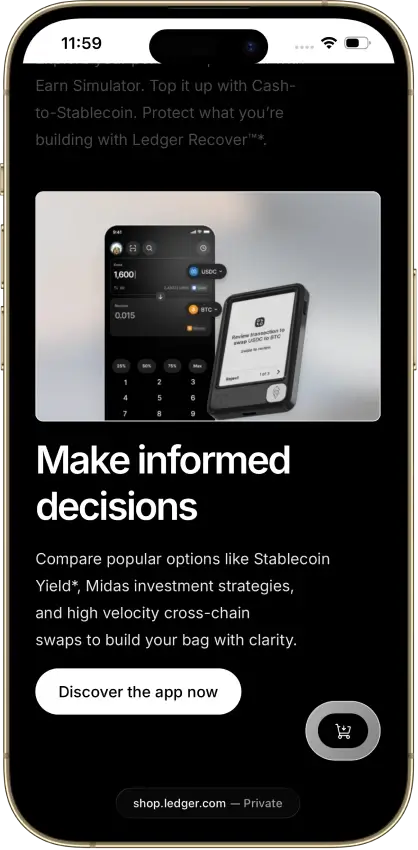
Some integrated swap routes transfer the input asset to a provider that performs the exchange and sends the output. You rely on that provider to complete the exchange after approving the transfer on Stax. Other routes work differently, so check the named service before signing.
Ledger's developer documentation distinguishes Ledger, partner and withdrawal fees that can reduce the amount received. The pay-in transaction can carry a separate network fee. Slippage tolerance instead sets the maximum permitted price change for the exchange.
Staking Routes
Ledger describes SOL delegation and ETH staking options. Network and provider rules determine the staking process and the wait to exit. Depending on the route, validator performance or slashing can affect the position. Ledger also warns that malicious staking contracts can seek token permissions or redirect funds. These risks remain with the owner when using Stax to sign.
Ledger Stax Price and Ongoing Costs
The $399 figure comes from Ledger's lineup page, updated March 12, 2026 and checked September 12. The store's price field did not load during our check, so confirm the actual regional checkout total before paying. Ledger's sales terms name Global-e US Inc. for US orders and retain order-eligibility conditions.
| Cost | What determines it |
|---|---|
| Stax purchase | Advertised device price plus applicable checkout charges |
| Blockchain transactions | The network and transaction conditions |
| Buy and swap services | Selected provider, payment route and quoted receiving amount |
| Staking | Network and provider or validator conditions |
| Recovery Key use | No ongoing subscription charge for the included card |
| Ledger Recover | Optional paid subscription, with eligibility requirements |
The quoted amount received is the useful comparison for a buy or swap. It shows how much of the input survives the exchange rate and any included fees, while the pay-in network charge may remain separate.
Who Should Choose Ledger Stax?
Stax suits owners who expect to read transaction details on its curved touchscreen and use its wireless connections regularly.
- Phone users who want Bluetooth access to a hardware signer.
- Owners who already use Qi charging and want it for their wallet.
- Buyers who will maintain separate written and card backups.
It is less suitable for anyone requiring completely open firmware, or for users unwilling to track coin-app updates. A passphrase user who expects the included card to preserve every recovery secret would also need to change that backup plan.
Final Verdict
Stax combines a curved E Ink screen, mobile Bluetooth and Qi charging with Ledger's coin-app system. The box includes a protective shell and an offline backup card. Owners using an additional passphrase still need a separate record of it. Our recommendation depends on whether you will use those physical features enough to justify the advertised $399. Choose Stax for the screen and handling preferences, with a plan to update apps and preserve backups.
Curved 3.7-inch E Ink touchscreen · Qi charging alongside USB-C · Magnet Shell included in the box
Disclaimer: CryptoSlate may receive a commission when you click links on our site and make a purchase or complete an action with a third party. This does not influence our editorial independence, reviews, or ratings, and we always aim to provide accurate, transparent information to our readers.
Review Update Notes
-
September 17, 2026: Added a publisher-approved editorial rating of 8.0/10 (Very Good). The rating reflects Stax’s touchscreen and charging convenience alongside its price, firmware transparency and signing limitations. It is an editorial assessment, not a calculated pillar score.