

Coinbase fits U.S. users who fund by ACH and use Advanced, but Simple Buy costs and regional product rules require attention.
Coinbase vs Robinhood: Which Is Better for Crypto in 2026?
Coinbase wins for a crypto-focused US account with more listed assets and staking choices. Robinhood fits existing brokerage customers and charges less commission on ETH, SOL and ADA staking.

Free standard ACH and crypto near your investments, with different pricing for market maker and exchange-routed orders.
Affiliate Disclosure
Some links in this comparison are affiliate links. CryptoSlate may earn a commission if you sign up through these links. Our ratings remain editorially independent.
Winners by Category
Coinbase takes the overall verdict for a crypto-focused US account. Robinhood wins the shared-asset staking commission comparison, while entry maker fees and standard ACH tie.
Coinbase Robinhood
Coinbase wins for crypto selection and staking breadth. Robinhood remains convenient for existing securities investors.
Larger dated crypto range and nine staking assets
Crypto alongside an existing brokerage account
Tie — $5 per $1,000 filled at the published entry maker tier.
0.50% on US Advanced
0.50% on eligible exchange-routed orders
Coinbase wins by $0.50 per $1,000 fill before spread and slippage.
0.90% on US Advanced
0.95% on eligible exchange-routed orders
Coinbase has the larger stated range. These are dated, unsynchronized inventories, not a live listing-gap measurement.
Roughly 270–315 assets
90 tradable assets, September 8, 2026
Coinbase wins on supported staking assets, with state restrictions on both.
Nine named assets where eligible
ETH, SOL and ADA
Robinhood wins on the commission percentage for these shared assets, not necessarily net yield.
35% standard, or 31.75%–25.25% with eligible One plans
25% combined deduction
Tie — standard US bank deposits and withdrawals carry no platform fee.
No platform charge
No platform charge
Tie on chat hours. Neither establishes faster resolution through these hours alone.
24/7 live chat
24/7 live chat
Tie on audited corporate disclosure, not a claim that custody risks are identical.
Listed parent with annual financial audit
Listed parent with annual financial audit
Screenshots
Coinbase screenshots

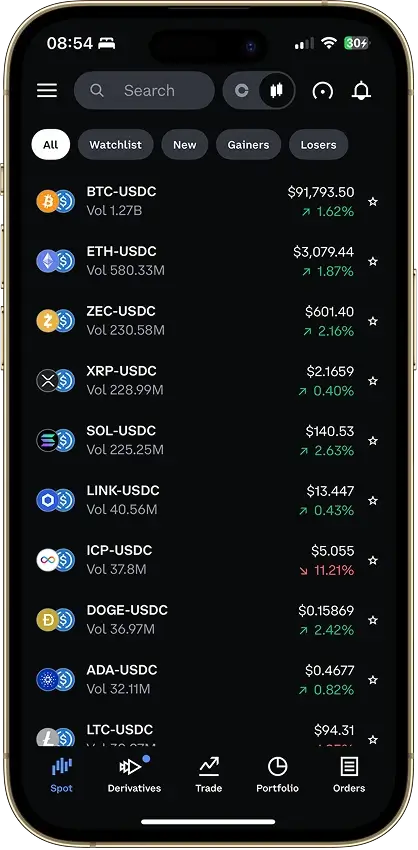
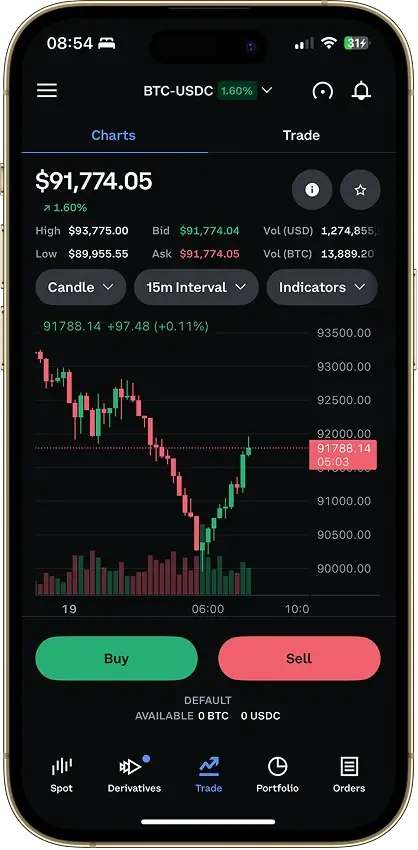
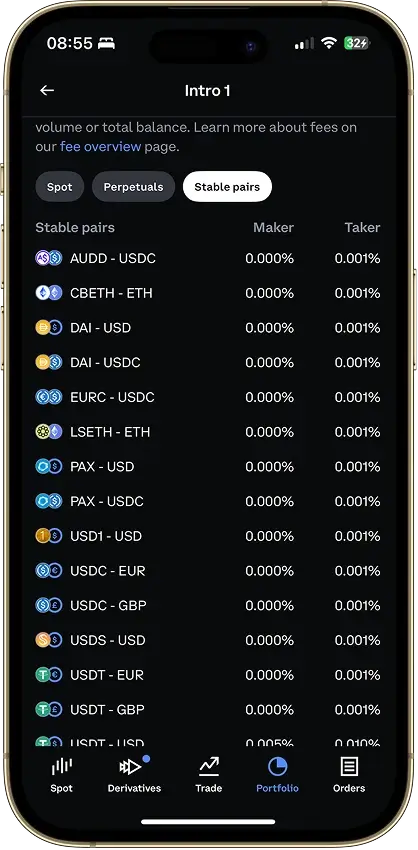
Screenshot 1 of 4
Robinhood screenshots




Screenshot 1 of 4
Coinbase vs Robinhood Overview
This comparison covers both US custodial crypto accounts. Coinbase suits users building a crypto portfolio, while Robinhood keeps supported coins close to an existing securities portfolio.
Trading Fees
Entry maker commission ties. Coinbase’s US Advanced taker rate is slightly lower than Robinhood’s published exchange-routing entry rate. Simple purchases use different pricing.
Coinbase Robinhood
Entry Maker Order
Tie at the entry maker tier, where that pricing is available.
0.50% — $5 per $1,000 filled
0.50% — $5 per $1,000 filled
Entry Taker Order
Coinbase wins by $0.50 per $1,000 fill, excluding spread and slippage.
0.90% — $9 per $1,000 filled
0.95% — $9.50 per $1,000 filled
Coinbase wins trading Fees
Coinbase wins on entry taker commission. Entry maker commission ties.
Coinbase’s US entry rates changed on September 16, 2026. They should not be confused with the lower EU and UK rates or the separate institutional Exchange schedule. Robinhood’s entry tier applies below $10,000 in qualifying 30-day exchange-routed volume and remains subject to its maker/taker rollout. The fee shown for the account controls.
A limit order can fill immediately and incur taker pricing. Robinhood’s fee-tier API v2 orders currently receive taker pricing until the rollout completes, even though qualifying executions count toward volume tiers. Orders using its market-maker route do not build that qualifying volume.
For a simple purchase, compare the amount of crypto received for the same dollar spend. Coinbase’s small-purchase estimate is roughly 2.5%–3.5% after fee and spread, not a universal tariff. Robinhood’s default market-maker route has no separate commission, but compensation to Robinhood sits inside the spread. A zero commission does not establish the cheaper executable quote.
Coinbase One Preferred and Premium rebate 25% of eligible Advanced spot fees. Preferred caps that rebate at 100 USDC per month and costs $29.99 monthly, while Premium costs $299.99 monthly. Basic has no Advanced rebate. Robinhood’s volume tiers require neither Gold nor a house token. Frequent traders should compare the assigned tiers and subscription cost rather than extending this entry-tier result to every balance.
Supported Crypto Assets
Coinbase has the larger dated US crypto range. Robinhood’s list is smaller, and fewer assets qualify for exchange routing than for ordinary purchases.
Coinbase Robinhood
Dated Tradable Asset Count
Coinbase wins on the stated range. State and interface restrictions can narrow either account’s menu.
Roughly 270–315 US retail assets
90 market-maker-routed assets, September 8, 2026
Coinbase wins supported Crypto Assets
Coinbase wins on the dated asset range.
Coinbase’s same US retail scope includes about 460 pairs. Robinhood marked 66 of its 90 assets for exchange routing and listed another 45 as view-only. Those 45 cannot be counted as tradable holdings. The published Robinhood table places ZRX in both lists, so check its trade button before funding specifically for that token.
Coinbase is the more useful starting point for an uncommon coin. If both services offer it, inspect the withdrawal network as well as the trade screen. Stocks, prediction markets and tokens reached only through a separate wallet are outside these crypto counts.
Staking and Other Products
Coinbase wins on staking selection. Robinhood takes a smaller commission on the three assets both support, although batching and unstaking rules can change the return actually received.
Coinbase Robinhood
Named Staking Assets
Coinbase wins on asset choice. Availability depends on state and account eligibility.
ADA, ATOM, AVAX, DOT, ETH, MATIC (POL), SOL, SUI and XTZ
ETH, SOL and ADA
Commission on ETH, SOL and ADA
Robinhood wins on the stated deduction for the shared assets. This is not a net-yield ranking.
35% standard. Eligible One plans reduce it to 31.75%, 28.5% or 25.25%
25%, including the partner’s share
Coinbase’s 35% standard commission covers eight assets, not all nine. SUI’s commission needs a separate in-account check. Coinbase One discounts apply to ADA, ATOM, DOT, ETH, SOL and XTZ, excluding AVAX, MATIC and SUI from that general discount disclosure.
Robinhood’s ETH batching can deliver 50%–100% of the protocol rate before its commission. Its ADA rewards begin after a 15-day bonding period. These conditions explain why a lower deduction alone cannot identify the higher return. Compare the asset’s displayed net rate and release time using the staking comparison guide.
Robinhood Earn is different: USDG moves into a self-custody wallet and a Morpho lending vault. Low vault liquidity can delay withdrawals, and the described insurance does not give customers a direct claim against lending losses. It is not a substitute for insured bank savings.
Both groups offer US futures through separately approved derivatives accounts. Coinbase additionally describes US perpetual-style contracts. Contract size, margin and eligibility need a separate comparison, so neither receives a derivatives win from its spot-account features. The derivatives guide explains those trading risks.
Order Types and Execution
Both provide market, limit and stop-limit orders. Coinbase runs the Advanced order book, while Robinhood sends orders to market makers or partner exchanges.
Coinbase Robinhood
Market and Limit Orders
Tie on these order types. A limit order can still incur taker commission.
Available on Advanced
Available on supported routes
Stop-Limit Orders
Tie on the order instruction. A stop trigger does not guarantee a fill at the limit price.
Available on Advanced
Available under the supported routing rules
Robinhood routes supported advanced orders to partners including EDX Markets and Bitstamp. Resting limits normally use affiliated Bitstamp, with another exchange possible when price improvement offsets the taker fee. Coinbase lets users trade against its own Advanced order book.
That difference matters for traders who want a particular execution model, but it does not prove which will fill the next order at a better price. Compare the live executable price and charge for the same market. Holding caps, bank limits and crypto withdrawal allowances are separate restrictions, with transfer limits shown in each account.
Deposits and Withdrawals
Standard ACH fees tie. Coinbase adds a Bitcoin Lightning route that Robinhood does not support, while instant bank cash-out and ordinary crypto transfers need an account-specific quote.
Coinbase Robinhood
Standard ACH Deposit or Withdrawal
Tie on platform fees. Settlement and account holds can still delay access.
No Coinbase charge
No Robinhood charge
Bitcoin Lightning Transfers
Coinbase wins for users who specifically need Lightning. The destination must support that network.
Supported, with a 0.2% processing fee
Not supported
Coinbase lists standard ACH at one to five business days. Robinhood lists one day for its own standard withdrawal processing, with additional receiving-bank time possible. These estimates measure different stages, so they do not establish a speed winner. Buying power from an unsettled deposit can also arrive before funds are withdrawable.
Coinbase’s standard domestic wire fees are $10 incoming and $25 outgoing. One Preferred and Premium waive Coinbase’s wire fees, but bank charges may remain. Eligible Coinbase RTP cash-out can be instant up to $100,000 per transaction. Robinhood’s eligible instant withdrawals cost 1.75%, with a $1 minimum and $150 maximum. Compare the actual offer before paying for speed.
Robinhood adds no platform transfer fee to supported crypto sends, although network costs apply. Coinbase’s BTC onchain and ETH examples show network charges, while Lightning has its own processing fee. USDT sends add 0.01%, capped at 20 USDT, plus network cost. Robinhood lists USDT as view-only and does not support Lightning, so those extra Coinbase charges cannot establish a like-for-like Robinhood withdrawal win.
For an ordinary onchain send, use the same coin and network on both quote screens. Robinhood excludes Bitcoin taproot addresses. Its withdrawal allowlist imposes a 48-hour wait on new addresses and configuration changes, while previously approved addresses remain usable.
US Availability and Verification
Both offer basic crypto trading in all 50 states and require identity verification. State restrictions matter more when the account is being opened for staking, a specific coin or exchange routing.
Coinbase Robinhood
Basic US Crypto Trading
Tie on basic state coverage, not on every coin or product.
All 50 states, subject to asset rules
All 50 states, subject to asset rules
Coinbase pauses new staking principal in California, Maryland, New Jersey and Wisconsin. Robinhood staking is unavailable in those four states. Coinbase SUI staking also excludes New York. A supported spot account does not remove these staking restrictions.
Robinhood excludes exchange routing in North Carolina and restricts individual assets in New York. USDC and USDG restrictions include Texas, and its USDG Earn product excludes both New York and Texas. These restrictions should be checked before funding for a particular use.
The US exchange directory helps compare alternatives where a required product is unavailable. Both services can request additional identity, funding or transfer checks after onboarding.
Security and Custody
Both publish audited corporate financials and describe offline custody. Neither offers a personal Merkle reserve-inclusion check, and neither account makes crypto equivalent to an insured bank deposit.
Coinbase Robinhood
Annual Corporate Financial Audit
Tie on annual audited corporate reporting. This does not prove equal custody risk.
Coinbase Global receives an annual audit
Robinhood Markets receives an annual audit
Passkeys and Address Allowlisting
Tie on providing passkeys and allowlisting, with different device and transfer rules.
Supported, alongside hardware-key and session controls
Supported, with Apple-device passkey limits and a new-address waiting period
Coinbase says customer crypto is held 1:1 and not lent or used without permission. Robinhood says it does not lend or borrow against ordinary customer crypto. Both describe holding most coins offline and carrying crime insurance on a portion of custody assets. These policies do not promise reimbursement for every customer loss.
Crypto is not FDIC-insured. Robinhood Crypto holdings also lack SIPC protection, even when securities appear in the same app. Coinbase’s conditional pass-through cash protection and either group’s separate brokerage arrangements must not be presented as insurance for coins.
Coinbase’s 2025 support-contractor incident exposed customer information that criminals used in scams, though Coinbase said centralized custody was not breached. Robinhood’s 2021 support-related breach exposed information, with no customer financial loss reported by the company. Coinbase also reported trading and transfer disruptions in May and July 2026. These histories rule out a blanket promise of safety or uninterrupted access.
The exchange custody guide separates login controls, corporate disclosure and reserve verification. Neither platform earns an overall safety win here from a shared feature checklist.
Apps, APIs and Support
Robinhood is convenient for an existing brokerage customer. Coinbase keeps Advanced inside its crypto account and provides WebSocket feeds. Both offer mobile trading and round-the-clock chat.
Coinbase Robinhood
Web, iOS and Android
Tie on these access formats, not an assessment of app reliability.
Available
Available
REST Crypto Trading API
Tie on REST trading access. Version, permissions and pricing rules differ.
Advanced endpoints
Retail v1 and v2 endpoints
Live Chat Hours
Tie on round-the-clock chat. Published hours do not measure resolution speed.
24/7
24/7
Coinbase Advanced provides public market-data and private account/order WebSocket feeds, plus a static sandbox. The sandbox returns mocked responses rather than reproducing live liquidity. Robinhood’s public crypto API documentation describes REST v1 and v2 but does not disclose a corresponding WebSocket service or public sandbox. Coinbase is a documented option for a developer who specifically needs those features.
Coinbase advertises 24/7 live phone and chat for all customers. One Preferred changes support priority, and Premium adds concierge service. Robinhood offers 24/7 chat and a dedicated Crypto phone resource. Its general investing callbacks run from 7 a.m. to 9 p.m. ET on weekdays, excluding holidays, and not every inquiry qualifies. Those general hours should not be assumed to cover every Crypto phone inquiry.
Base and Robinhood Wallet are separate self-custody products. Using either changes who manages recovery, as the custodial wallet explainer describes. Coinbase’s Visa debit card is also a separate spending choice, available outside Hawaii. Neither wallets nor cards decide the core exchange verdict.
Final Verdict
Coinbase wins for a crypto-focused US account through its larger dated asset range and broader staking selection. Robinhood is a practical alternative for existing brokerage customers buying supported coins.
Affiliate Disclosure
Some links in this comparison are affiliate links. CryptoSlate may earn a commission if you sign up through these links. Our ratings remain editorially independent.
Choose Coinbase when the strategy needs a coin outside Robinhood’s list, one of Coinbase’s additional staking assets, or Advanced WebSocket access. Its entry taker commission is slightly lower, but maker commission ties and neither entry schedule is especially cheap.
Choose Robinhood when keeping a supported crypto allocation beside existing securities matters more than expanding the coin menu. Its commission on ETH, SOL and ADA staking is lower. Check the actual net reward rate and order-routing fee before treating that convenience as a cost saving.
Coinbase vs Robinhood FAQs
Is Coinbase or Robinhood better for crypto?
Coinbase wins this US comparison for its larger dated crypto inventory and nine named staking assets. Robinhood fits an existing brokerage customer who only needs supported coins. The choice can change when a state restriction removes the required coin, staking option or order route.
Which has lower crypto trading fees?
At the published US entry tiers, maker commission ties at 0.50%. Coinbase Advanced takers pay 0.90%, against 0.95% for Robinhood exchange routing, a $0.50 difference on a $1,000 fill before spread and slippage. Robinhood’s maker/taker rollout and account-displayed fee still apply. Simple-buy quotes use different pricing.
Does Coinbase list more crypto than Robinhood?
The stated Coinbase US range is roughly 270–315 assets. Robinhood’s September 8, 2026 table lists 90 tradable assets, with 66 marked for exchange routing. These dated inventories are not synchronized, and the actual menu depends on state and interface. View-only prices do not count as tradable coins.
Is staking cheaper on Robinhood?
Robinhood deducts 25% of rewards on ETH, SOL and ADA. Coinbase’s standard deduction on those assets is 35%, with eligible One plans reducing it to 31.75%, 28.5% or 25.25%. Robinhood has the lower stated commission, but ETH batching and protocol timing can change net rewards. Coinbase supports more staking assets, including SUI under separate commission terms.
Can you withdraw crypto from both platforms?
Yes, for supported assets and networks after account checks. Robinhood charges network costs without an added platform transfer fee. Coinbase shows the applicable route charge and supports Lightning at a 0.2% processing fee, which Robinhood does not support. Compare compatible onchain routes rather than treating unlike networks as the same service.
Can you use either exchange in every US state?
Both provide basic spot trading in all 50 states, but individual products remain restricted. Both restrict new staking access in California, Maryland, New Jersey and Wisconsin. Coinbase SUI staking excludes New York. Robinhood exchange routing excludes North Carolina, and its USDC and USDG restrictions include Texas.
Is crypto insured on Coinbase or Robinhood?
Crypto holdings are not FDIC-insured, and Robinhood Crypto is not SIPC-protected. Both disclose partial crime insurance for specified custody events, not blanket personal coverage. Cash and securities held through separate products may have different protection. Audited corporate reporting also does not replace a customer reserve-inclusion check.
Should an existing Robinhood investor move to Coinbase?
Not solely for the entry taker-fee difference: it is $0.50 per $1,000 filled, and maker fees tie. Coinbase becomes more compelling when a required coin, staking asset or developer feature is unavailable in Robinhood. Compare any transfer charge and the intended trading route before moving a balance.






Coinbase combines Simple Buy and Advanced with one retail balance. Its larger dated crypto inventory and wider staking selection earn the overall recommendation here. The Coinbase account review covers the underlying US service.
Robinhood lets an existing brokerage customer buy supported crypto in a familiar app. Its crypto account remains legally separate from securities, and changing the order route changes the fee. The Robinhood crypto assessment explains those boundaries.
The practical choice starts with the required coin and order method. A small taker-fee difference rarely justifies moving an account on its own. Separate wallets, cards and derivatives have their own terms and do not expand either custodial spot inventory.