


Overview
Introduction
A prop firm consistency rule limits how concentrated qualifying profit can be in one day or trade. Minimum-day conditions form a separate version. The familiar best-day formula divides the largest daily profit by a defined profit total. That denominator may be net profit or a fixed target. Other contracts use positive-days profit or a payout-cycle total. The checkpoint decides whether an oversized result delays completion or changes eligibility. A stated consequence may instead clip profit or breach the account.
Key takeaways
What Is a Prop Firm Consistency Rule?
A prop firm consistency rule is a contract condition that limits profit concentration. In its common best-day form, it asks what share of a defined profit total came from the trader’s most profitable day.
The generic expression is:
Best-day percentage = largest qualifying profit day ÷ defined profit denominator × 100
Both the numerator and denominator need precise definitions. “Defined profit” could mean account net profit or the sum of profitable days. A fixed evaluation target and profit earned since the last payout are two other possible bases. The daily result may include commissions and swaps, or it may use closed trading profit before certain charges.
The percentage measures concentration under one contract formula. It cannot establish repeatability or controlled loss exposure. It also says nothing about whether orders reached a live market. A smooth sequence of small gains can still expose the account to substantial losses. One large gain can also come from a planned trade that remained inside every loss limit.
A consistency test sits beside loss limits and conduct restrictions. Position caps also form part of how prop firm rules work. Its checkpoint may occur at evaluation completion, during a funded stage, or when a payout is requested. Some programs omit the concentration test.
Decode the Rule Before You Calculate It
A percentage alone leaves the rule unidentified. Record the contract fields first, then choose the matching calculation.
| Contract Field | Question to Answer |
|---|---|
| Numerator | Is the rule based on the largest day, largest trade, one position, or another measure? |
| Denominator | Does it use net profit, positive-days profit, a fixed target, or payout-cycle profit? |
| Measurement window | Does the record cover an evaluation, account lifetime, rolling period, or current payout cycle? |
| Trading-day definition | Which timezone sets midnight, and do open positions, fees, commissions, or swaps enter the daily result? |
| Checkpoint | Is the score monitored continuously, checked at stage completion, or tested when a payout is requested? |
| Consequence | Does an oversized result raise a target, delay eligibility, exclude profit, trigger review, or breach the account? |
| Reset event | Does the calculation restart after a request, approved payout, stage change, new account, or never? |
A best day may use only closed trades, or it may include unrealized profit at a specified time. Two positions closed on opposite sides of midnight can fall on separate trading days even when they belong to one market session. A provider that uses server time can also assign the same trade to a different date than the trader’s local journal.
A rule that uses net daily profit gives a different numerator from a gross-profit dashboard. A $1,000 trading gain with $40 of commissions contributes $960. Copying the gross headline figure would overstate the numerator.
Threshold wording changes the boundary because “below 30%” excludes an exact 30.00% result, while “at or below 30%” includes it. Dashboard rounding can hide the underlying decimals, so a displayed 30.0% is not enough to settle a borderline result.
A dashboard score may update every day even when the condition is enforced only at passing or payout. Treat the live figure as a measurement, then find the contract’s checkpoint and stated outcome.
Three Common Best-Day Formulas
The phrase “best-day rule” covers several formula families. Substituting one denominator for another can change both the percentage and the action needed.
Best Day Divided by Current Net Profit
The common current-profit formula is:
Best-day percentage = best-day profit ÷ current cumulative net profit × 100
Under this model, profitable days enlarge the denominator and losing days shrink it. A $1,000 best day divided by $2,000 of net profit equals 50%. If the next day loses $300, net profit falls to $1,700 while the numerator remains $1,000. The result rises to 58.82%.
Tradeify publishes this losing-day effect for products that use net profit as the denominator. Other denominator families react differently.
Best Day Divided by a Fixed Profit Target
A target-based version uses:
Best-day share = best-day profit ÷ fixed profit target × 100
If the evaluation target is $3,000 and the largest day is $1,000, the best-day share is 33.33%. A later $500 profit leaves the $3,000 denominator unchanged. The published consequence decides whether an oversized day fails the condition or increases the effective target. Other treatments are possible.
This formula is useful for planning the maximum daily contribution against a target. It must not be treated as the current-profit ratio merely because both are described as consistency rules.
Best Day Divided by Positive-Days Profit
A positive-days version uses:
Best-day percentage = best-day profit ÷ sum of profit from positive days × 100
FTMO’s current 1-Step Best Day rule shows how positive-days formulas leave losing days outside the denominator. Its Positive Days’ Profit base sums closed results from profitable trading days. The 2-Step model publishes no matching Best Day condition, so the formula is product-specific even within one provider.
One short record shows how much the denominator changes the answer:
- Day 1: +$1,000
- Day 2: +$500
- Day 3: -$300
- Fixed evaluation target: $3,000
| Profit Basis | Best-Day Result |
|---|---|
| Current net profit of $1,200 | $1,000 ÷ $1,200 = 83.3% |
| Fixed target of $3,000 | $1,000 ÷ $3,000 = 33.3% |
| Positive-days profit of $1,500 | $1,000 ÷ $1,500 = 66.7% |
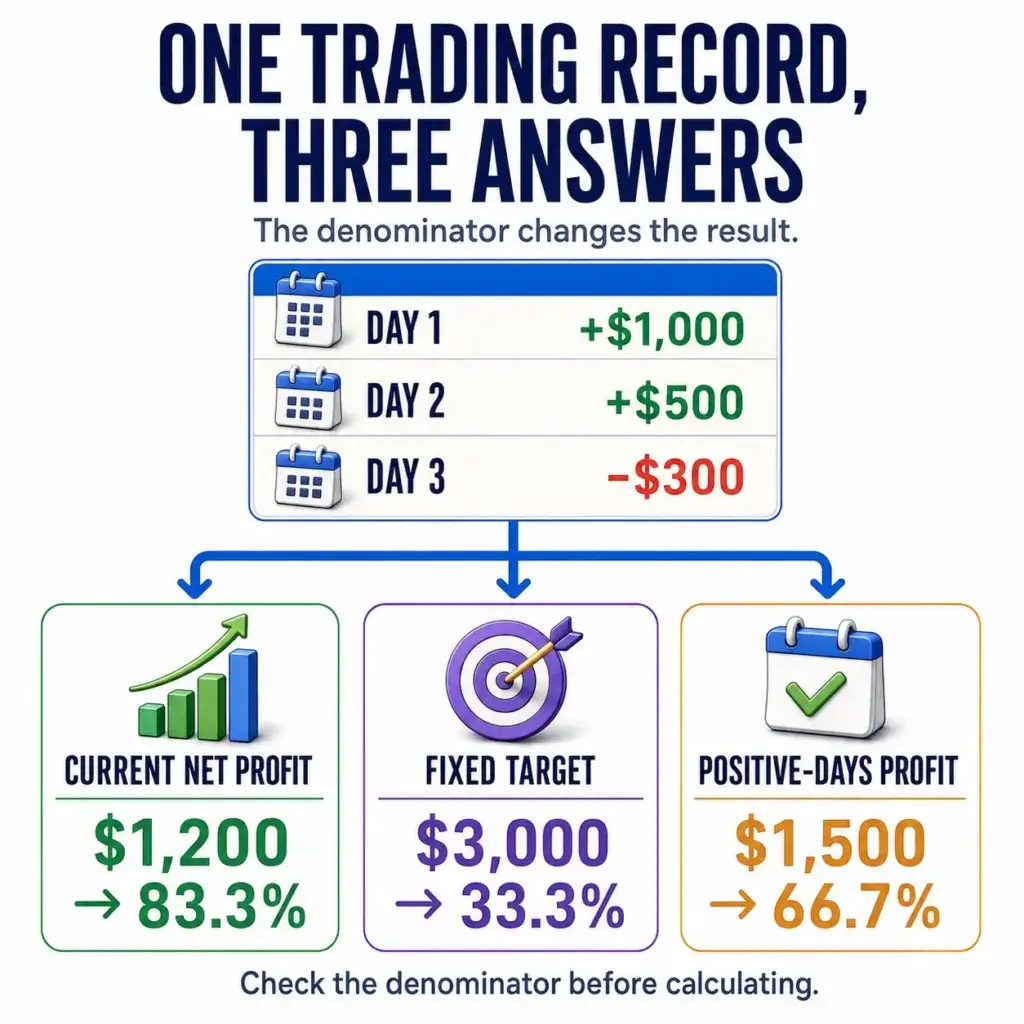
Each calculation is arithmetically correct under its stated denominator. Only the agreement identifies the result that controls the account.
How to Calculate a Prop Firm Consistency Rule
A calculator needs distinct inputs for each result it produces. Work through them in order and keep the denominator’s exact name beside every result.
Calculate the Current Percentage
Assume a rule divides a $1,800 largest day by $3,200 of current defined profit under a 40% limit.
$1,800 ÷ $3,200 × 100 = 56.25%
The current result is 56.25%, which is above the 40% limit. The checkpoint and consequence decide whether the account has failed.
Find the Minimum Required Profit Total
For a ratio whose denominator can grow through added qualifying profit:
Minimum required denominator = best-day profit ÷ limit as a decimal
Using the same example:
$1,800 ÷ 0.40 = $4,500
The result is a $4,500 minimum profit denominator. It is separate from account balance and withdrawal amount and has no relationship to nominal account size or buying power.
The formula can also show how a stated threshold changes the required denominator for the same $1,000 best day.
| Limit | Required Profit for a $1,000 Best Day |
|---|---|
| 15% | $6,666.67 |
| 20% | $5,000 |
| 30% | $3,333.33 |
| 40% | $2,500 |
| 50% | $2,000 |
These figures show the arithmetic only. They do not establish that any percentage is an industry standard or that added profit is the permitted remedy.
Calculate the Additional Profit Needed
Subtract the current qualifying denominator from the required denominator:
Additional qualifying profit = minimum required denominator − current denominator
For the $1,800 example:
$4,500 − $3,200 = $1,300
The account needs another $1,300 of qualifying profit if the rule retains the full best day and allows the denominator to expand. A later day must also remain below the original best day. Earning that $1,300 on the same trading day as the original $1,800 would raise the numerator to $3,100 and invalidate the calculation.
A provider can use a different remedy. HyroTrader’s published evaluation example clips an oversized day to the permitted contribution. HyroTrader does not disclose whether the excluded amount can later count.
Find the Maximum New Best Day
A proposed profitable day changes both the numerator and denominator when it becomes the new best day. For a compatible current-net-profit rule, let prior net profit be P and the proposed day be x. Let the decimal limit be L:
x ÷ (P + x) ≤ L
Rearranged:
x ≤ (L × P) ÷ (1 − L)
If prior net profit is $2,000 and the limit is 40%, the largest proposed new best day under this equation is $1,333.33:
(0.40 × $2,000) ÷ 0.60 = $1,333.33
The result applies only to the matching current-net-profit formula. The trader must also check the existing best day and fee treatment. Rounding and the day cutoff remain relevant. Separate position or conduct rules still apply.
Read an Inverted Consistency Score
Some interfaces reverse the ratio and display total profit divided by the best day. That score rises as profit becomes less concentrated, while the common best-day percentage falls. A dashboard could therefore show a higher-is-better score even though another provider uses a lower-is-better percentage.
Follow the displayed equation and the stated pass condition. The formula determines which direction is favorable.
The ordinary net-profit ratio is also not useful when cumulative net profit is zero or negative. After the first positive day, the best day is normally 100% of current profit. Whether that requires action depends on the checkpoint. A net-profit result can exceed 100% after later losses because the best day stays fixed while total profit falls.
Where Can a Consistency Rule Apply?
The account stage and measurement window can change even when the percentage looks familiar.
| Stage or Window | What to Verify |
|---|---|
| Evaluation | Whether the rule is tested continuously or only when the profit target is reached. |
| Verification | Whether a second stage resets the record or carries the first stage forward. |
| Funded or reward account | Whether the evaluation rule disappears, changes denominator, or becomes a withdrawal condition. |
| Payout cycle | Whether profit since the last request or approved payout forms a new measurement window. |
| Scaling review | Whether qualifying days or profit distribution affect access to a larger account. |
An evaluation can reach its profit target while a concentration condition keeps completion pending. That checkpoint changes how a prop firm challenge works without breaching the account. Earn2Trade publishes an evaluation-only condition. HyroTrader applies its Profit Distribution Rule during evaluation and removes it from the funded account.
After qualification, funded account status begins under a rule set that may retain, revise, or remove the evaluation test. The current funded agreement supplies the active terms.
FundedNext’s stage-specific rules show how one provider can attach different tests to different products. A current optional On-Demand Rewards add-on uses a 40% request-time calculation. A historical FNL evaluation used a 40% target test that recalculated the target instead, and that product is no longer available for new purchase.
MyFundedFutures applies a cycle-based condition to its Builder payout path and restarts it after a defined withdrawal event. Topstep offers an optional XFA consistency path with its own reset wording. A consistency gate can block a prop firm payout before review and settlement begin.
What Happens If You Exceed the Limit?
An above-limit result describes the measurement. The contract supplies the outcome.
| Possible Treatment | What It Means |
|---|---|
| Target increases | The required target is recalculated from the largest qualifying day. |
| Stage remains incomplete | The account stays active, but the trader has not yet met every completion condition. |
| Payout remains pending | A request is unavailable or deferred until the ratio meets the stated test. |
| Excess profit is excluded | Only the permitted part of an oversized result counts toward the relevant target or eligible amount. |
| Manual review | The firm examines the account under its agreement before deciding eligibility. |
| Hard breach | The account fails or closes only where the applicable rule makes the threshold a breach. |
| No concentration rule applies | Other loss, conduct, activity, and payout conditions still control the account. |
Target recalculation changes the required target after an oversized day. Later dilution keeps the original numerator while qualifying profit enlarges a current-profit denominator. Profit clipping counts only the permitted portion of the day.
Several current programs use soft gates. Topstep’s published evaluation and optional payout paths can require more profit without an immediate account breach. FTMO’s applicable Best Day condition leaves passing or reward eligibility pending. HyroTrader’s evaluation example excludes part of the daily contribution. None of those examples creates a universal rule for another product.
A hard breach needs explicit contract language. A red dashboard score or calculator warning cannot prove termination. Another firm’s policy has no authority over the account.
Every extra trade remains subject to the account’s drawdown rule while the trader tries to enlarge a qualifying denominator. A mathematically available repair can therefore reduce remaining loss headroom.
Other Rules That May Be Called Consistency
A best-day percentage is only one way to measure the distribution of performance.
| Rule Type | What It Measures |
|---|---|
| Best trade | The share of total profit produced by one closed trade instead of one day. |
| Position-size or risk consistency | Changes in lot size, contract count, exposure, or risk between trades. |
| Minimum profitable days | Whether enough days meet a defined daily profit threshold. |
| Profit clipping | How much of an oversized daily result counts toward the target or eligible result. |
| Composite or conduct review | A combination of performance concentration and behavior restricted by the agreement. |
Best trade and best day can produce different answers. Suppose one trade earns $2,500 while other trades on the same day lose $500. Total profit is $5,000. The day contributes $2,000, or 40% of total profit. The single trade contributes 50%. A day-only 40% test and a separate best-trade 40% test would not reach the same result.
The5ers High Stakes shows how minimum profitable days can measure distribution without a concentration ratio. It currently requires three profitable days in each evaluation step and defines a qualifying day as at least 0.5% of initial balance under its daily formula. On a $100,000 account, three $100 green days would not meet that condition because each qualifying day needs $500.
A trader can meet a best-day percentage and still breach a separately defined position-size or conduct check. Apply the formula named in the agreement instead of treating every use of “consistent” as the same test.
Why Do Firms Use Consistency Rules?
The rule controls the concentration of performance that a program recognizes for passing or payout. Scaling can use the same condition. One outlier day can dominate a short evaluation record. A percentage cap makes the account reach a larger defined profit total or satisfy more qualifying days before the checkpoint is complete.
Providers often describe this as a way to reward repeatable performance and discourage oversized risk. The ratio supports a narrower conclusion by showing how profit was distributed under the selected formula. Repeatability, prudent risk, and future performance require separate evidence.
The condition also shapes the firm’s payout exposure and the trader’s route through an evaluation. Fees and trading revenue determine part of how prop firms make money. Execution and payout costs supply the other side of that calculation. Judge the consistency condition from its contract effect instead of a marketing explanation of why it exists.
Does No Consistency Rule Mean Fewer Restrictions?
A product without a best-day percentage removes one concentration test. Daily and maximum loss limits can remain. So can exposure caps and prohibited-strategy clauses. Identity checks may sit beside payout conditions and inactivity rules.
Breakout’s account-rule structure, a current crypto example, has no published consistency rule or minimum trading days. Its drawdown limits and conduct restrictions leave the wider rule set intact.
The absence of a rule should be checked at product level. A provider can change the answer by model or stage. An optional add-on or payout route can also matter, as can the purchase date. A firm-wide label can hide those differences.
Assess a no-consistency product against its remaining loss, conduct, activity, and payout rules. Removing one cap does not remove those conditions.
How to Track the Rule Without Forcing Trades
Start with the written formula and copy its labels into a journal. Record the provider’s timezone and daily cutoff, then note how open positions are treated. Record fees separately. Calculate the daily result from the same inputs the agreement uses. A local calendar-day figure is unreliable when the server day closes at another time.
Track the current ratio together with its checkpoint because a result above the threshold is expected after one positive day. The same result at a payout request may block eligibility. Put the date and stage beside the percentage. Record the measurement window too.
Use a working buffer below the stated limit because fees and rounding can move a borderline score. The stated limit remains the contract threshold. Recalculate after a losing day when the denominator uses net profit, and do not reduce a positive-days denominator by losses that the formula excludes.
Do not add market risk merely to dilute an earlier result. Filler trades and artificial midnight splits can create losses. Abrupt size changes may trigger separate conduct rules. The account agreement controls whether more qualifying profit is an available remedy.
Consistency Rule Checklist Before Paying
Save the exact plan name and purchase date. Preserve the agreement version separately. Then record each field before relying on a calculator.
| Check | What to Record |
|---|---|
| Plan and purchase date | The product version and whether legacy terms apply. |
| Numerator | Largest day, largest trade, position, or another measure. |
| Denominator | Net profit, positive-days profit, fixed target, or cycle profit. |
| Limit semantics | Below the cap or at or below the cap. |
| Stage | Evaluation, verification, funded, scaling, or payout review. |
| Window | Whole stage, account lifetime, rolling period, or payout cycle. |
| Day boundary | Timezone, reset time, and handling of trades across midnight. |
| P&L basis | Closed or open P&L, fees, commissions, swaps, and funding costs. |
| Losing days | Included in net profit, excluded from positive-days profit, or treated another way. |
| Checkpoint | Continuous monitoring, target completion, or payout request. |
| Reset | Request, approved payout, new stage, new account, or no reset. |
| Consequence | Higher target, pending status, held payout, clipped profit, review, or hard breach. |
| Other conditions | Minimum days, loss limits, buffers, payout caps, and conduct checks. |
Run one calculation for the current percentage and another for the stated consequence. If the contract uses a soft current-profit gate, calculate the minimum denominator and additional qualifying profit. If it uses a fixed target, record the maximum permitted day and the published treatment of an overshoot.
The signed agreement and account-specific dashboard control an individual account. Use current prop firm rule sets only after confirming which product and stage each listed condition covers.
FAQ
What does a 40% prop firm consistency rule mean?
A 40% rule means the named numerator cannot exceed 40% of the contract’s defined denominator at the stated checkpoint. Under a best-day-to-net-profit formula, a $1,000 best day needs at least $2,500 of net profit. A target-based or positive-days formula can produce another result from the same trades.
How much additional profit is needed after a large best day?
For a compatible expanding-denominator rule, divide the best day by the decimal limit, then subtract the current qualifying denominator. A $1,800 best day at 40% needs a $4,500 denominator, so a current $3,200 denominator needs another $1,300. This holds only if added profit is permitted and no later day becomes the new best day.
Does exceeding a consistency rule fail the account?
Only when the applicable agreement defines the threshold as a breach. Other published treatments raise the effective target or leave stage completion pending. Payout deferral and profit clipping are also possible. Some accounts enter review.
Do losing days make a consistency percentage worse?
They make the result worse when losses reduce a current-net-profit denominator and the best-day numerator stays fixed. A positive-days formula can exclude losing days, while a fixed target does not change after a loss. The denominator decides the effect.
Does a consistency rule apply after an account is funded?
A consistency rule can apply after funding, but the treatment varies by product. Some evaluation rules disappear after qualification. Other programs add a payout-cycle test or keep a best-day condition for reward eligibility. An optional funded-account feature can add another version.
Do all prop firms have a consistency rule?
Some products omit best-day percentages and minimum-day conditions, while drawdown and exposure limits remain. Conduct, identity, inactivity, and payout conditions may also continue to apply.