
Quick Take
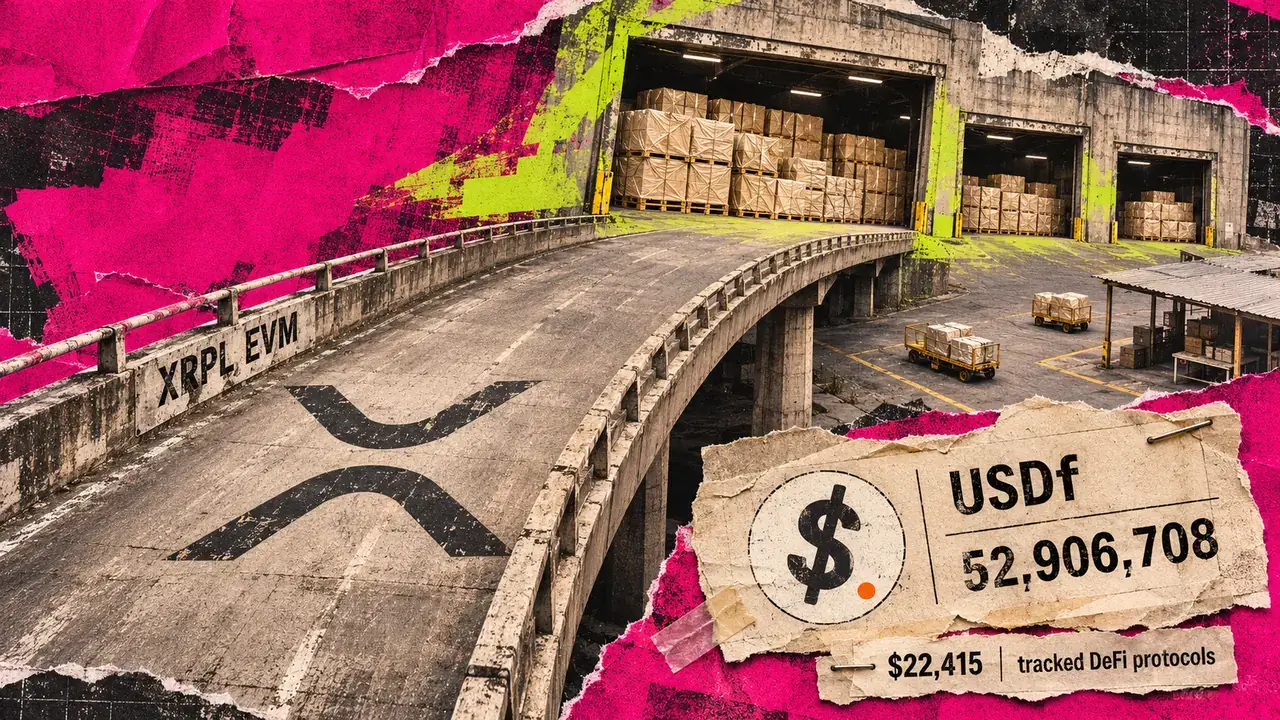
- Three addresses held virtually all 52.91 million USDf tokens on XRPL EVM in a Nov. 17 snapshot.
- DefiLlama tracked $22,415 in DeFi TVL and $0.09 in 24-hour chain fees, separate from bridged stablecoin inventory.
- XRP is required for gas, but concentrated USDf balances do not establish usable liquidity or sustained new XRP buying.


Three addresses hold virtually all the dollar-pegged USDf token supply on XRP Ledger (XRPL) EVM, an XRP-powered smart contract sidechain, according to a Nov. 17 explorer snapshot.
The contract contains 52.9 million tokens, while DefiLlama values the chain's tracked bridged stablecoin inventory at about $52.7 million.
DefiLlama reports $22,415 in total value locked (TLV) in tracked DeFi protocols and just $0.09 in chain fees over 24 hours. Tokens are present, but measured application activity and fee expenditure remain small.
XRPL EVM is a separate blockchain from the native XRP Ledger. Its official documentation describes a sovereign layer-1 that runs Ethereum-compatible smart contracts and uses XRP for transaction fees.
That gives XRP a direct role in operating the chain, without making every dollar bridged there a dollar spent buying XRP.
Where the USDf inventory sits
On Nov. 17, the USDf contract metadata showed a supply of 52,906,708 tokens. The holder list showed four balances: 40 million USDf in the largest, about 7 million in the second, and 5.9 million in the third.
Those positions represent about 75.6%, 13.25%, and 11.15% of supply, respectively. The fourth address, labeled SquidMulticall, held one smallest unit, or 0.000000000000000001 USDf.
The three large addresses have no names or public tags in that response, so they cannot safely be described as three independent investors, customers, or beneficial owners.
52.91 million USDf. Three large balances.
A November 17 snapshot on XRPL EVM shows virtually all indexed USDf supply concentrated in three addresses, plus dust in a fourth.
The largest address holds about three-quarters of USDf supply; concentration alone establishes neither ownership nor economic use.
Explorer snapshot at 13:13 UTC on November 17, 2026. Indexed balances do not establish beneficial owners, transfer-index freshness, redeemability, trading depth, application use or XRP purchases.
Sources and evidence
Sources
Supporting facts
- At 13:13 UTC on November 17, the XRPL EVM explorer reported 52,906,708 USDf tokens at contract 0x5E54c1bbc5F19C7A39CC6ff7dbdFBdF438a3CD60, using 18 decimal places. [1]
- The complete holder response returned three large balances of 40,000,000 USDf, 7,010,009.999999999999999999 USDf and 5,896,698 USDf, plus 0.000000000000000001 USDf in a fourth address. [2] [1]
- Virtually all the indexed USDf supply is in those three addresses; the largest holds about 75.60%, with about 13.25% and 11.15% in the next two. Addresses do not establish distinct beneficial owners. [2] [1]
- The explorer does not name or tag the three large holder addresses, while the one-base-unit fourth holding is labeled SquidMulticall; the large holders' roles remain unidentified in this evidence. [2]
Method
Treemap areas use each raw balance divided by 52,906,708 × 10^18. Labels round shares to two decimals and holdings to the displayed millions. Fourth-address dust is one base unit (10^-18 USDf) and is not given an exaggerated area. Desktop and mobile preserve the same areas.
Scope
Explorer snapshot at 13:13 UTC on November 17, 2026. Indexed balances do not establish beneficial owners, transfer-index freshness, redeemability, trading depth, application use or XRP purchases.
 CryptoSlate
Falcon Finance reported the bridge route in a recap published July 14, 2025, and said USDf was among the assets included in $100 million bridged to XRPL EVM through Axelar.
DefiLlama's Nov. 17 stablecoin API entry records 52,906,708 circulating dollar-pegged units and a dollar valuation of $52,674,373.43, implying about $0.9956 per unit.
Its separate chain dashboard displayed $52.6 million in stablecoin market capitalization, with USDf accounting for all tracked stablecoins.
The $22,415 DeFi total measures another category. Under DefiLlama's methodology, chain TVL sums assets deposited in tracked protocols, while bridge TVL is excluded from chain totals. The difference between inventory and TVL cannot be read as missing money, or used to establish that every token outside tracked protocols is idle.
Tokens can be present without the data demonstrating deep trading liquidity, broad participation, or sustained borrowing and lending. Dollar TVL also changes with token prices, making token balances and application activity necessary companions to the valuation.
What the activity means for XRP
The same DefiLlama dashboard reported zero in tracked decentralized-exchange volume over 24 hours and $5.37 over seven days, with its reported chain fees at $0.09 over 24 hours.
The chain explorer series counted 1,365 on Nov. 16, the latest full calendar day, following 1,004 on Nov. 15 and 1,020 on Nov. 14.
Paying fees uses XRP, but the stock of USDf does not establish fresh XRP purchases, the size of users' XRP holdings, or persistent demand to replenish them.
Broader balance distribution, usable trading depth, and repeated application transactions would strengthen the case for functioning liquidity.
Repeated XRP fee expenditure would demonstrate continued gas use, while evidence of fresh purchases would be needed to establish new buying demand.
Mentioned in this article


Editorial credits