



Prop-firm fees are at risk, most participants do not reach a payout, and simulated funding does not necessarily represent live firm capital. This review is informational, not financial advice.
Blue Guardian Overview
- Company Name
- Blue Guardian
- Registered In
- Saint Lucia and United Arab Emirates
- Launch Year
- 2021
- Evaluation Fees
- Forex / CFD: $32–$930; Futures: $154–$424
- Account Sizes
- Forex / CFD: $5,000–$200,000; Futures: $25,000–$150,000
- Challenge Types
- Forex / CFD: Two Step; Futures: Futures Evaluation
- Profit Targets
- Forex / CFD: 4–8%; Futures: 1500 USD
- Maximum Drawdown
- Forex / CFD: 8%; Futures: 1,500 USD
- Maximum Daily Loss
- Forex / CFD: 4%; Futures: 1000 USD
- Profit Split
- Forex / CFD: 85%–90%; Futures: 90%
- Minimum Trading Days
- Forex / CFD: 5; Futures: 1–3
- Fee Refund
- Forex / CFD: Refundable: The evaluation fee is refunded after the fourth funded-account payout.; Futures: Not refundable
- Maximum Allocation
- Forex / CFD: $2,000,000
- Payout Time
- Crypto: 24 hours; Rise: 24 hours
- Website
- blueguardian.com
Blue Guardian Screenshots

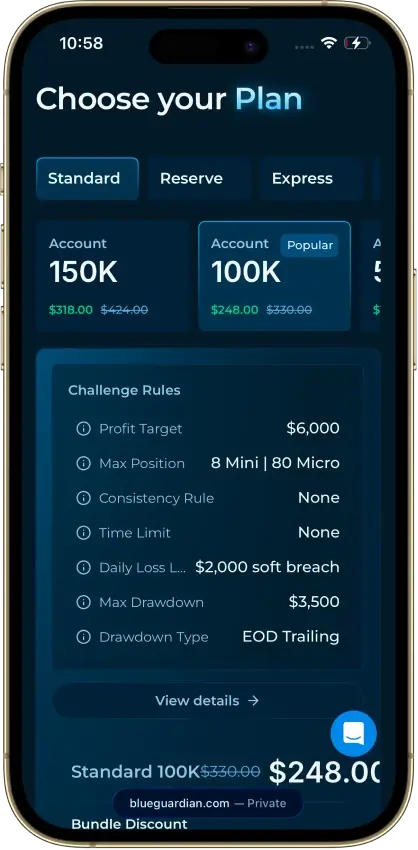
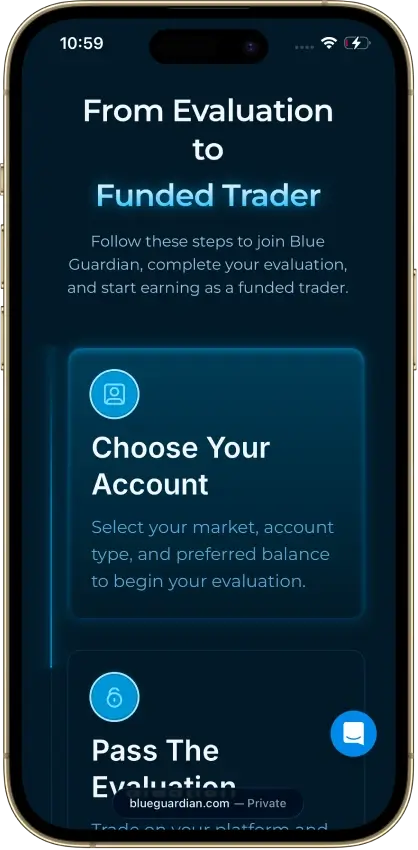
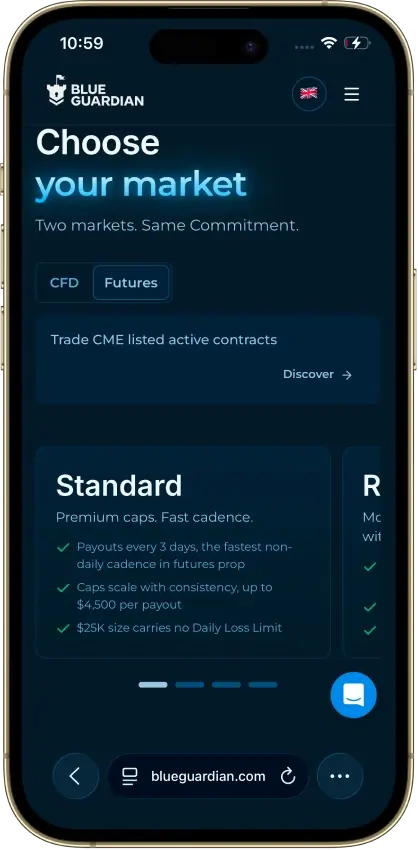

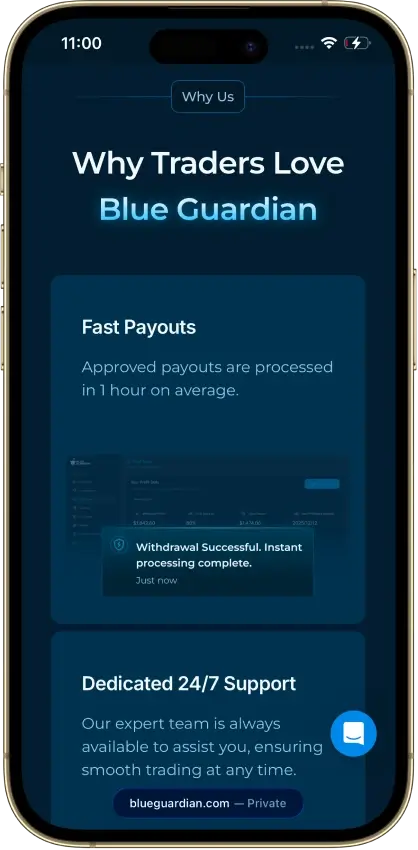

Screenshot 1 of 8
Blue Guardian Pros and Cons
Pros
- CFD entry fees start at $24
- Fee refund after the fourth CFD payout
- Up to 90% CFD profit split
- Instant CFD and futures funding
- $0 commission on indices and crypto
Cons
- Tighter CFD drawdown limits
- Guardian Shield can cut the split to 50%
- Funded CFD news window is restricted
- Funded leverage drops on some programs
How the Blue Guardian Challenge Works
Blue Guardian runs nine account structures across two divisions. CFD spans instant funding through a two-phase challenge, while Futures is built specifically around futures contracts with its own daily loss and payout cadence per model.
Instant (CFD)
Get it if:
You already trust your strategy and don’t want to spend time chasing a profit target
You want funded access immediately after purchase
You’re comfortable with a tighter trailing drawdown and daily loss limit than the challenge accounts get
| Rule | Limit |
|---|---|
| Account sizes | $5K, $10K, $25K, $50K, $100K, $200K, $300K, $400K |
| Profit target | None (instant access) |
| Max daily loss | 3% of initial balance |
| Max overall drawdown | 6% trailing |
| Minimum trading days | 5 profitable days |
| Consistency rule | 20% (15% on $300K and $400K accounts) |
| Profit split | 80% standard, 90% with add-on |
| Payout cycle | On demand |
| News trading | Not allowed |
| KYC requirement | Required before first payout |
Instant Starter (CFD)
Get it if:
You want to test Blue Guardian’s instant funding model at the lowest possible cost
You’re fine with a single payout capped at $250 before deciding whether to scale up
You’d rather skip KYC verification for a quick, low-stakes trial run
| Rule | Limit |
|---|---|
| Account size | $5K |
| Profit target | None (instant access) |
| Max daily loss | 3% of initial balance |
| Max overall drawdown | 5% trailing |
| Minimum trading days | 5 profitable days |
| Consistency rule | 15% |
| Maximum profit cap | $250 |
| Profit split | 90% (fixed) |
| Payout cycle | On demand, one payout only |
| News trading | Allowed |
| KYC requirement | Not required |
1-Step (CFD)
Get it if:
You want only one evaluation phase to clear instead of two
You don’t want a consistency rule attached to your account at any stage
You’re comfortable with a 6% trailing drawdown instead of a fixed static one
| Rule | Limit |
|---|---|
| Account sizes | $5K, $10K, $25K, $50K, $100K, $200K |
| Profit target | 10% |
| Max daily loss | 4% |
| Max overall drawdown | 6% trailing |
| Minimum trading days | 3 profitable days |
| Consistency rule | Not applicable |
| Profit split | Up to 90% with add-on |
| Payout cycle | Every 14 days (7-day add-on available) |
| News trading | Allowed during evaluation, restricted once funded |
| KYC requirement | Required before first payout |
2-Step Standard (CFD)
Get it if:
You want a predictable static drawdown that won’t shift once it’s set
You’d rather skip a consistency rule tied to your funded account, unlike 2-Step Pro
You prefer a gradual two-phase evaluation with a smaller Phase 2 target
| Rule | Limit |
|---|---|
| Account sizes | $5K, $10K, $25K, $50K, $100K, $200K |
| Profit target | 8% (Phase 1), 4% (Phase 2) |
| Max daily loss | 4% |
| Max overall drawdown | 8% static |
| Minimum trading days | 5 profitable days |
| Consistency rule | Not specified |
| Profit split | 85% standard, 90% with add-on |
| Payout cycle | Every 14 days (7-day add-on available) |
| News trading | Allowed during evaluation, restricted once funded |
| KYC requirement | Required before first payout |
2-Step Pro (CFD)
Get it if:
You want extra drawdown room, 10% trailing versus Standard’s 8% static
You don’t mind a 25% consistency rule once funded in exchange for that room
You want one fewer minimum trading day than Standard
| Rule | Limit |
|---|---|
| Account sizes | $5K, $10K, $25K, $50K, $100K, $200K |
| Profit target | 10% (Phase 1), 4% (Phase 2) |
| Max daily loss | 4% |
| Max overall drawdown | 10% trailing |
| Minimum trading days | 4 profitable days |
| Consistency rule | 25% (funded accounts) |
| Profit split | 85% standard, 90% with add-on |
| Payout cycle | Every 14 days (7-day add-on available) |
| News trading | Allowed during evaluation, restricted once funded |
| KYC requirement | Required before first payout |
Standard (Futures)
Get it if:
You want a predictable one-phase evaluation with a fixed profit target scaled to account size
You’re comfortable passing in as little as a single trading day
You don’t need extra payout flexibility beyond a standard cycle
| Rule | $25K | $50K | $100K | $150K |
|---|---|---|---|---|
| Profit target | $1,500 | $3,000 | $6,000 | $9,000 |
| Max position size | 1 mini / 10 micro | 4 mini / 40 micro | 8 mini / 80 micro | 12 mini / 120 micro |
| Daily loss limit | None | $1,000 | $2,000 | $3,000 |
| Daily loss breach type | Not applicable | Soft breach | Soft breach | Soft breach |
| Max drawdown (evaluation) | $1,500 | $2,000 | $3,500 | $5,000 |
| Drawdown type | EOD trailing | EOD trailing | EOD trailing | EOD trailing |
| Consistency rule (funded) | 40% | 40% | 40% | 40% |
| News trading | Allowed | Allowed | Allowed | Allowed |
| Profit split | 90/10 | 90/10 | 90/10 | 90/10 |
Daily loss on Standard runs at 2% of the initial balance, with the $25K tier carrying no daily loss limit at all.
Express (Futures)
Get it if:
You want frequent (daily), smaller payouts instead of one large cycle
You’re fine with a 40% consistency rule during the challenge that disappears once funded
You’re starting with at least $50K, since Express isn’t offered on the $25K tier
| Rule | $50K | $100K | $150K |
|---|---|---|---|
| Profit target | $3,000 | $6,000 | $9,000 |
| Max position size | 4 mini / 40 micro | 8 mini / 80 micro | 12 mini / 120 micro |
| Daily loss limit | $1,000 | $2,000 | $3,000 |
| Daily loss breach type | Soft breach | Soft breach | Soft breach |
| Max drawdown (evaluation) | $2,000 | $3,500 | $5,000 |
| Drawdown type | EOD trailing | EOD trailing | EOD trailing |
| Consistency rule | 40% (challenge only, none on funded) | 40% (challenge only, none on funded) | 40% (challenge only, none on funded) |
| News trading | Allowed | Allowed | Allowed |
| Profit split | 90/10 | 90/10 | 90/10 |
Reserve (Futures)
Get it if:
You want no default daily loss limit at all, with the option to add one back for extra protection
You can handle a 50% challenge-only consistency cap in exchange for that flexibility
You’d rather have no consistency requirement left once funded
| Rule | $25K | $50K | $100K | $150K |
|---|---|---|---|---|
| Profit target | $1,500 | $3,000 | $6,000 | $9,000 |
| Max position size | 2 mini / 20 micro | 4 mini / 40 micro | 8 mini / 80 micro | 12 mini / 120 micro |
| Daily loss limit | None (optional add-on: $500) | None (optional add-on: $1,000) | None (optional add-on: $2,000) | None (optional add-on: $3,000) |
| Max drawdown (evaluation) | $1,500 | $2,000 | $3,500 | $5,000 |
| Drawdown type | EOD trailing | EOD trailing | EOD trailing | EOD trailing |
| Consistency rule | 50% (challenge only, none on funded) | 50% (challenge only, none on funded) | 50% (challenge only, none on funded) | 50% (challenge only, none on funded) |
| News trading | Allowed | Allowed | Allowed | Allowed |
| Profit split | 90/10 | 90/10 | 90/10 | 90/10 |
Reserve also carries a 1% consistency cushion, letting the single largest profit day reach up to 51% of total profits instead of a hard 50% cutoff.
Direct (Futures)
Get it if:
You want instant funded access, skipping the evaluation phase entirely
You’re comfortable with a consistency requirement that climbs with each successive payout
You want Blue Guardian’s fastest realistic path to a first futures payout
| Rule | $25K | $50K | $100K | $150K |
|---|---|---|---|---|
| Profit target | Not applicable | Not applicable | Not applicable | Not applicable |
| Max position size | 1 mini / 10 micro | 4 mini / 40 micro | 8 mini / 80 micro | 12 mini / 120 micro |
| Daily loss limit | $1,000 | $1,250 | $2,500 | $3,000 |
| Max drawdown | $1,500 | $2,000 | $3,500 | $4,500 |
| Drawdown type | EOD trailing until threshold or first payout, then static | Same | Same | Same |
| Consistency rule | 20% (1st payout), 25% (2nd), 30% (3rd+) | Same | Same | Same |
| News trading | Allowed | Allowed | Allowed | Allowed |
| Profit split | 90/10 | 90/10 | 90/10 | 90/10 |
Blue Guardian Markets, Platforms, and Trading Conditions
Blue Guardian runs on MetaTrader 5 (MT5), Match Trader, and TradeLocker on the CFD side, selected at signup. US traders are restricted to Match Trader and TradeLocker only, with MT5 unavailable. Platform migration is only possible if no trades have been executed on the account yet, and giveaway accounts aren’t eligible for migration at all.
On the Futures side, Blue Guardian runs on Tradovate and DeepCharts, a narrower selection than other futures prop firms offer, several of which now include TradeSea as well, which has become fairly standard across the space.
Every account, evaluation or funded, is explicitly a demo account operating in a simulated environment. No orders are routed to a live exchange, though pricing mirrors real market quotes sourced from liquidity providers to keep execution realistic. This applies across both the CFD and Futures divisions.
Tradable instruments on the CFD side span forex, indices, gold and commodities, and cryptocurrencies. The commission runs $5 per lot on forex and commodities, and $0 on indices and crypto. The trading margin stop out level sits at 100%, meaning the least profitable open position gets closed automatically if the account falls below that threshold.
Leverage is where the account-specific rules matters most, since the advertised ratio shifts depending on which stage of the account a trader is in, not just the account type itself.
| Stage | Forex | Indices | Commodities | Crypto |
|---|---|---|---|---|
| Evaluation (1-Step, 3-Step) | 1:50 | 1:20 | 1:20 | 1:2 |
| Evaluation → Funded (2-Step Pro, 2-Step Standard) | 1:50 | 1:10 | 1:10 | 1:2 |
| Funded (1-Step, 2-Step Standard) | 1:50 | 1:10 | 1:10 | 1:2 |
| Instant & Instant Starter | 1:30 | 1:10 | 1:10 | 1:2 |
Leverage for indices and commodities gets cut in half the moment an account moves from evaluation to funded status on every challenge model, dropping from 1:20 down to 1:10. Instant accounts start even lower, at 1:30 on forex against the 1:50 evaluation traders get on the challenge path, so the instant route trades faster access for a tighter leverage ceiling from day one. Crypto stays flat at 1:2 regardless of stage or account type, and forex leverage is the only figure that holds steady at 1:50 once an account reaches funded status on a challenge model.
On the Futures side, there’s no leverage ratio in the traditional sense. Exposure is capped instead by a fixed number of mini and micro contracts per account size. Standard and Direct accounts use fixed contract limits that stay the same from evaluation through funded, scaling from 1 mini or 10 micro contracts on the smallest $25K tier up to 12 mini or 120 micro contracts at $150K.
Reserve and Express work differently. Both give full contract access during evaluation, but once funded, contract limits actually start lower than what was available during the challenge and scale back up progressively as the account grows, recalculated at end of day based on closing balance. A $100K Reserve account trading with 8 minis during evaluation drops to 3 minis the moment it’s funded, then climbs back up in steps, unlocking 4 minis after growing the balance by $1,500 and holding that gain through end of day, then 5 minis at the next threshold, and so on.
Blue Guardian Rules and Restrictions
CFD
Blue Guardian applies a consistent framework of core rules across every CFD account, though the specific thresholds shift depending on which model a trader has chosen. Below is a breakdown of each major rule, how it differs across account types, and a worked example to show how the calculation plays out in practice.
Maximum Daily Loss
This rule caps how far equity can fall within a single trading day, measured against whichever figure is higher: the account balance or the equity at the moment of reset. Both open and closed losses count toward the limit, and the clock resets at 5pm EST every day, marking the start of a new trading day.
| Account Type | Max Daily Loss |
|---|---|
| Instant, Instant Starter | 3% of initial balance |
| 1-Step, 2-Step Standard, 2-Step Pro | 4% of initial balance |
Example (2-Step Standard, $25K account): If equity at 5pm EST sits at $25,600 due to an open floating profit, but the account balance is only $25,000, Blue Guardian uses the higher figure, $25,600, as the baseline. 4% of $25,600 is $1,024, so equity cannot drop below $24,576 before the next reset. If instead the trader is sitting on a floating loss and equity reads $24,400 while balance remains $25,000, the daily limit is calculated on the $25,000 balance instead, since that’s the higher value, setting the floor at $24,000.
Maximum Overall Drawdown
This is the hard ceiling on total losses across the life of the account, and Blue Guardian uses either a trailing or static structure depending on the model. On trailing accounts, the floor rises alongside the account’s highest ever closing balance but never moves back down, and it locks permanently once the account reaches its qualifying profit percentage, at which point a small buffer is added on top. On static accounts, the floor is fixed a set distance below the starting balance from day one and never adjusts regardless of how much profit the account later makes.
| Account Type | Max Overall Drawdown | Type |
|---|---|---|
| Instant | 6% | Trailing |
| Instant Starter | 5% | Trailing |
| 1-Step | 6% | Trailing |
| 2-Step Standard | 8% | Static |
| 2-Step Pro | 10% | Trailing |
Example (1-Step, $50K account): The trailing floor starts at $47,000, sitting 6% below the $50,000 starting balance. If the account climbs to a $54,000 high watermark, the floor rises with it to $50,760. If the account later pulls back to $51,500, the floor stays at $50,760 instead of dropping, since a trailing floor only ever moves upward. Once the account clears 6% profit from its original starting balance, the floor locks permanently at $50,000 plus a small buffer, and stops trailing from that point forward.
Consistency Requirements
This rule stops a single winning day from making too large a share of an account’s total profit before a payout can be requested. It doesn’t breach or close the account when triggered. It simply blocks the payout request button until additional trading brings the percentage back under the threshold.
| Account Type | Consistency Rule |
|---|---|
| Instant | 20% (15% on $300K and $400K accounts) |
| Instant Starter | 15% |
| 1-Step | Not applicable |
| 2-Step Standard | Not applicable |
| 2-Step Pro | 25% (funded accounts) |
Example (Instant, $100K account): A trader books $2,400 on a single best day. Under the 20% consistency rule, that day cannot represent more than a fifth of total profits, meaning the account needs at least $12,000 in cumulative profit before a payout request becomes available. Trading a smaller, steadier string of profitable days afterward brings that single day’s share back under the 20% mark and unlocks the payout button.
Guardian Shield
Guardian Shield is Blue Guardian’s automated risk control that closes every open position once floating losses across the account hit a set percentage of the starting balance. It counts as a soft breach, meaning trading can resume immediately afterward, but the consequences escalate with repeat triggers and can’t be reversed once applied.
| Account Type | Trigger Threshold | 1st Breach | 2nd Breach |
|---|---|---|---|
| Instant, Instant Starter | 1% floating loss | Profit split cut to 50% | Account permanently closed |
| 1-Step, 2-Step Standard, 2-Step Pro | 2% floating loss (funded only) | Profit split cut to 50% | Account permanently closed |
Example (2-Step Pro, $200K funded account): Three open positions carry a combined floating loss of $4,000, which equals 2% of the starting balance. Guardian Shield automatically closes every open trade the moment that threshold is crossed. Trading can continue right away, but this counts as the first breach, so the profit split on this account drops from 85% to 50% for good. A second breach at any point afterward ends the account permanently.
News Trading
Blue Guardian restricts trading activity around high impact, red folder economic releases and FOMC events on funded accounts, defined as a window running from 5 minutes before the event to 5 minutes after. Evaluation phase accounts trade through news without restriction, since the rule only applies once an account is funded.
Weekend and Overnight Holding
Blue Guardian places no restrictions on holding trades overnight or across the weekend on any CFD account, evaluation or funded. This is a notable point of difference from firms that force flat positions before the weekly close.
Inactivity Rule
An account is flagged inactive if no trade is placed within a rolling 30-day window, whether during the evaluation stage or after funding. This rule applies identically across every account type on the CFD side.
Futures
The same rule categories apply on the Futures side, though the mechanics differ in a few places, most notably that limits are set in flat dollar terms instead of percentages, and they scale by account size.
Daily Loss Limit
| Account Type | $25K | $50K | $100K | $150K |
|---|---|---|---|---|
| Standard | None | $1,000 | $2,000 | $3,000 |
| Express | Not offered | $1,000 | $2,000 | $3,000 |
| Reserve | None (optional add-on: $500) | None (optional add-on: $1,000) | None (optional add-on: $2,000) | None (optional add-on: $3,000) |
| Direct | $1,000 | $1,250 | $2,500 | $3,000 |
Example (Express, $50K account): The daily loss limit sits at $1,000, or 2% of the starting balance. If the account’s balance or equity falls through that figure on a given trading day, every open position is closed automatically and the account is paused for the rest of that session. This is a soft breach, so trading resumes normally at the start of the next session instead of ending the account outright.
Maximum Drawdown
| Account Type | $25K | $50K | $100K | $150K |
|---|---|---|---|---|
| Standard | $1,500 | $2,000 | $3,500 | $5,000 |
| Express | Not offered | $2,000 | $3,500 | $5,000 |
| Reserve | $1,500 | $2,000 | $3,500 | $5,000 |
| Direct | $1,500 | $2,000 | $3,500 | $4,500 |
Example (Standard, $50K account): The drawdown trails the account’s end of day closing balance instead of intraday equity, so a temporary intraday dip that recovers by the close doesn’t tighten the floor. Once the trailing amount climbs to match the $50,000 starting balance, it locks in place and stops trailing altogether, becoming the account’s permanent loss ceiling from that point forward. After any approved payout, the floor resets to $50,100, the starting balance plus a $100 buffer.
Consistency Requirements
| Account Type | Consistency Rule |
|---|---|
| Standard | 40% (funded accounts) |
| Express | 40% (evaluation only, none on funded) |
| Reserve | 50% (evaluation only, none on funded), 1% cushion applies |
| Direct | 20% on 1st payout, 25% on 2nd, 30% on 3rd and beyond |
Example (Reserve, $100K account): The profit target during evaluation is $6,000. Suppose a trader’s best single day nets $3,500, more than 50% of that $6,000 target. To bring that day’s share back under the 50% cap, total profit needs to climb to at least $7,000 instead of the original $6,000, since $3,500 divided by $7,000 works out to 50%. The 1% cushion nudges that slightly lower in practice, but the trader still needs to keep trading past the original target to dilute that one big day’s share before the evaluation can be passed.
News Trading
News trading is allowed across every Futures account type, both during evaluation and once funded, unlike the restricted window that applies to CFD accounts on the Master stage.
Weekend and Overnight Holding
Blue Guardian’s futures rule pages don’t carry any explicit restriction on weekend or overnight holding, matching the open approach taken on the CFD side.
Blue Guardian Pricing and Account Sizes
Blue Guardian charges a one time evaluation or activation fee per account, priced by size and model, before any promotional discount.
CFD Pricing
| Account Size | Instant | 1-Step | 2-Step Standard | 2-Step Pro |
|---|---|---|---|---|
| $5K | $72 | $40 | $32 | $24 |
| $10K | $100.00 | $66.00 | $75.00 | $54 |
| $25K | $206 | $134 | $154 | $95 |
| $50K | $324 | $200 | $232 | $168 |
| $100K | $623 | $390 | $463 | $371 |
| $200K | $954 | $736 | $930 | $736 |
| $300K | $1,712 | Not offered | Not offered | Not offered |
| $400K | $2,200 | Not offered | Not offered | Not offered |
Instant Starter, Blue Guardian’s one time $5K entry account, is priced separately at $13.34 and can only be purchased once per trader.
Futures Pricing
| Account Size | Standard | Express | Reserve | Direct |
|---|---|---|---|---|
| $25K | $154 | Not offered | $110 | $307 |
| $50K | $209 | $178 | $154 | $494 |
| $100K | $330 | $282 | $248 | $659 |
| $150K | $424 | $386 | $462 | $824 |
Add-Ons and Extra Fees
Profit Split Add-On (CFD): A 90% profit split can be purchased at checkout on Instant, 1-Step, 2-Step Standard, and 2-Step Pro accounts, upgrading from the default 80% or 85% split. Instant Starter is fixed at 90% with no upgrade needed.
7-Day Payout Add-On (CFD): Available on 1-Step, 2-Step Standard, and 2-Step Pro accounts, this shortens the payout cycle from the standard 14 days down to 7. Instant and Instant Starter already run on demand, so this add-on doesn’t apply to either.
Payout Processing Fee (Both): A flat 2% fee applies to every payout across both CFD and Futures accounts, deducted before funds are released. This means the amount received will run slightly below the figure shown on the payout certificate.
CFD Refund Policy (CFD): There’s no separate reset fee structure documented for CFD accounts. Instead, the evaluation fee is fully refunded after a trader’s fourth payout on a funded account. This policy applies to accounts purchased from January 21, 2026 onward. earlier accounts may not be covered. If the account hard-breaches before reaching the fourth payout, the original fee is forfeited entirely.
Reset Fees (Futures): Breached Standard, Express, and Reserve futures accounts can be reset instead of repurchased from scratch, with fees fixed by account size regardless of any active promo code. Direct accounts, being instant funded with no evaluation phase, don’t carry a reset option.
Reactivation Fees (Futures): A breached funded futures account on Standard, Express, or Reserve can be reactivated without repeating the evaluation, provided it’s before the first payout and within 30 calendar days of the breach, capped at two reactivations per account. Direct accounts don’t carry this option either.
Daily Loss Limit Add-On (Futures): Since Reserve accounts carry no daily loss limit by default, traders can optionally add one back in at checkout for extra protection.
No Recurring Fees (Both): Blue Guardian does not charge monthly subscription or platform fees on Futures accounts beyond the one time purchase, reset, or reactivation cost. Nothing in the available material suggests a recurring fee structure on the CFD side either.
Blue Guardian Discount and Offers
The current Blue Guardian coupon code is BG25, taking 25% off the evaluation fee at checkout across every CFD and Futures account model, with no account size excluded from the discount.
Blue Guardian also runs a bundle discount for traders purchasing multiple accounts in a single order: 30% off for 2 accounts, 35% off for 3, and 40% off for 4.
Beyond the discount code, the real long-term saving is the challenge fee refund available on every CFD account except Instant Starter, where the original evaluation fee is returned in full after a trader’s fourth payout on a funded account.
Blue Guardian Payouts and Profit Split
CFD Payouts
Profit split on the CFD side depends on the account model, with an optional add-on available on every type except Instant Starter, which comes fixed at the top rate.
| Account Type | Default Split | With Add-On | Payout Frequency |
|---|---|---|---|
| Instant | 80% | 90% | On demand |
| Instant Starter | 90% (fixed) | Not applicable | On demand, one payout only |
| 1-Step, 2-Step Standard, 2-Step Pro | 85% | 90% | Every 14 days (7-day add-on available) |
To request a payout, a trader must have cleared the account’s minimum trading day requirement, sit above the initial balance, hold no active rule violations, close every open position, and fall under the account’s consistency threshold where one applies.
Trailing drawdown accounts (Instant, 1-Step, and 2-Step Pro) also carry a 1% withdrawal buffer once the drawdown locks at breakeven, meaning a small slice of the initial balance has to stay untouched at withdrawal time so a trader can’t strip the account down to its exact breach level.
$200K, $300K, and $400K Instant accounts carry a special condition. The first two reward requests are capped at $10,000 each, after which the cap lifts entirely provided the account stays compliant.
Minimum withdrawal: $100 via crypto, $500 via Rise. Crypto payouts are available for amounts under $5,000. Rise carries no maximum. All CFD payouts are subject to a flat 2% processing fee, deducted before funds are released.
Futures Payouts
Futures payouts run on a 90/10 split across all four models, but the frequency, caps, and eligibility conditions differ sharply between account types. All Futures payouts are also subject to a flat 2% processing fee, the same as CFD.
| Account Type | Profit Split | Payout Frequency | Eligibility Basis |
|---|---|---|---|
| Standard | 90/10 | 3 days after first trade, then ongoing | Consistency rule (funded) + buffer balance cleared |
| Express | 90/10 | Instant, daily | Daily payout cap, buffer balance cleared |
| Reserve | 90/10 | Instant, after winning days met | 5 winning days at a minimum per-day profit, no buffer requirement |
| Direct | 90/10 | Instant, after consistency and profit goal met | Scaling consistency rule + payout profit goal, no buffer requirement |
Standard ties payouts to a buffer balance that scales by account size, meaning the account has to clear a set threshold above starting balance before any withdrawal becomes available, and the payout cap itself steps up after the first successful request.
Express trades that structure for speed, allowing a request every single day up to a fixed daily cap, provided the buffer balance is cleared.
Reserve drops the buffer requirement entirely but gates payouts behind five winning days, each needing to clear a small minimum profit tied to account size, and caps each request at 50% of accumulated profit up to a size-based ceiling.
Reserve accounts purchased before July 27, 2026 keep their original payout terms for the life of the account. For accounts purchased on or after that date, payouts 2 through 5 carry an added condition on top of the five winning days requirement: the account must also clear a minimum net profit since the last approved payout, calculated as total profits minus total losses over that stretch, not just gross winning-day profit.
| Account Size | Winning Day Minimum | Net Profit Required | Payout Cap |
|---|---|---|---|
| $25K | $100 | $500 | $1,000 |
| $50K | $150 | $750 | $2,000 |
| $100K | $200 | $1,000 | $2,500 |
| $150K | $250 | $1,250 | $3,000 |
Net profit is calculated across all trading since the last payout, winners and losers combined. On a $50K account, a trader who books $900 in profit but also takes a $300 loss during the same cycle nets $600, which falls short of the required $750, so the payout stays blocked until net profit reaches that threshold even if the five winning days are already satisfied.
Both the winning day count and the net profit requirement reset after every approved payout. This doesn’t change how much can be withdrawn, the 50%-of-profit payout cap still applies, it only changes when a payout becomes available.
Direct has no buffer requirement either, but its consistency bar climbs with each payout (20% on the first, 25% on the second, 30% from the third onward), paired with a rising profit goal that has to be re-earned before each request.
Minimum withdrawal: $100 via crypto and $500 via Rise across Standard, Express, and Reserve. Direct carries a higher floor at $1,000 via either method.
24-Hour Payout Guarantee
Blue Guardian processes every payout, CFD or Futures, within 24 business hours of the request. If that window is missed due to a delay on Blue Guardian’s end, compensation kicks in, though the structure varies by account type instead of by product line.
| Account Type | Late Payout Compensation |
|---|---|
| Instant, Instant Starter, 1-Step (CFD) | Additional 10% profit share on that payout |
| 2-Step Standard, 2-Step Pro (CFD) | Flat $1,000 |
| Standard, Express, Reserve, Direct (Futures) | Flat $1,000 |
The guarantee doesn’t apply to delays caused by weekends, bank holidays, compliance checks, or a trader’s own slow response during Rise onboarding.
Payout Evidence
Blue Guardian’s own blog states the firm has distributed $23.8M across more than 9,219 individual withdrawals, with the largest single payout reaching $40,000.
Trustpilot reflects a generally positive picture. The CFD entity carries just over 2,000 reviews with roughly 65% 5-star ratings, while the Futures entity sits around a 4 out of 5 rating across just over 1,000 reviews. Recurring praise centers on fast payout processing and responsive support, while complaints tend to cluster around consistency rule enforcement instead of outright non-payment.
Is Blue Guardian Legit and Safe?
Blue Guardian is a real, operating company incorporated as Blue Guardian Limited in Saint Lucia, with payment processing and educational products handled through a related Dubai entity, Iconic Exchange FZCO. It states plainly that it isn’t a regulated broker and doesn’t hold a financial services license, and every account is explicitly a demo account trading in a simulated environment instead of live markets.
It’s been operating since 2021, putting it at roughly five years in business as of mid-2026, backed by a self-reported $23.8M in payouts across more than 9,219 withdrawals. On Trustpilot, the CFD entity holds roughly 65% five-star reviews across just over 2,000 total, while the Futures entity sits around 4 out of 5 across just over 1,000 reviews.
Blue Guardian Alternatives
The other major CFD prop firms bring materially different rule structures to the table, not just different price tags, so the right fit often comes down to what a trader’s strategy actually needs.
FundedNext: Runs 5% daily and 10% static drawdown on its Stellar 2-Step, plus a 40% consistency rule during the challenge, far looser than Blue Guardian’s 20-25% caps. It also permits unrestricted news trading during evaluation, and even funded CFD accounts only face a partial profit-split penalty instead of a full restriction, both easier than Blue Guardian’s 5-minute funded window. FundedNext also runs its own dedicated Futures division
FTMO: Runs 5% daily and 10% static drawdown on its 2-Step, similar to Blue Guardian’s 2-Step Pro, with no consistency rule at all, giving more room for a single best day. The limitation is weekend holding, which requires a separate Swing account type, while Blue Guardian allows it on every account by default.
FundingPips: Sits at 5% daily and 10% static max drawdown, wider than Blue Guardian’s 4% and 8%, but weekend holding on Master Accounts is currently suspended, a restriction Blue Guardian doesn’t carry on any account type.
Blue Guardian’s edge is unrestricted weekend and overnight holding across every account without needing a special variant, plus a dedicated Futures division. Its drawback is drawdown room, since its CFD limits run tighter than the 5%/10% baseline all three competitors share.
Prop Firm Pillar Scores
- Payout Reliability and Evidence 25% weight Self-reported $23.8M paid out across 9,219+ withdrawals, plus a 24-hour payout guarantee with compensation.9.0 / 10
- Rules Fairness and Transparency 20% weight Detailed CFD and futures rules with worked examples, offset by tighter CFD loss limits.8.5 / 10
- Cost and Value 15% weight CFD challenges start at $24 and most evaluation fees are refunded after the fourth payout.9.0 / 10
- Trading Conditions 15% weight Weekend and overnight holding is flexible, while funded-stage leverage and news rules are tighter.8.5 / 10
- Profit Split and Scaling 10% weight CFD splits reach 90% with an add-on and futures use a flat 90/10 split with scaling.9.5 / 10
- Firm Transparency and Stability 10% weight The Saint Lucia and Dubai entities are disclosed, as is the simulated, unregulated trading model.8.5 / 10
- Support and Reputation 5% weight 24/7 support and generally positive review patterns support a high score.9.0 / 10
Final Verdict
Blue Guardian is a good fit for CFD and futures traders who value weekend holding, low starting fees, and a choice between instant funding and evaluations. Its tighter drawdown limits, funded-stage news restrictions, and Guardian Shield penalties make disciplined risk control essential.
Prop-firm fees are at risk, most participants do not reach a payout, and simulated funding does not necessarily represent live firm capital. This review is informational, not financial advice.
Disclaimer: CryptoSlate may receive a commission when you click links on our site and make a purchase or complete an action with a third party. This does not influence our editorial independence, reviews, or ratings, and we always aim to provide accurate, transparent information to our readers.
Overall score: 8.8/10
| Category | Weight | Score | Why |
|---|---|---|---|
| Payout reliability & evidence | 25% | 9/10 | Self-reported $23.8M paid out across 9,219+ withdrawals, backed by a 24-hour payout guarantee that pays compensation if missed. Trustpilot reviews consistently praise payout speed, though the firm doesn’t publish a live, regularly updated payout counter the way some competitors do. |
| Rules fairness & transparency | 20% | 8.5/10 | Every rule is documented in detail across both the CFD and Futures help centers, with worked examples for daily loss, drawdown, and consistency calculations. The drawback is a tighter rule set on CFD, with 4% daily loss and 8% static drawdown on 2-Step Standard sitting below the 5%/10% baseline most competitors offer. |
| Cost & value | 15% | 9/10 | Among the cheapest entry prices in the industry, with CFD challenges starting at $24 and Futures at $110 before any discount code, plus a full evaluation fee refund after the fourth payout on most CFD accounts. |
| Trading conditions | 15% | 8.5/10 | Unrestricted weekend and overnight holding across every account type, evaluation or funded, is a genuine differentiator most competitors gate behind special account variants or don’t offer at all. The drawback is leverage that steps down meaningfully once an account moves from evaluation to funded. |
| Profit split & scaling | 10% | 9.5/10 | Splits reach up to 90% on CFD with an add-on and run a flat 90/10 across every Futures model, competitive with or ahead of the major alternatives, backed by a scaling plan that grows account size over time. |
| Firm transparency & stability | 10% | 8.5/10 | Over 5 years in operation with clearly disclosed entity and jurisdiction details across Saint Lucia and Dubai. It does not hold a conventional financial regulator license and states this plainly instead of obscuring it. |
| Support & reputation | 5% | 9/10 | 24/7 live chat and Discord support draw consistent praise in reviews, and the Trustpilot presence across both divisions sits in solidly positive territory despite a meaningful share of 1-star reviews tied to rule enforcement disputes. |
FAQ
Blue Guardian FAQs
Is Blue Guardian a scam?
No. Blue Guardian has operated since 2021 with a self-reported $23.8M paid out across 9,219+ withdrawals, and a Trustpilot presence sitting around 3.6 to 4 out of 5 across its two divisions. It isn’t a regulated broker, but it doesn’t claim to be one either.
Which Blue Guardian account is easiest to pass?
The Instant account skips evaluation entirely, but for a challenge based path, 1-Step only needs a single 10% target and 3 trading days with no consistency rule attached, making it the fastest evaluation to clear.
Can I hold trades over the weekend on Blue Guardian?
Yes, on every CFD and Futures account type, evaluation or funded. Blue Guardian places no restriction on weekend or overnight holding at any stage.
How fast does Blue Guardian pay out?
It depends on the account. Instant and Instant Starter pay on demand, while 1-Step, 2-Step Standard, and 2-Step Pro run on a 14-day cycle, shortened to 7 days with the payout add-on. All payouts are processed within 24 business hours of the request.
Does Blue Guardian offer futures accounts?
Yes. Blue Guardian offers Standard, Express, Reserve, and Direct futures routes, with evaluation and instant-funded options depending on the program.