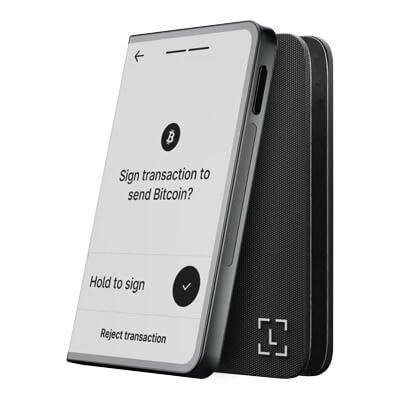

Ledger Stax is a self-custody hardware wallet designed to keep private keys in secure hardware while supporting day-to-day asset management through Ledger’s companion app. The device is positioned as a premium “signer,” combining a curved E Ink touchscreen with mobile and desktop connectivity for users who want a larger display for transaction review when managing assets such as Bitcoin, Ethereum, and Solana.
Overview
Ledger Stax follows the standard hardware wallet model: transactions are prepared on a connected phone or computer and must be reviewed and approved on the device itself. This workflow is intended to reduce exposure to malware on the host device by keeping sensitive signing operations within dedicated hardware. Stax also emphasizes readability and personalization, including support for naming the device and setting a lock screen image, including NFT artwork where supported.
History and Background
Ledger introduced Stax as a next-generation device focused on user experience and clearer transaction review. It was designed as part of Ledger’s broader shift toward describing hardware wallets as “signers,” meaning devices that authorize and verify actions rather than “holding” value. Stax is sold as a premium option in Ledger’s lineup, alongside smaller-screen devices such as the Nano series and newer touchscreen models.
Core Products and Services
- Offline key storage and transaction signing: Private keys remain within the device’s secure hardware, with transactions requiring physical confirmation on the device.
- Ledger companion app support: Portfolio and account management through the Ledger Wallet app on mobile and desktop, with additional coverage via compatible third-party wallets.
- Multi-asset coverage: Ledger states hundreds of assets are supported directly in its companion app, with broader support for thousands of coins, tokens, and NFTs through third-party wallet integrations.
- Optional service integrations: Features such as buying, swapping, and staking can be available through the companion app’s provider integrations, with availability depending on asset and jurisdiction.
Technology and Features
Ledger Stax is built around a curved E Ink touchscreen intended to improve the clarity of on-device review. The display supports 16 levels of grayscale and a 400 × 670 pixel resolution, with an anti-glare coating. The device is designed to help users verify transaction details and approvals directly on the signer before confirming.
Security is anchored by a certified Secure Element chip and Ledger OS. Ledger lists the Secure Element as ST33K1M5 with a Common Criteria CC EAL6+ certification. The device also highlights a “secure screen” concept, where the information shown for confirmation is controlled by the secure hardware rather than relying exclusively on the connected phone or computer.
For connectivity, Ledger Stax supports USB-C for desktop and Android use and Bluetooth (BLE 5.2) for smartphone pairing. It also supports NFC, including compatibility with Ledger’s Recovery Key accessory and security key related functions. The device supports wireless Qi charging.
Stax includes embedded magnets to support stackability and ships with a protective magnet shell. Ledger describes the chassis materials as aluminum and plastic, with embedded magnets used for stacking.
Use Cases and Market Position
Ledger Stax is generally used by self-custody users who want a premium hardware wallet experience and a larger, more readable confirmation interface for frequent signing. It can be used for long-term storage as well as for active participation in token ecosystems, where users may need to confirm approvals and smart contract interactions. Compared with smaller-screen devices, Stax is designed to prioritize readability and comfort for regular use across mobile and desktop environments.
Risks and Considerations
- Self-custody responsibility: Users must securely store recovery materials. Loss can make assets unrecoverable, and exposure can enable theft.
- Transaction deception risk: Hardware wallets reduce key exposure, but users can still approve harmful transactions if they connect to malicious applications or sign unsafe approvals.
- Third-party service dependency: Buying, swapping, and staking features can rely on external providers and may introduce fees, limits, and regional availability constraints.
- Compatibility variability: Asset coverage and advanced features can differ between the companion app and third-party wallet integrations.