

Tour De France Winner 2026
Final Results
Scheduled deadline: Aug 9, 2026, 23:59 UTC
108 more outcomes Other final results
- Juan AyusoNo
- Isaac del ToroNo
- Tobias Halland JohannessenNo
- Tom PidcockNo
- Cian UijtdebroeksNo
- Mattias SkjelmoseNo
- Richard CarapazNo
- Antonio TiberiNo
- Derek Gee-WestNo
- Matteo JorgensonNo
- Thymen ArensmanNo
- Adam YatesNo
- Jai HindleyNo
- Lenny MartinezNo
- Ben O'ConnorNo
- Kévin VauquelinNo
- Ben HealyNo
- Luke PlappNo
- Lennert Van EetveltNo
- Egan BernalNo
- Brandon McNultyNo
- Sepp KussNo
- Michael StorerNo
- Matthew RiccitelloNo
- Ilan Van WilderNo
- Valentin Paret-PeintreNo
- Warren BarguilNo
- Cyclist ANo
- Cyclist BNo
- Cyclist CNo
- Cyclist DNo
- Cyclist ENo
- Cyclist FNo
- Cyclist GNo
- Cyclist HNo
- Cyclist INo
- Cyclist JNo
- Cyclist KNo
- Cyclist LNo
- Cyclist MNo
- Cyclist NNo
- Cyclist ONo
- Cyclist PNo
- Cyclist QNo
- Cyclist RNo
- Cyclist SNo
- Cyclist TNo
- Cyclist UNo
- Cyclist VNo
- Cyclist WNo
- Cyclist XNo
- Cyclist YNo
- Cyclist ZNo
- Cyclist AANo
- Cyclist ABNo
- Cyclist ACNo
- Cyclist ADNo
- Cyclist AENo
- Cyclist AFNo
- Cyclist AGNo
- Cyclist AHNo
- Cyclist AINo
- Cyclist AJNo
- Cyclist AKNo
- Cyclist ALNo
- Cyclist AMNo
- Cyclist ANNo
- Cyclist AONo
- Cyclist APNo
- Cyclist AQNo
- Cyclist ARNo
- Cyclist ASNo
- Cyclist ATNo
- Cyclist AUNo
- Cyclist AVNo
- Cyclist AWNo
- Cyclist AXNo
- Cyclist AYNo
- Cyclist AZNo
- Cyclist BANo
- Cyclist BBNo
- Cyclist BCNo
- Cyclist BDNo
- Cyclist BENo
- Cyclist BFNo
- Cyclist BGNo
- Cyclist BHNo
- Cyclist BINo
- Cyclist BJNo
- Cyclist BKNo
- Cyclist BLNo
- Cyclist BMNo
- Cyclist BNNo
- Cyclist BONo
- Cyclist BPNo
- Cyclist BQNo
- Cyclist BRNo
- Cyclist BSNo
- Cyclist BTNo
- Cyclist BUNo
- Cyclist BVNo
- Cyclist BWNo
- Cyclist BXNo
- Cyclist BYNo
- Cyclist BZNo
- Cyclist CANo
- Cyclist CBNo
- OtherNo
Market Resolution
Polymarket reports Tadej Pogačar as the winning outcome for the Tour De France Winner 2026 prediction market with a final probability of 100%. Scheduled deadline: Aug 9, 2026, 23:59 UTC. Final reported trading volume was $1.32M.
Polymarket · Final sync
Market Analysis
Pogačar’s Dominance Meets a Tour Still Built for Reversals
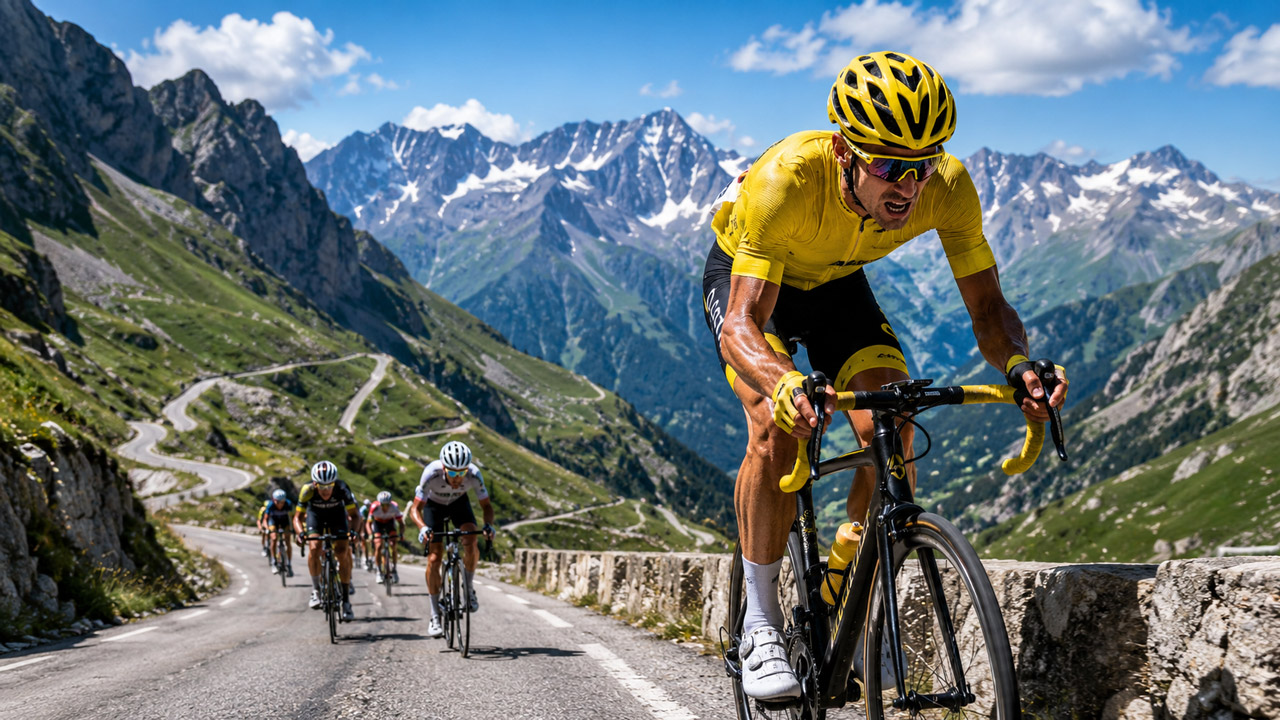
The market is treating Tadej Pogačar as the rider to beat after an early race lead change, yet the route still contains terrain designed to punish one bad day. The pricing tension sits between visible control and the Tour’s remaining capacity for sudden damage.

The market’s Pogačar-heavy shape is best read as a judgment about control: control of the general classification, control of the race narrative, and control of the scenarios that would normally give Jonas Vingegaard or another climber a path back. At 92.5% for Tadej Pogačar versus 5.1% for Vingegaard, the price implies that the early volatility of the 2026 Tour has already been processed and that Pogačar’s current position is seen as materially stronger than the remaining route is dangerous.
The lead change matters because it tested the pre-race hierarchy early
The supplied race context gives the market an important anchor: Vingegaard’s Visma-Lease a Bike squad won the stage 1 team time trial in Barcelona, putting him in yellow, before Pogačar took the lead on stage 3. That sequence matters because the current price is not relying solely on reputation or a pre-race favorite label. It has already absorbed a direct competitive signal from Vingegaard’s team, a brief yellow jersey spell, and then Pogačar’s response.
For the market, that history compresses Vingegaard’s case. A successful opening team performance gave him the cleanest early route to seize control, and Pogačar still moved ahead quickly. The inference from the odds is that participants see Pogačar’s lead as more meaningful because it came after Visma-Lease a Bike landed an early tactical win, rather than before Vingegaard had a chance to apply pressure.
A 92.5% leader price assumes the race is becoming harder to reopen
The listed prices create a sharp hierarchy. Pogačar sits far above the field, Vingegaard remains the only clearly live challenger, and the rest of the board is priced as a collection of low-probability contingency outcomes. Isaac del Toro at 1.5%, Remco Evenepoel at 0.8%, Paul Seixas at 0.6%, and Juan Ayuso at 0.5% show how little room the market gives to a third-party takeover unless the two principal favorites suffer a major disruption.
| Rider | Market price | Market-implied role |
|---|---|---|
| Tadej Pogačar | 92.5% | Race controller |
| Jonas Vingegaard | 5.1% | Primary comeback threat |
| Isaac del Toro | 1.5% | Best-priced outsider |
| Remco Evenepoel | 0.8% | Long-range disruption scenario |
This structure matters because cycling’s GC markets usually leave space for route volatility, crashes, illness, and tactical alliances. Here, the $650,490 in volume, $1.24 million in liquidity, and $224,180 in open interest suggest the market has had enough activity to form a firm consensus around one central story: Pogačar can defend across the remaining mountain stages and avoid conceding enough time in the late 26.1 km time trial to reopen the race.
The route still contains the exact terrain that can attack the favorite
The strongest counterweight to the current price is embedded in the supplied research: the Tour still has several high-impact mountain stages and a late 26.1 km time trial. Those are precisely the settings where GC assumptions can move quickly. A mountain stage can produce a collapse measured in minutes, while a late time trial can convert fatigue, positioning, and pacing into a decisive swing after two weeks of accumulated stress.
That matters because Pogačar’s price is carrying an implicit durability assumption. The market is treating him as capable of matching Vingegaard on the climbs, limiting time-trial risk, and avoiding the kind of isolated team situation that can turn a manageable gap into a race crisis. If one of those assumptions breaks, the market does not need a new favorite immediately; it only needs evidence that the race is again contestable.
Vingegaard’s path depends on turning team strength into personal time gains
Vingegaard’s 5.1% price keeps him separate from the rest of the challengers because the race has already shown Visma-Lease a Bike can impose itself. The stage 1 team time trial win is relevant beyond the result sheet: it demonstrated collective execution in a discipline where pacing, organization, and cohesion directly protect a GC leader. That team signal supports Vingegaard’s residual market value even after Pogačar took yellow.
The challenge is that team strength must eventually become individual separation. A hypothetical repricing scenario would involve Vingegaard gaining time on a mountain stage, forcing Pogačar to chase without full team support, or reducing the GC gap enough before the late time trial that every second becomes contestable. Without that kind of direct damage, Visma’s early success reads as proof of competitiveness rather than proof of a winning path.
The market would move fastest on evidence of physical vulnerability
The catalysts most likely to change the price are straightforward because the market is so concentrated. Any verified crash, illness, visible climbing weakness, or unexpected time loss for Pogačar would carry outsized market significance. A narrow stage result might matter less than the manner of the performance: losing contact on a climb, relying heavily on teammates, or fading late in a time trial would challenge the assumption that he controls the remaining race shape.
- A mountain stage where Vingegaard gains meaningful time would strengthen the comeback narrative.
- A late 26.1 km time trial with a reduced GC gap would make pacing and fatigue central to pricing.
- A third rider moving into realistic GC range would expand the market beyond a two-rider frame.
- Team attrition around Pogačar would matter if it leaves him exposed on repeated climbs.
The main failure mode for the current Pogačar-centric story is a race that stops behaving like a controlled defense and turns into a sequence of forced responses. The market is assigning very little probability to that version of the Tour. The next repricing pressure point will come when the mountains or the late time trial provide evidence about whether Pogačar’s lead is a stable advantage or a target still within reach.
Sources
Market Details
- Resolution criteria
- This market will resolve to the cyclist that wins the 2026 Tour De France scheduled for July 4, 2026 through July 26, 2026.
- Platform
-


- Category
- Sports › Cycling
- Scheduled deadline
- August 9, 2026, 11:59 PM UTC
- Market rules summary
- Multi-outcome Polymarket event. Each listed option is represented by its Yes price on the underlying market. View full rules
Frequently Asked Questions
What was the final result of the Tour De France Winner 2026 prediction market?
Polymarket reports Tadej Pogačar as the winning outcome for the Tour De France Winner 2026 prediction market with a final probability of 100%. The final market snapshot includes $1.32M volume and $321.97K open interest. CryptoSlate last synced the final market data at Jul 27, 2026, 01:42 UTC.
How does the Tour De France Winner 2026 prediction market resolve?
This market will resolve to the cyclist that wins the 2026 Tour De France scheduled for July 4, 2026 through July 26, 2026. Multi-outcome Polymarket event. Each listed option is represented by its Yes price on the underlying market.
Related Cycling Markets
 Barcelona vs Real Madrid: El Clásico, October 25, 2026
  Galatasaray vs Barcelona: October 13, 2026
  Manchester United vs Tottenham: October 10, 2026