

Quick Take
- The OCC removed the proposed automatic seven-day extension, leaving stress-related redemption extensions subject to regulator decisions.
- Covered issuers’ ordinary deadline measures payment initiation after qualifying requests, while external bank availability remains separate.
- Revised confidential PS-01 reports would track unpaid tokens and payment initiation, with implementation conditional on OMB approval.


The Office of the Comptroller of the Currency (OCC) has dropped a proposed automatic seven-day stablecoin redemption extension, while defining timely redemption as the point at which the issuer sends the money.
An issuer can meet its payment deadline before an outside bank makes the proceeds available.
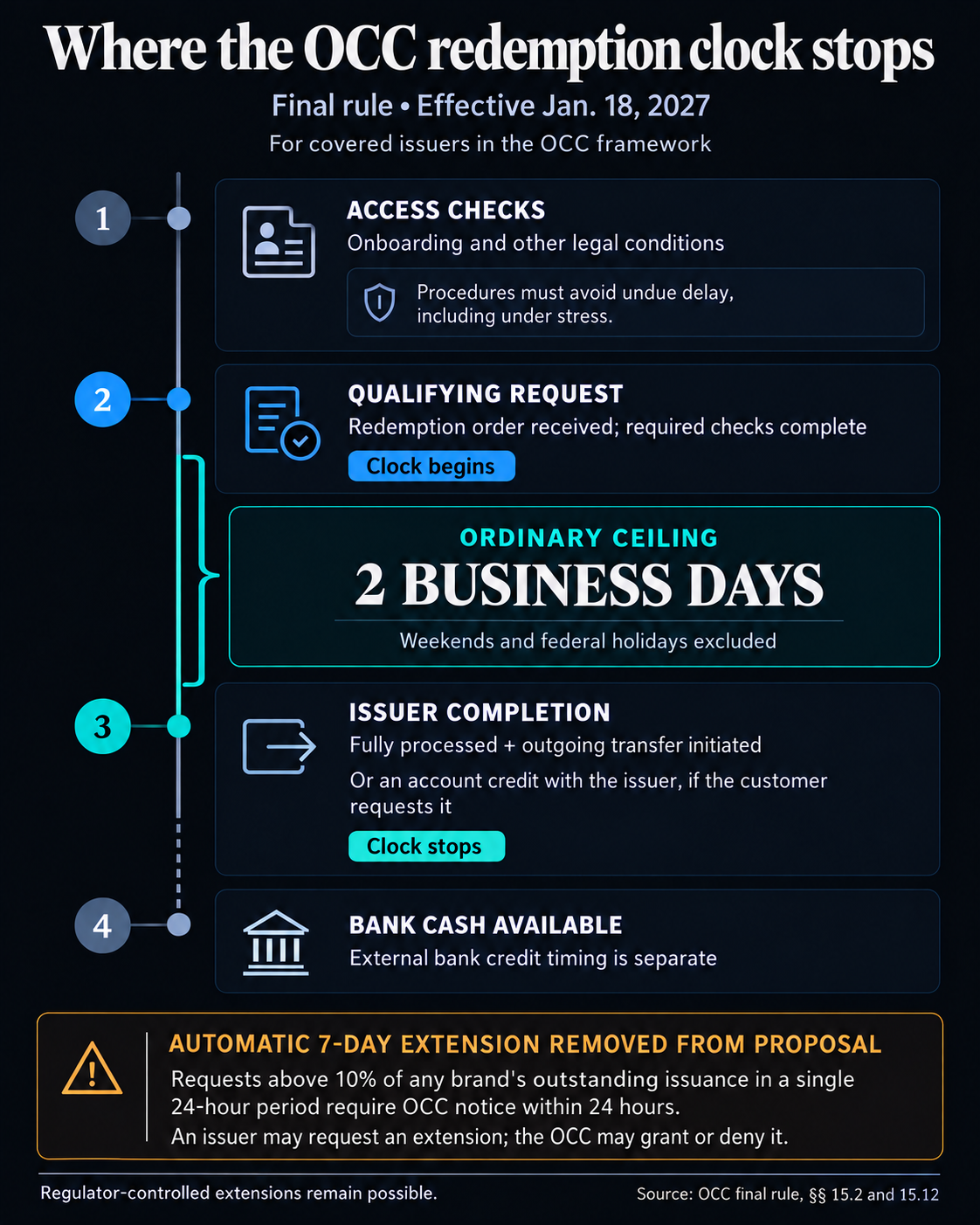
The OCC’s final GENIUS Act rule, issued Oct. 21 and effective Jan. 18, 2027, retains an ordinary ceiling of two business days following a qualifying stablecoin redemption request. The endpoint is fully processed payment initiation, or, if the customer requests it, a credit to an account with the issuer.
The rule applies to issuers within the OCC framework, so it doesn't provide a universal timetable for every stablecoin sale or exchange withdrawal.
How the final rule changes stablecoin redemption
The adopted text removed a provision that would have automatically extended stablecoin redemption to seven calendar days when demand crossed a specified threshold.
Under section 15.12(d) of the OCC rule published in the Oct. 23 Federal Register, an issuer receiving stablecoin redemption requests above 10% of any brand’s outstanding issuance value in a single 24-hour period must notify its OCC supervisory office within 24 hours.
The issuer can ask the OCC for more time, and the regulator can grant or deny the request.
Crossing the threshold starts a supervisory process without automatically resetting the deadline, and the OCC says it expects extensions to be rare. Regulator-controlled limitations remain possible in other circumstances consistent with the law.
Section 15.12(a) also establishes explicit boundaries for the ordinary redemption clock, and the issuer must have received a redemption order.
Where its onboarding procedures are reasonably designed to avoid undue delay, including during stress, the customer must also have completed onboarding and satisfied the other legal conditions needed for redemption.
In explaining the final rule, the OCC says issuers cannot use onboarding deficiencies as a pretext to manufacture extra stablecoin redemption time. They should be ready to handle new customers during stress, including holders who previously relied on an intermediary.
Covered issuers must be able to redeem from retail holders, subject to applicable law, screening and onboarding. Their policies must permit quantities of one token or more.
The completion must fully process and initiate the directed outgoing transfer of monetary value to the customer or the customer’s financial institution. Alternatively, it can credit the customer’s account with the issuer if the customer requests that route. Merely placing a payment in a queue does not satisfy that wording.
External bank receipt comes later in the sequence and falls outside that defined endpoint. The practical implication is that the ordinary ceiling protects timely issuer action while bank-credit timing remains a separate part of the holder's cash-out.
Business days exclude Saturdays, Sundays, and federal holidays, so two business days also cannot be read as 48 elapsed hours.
Existing cash-out routes show why access matters
Current service terms provide an example of access conditions before the OCC rule takes effect, but whether that framework governs a particular issuer depends on its jurisdiction.
Circle’s current non-EEA USDC terms, updated Oct. 15, make direct redemption conditional on a Circle Mint account in good standing.
The Circle Mint service description says the product serves institutions and distributors, excludes individuals, and requires background checks, identity and know-your-customer checks, and sanctions screening. Its stated application-processing range runs from one day to a week or longer, and it covers account opening.
Circle documents wire redemption and SEPA or banking-network transfers limited to participating banks and regions. Instant settlement depends on participating bank programs.
An already onboarded customer with a suitable bank connection can follow a different sequence than a new applicant arranging direct access.
In its Oct. 16 explanation of USDC economics, Circle says qualifying Circle Payments Network and Platform customers can redeem free in near real time. It attributes that capability to cash positioned in advance at bank partners and settlement rails able to move it.
Circle's description ties that speed to funded banking infrastructure for qualifying customers, while the service and bank connection determine the available route.
If a buyer pays a holder before issuer redemption and keeps the acquired tokens, that buyer supplies the immediate dollars and carries the tokens until resale or redemption. This conditional funding mechanism can bring a holder’s exit forward.
PS-01 would separate unpaid stablecoin from late initiation
Subject to Office of Management and Budget approval, the OCC’s revised PS-01 instructions would capture three distinct Schedule A measures:
| Measure | What would be reported |
|---|---|
| Tokens redeemed but not yet paid | The day-end token count tendered for redemption whose corresponding fiat settlement has not yet been provided to the holder. |
| Average redemption time | Average hours from confirmation of a redemption request to initiation of a transfer. |
| Redemptions exceeding two business days | The daily redemption dollar amount for which funds transfers were not initiated within two business days. |
Read together, they could help supervisors investigate an unpaid redemption backlog separately from slow issuer payment initiation.
PS-01 would generally contain daily observations submitted weekly, with Schedule A remaining daily even under the limited small-issuer reporting option for other schedules. Its data would be confidential, while public information would continue through separate channels.
The final rule retains monthly public reserve-composition reports. Under the OCC’s revised PS-02 instructions, quarterly financial reports would generally become public after submission, acceptance and preparation for release.
The OCC could approve limited confidentiality where an issuer provides a compelling, specific justification of substantial competitive harm.
OCC Bulletin 2026-52 sets intended first report dates of Jan. 25, 2027, for the weekly collection and March 31 for the quarterly collection, subject to Office of Management and Budget approval.
The final rule provides a clearer way to assess a cash-out promise for holders: establish direct access, identify when a qualifying request triggers the obligation, and distinguish payment initiation from bank availability.
The bank route and any provider funding an earlier exit still determine how that timetable translates into money the holder can spend.
Mentioned in this article


Editorial credits