


Overview
Introduction
Most crypto networks record transactions in a chain of blocks. Hedera does not. Instead, it uses a consensus method called hashgraph, where nodes share signed events and build a shared history to agree on transaction order without producing blocks at all. The native token, HBAR, pays the fees for every action on that network, from simple transfers to smart contract calls.
That technical difference matters because it changes how finality works, how fees are priced, and who controls the network. Hedera's council-based governance and permissioned node model make it faster and more predictable than many blockchain alternatives, but they also introduce a centralization tradeoff that is worth understanding before buying or using HBAR.
This guide explains how hashgraph consensus works, what HBAR does on the network, who governs Hedera, and what the real risks are for holders and builders.
Key Takeaways
- Hedera Hashgraph is a public ledger network that orders transactions with hashgraph consensus instead of a normal blockchain.
- HBAR pays network fees, supports staking-related economics, and sits at the center of Hedera's token model.
- Hedera gives apps predictable fees, fast finality, native tokens, consensus timestamps, and EVM-compatible smart contracts.
- HBAR value and network trust depend on real usage, token economics, and continued decentralization beyond council-operated nodes.
What Hedera Hashgraph Is and What HBAR Does
Hedera Hashgraph is a public distributed ledger where transaction order is decided by a consensus mechanism that does not group transactions into blocks. Nodes share signed events, build a shared history of those events, and use that history to agree on order and timestamps.
HBAR is the network's native asset. Users pay transaction fees in HBAR, accounts can stake HBAR to help weight consensus, and transfers can move HBAR directly between accounts. That makes HBAR closer to network fuel than a governance token or share of enterprise revenue.
The four components are distinct and worth keeping separate:
- Hedera is the public network and service layer.
- Hashgraph is the consensus mechanism.
- HBAR is the token used for fees, transfers, and staking.
- Hiero is the open-source codebase contributed to LF Decentralized Trust.
That separation also prevents a common mistake when reading price charts. A stronger developer story does not automatically produce higher HBAR demand, and a weak HBAR chart does not automatically mean the network has stopped working. The token's performance and the network's technical health are related but not the same thing.
How Hashgraph Reaches Consensus Without Blocks
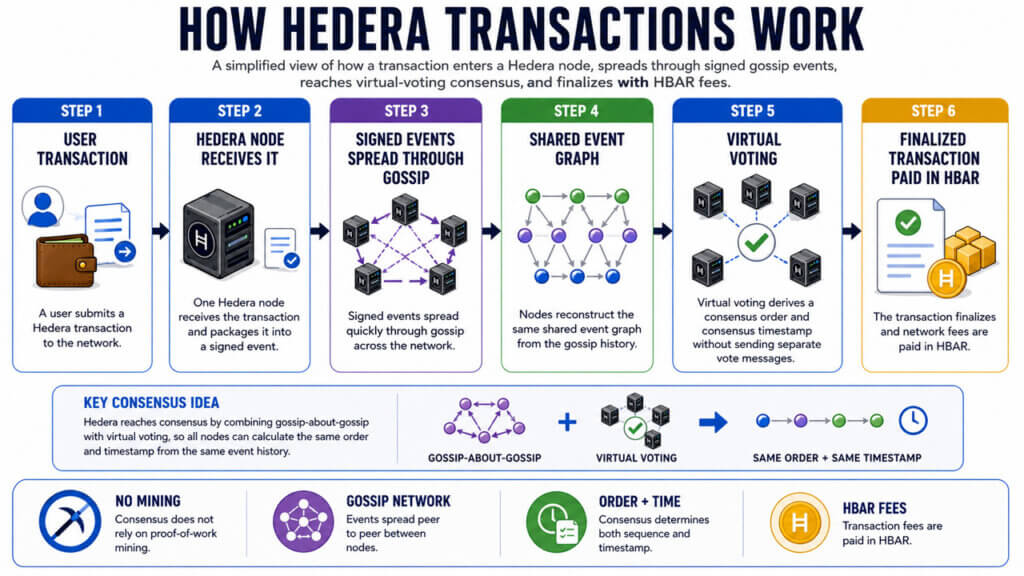
Hashgraph reaches consensus by letting nodes share transactions and the history of how those transactions spread. Each node can then reconstruct the same event graph and calculate the outcome without sending extra voting messages across the network.
A transaction flows from the user through nodes, events, and virtual voting before it finalizes:
Gossip About Gossip
Gossip, in Hedera's context, means nodes rapidly share new information with other nodes. Gossip about gossip adds a record of who shared each event and when, so the network builds a shared history of transaction flow rather than just a record of the transactions themselves.
In Hedera, gossip about gossip and virtual voting are the core mechanism behind hashgraph. Nodes do not wait for miners to build blocks or for validators to complete a separate voting round for every transaction. The history of communication between nodes is itself the record the network relies on.
Virtual Voting and Consensus Timestamps
Virtual voting lets each node infer how other nodes would vote from the event history they already hold. Because the votes do not need to be sent as separate messages across the network, communication overhead drops significantly.
The result of that process is a consensus timestamp and a final transaction order. That order matters for payments, audit trails, marketplaces, and any application where the sequence of events changes balances or rights.
Finality, Fair Ordering, and ABFT
Finality means a transaction is settled by consensus rather than waiting for a longer chain to make reversal statistically unlikely. Hedera positions hashgraph as asynchronous Byzantine fault tolerant (aBFT), meaning it is designed to keep reaching agreement even if some participants behave incorrectly or maliciously.
Fair ordering means Hedera's design aims to sequence transactions based on when they reach the network through consensus rather than on miner or validator preferences. That promise is harder to evaluate from the outside. Anyone comparing Hedera against other layer 1 networks should check developer adoption, liquidity, wallet support, and decentralization alongside the technical claims.
How HBAR Powers Fees, Staking, and Network Security
HBAR connects every network action to an economic cost. Fees are paid in HBAR, stake affects consensus weight, and the token links application usage to network security. Without HBAR, nothing runs on Hedera.
Fees Are Priced in USD and Paid in HBAR
Hedera transaction and query fees are denominated in USD and paid in HBAR, so the amount of HBAR required can shift when the token price changes. That design helps app builders plan costs because the USD equivalent stays stable, but it also means the per-transaction HBAR demand depends heavily on overall usage volume.
Here is what HBAR's core jobs look like in practice:
| HBAR Job | What It Means For Users |
|---|---|
| Transaction Fees | Users spend HBAR to move HBAR, tokens, messages, or smart contract calls. |
| Staking Weight | Staked balances help weight consensus and can earn rewards when eligible. |
| Network Security | More distributed stake makes it harder for one actor to dominate consensus. |
| Transfer Asset | HBAR itself can move between accounts as a native asset. |
For broader context on how token ownership connects to validator economics, the proof-of-stake assets category places HBAR alongside other networks using similar security models.
Staking Secures Consensus But Does Not Grant Governance Votes
Staking HBAR is not the same as voting on Hedera governance. The staking program lets accounts stake to nodes and keeps balances liquid. Council governance handles policy, pricing, treasury, and network changes separately.
That separation is deliberate. HBAR holders support security weight through staking, but they do not get the same governance role that a council member holds. For users accustomed to governance tokens where token ownership drives voting rights, Hedera's model works differently.
What Hedera Is Used For Today
Hedera is used for applications that need ordered records, token transfers, predictable fees, and smart contracts without building a separate ledger. Most active use cases lean toward infrastructure rather than consumer payments.
Tokenization and Stablecoins in Hedera
Hedera Token Service lets applications create and manage fungible tokens and NFTs natively on-chain. That puts Hedera squarely in tokenization territory when the asset is a real-world claim, loyalty unit, in-game item, or compliance-aware token.
Stablecoin transfers use the same infrastructure logic. Hedera's low fees can help in stablecoin transfer contexts, but any specific stablecoin availability claim should be checked against live issuer and network data rather than taken from a static source.
Hedera Consensus Service for Audit Trails
Hedera Consensus Service gives applications a way to submit messages for aBFT ordering and consensus timestamps. Messages submitted to a topic receive order, validity, and a consensus timestamp.
That makes it a natural fit for audit logs, supply-chain event records, provenance tracking, and advertising verification systems where proving event order matters more than moving a token.
Hedera Smart Contracts, DeFi, and App Services
Hedera also supports EVM-compatible smart contracts, so Solidity developers can build with familiar tools. That puts Hedera within reach of smart contract platforms and the DeFi ecosystem, even though its application culture is different from Ethereum or Solana.
Use cases look strongest when predictable costs and ordered events are the core requirement. They look weaker when deep liquidity, broad retail wallet support, or an open validator culture are essential.
Who Governs Hedera and Why Centralization Is the Main Tradeoff
Hedera is governed by the Hedera Council, and consensus nodes are still permissioned. That means Hedera can be public and technically useful while remaining more centrally coordinated than networks where anyone can run a validator today. For beginners, this is the single most important structural difference to understand before buying HBAR.
The Governing Council Sets Network Policy
The council model spreads governance across term-limited organizations rather than concentrating it in one foundation or founding company. Council governance covers software updates, network pricing, treasury management, and node operations.
The Hedera Council's public governance structure includes board, chair, and committee roles across technical steering, network utilization, and coin economics. For companies evaluating Hedera, its trust model sits closer to enterprise crypto because it relies on known institutions rather than anonymous validator entry.
Consensus Nodes Are Different from Governance Votes
Consensus nodes process transactions and contribute to network agreement. Governance votes decide policy, upgrades, and treasury actions. Those two layers are related but distinct.
The public network currently uses permissioned nodes run by the Hedera Council. Anyone who cares about decentralization should ask who can run a node, how stake is distributed, how upgrades are approved, and whether the permissionless-node roadmap progresses.
What Hiero Changed About the Codebase
Hiero moved Hedera's codebase into an open-source project under LF Decentralized Trust. The Hiero open-source project gives the codebase a neutral foundation home and lets builders inspect, contribute, and fork software.
That is a genuine transparency improvement, but it is not the same as permissionless node operation. Network control still depends on who runs consensus, who approves upgrades, and how the council model evolves over time.
The Path To Permissionless Nodes
Hedera's decentralization roadmap points toward broader node participation. Until that changes on mainnet, the accurate picture is mixed: the ledger is public, the codebase is open, and governance is institutionally distributed, but mainnet consensus participation is still permissioned.
The centralization question breaks into five concrete checks:
| Concern | What To Check |
|---|---|
| Council Concentration | Which organizations hold seats and how terms rotate. |
| Node Access | Whether non-council nodes can join mainnet consensus. |
| Token Distribution | How released and unreleased HBAR affect stake concentration. |
| Open Source | Whether important code and issues are visible in Hiero. |
| Upgrade Control | Who approves network changes and fee policy. |
That tradeoff may be acceptable for enterprise use cases where predictability matters most, and it may be unacceptable for users who prioritize open validator participation above all else.
Hedera Hashgraph vs Blockchain and Other Layer 1s
Hedera differs from a blockchain because it does not use a single chain of blocks as the core data structure. It uses a directed event graph and virtual voting to agree on transaction order. For beginners, the simplest framing is that blockchain and hashgraph are two different answers to the same question: how do distributed nodes agree on what happened and in what order?
Blocks vs Events
In a blockchain, validators or miners append batches of transactions to blocks. In hashgraph, nodes create and share events containing transactions plus information about previous gossip. That difference makes Hedera easier to describe as an ordering network than as a conventional chain, and it means slogans like “better than blockchain” are not useful on their own. The right comparison depends on fees, finality, tooling, decentralization, liquidity, and what an application actually needs.
Probabilistic vs Deterministic Finality
Many blockchains rely on probabilistic finality, where confidence rises as more blocks build on top of a transaction. Hedera aims for deterministic finality through consensus, meaning a transaction is either settled or it is not.
For users, the question is not only finality speed. It is whether wallets, exchanges, apps, and auditors trust that finality enough to build their systems around it.
Enterprise Predictability vs Open Validator Culture
Hedera leans toward predictable fees, known governance, and enterprise-friendly controls. Ethereum offers a deeper smart contract ecosystem, while Solana is often the comparison point on throughput, fees, and developer culture. Cardano offers a different proof-of-stake comparison, and XRP is relevant when the question is enterprise payments and settlement positioning rather than general smart contracts.
Here is how the core differences look side by side:
| Question | How Hedera Differs |
|---|---|
| How Are Transactions Ordered? | Events and virtual voting replace normal blocks. |
| Who Runs Consensus? | Permissioned council nodes run mainnet consensus today. |
| What Asset Pays Fees? | HBAR pays fees across network services. |
| Where Is The Tradeoff? | Predictability improves, but open validator access is limited. |
Stellar is another option for payments and tokenization, especially when evaluating low-cost transfer networks rather than broad DeFi ecosystems.
How To Buy, Store, and Transfer HBAR Safely
Buying HBAR means using an exchange or on-ramp that supports HBAR, then deciding whether to keep it with a custodian or withdraw to a Hedera-compatible wallet.
Before You Buy HBAR
Buying Hedera Hashgraph exposure usually means buying HBAR on a supported exchange. Start by checking whether the venue supports native Hedera withdrawals, not only a wrapped or synthetic version of the token.
For a first purchase, check this list of crypto exchanges for beginners that can help you narrow options. If fees, region, liquidity, and security features matter more, the crypto exchanges comparison covers more ground.
Custodial vs Self-Custody Wallets
A custodial exchange keeps the account setup simple, but the platform controls the private keys until you withdraw. A self-custody wallet gives more control and more responsibility.
For a first setup, this comparison of crypto wallets for beginners is a good starting point. Those ready to hold their own keys should read through self-custodial wallet options before moving meaningful balances.
Hedera Account IDs, Memos, and Test Transfers
Hedera transfers use account IDs rather than standard wallet addresses, and memo requirements vary by exchange. Account memos are visible on the public ledger, so the account memo field should never contain private information.
Run through this checklist before any HBAR transfer:
- Confirm the receiving account ID and network.
- Check whether the exchange requires a memo.
- Send a small test transfer first.
- Enable 2FA and withdrawal allowlists where available.
- Never enter a seed phrase into a website.
- Verify the transaction in a Hedera explorer.
Most HBAR loss comes from operational errors: wrong network selection, missing exchange memos, mistyped account IDs, and fake wallet prompts. These are preventable. None are reversible after the fact.
FAQs
Is Hedera a blockchain?
No. Hedera is a public distributed ledger, but its core consensus method is hashgraph rather than a conventional chain of blocks.
What is HBAR used for?
HBAR is used to pay Hedera network fees, transfer value, stake to nodes, and support the network’s proof-of-stake security model.
Is Hedera decentralized?
Hedera is partly decentralized and partly permissioned. Its ledger is public and its codebase is open through Hiero, but mainnet consensus nodes are still permissioned and tied to the council model.
Why do people say Hedera Hashgraph will fail?
Critics usually point to permissioned nodes, council governance, token-demand uncertainty, competition from larger ecosystems, and the possibility that enterprise adoption takes longer than HBAR markets expect.
How do Hedera fees stay predictable?
Hedera denominates many fees in USD and collects them in HBAR, so the HBAR amount can adjust when the exchange rate changes.
Where can I check the current HBAR price?
Use a live market page such as this Hedera coin profile for current HBAR price, market cap, volume, and chart data.