Quick Take
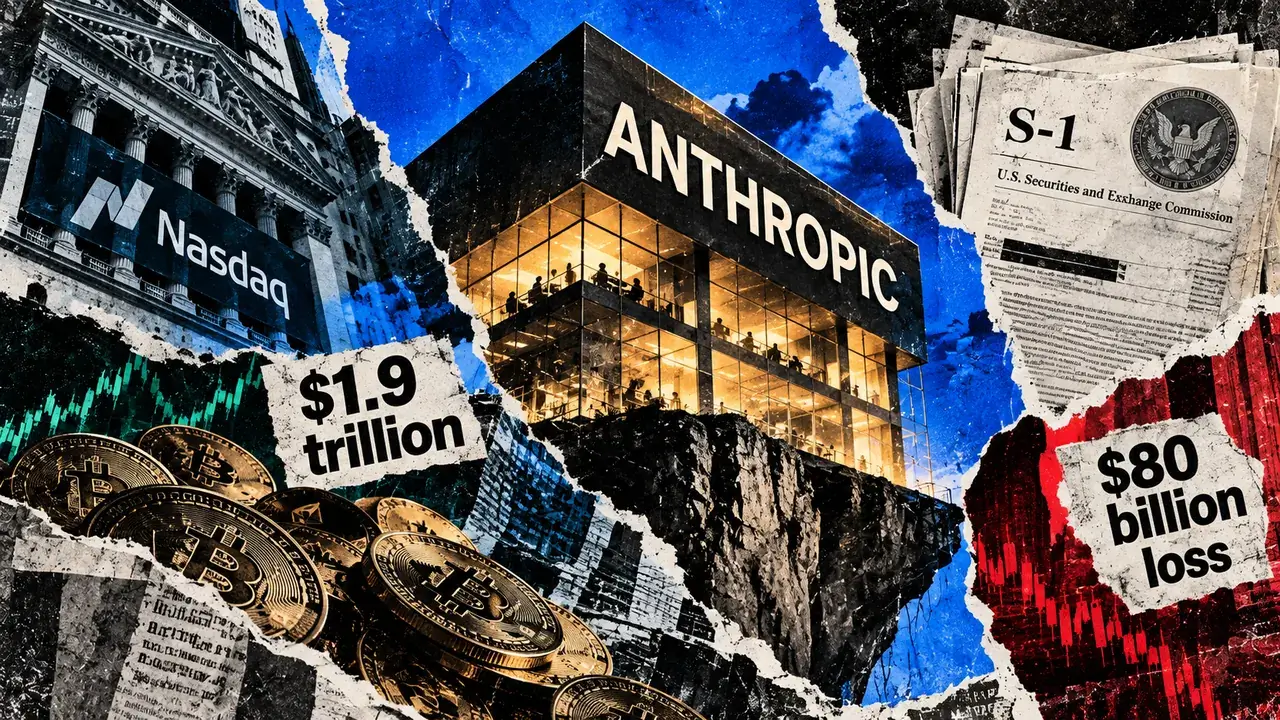
- Anthropic filed for a Nasdaq IPO as crypto traders valued the Claude developer near $1.9 trillion ahead of its anticipated November debut.
- Moonrock Capital's Simon Dedic warned the listing could mark the AI bubble's peak while creating one of the largest private-market wealth events.
- The potential windfall could redirect billions into crypto and other markets, but staggered insider lockups complicates that.


Anthropic filed for a Nasdaq IPO Monday, reporting a quarterly operating profit as crypto markets valued it near $2 trillion.
The Claude developer submitted its S-1 registration statement to the US Securities and Exchange Commission (SEC) on Oct. 26, seeking a listing under the ticker ANT.
Goldman Sachs and Morgan Stanley are leading the offering, which could become one of the largest in US history. Anthropic has not yet disclosed its proposed share price or offering size, though market expectations point to a November debut.
Crypto traders price Claude developer near $2 trillion
Crypto trading platform Liquid reported that Anthropic's implied valuation fell roughly 2% to $1.88 trillion after the announcement.
Meanwhile, Better Markets quoted an indicative pre-IPO share price of $2,967.92, corresponding to an estimated $1.43 trillion valuation under its pricing methodology.
The enormous valuations have divided investors over what Anthropic's public debut could mean for the wider technology sector.
Simon Dedic, founder of Moonrock Capital, said he expects the company to begin trading by mid-November, adding that the listing could mark the “top of the AI bubble” or become one of the largest wealth-creation events in private-market history.
Dedic argued that an offering of this magnitude could release substantial capital accumulated by early investors and employees, potentially redirecting investment toward startups and other markets.
His assessment raises a broader question about how much of the wealth created during the AI investment boom might eventually flow into other asset classes, including crypto.
However, Anthropic has not confirmed its trading date or offering valuation, while the timing of shareholder sales will depend on restrictions attached to existing holdings.
Anthropic's profitability gains face massive infrastructure obligations
The company's financial disclosures provide a clearer basis for evaluating the valuations circulating across these markets.
Anthropic generated $16.3 billion in revenue in the first half of 2026, up from about $1.16 billion a year earlier, reflecting growth of about 1,300%.
Social Capital, citing the IPO filing, highlighted an even sharper acceleration in quarterly revenue, which climbed from $376 million in the first quarter of 2025 to $11.6 billion in the second quarter of 2026.
That approximately 31-fold increase over five quarters was accompanied by significant improvements in operating efficiency.
During the first quarter of 2025, Anthropic spent approximately $2.51 on computing and infrastructure for every dollar of revenue. By the second quarter of 2026, that figure had declined to about 48 cents.
The improvement helped the company record $974 million in operating profit during the June quarter, reversing a $1.67 billion operating loss in the preceding three months.
However, the company reported a $66.3 billion net loss for the quarter, largely reflecting noncash financing adjustments, including $59.6 billion from the revaluation of convertible notes as Anthropic's valuation increased.
Those accounting effects also contributed to its $80.7 billion first-half net loss, which included $72.4 billion in fair-value adjustments to convertible notes, derivatives and related financing instruments.
Venture capitalist Nic Carter described the financial results as “robust and improving,” arguing that the headline loss obscured improvements in Anthropic's underlying operations.
Nevertheless, he questioned whether a valuation approaching $1.5 trillion could be justified by approximately 22 times annualized third-quarter revenue.
Meanwhile, Milk Road AI analyst Melvin argued that the company's improving profitability and approximately $131.7 billion in cash and short-term investments challenge assumptions that frontier AI developers must continually raise external capital to maintain their operations.
However, Anthropic's infrastructure commitments introduce a substantial financial vulnerability.
The company has agreements with Amazon, Google, Microsoft, and other computing providers involving hundreds of billions of dollars in potential expenditure over several years.
Its arrangements with SpaceX alone could reach $120.5 billion through 2029, although the agreements contain cancellation provisions after initial noncancelable periods.
The financial exposure is particularly significant because approximately 80% of Anthropic's first-half revenue came from consumption-based services, allowing customers to reduce spending faster than the company can unwind many of its infrastructure commitments.
Anthropic warned that weaker demand could leave it unable to meet minimum payment obligations, potentially triggering defaults under commercial agreements and accelerated repayment requirements under related financing arrangements.
The company has expanded its revolving credit commitments to $15 billion and faces a minimum quarterly liquidity requirement of $5 billion beginning at the end of 2026.
Meanwhile, the IPO could create another significant market event after the initial listing.
Dedic questioned what thousands of newly wealthy employees and early investors might do with their proceeds once restrictions on selling their shares expire, suggesting some of the resulting liquidity could flow into new investments.
Anthropic's prospectus outlines an unusual staggered lock-up structure that allows certain shareholders to sell limited portions of their holdings from the first trading day, with additional releases scheduled afterward.
Some employees may sell shares immediately, while other investors face restrictions lasting as long as 180 days. The company's co-founders and certain major shareholders face longer restrictions, up to 365 days, with specified early releases.
The structure could spread shareholder selling across several months rather than concentrate it around a single lock-up expiration.
However, the filing has not yet established the final offering size and share count, leaving the dollar value of stock that could enter public markets at each stage undetermined.
Mentioned in this article








Editorial credits