

 Released in 2018
- Historical reports in one subscription
- Free bulk edits and saved backups
- Choice of who keeps the working records
Summ Overview
Key facts
- Supported countries
-
US, Canada, Australia, India, Japan, New Zealand, …Show More (+18)Show Less
US, Canada, Australia, India, Japan, New Zealand, Singapore, Austria, Belgium, Germany, Finland, France, Greece, Ireland, Italy, Netherlands, Norway, Portugal, Spain, Sweden, Switzerland, UK, South Africa, Brazil
- Paid plans from
- Rookie; Report years back to 2013 while subscribed; USD 49; annual subscription; 100 across all imported years
- Billing & report access
- annual subscription; Reports back to 2013
- Transaction limits
- 100 across all imported years
- Free plan
- Imports, edits, backups (reports paid)
- Import methods
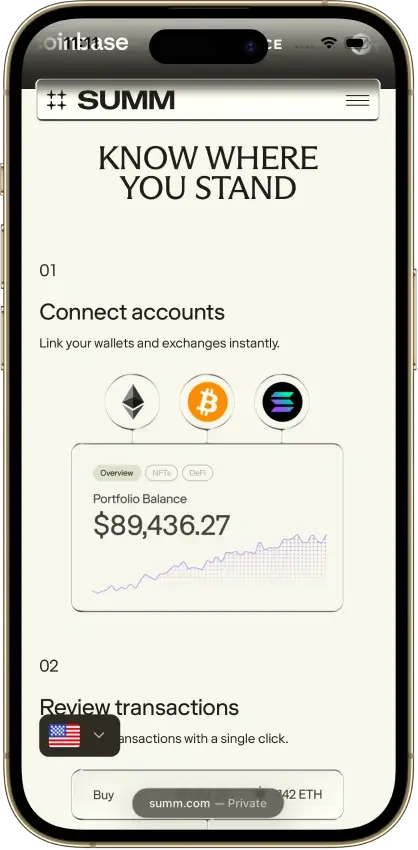
- API, wallet address, CSV, manual entry
- Key integrations
- Filing options
- TurboTax Online PDF (income entered separately)
- DeFi support
- Smart-contract reports from Hobbyist
- NFT support
- Ethereum, Solana (escrow corrections)
- Staking support
- Deposit, withdrawal and reward categories
- Correction tools
- Free bulk edits, backups (rules: Trader)
- Accountant access
- Shared editing (client can revoke access)
- Official website
- summ.com
Summ Screenshots



Screenshot 1 of 8
Summ Pros and Cons
Pros
- 1099-DA proceeds comparison portal
- Transaction warnings and manual repairs
- Alternate PDF for TurboTax Online
Cons
- Full history consumes the plan allowance
- Recurring rules require the Trader plan
- Reports unavailable after subscription expiry
Pricing and Free Plan
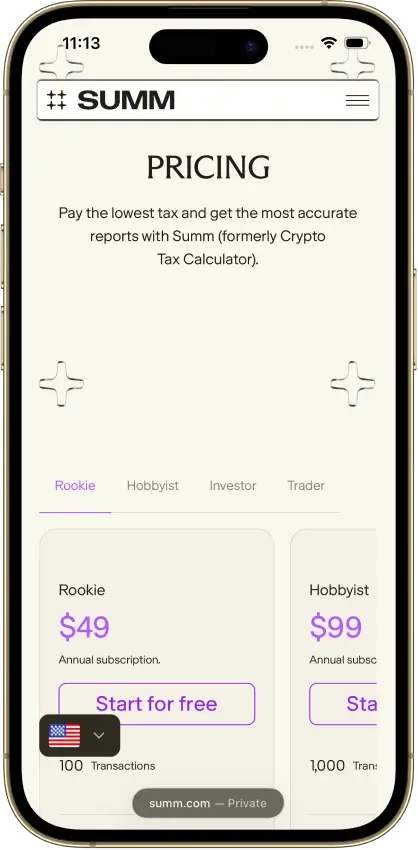
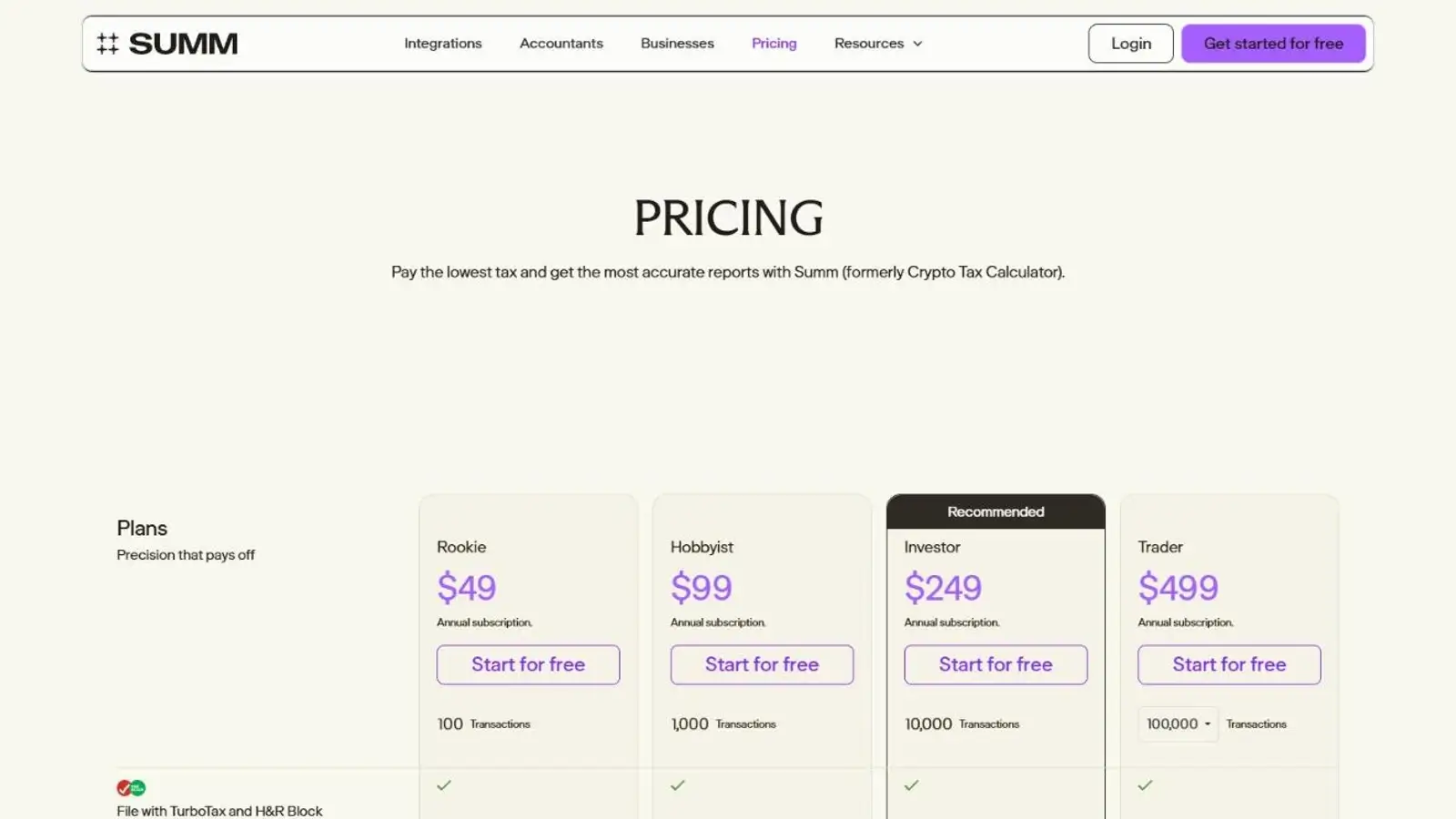
Rookie costs $49 a year for up to 100 transactions across your full history. Smart-contract reporting needs Hobbyist at $99 a year, while recurring categorization rules need Trader at $499 a year. These feature requirements can force an upgrade even for a small history. One active subscription covers reports back to 2013.
Ignored transactions and spam are excluded from the billed count. Dust (tiny leftover balances) still counts, even when hidden.
- Free
Imports, transaction inspection, individual and bulk edits, backups, portfolio tracking, and obscured report samples. Full tax reports require payment.
- Rookie
$49 annually for 100 transactions, for simpler reporting without smart-contract activity.
- Hobbyist
$99 annually for 1,000 transactions. The minimum paid tier for smart-contract reporting.
- Investor
$249 annually for 10,000 transactions. Adds advanced cost-basis methods, advanced reports, and tax-loss harvesting.
- Trader
$499 annually for 100,000 transactions. Includes the advanced features and recurring categorization rules.
These are standard US dollar prices before promotions. In-app upgrades support higher allowances up to 200,000 transactions, with larger histories handled through support. An investor with many old acquisitions can need a higher tier despite making few trades this year. If you need recurring rules, the Trader requirement can raise the price even for a small history.
- One 2025 return with 80 current-year transactions and 200 earlier acquisitions or trades
Hobbyist at $99 for one annual subscription. The 280-transaction history exceeds Rookie. Assumes no Investor- or Trader-only feature is needed.
- Reports for 2023–2025 with 900 transactions across the full history and some smart-contract activity
Hobbyist at $99 for one annual subscription. The 900-transaction history fits within the 1,000 allowance, and Hobbyist includes smart-contract reporting. Assumes no Investor- or Trader-only feature is needed.
Reports extend back to 2013 during an active subscription. This makes Summ appealing for a backlog of returns because the number of reporting years does not itself increase the software bill.
Annual renewal keeps report access active. Cancel before renewal to stop the next annual charge. After a paid-up period is canceled, paid features remain available until that period ends, then reports become unavailable. If renewal has already occurred and payment failed, cancellation stops the following renewal but does not stop collection for the unpaid renewed period; contact support about that period.
After the paid period ends, imported history and integrations remain viewable on the Accounts and Transactions pages. Taking a refund can delete your imported data. The terms exclude change-of-mind refunds, subject to consumer rights and stated exceptions, so inspect and correct the history in the free account before committing.
Exchanges, Wallets, and Data Imports
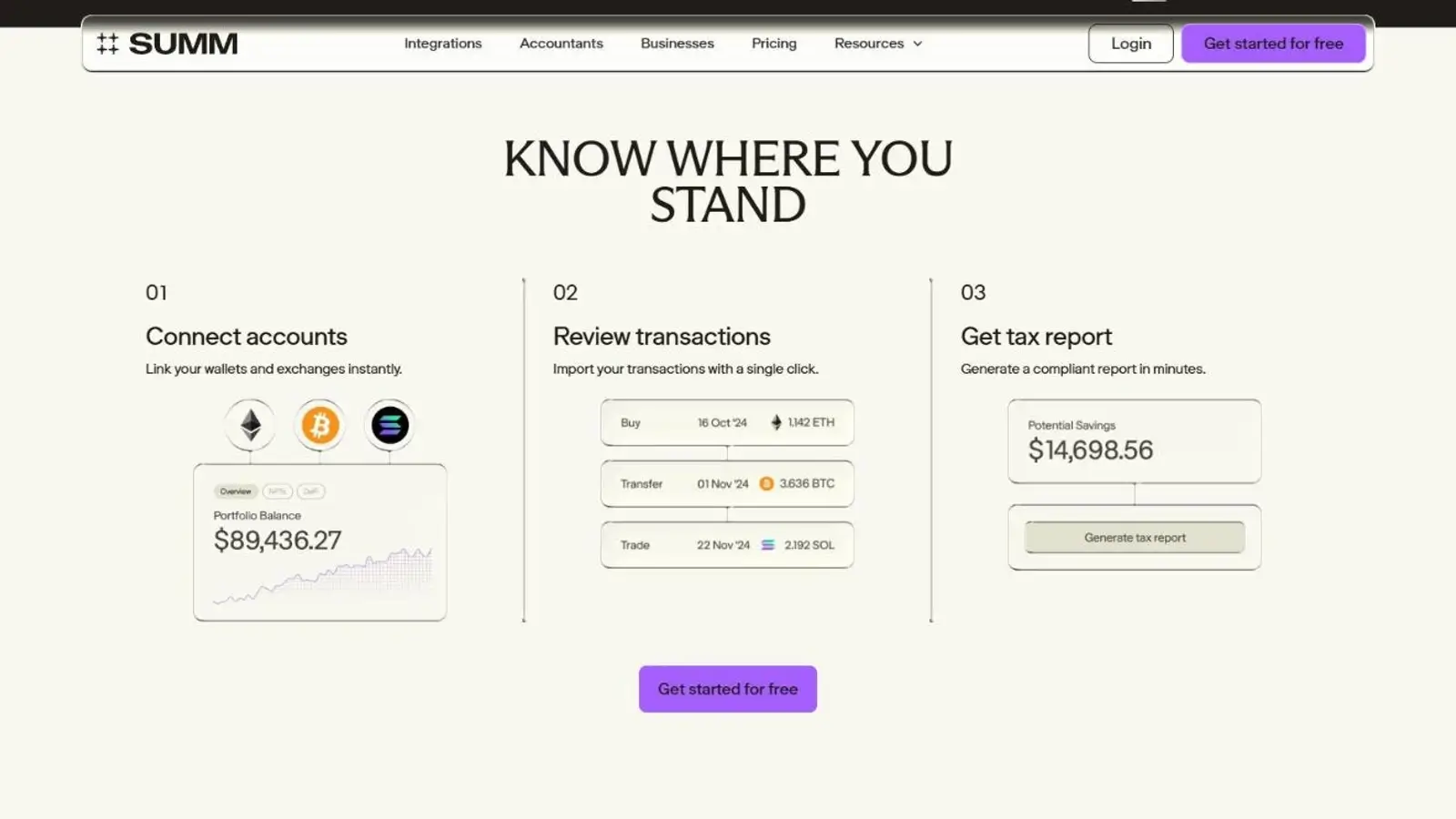
Summ supports exchange application programming interfaces (APIs), authorized account connections, public wallet addresses, and files. A custom comma-separated values (CSV) template covers missing transactions or sources without a dedicated importer. If an exchange retires its API, as Coinbase Pro did, later records have to come through another import route.
- Exchange API or account connection
Read-only access. Available connection and file options vary by exchange. Missing records can be added through files or individual entries.
- Historical Coinbase Pro
Its discontinued API no longer resyncs. Summ imports later records from CSV files, starting at the last API import date. Deleting the old API key removes its imported transactions.
- Ethereum and Uniswap
Importing the public Ethereum wallet address retrieves the associated Uniswap activity.
- Custom CSV
Separate files preserve source accounts. Base and quote amounts exclude fees, with dedicated fee columns and Coordinated Universal Time (UTC) timestamps by default.
- Manual entry
Adds an individual trade, transfer, or other event with its date, quantities, accounts, and optional fee.
If a file leaves the quote amount blank, Summ can fill in a market value that differs from what you paid or received. Check that value in the transaction detail.
Accuracy and Transaction Cleanup
Summ’s custom CSV format treats quote amounts as excluding fees, making fee mapping important before you import. In a purchase-and-sale check, a $1,500 sale with a separate $40 fee imported as $1,540 gross sale value and $1,500 received. This check used the US profile, US dollars, tax year 2025, first-in, first-out (FIFO) accounting, and tracking by wallet and exchange.
- Custom CSV fee mapping
Changing the sale value and the stored USD amount from $1,540 to $1,500, with the $40 fee kept, produced $1,460 net proceeds. Against the $1,010 cost basis, the gain fell from $490 to $450.
- Combined balance display
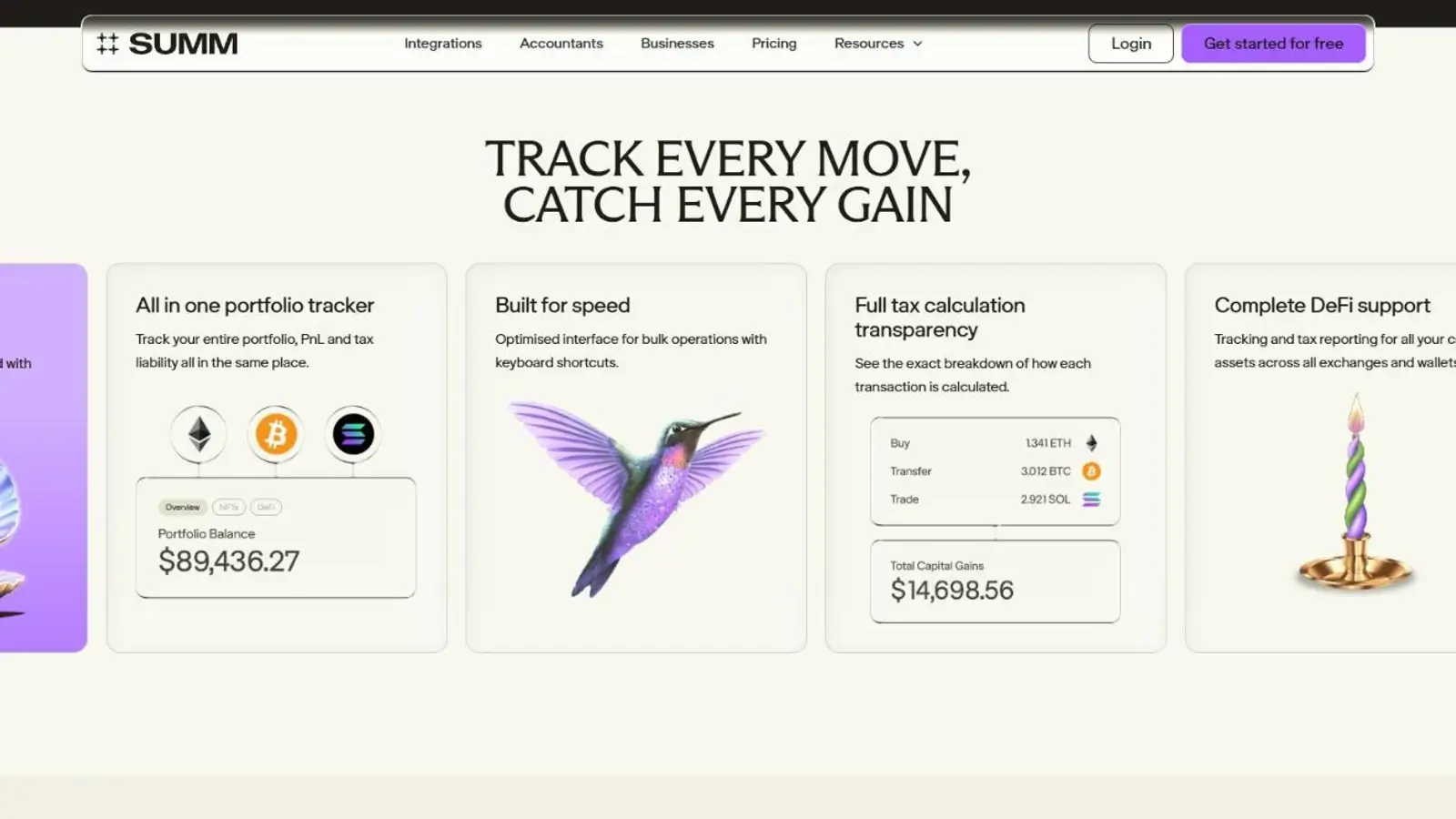
One all-account ledger row showed 4 Ether (ETH) while its account balances and transaction history implied 1 ETH. The discrepancy remained unresolved, making that combined view unsuitable as the sole balance cross-check.
The unresolved mismatch concerned the combined display. It did not demonstrate a tax-calculation error. If that view disagrees with your account balances, check each account’s records.
- Warning review
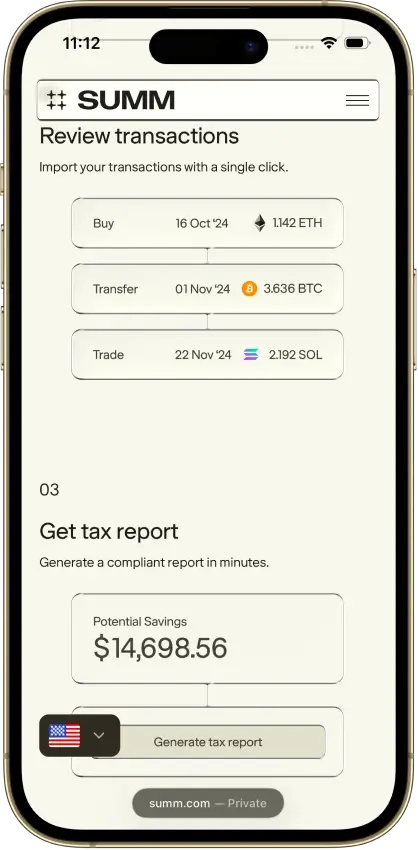
Missing prices, missing purchase history, categorization problems, and unmatched transfers can be investigated from Transactions. Opening the dedicated Review page requires a paid plan.
- Filters and bulk editing
Filters narrow by account, asset, import method, comments, or review status. One-time bulk edits are available on every plan.
- Recurring rules
Trader or above applies matching categories to future imports. Editing or deleting a rule does not reverse categories it already applied.
- Missing acquisition cost
The Advanced Reconciliation Engine creates assumed-cost records, normally at zero, and marks the affected transaction for investigation.
- Restoring missing history
Importing the missing source or correcting the category replaces the assumed cost on recalculation.
A sale using an assumed zero cost can look much more profitable than it was. Summ flags the transaction with missing purchase history, giving the investor a place to start investigating.
Summ’s general engine guide describes migration from a chosen date, with adjustment records where balances differ and protection for locked periods. The self-service switch has country limits: the US has its own engine version, and the general switch setting excludes US, UK, and Canadian accounts. Confirm the migration options for your US account with support before changing engines.
DeFi, NFTs, and Staking
Summ has specific categories for decentralized finance (DeFi) activity such as liquidity positions, staking, and loans, as well as non-fungible tokens (NFTs). The liquidity and staking categories separate an original position from the rewards or receipt tokens created around it. Hobbyist is the starting paid tier for reporting smart-contract activity.
- Liquidity pools
Add Liquidity and receipt-token entries represent deposits and the resulting position. Summ records entering a pool as disposing of the deposited tokens and acquiring the receipt token, and exiting as the reverse (its help guide uses SushiSwap on Arbitrum). That is Summ’s recording choice, not a ruling on US tax treatment.
- Staking
Deposit, withdrawal, and reward categories separate the original stake from additional rewards. Receiving a different token uses a different classification from a simple deposit.
- Borrowing and collateral
Loan, Loan Repayment, Collateral Deposit, and Collateral Withdrawal distinguish borrowed assets from pledged funds.
- Ethereum and Solana NFTs
NFT gas fees, minting, and royalties have dedicated handling. With escrowed listings, the outgoing NFT and the incoming payment may not be linked, and the sale value then has to be adjusted by hand.
Until you withdraw from a liquidity pool, Summ values the receipt token at the deposit value. The dashboard can therefore misstate an open position’s current worth even when every deposit record is present.
Tax Reports and Filing
Summ names these 24 jurisdictions in its support guide and advertises broader country availability. Pre-filled forms are available for some jurisdictions, while the available reports depend on the selected country. An active subscription is required to generate reports.
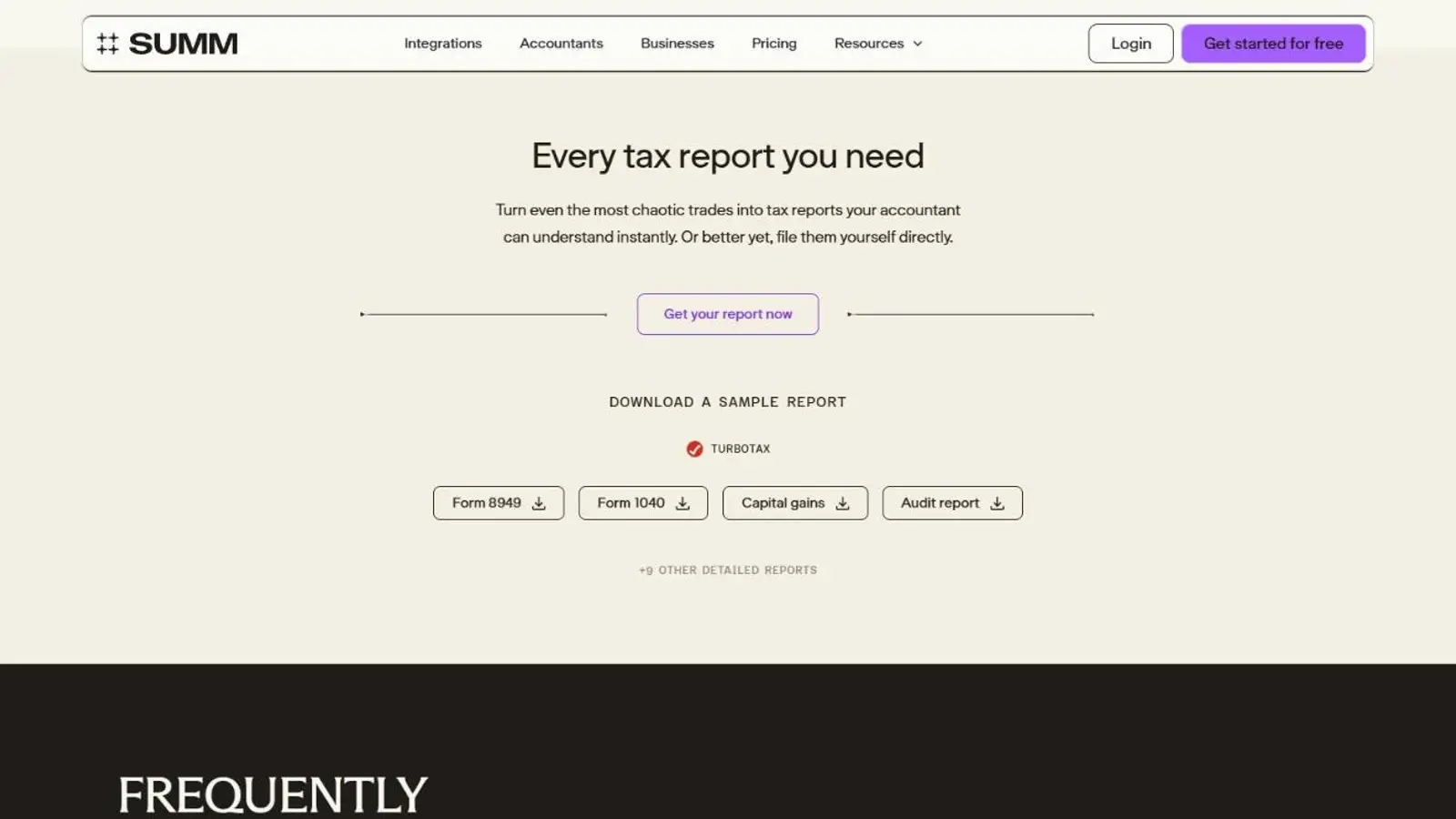
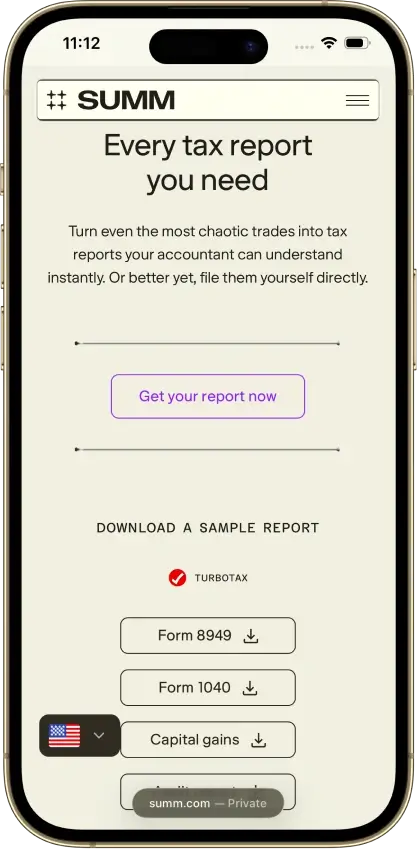
Summ provides Form 8949 (standard and consolidated), Schedule D, and Schedule 1. When a correction to an old acquisition affects later disposals, the relevant years can be regenerated within the same active subscription.
- Form 8949
Individual disposal records, with a consolidated PDF option grouped by currency. The download can fill in your identifying details.
- Schedule D and Schedule 1
Crypto capital-gains and additional-income summaries in the corresponding forms.
- TurboTax Online for tax year 2025
A dedicated capital-gains PDF, with an Alternate PDF if the first upload fails. Income uses the separate Income Report and manual entry.
- Transactions Report
A paid CSV export for a selected period. Filtered transaction exports can include comments and notes.
- 1099-DA comparison from tax year 2025
Exchange-statement uploads compare proceeds with matched records, with the user choosing which proceeds to apply.
TurboTax Online can reject an uploaded PDF or flag entries for review. Summ supplies an Alternate PDF and guidance for those cases, but getting the figures into TurboTax can take more than one attempt. Summ’s instructions for tax year 2025 cover TurboTax Online and do not describe an equivalent Desktop route.
The 1099-DA portal compares the exchange’s proceeds with Summ’s transaction records. Uploading a statement alone does not change the report. Changes require confirmation, either per transaction or across the matched records. Cost basis still comes from the imported history, so if an acquisition happened elsewhere, its purchase records are needed to calculate the gain on a later exchange sale.
Automatic statement matching is available only for supported exchanges. Other listed exchanges can still use the Disposal Summary for manual review and adjustment. Summ prepares the crypto files, with the remainder of the return completed in filing software or by an accountant.
Security and Privacy
Summ’s exchange connections use read-only access. Its wallet imports do not require private keys. Its security page states that API keys are encrypted in transit and at rest and describes System and Organization Controls (SOC) 2 Type 2 certification. You can turn on two-factor authentication after verifying your email.
- Two-factor recovery
Saved recovery codes restore login when the device is unavailable. Summ warns that losing both the device and codes can mean losing account access.
- In-app backups
Free and paid accounts can save transaction data, categories, accounts, and tax settings. API keys, original CSV files, and rules are excluded.
- External copies
Transaction CSV exports require a paid plan and provide records outside Summ.
- Deletion and retention
Imported data can be deleted. Personal information can remain where necessary for purposes listed in the privacy policy or to meet legal obligations.
Summ permits up to 10 saved backups, including automatic snapshots taken before restoration. Each safety snapshot needs a free slot, so you must delete an older backup before restoring when all 10 slots are full. Restoring an account whose API connection was deleted also requires reconnecting it before the next sync.
CTC Ledger Pty Ltd operates Summ. Summ’s privacy policy allows personal information to be processed with AI tools but bars its AI providers from training language models on it.
Third-party tools that you connect to your Summ account follow their own policies and only get the permissions you grant. If you give a tool permission to make changes, it can edit your Summ data. Disconnecting stops future access, but Summ cannot retrieve or delete information the tool already received.
Support and Accountant Access
Summ’s help center covers individual warnings and correction workflows. Paid-plan support uses email and in-app chat for product assistance, while professional tax advice and an accountant’s cleanup work are arranged separately.
- Product assistance
Email and in-app chat on paid plans, plus task-specific documentation.
- Your accountant
They initiate the connection from the Accountant Portal. Acceptance gives them permission to view and edit records, adjust settings, and prepare reports.
- Accountant registration
A free Accountant account can send the invitation. You arrange the accountant’s own services directly with them.
- Revoking access
The client can revoke permission from account settings. Who keeps the records depends on whether you shared My imported data or Accountant data.
Once connected, they can correct the records directly in Summ rather than only exchange finished PDFs. Comments on transactions and comment filters help both sides locate the records under discussion.
If you choose My imported data, you keep access to the records after revoking your accountant’s access. With Accountant data, the working records stay with the accountant and you lose access. The two data sets cannot be moved between sides.
A client who has already assembled and corrected the history can keep those records by sharing My imported data for review. If most of the cleanup will happen in Accountant data, get the finished reports from your accountant before access ends.
Alternatives to Summ
-


CoinLedger
You want a one-time purchase for one report year, with continued regeneration of that purchased year’s reports within its transaction allowance. Each extra year is another purchase, which can cost more for a backlog.
-

Koinly
You want to initiate an accountant invitation yourself, with full editing access once accepted. Reports are purchased for selected tax years, so several historical returns can require several purchases.
Pillar Scores
- Transaction inspection and correction 20% weight Finding missing history, inspecting calculations, matching transfers and maintaining corrections.8.0 / 10
- US reporting workflow 20% weight US outputs, separate income records, broker statements and the handoff to filing software or an accountant.8.0 / 10
- Import routes and recovery 15% weight Exchange and wallet connections, file and manual alternatives, and recovery of missing or repeated imports.8.0 / 10
- Complex-activity workflows 10% weight Named DeFi, staking and NFT workflows, including supported corrections and remaining manual work.6.0 / 10
- Pricing and access terms 15% weight Transaction allowances, feature gates, report years, renewal, refunds and access after a plan ends.8.0 / 10
- Help and collaboration 10% weight Task guidance, support routes, record navigation, accountant permissions and continuity of working data.10.0 / 10
- Data and account controls 10% weight Connection permissions, authentication, recovery, portability and disclosed processing, retention and deletion practices.8.0 / 10
Final Verdict
Summ's free bulk edits and restorable backups make it useful for an investor and accountant correcting the same history. One $99 Hobbyist subscription can produce three years of reports for the 900-transaction example, including smart-contract activity. Older records still consume that allowance, and report access ends with the subscription, so it is better suited to finishing a backlog during one paid period than keeping permanent access to reports. Recurring rules raise the minimum to $499 Trader. For one year you expect to revisit without renewing, CoinLedger's purchased-year access is a better fit.

Best For
Investors preparing several report years who want to share transaction repairs with an accountant
Avoid If
- Investors needing free downloadable tax reports or report access after a subscription expires
CryptoSlate may earn a commission when you use partner links, at no extra cost to you. Our reviews, ratings, and editorial decisions remain independent of advertisers. Read How CryptoSlate Makes Money for funding details.