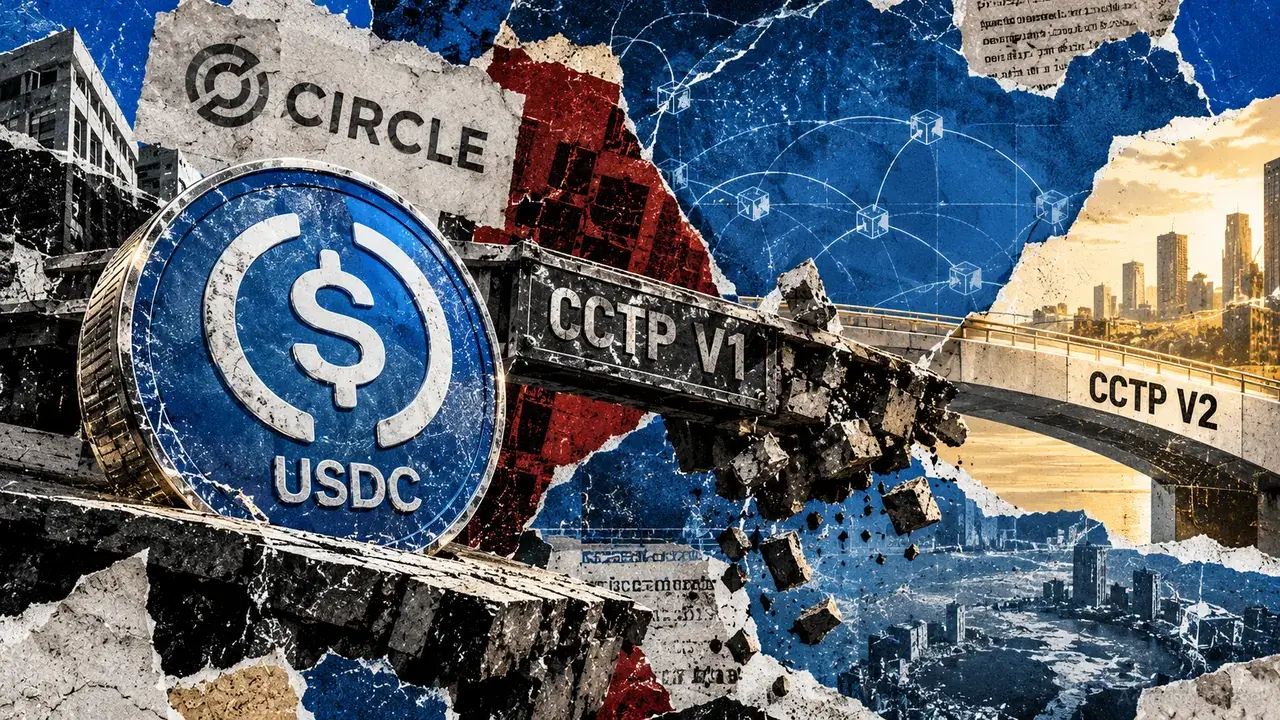
Quick Take
- Circle plans to reduce CCTP V1 burn limits from Oct. 31 before pausing the legacy contracts on Dec. 1.
- Applications still using V1 must update contract calls and APIs because CCTP V2 is incompatible with legacy integrations.
- Circle says pending redemptions will remain available during the wind-down, with minting capacity maintained before the full pause.


Circle plans to begin winding down the legacy version of its Cross-Chain Transfer Protocol (CCTP V1) on Oct. 31, leaving applications that still use it facing tighter USDC transfer limits before a planned Dec. 1 contract pause. As of Oct. 29, 2026, both milestones remain ahead.
The immediate pressure is on applications' transfer capacity. Circle's published schedule calls for lower burn limits from Oct. 31, followed by a gradual decline in performance. Once the contracts are paused, integrations still pointing to CCTP V1 will stop transferring USDC between blockchains, the company says.
CCTP transfers USDC by burning it on a source blockchain and minting it on the destination blockchain. A burn limit caps how much can enter that process. An attestation is Circle's signed approval for burned USDC to be minted on the destination chain.
The transition itself is older than the approaching deadline. Circle announced the move away from V1 on Nov. 14, 2025 and published the October-to-December timetable on Aug. 27, 2026.
Circle's migration guide describes progressively tighter message limits until no new burns can be initiated. Transfer volume is intended to reach zero before contracts are fully paused. That makes the staged phase-out relevant to an application's ability to keep routing transfers throughout November, as well as at the final cutoff.
Pending redemptions receive different treatment. Circle says they will remain available during the phase-out and that it will maintain minting allowances above the total of pending attestations, so redemptions can be processed before the full pause. The plan therefore separates completing outstanding transfers from allowing new activity.
The distinction matters for applications managing transfers at different stages: the guide pairs a gradual halt to new burns with enough minting allowance to process pending redemptions. Circle's published plan places both steps before the full pause scheduled for Dec. 1, 2026.
CCTP V1: the planned wind-down
Circle's Oct. 31 start and Dec. 1 pause remain ahead as of Oct. 29, 2026. Explore how the plan treats new transfers and pending redemptions.
Explore Circle's planned treatment
Burn limits begin falling Oct. 31. Message limits are intended to tighten until new burns cease before the planned Dec. 1 pause.
Circle says pending redemptions remain available during the wind-down, with minting allowance above pending attestations so redemptions can be processed before the full pause.
New V1 activity is set to wind down while pending redemptions are processed before the planned pause.
Future scheduled changes as of October 29, 2026, not observed execution. No intermediate numerical limits, per-chain timetable, adoption data or post-pause redemption promise is shown. Diagram endpoints indicate intended process order only.
Sources and evidence
Sources
Supporting facts
- Circle says CCTP V1 (Legacy) deprecation is scheduled to begin on October 31, 2026 and complete on December 1, 2026. [1] [2]
- Circle's August 27, 2026 blog says V1 burn limits will be reduced starting October 31, followed by a gradual decrease in performance before contracts are paused on December 1. [1]
- Circle says integrations still pointing at V1 contracts after the planned December 1, 2026 pause will stop transferring USDC crosschain. [1]
- Circle's migration guide says pending redemptions will remain available during the V1 phase-out and that it will maintain minter allowances above the total of pending attestations so redemptions can be processed before the full pause. [2]
- The migration guide describes progressively tighter message limits until no new burns can be initiated, with transfer volume intended to reach zero before contracts are fully paused. [2]
Method
Uses Circle's published general phase-out schedule and current migration-guide commitments. Dates and paths are schematic, not a measured capacity curve or a timing scale. The selectable states compare two parts of the same plan.
Scope
Future scheduled changes as of October 29, 2026, not observed execution. No intermediate numerical limits, per-chain timetable, adoption data or post-pause redemption promise is shown. Diagram endpoints indicate intended process order only.
 CryptoSlate
CCTP V1 apps need new contracts and APIs
V2 migration requires changes to contract calls and APIs. Circle says the newer system, now branded simply as CCTP, is incompatible with V1 integrations. Applications must update the contracts and APIs they use, alongside the calls made to those contracts.
The guide identifies new addresses and interfaces, including TokenMessengerV2 and MessageTransmitterV2. In its TokenMessengerV2 interface, the depositForBurn function adds parameters for the permitted destination caller, maximum fee and minimum finality threshold. Existing calls therefore need to account for the new interface.
The attestation workflow also changes. Instead of extracting message bytes from an onchain transaction and hashing them before requesting an attestation, an integration can use the V2 messages endpoint with the transaction hash to retrieve the message and attestation.
Beyond the required contract and API changes, V2 offers Standard and Fast Transfer modes and programmable hooks for actions on the destination blockchain. Fast Transfer carries a variable fee based on the source chain, according to the guide, so migration also involves accounting for the chosen transfer mode and its fees.
Some functions do not carry over. The guide lists replaceDepositForBurn as removed with no V2 equivalent. Circle also offers Arc App Kits as an optional route that abstracts routine contract-address, interface and attestation work.
Mentioned in this article


Editorial credits