

Quick Take
- Deribit’s July 31 board shows Bitcoin’s largest call clusters at $70,000 and $72,000, alongside a reported 20,000-by-20,000 spread.
- That setup implies about $2.5 billion in gross notional and lands just two days after the Fed’s next policy decision.
- Bitcoin was near $64,289, so the trade still needs a sharp move through $69,000 and uneven ETF flows before expiry.


Deribit’s July 31 options board shows more than 20,000 Bitcoin call contracts open at both the $70,000 and $72,000 strikes.
The two strikes represent the largest call concentrations for that expiry, with roughly 27,000 contracts at $70,000 and 21,000 at $72,000, according to the exchange's data as of press time. Bitcoin sits near $64,289, placing the lower strike about 8.9% above spot.
Deribit Chief Commercial Officer Jean-David Péquignot told CoinDesk that one large block involved buying 20,000 July 31 calls at $70,000 and selling the same number at $72,000.
The exchange data concentration independently confirms substantial positioning at the strikes in the 20,000-by-20,000 bull call spread.
Based on that construction, the two legs carry roughly $2.5 billion in aggregate gross notional at prevailing Bitcoin prices. Premium paid, capital committed and net exposure are separate measures from that figure.
The options expire two days after the Federal Reserve’s next policy decision. Together, the strike concentration, expiry and spot gap define a tactical test for Bitcoin during the final days of July.
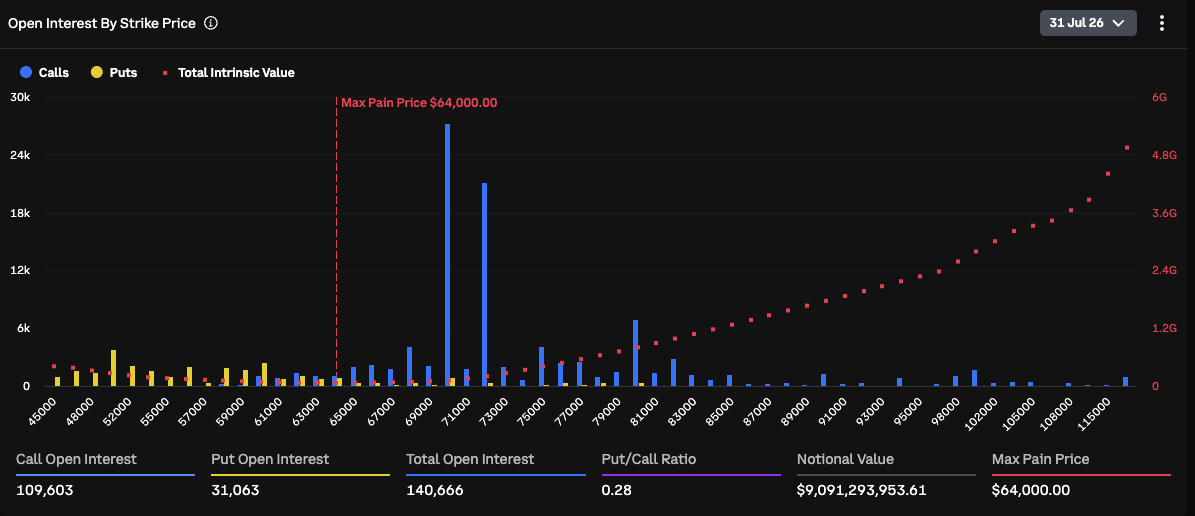
One spread inside a larger options concentration
Under the reported structure, the $70,000 calls provide upside exposure above the lower strike at expiry, while selling the same number of $72,000 calls reduces the cost and caps further gains. The resulting bull call spread reaches its maximum payoff once Bitcoin finishes at or above the upper strike.
The structure can express a directional view, offset another options position, or hedge a separate exposure. Neither Deribit’s open-interest chart nor the reported block identifies the counterparty’s wider portfolio, so the position speaks most clearly through its capped payoff and short expiry.
CryptoSlate's July 17 review of options positioning found roughly $4.5 billion of call open interest between $70,000 and $80,000. Open interest counts outstanding contracts; direction depends on how calls are bought, sold, and combined with the rest of a portfolio. The concentration highlights the price area without turning every contract into the same bullish wager.
A separate July prediction market snapshot from July 20 assigns a 14.5% probability to Bitcoin touching $70,000 during the month and 4.1% to touching $72,500. The $67,500 threshold stands at 34.5%, while a downside touch of $62,500 stood at 67.4%.
Each threshold is a standalone, non-exclusive binary, so Bitcoin can trigger several during a volatile month. The contracts measure whether a level is touched at any point in July.
The options spread instead has a payoff tied to its July 31 expiry structure. The percentages therefore provide wider market context while answering a different question from the spread.
| Signal | Level or reading | Window | What it measures |
|---|---|---|---|
| Bitcoin spot snapshot | $64,289.73 | July 20, 08:24 UTC | Reference price at one point in time |
| July 31 call positioning | More than 20,000 contracts at both $70,000 and $72,000 | July 31 expiry | Deribit open interest confirms the strike concentration; the matched spread structure remains reported |
| July threshold contracts | 14.5% for $70,000; 4.1% for $72,500 | July 20, 09:12 UTC | Separate probabilities of touching each level during July |
| Institutional scenarios | Roughly $38,000 to $150,000 | Early October, year-end or 12 months | Conditional models, support zones and research targets |
Fed timing leaves demand as the July test
The Federal Reserve's official calendar places the next Federal Open Market Committee meeting on July 28 and 29. The policy decision is scheduled for 2 p.m. Eastern on July 29, followed by a press conference at 2:30 p.m. The call spread expires on July 31.
The Fed decision lands in the trade’s final stretch. From Bitcoin’s July 20 price, a move into the $70,000 to $72,000 band would still require a push through the $69,000 area, where recent buying and selling has clustered.
CryptoSlate's July 19 on-chain analysis placed an immediate recent-buyer cost-basis test near $69,000, with Bitcoin below it at the time. The same analysis identified $52,891 as a conditional lower stress boundary if weak demand persisted. Both levels change as coins transact, making them moving reference points instead of fixed destinations.
US spot Bitcoin exchange-traded fund flows provide a second check on demand. Farside's daily table recorded $197 million in net inflows during July 6 to 10 and $75 million during July 13 to 17, for a combined $272 million. One session produced a $424 million outflow, showing how quickly the short positive run could reverse.
ETF buyers still added $272 million over the two weeks, but the $424 million one-day outflow showed how quickly that support could disappear. A sustained move through the $69,000 to $70,000 area alongside steadier inflows would provide broader confirmation for the bullish spread. Continued failure at that zone would leave the trade as an isolated tactical position into expiry.
Longer forecasts run on different clocks
NYDIG, a digital-asset financial services firm, said on July 10 that matching the duration of the prior two major cycle drawdowns, paired with a shallower decline of roughly 70%, could imply a potential low around $38,000 to $39,000 in early October.
Coinbase Institutional's July 3 analysis identified $58,000 to $59,000 as the first high-strength support zone, followed by $48,000 to $50,000, roughly $42,000 and $39,000 to $40,000 if higher levels failed. Its July 6 positioning note described June month-end positioning as flushed, and options skew as tilted toward downside protection. Both pieces preceded the July 18 call-spread flow and provide an earlier risk baseline.
Citi cut its 12-month Bitcoin target from $112,000 to $82,000 and set a $53,000 bear case conditioned on recession and continued ETF outflows. Citi also reduced its assumed 12-month net ETF inflows to zero from $10 billion. In two other outlooks, Standard Chartered retained a $100,000 end-2026 target, while Bernstein retained an explicitly ambitious $150,000 year-end target.
These numbers span an early-October cycle scenario, conditional support zones, a 12-month bank target and year-end targets.
The July decision tree is shorter: spot must cover the 8.9% gap to $70,000, absorb selling around the recent-buyer cost basis and do so through an uneven ETF-flow backdrop.

Bitcoin is +0.90% over the past 24 hours and currently sits at rank #1 by market cap.
Mentioned in this article



Editorial credits