

Quick Take
- Four US spot Bitcoin ETF sessions posted a combined $526.5 million in net outflows.
- Glassnode found weaker perpetual buying and stagnant broader on-chain capital inflows.
- Long-term-holder conviction remains the main buffer as Bitcoin tests support near $64,000.


Bitcoin entered today (July 29) with three demand channels losing momentum near $64,000. Four consecutive US spot Bitcoin ETF sessions saw a combined $526.5 million in net outflows, while Glassnode reported weaker perpetual futures buying and stagnant broader on-chain capital inflows.
Bitcoin traded near $64,200, leaving $64,000 as an immediate market test rather than a guaranteed floor.
Farside Investors data shows ETF outflows of $225.1 million on July 23, $240.1 million on July 24, $11.6 million on July 27, and $49.7 million on July 28. As of about 08:50 UTC on Wednesday, July 28 was the latest session listed.
Those outflows show weakness in a major regulated demand channel, not the whole institutional market. They also do not establish what caused Bitcoin’s price move. As CryptoSlate noted after the first reversal, finalized flows can reflect positioning established at different points during a trading session.
Glassnode’s Week 31 market pulse described Bitcoin’s retreat from roughly $66,700 toward $64,000 and a recovery to about $65,100. Beneath that range, perpetual-futures buy-side aggression had declined and long-side funding payments had cooled sharply, even as aggregate open interest increased slightly. That combination points to more cautious leverage, not the disappearance of derivatives exposure.
On-chain measures offered little evidence of fresh capital replacing that demand. Glassnode found that active addresses were steady, but economic settlement and transaction pressure remained restrained and broader capital inflows were stagnant. The firm also said regulated investment products had shifted into net outflows as weekly trading volume declined.
The derivatives signal is not one-way. A separate CryptoSlate options analysis found about 52 open put contracts for every 100 calls, down from 76 in late June. The premium for one-week downside protection had also eased, although puts still traded above comparable calls. Options traders were carrying less immediate protection even as perpetual-futures demand softened.
When the holder buffer starts to erode
Long-term holders remain the clearest offset. Glassnode said they continued to show conviction while aggregate unrealized losses declined modestly and realized losses eased. That helps explain why weaker ETF, perpetual-futures and on-chain demand has not, by itself, shown that support has failed.
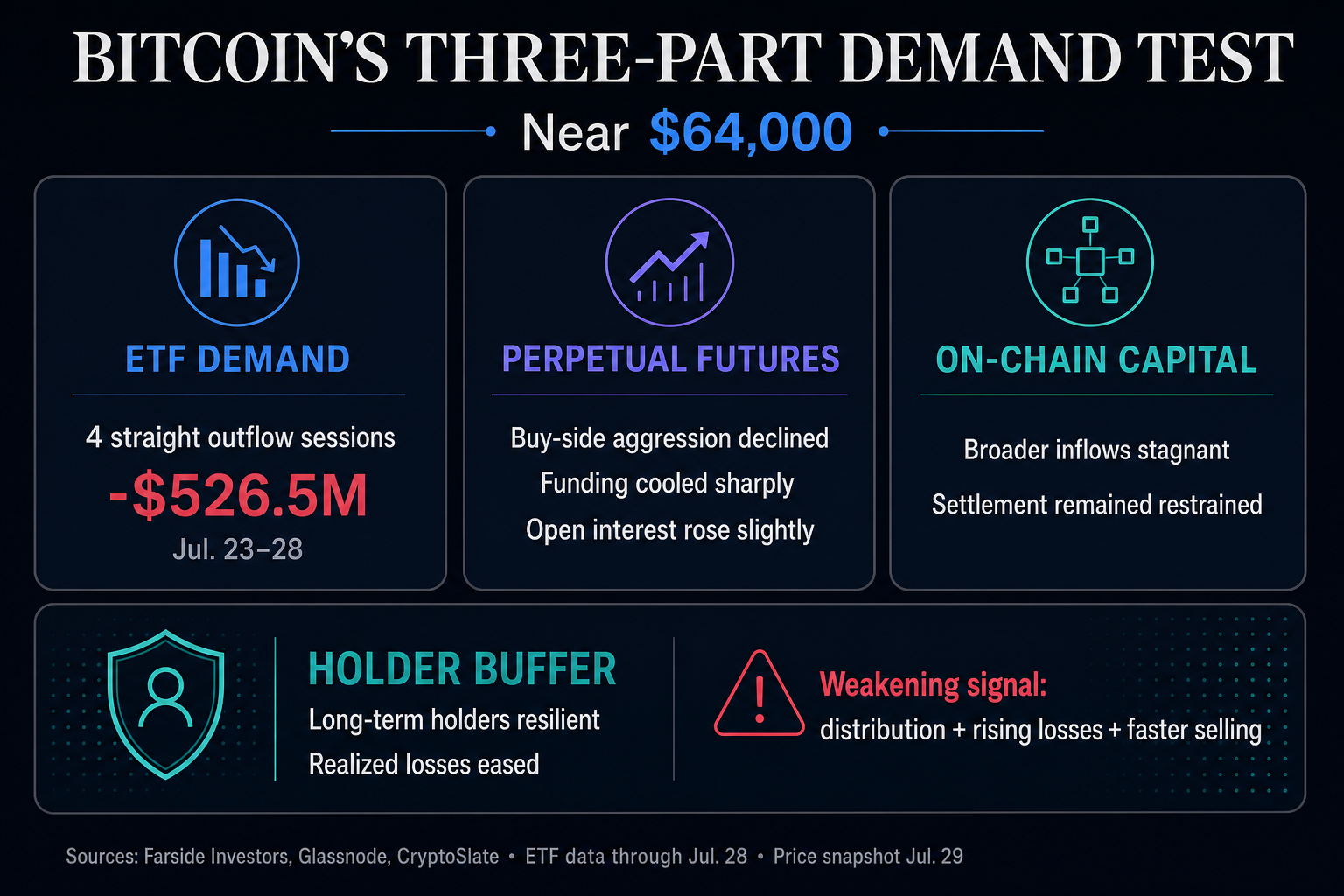
The holder-buffer thesis would weaken if a sustained break below the local range arrived with renewed long-term-holder distribution, rising realized losses or faster selling pressure. Those changes would remove the stabilizing forces Glassnode identified. A brief move below $64,000, without that deterioration, would show a deeper price test but would not by itself establish that holder-led support had broken.

Bitcoin is -1.65% over the past 24 hours and currently sits at rank #1 by market cap.
Mentioned in this article
Editorial credits